USAPhO 2002, Четвъртфинал — Задача 2
AAPT/AIP United States Physics Team 2002 — Preliminary Exam, Open Response Questions · 25 т.
Указания
4 Questions, 60 minutes
INSTRUCTIONS
DO NOT OPEN THIS TEST UNTIL YOU ARE TOLD TO BEGIN
Show all your work. Partial credit will be given.
Start each question on a new sheet of paper. Be sure to put your name in the upper right-hand corner of each page, along with the question number and the page number/total pages for this problem. For example,
Doe, Jamie
Q1 – 1/3
A hand-held calculator may be used. Its memory must be cleared of data and programs. You may use only the basic functions found on a simple scientific calculator. Calculators may not be shared. You may not use any tables, books, or collections of formulas.
Each of the four questions is worth 25 points. The questions are not necessarily of the same difficulty.
Possibly Useful Information
Gravitational field at the Earth’s surface
Newton’s gravitational constant
Binomial expansion for
Moment of Inertia about Center of Mass – Uniform Object (will not be provided on the second screening exam)
| Disk | |
| Sphere | |
| Rod |
Solutions to Problems
Any correct solution should be awarded equivalent points. Suggested partial-credit points are presented in square brackets at the right margin. You may further break down the listed points into one point increments. If it is clear they have done an intermediate step, they should get credit for it even if they have not presented it. For example, in 1.a., if a student wrote down , they should get 9 points credit. Students should not be penalized in a subsequent part for using the wrong answer to a previous part. (No double jeopardy.)
Условие
A particle of mass is constrained to move in one dimension. A force acts on the particle. always points toward the position labeled . For example, when the particle is to the left of , points to the right. The magnitude of is a constant except at point where it is zero.
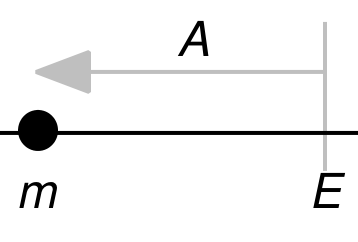
a. The system is horizontal. is the net force acting on the particle. The particle is displaced a distance from the equilibrium position and released from rest. What is the period of the motion? [10 т.]
b. The system is vertical. Both the force described above and gravity act on the system. The particle is displaced a distance above the position and released from rest. . What is the period of the motion? [15 т.]
Отговори
- a.
- b.
Решение
2. a. When the particle is released, it begins to move with an acceleration which has magnitude
[2]
and is directed toward position . Since it starts from rest [2]
It reaches in time
[1]
The particle oscillates back and forth between amplitude A on the right and A on the left. [2]
The time for one complete cycle is four times this [2]
[1]
b. The particle oscillates between amplitude above point and below. [1]
Let = time it takes the particle to go from amplitude above to point and from up to .
Let = time it takes the particle to go from point to amplitude below and from up to .
The period is [2]
When the particle is above point E, the net force acting on it is
[1]
The magnitude of the acceleration is [1]
Starting from rest the particle travels a distance given by [1]
Solving for
[1]
The particle passes through E with velocity
[1]
When the particle is below point E, the net force acting on it is
[1]
The magnitude of the acceleration is [1]
It reaches maximum downward displacement when . [1]
[1]
Solving for
[1]
[1]
[1]
Автори
The 2002 Preliminary Examination open response questions were written by the coaches of the United States Physics Team. The coaches are: Academic Director, Mary Mogge – Professor of Physics at California State Polytechnic University, Pomona, CA; Senior Coach, Leaf Turner – Physicist in the Theoretical Division of Los Alamos National Laboratory, Los Alamos, NM; Warren Turner – Physics Teacher at Massachusetts Academy of Math and Science, Worcester, MA; Robert Shurtz – Physics Teacher at the Hawken School, Gates Mills, OH. Questions 1 and 3 were suggested by Warren Turner, Question 2 by Mary Mogge, and Question 4 by Leaf Turner.
Оригинал в Архива: Quarterfinal 2002.pdf · официални решения: Quarterfinal 2002 Solutions.pdf