USAPhO 2002, Четвъртфинал — Задача 4
AAPT/AIP United States Physics Team 2002 — Preliminary Exam, Open Response Questions · 25 т.
Указания
4 Questions, 60 minutes
INSTRUCTIONS
DO NOT OPEN THIS TEST UNTIL YOU ARE TOLD TO BEGIN
Show all your work. Partial credit will be given.
Start each question on a new sheet of paper. Be sure to put your name in the upper right-hand corner of each page, along with the question number and the page number/total pages for this problem. For example,
Doe, Jamie
Q1 – 1/3
A hand-held calculator may be used. Its memory must be cleared of data and programs. You may use only the basic functions found on a simple scientific calculator. Calculators may not be shared. You may not use any tables, books, or collections of formulas.
Each of the four questions is worth 25 points. The questions are not necessarily of the same difficulty.
Possibly Useful Information
Gravitational field at the Earth’s surface
Newton’s gravitational constant
Binomial expansion for
Moment of Inertia about Center of Mass – Uniform Object (will not be provided on the second screening exam)
| Disk | |
| Sphere | |
| Rod |
Solutions to Problems
Any correct solution should be awarded equivalent points. Suggested partial-credit points are presented in square brackets at the right margin. You may further break down the listed points into one point increments. If it is clear they have done an intermediate step, they should get credit for it even if they have not presented it. For example, in 1.a., if a student wrote down , they should get 9 points credit. Students should not be penalized in a subsequent part for using the wrong answer to a previous part. (No double jeopardy.)
Условие
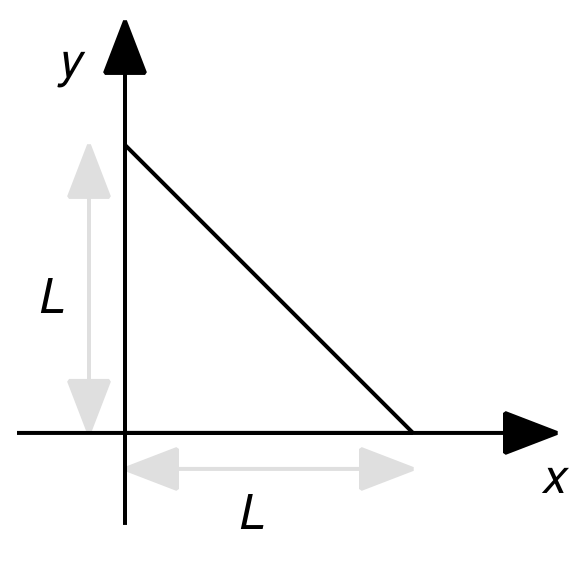
A wooden 45° right triangle has uniform mass and two equal sides of length . The coordinates of the triangle’s center of gravity, measured with respect to the axes shown in Fig. 4-1 above, are
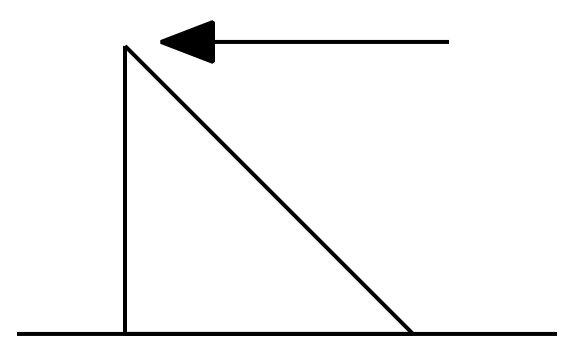
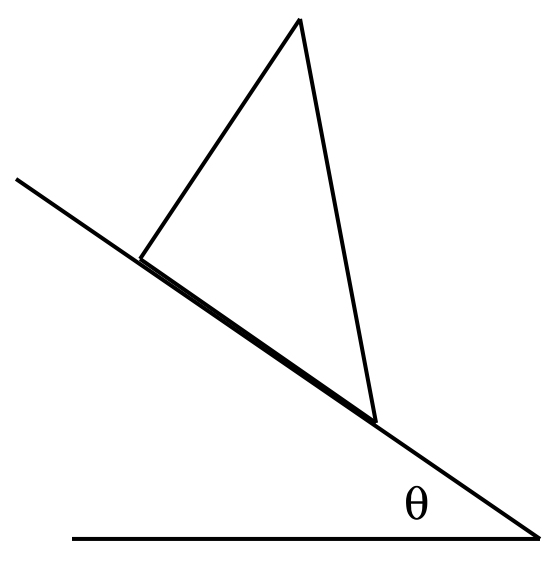
The triangle is placed on a rough horizontal surface and a horizontal force is applied at the top of the triangle, as shown in Fig. 4-2. The force is gradually increased until the triangle just starts to tip over without sliding. The force is then removed and the surface is inclined as shown in Fig 4-3. The triangle is placed on the inclined plane. For what range of angle , measured with respect to the horizontal, can you be certain that the triangle will not slide?
Отговори
The official solution prints “θ ≤ tan⁻¹(xcg/L) − tan⁻¹(1/3) = 0.32 radians = 18.4°”; the minus sign between the two arctangents is evidently a misprint for “=”.
Решение
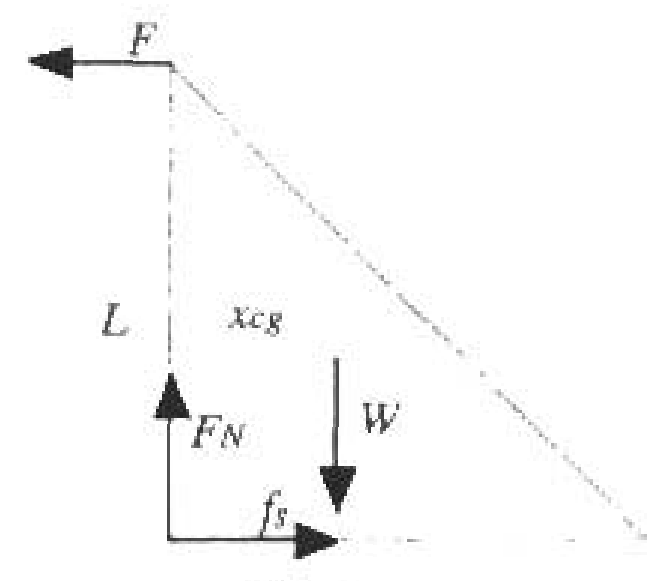
4. Let be the magnitude of the horizontal force when the triangle just starts to tip over. The forces acting on the triangle when it is on the horizontal surface are shown in Figure 4-4.
Each force identified 1 point. [4]
Since the triangle is just starting to tip over and is not sliding, the conditions of static equilibrium still apply and, in addition, [1]
(Students should not be penalized for using “=” instead of “” in intermediate steps. Finding the upper limit of the range is a valid technique.)
The forces in the -direction must sum to zero. [1]
The forces in the -direction must sum to zero. [1]
The sum of the torques must also be zero. Taking torques about the lower left-hand corner,
[1]
Each torque can be written or [1]
where is the perpendicular distance from the axis to line of action of the force.
[2]
[1]
[1]
[1]
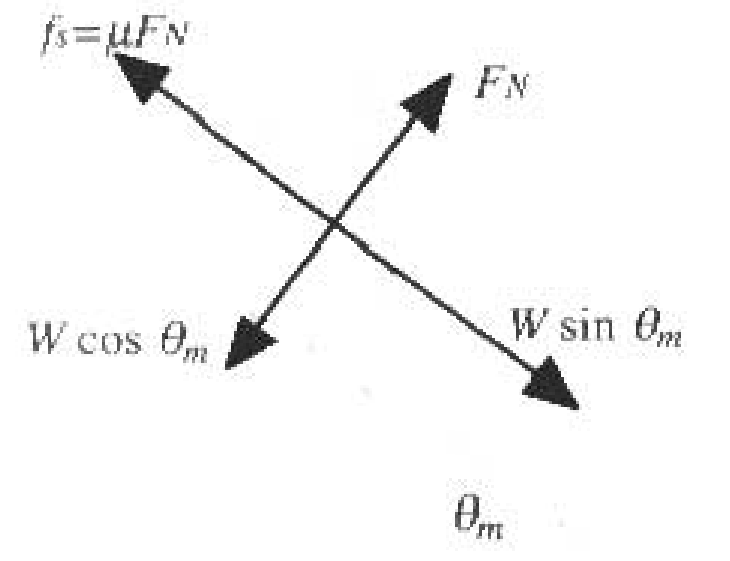
Let be the maximum inclination angle for which the triangle will not slide. The parallel and perpendicular components of the forces acting on the triangle are shown in Figure 4-5.
Each correct force component 1 point. [4]
The components perpendicular to the plane must sum to zero. [1]
The components parallel to the plane must sum to zero. [1]
Combining the last two equations:
[1]
We can only be certain that is no smaller than [1]
The range we can be certain of has as its maximum
[3]
Must have inequality for the full 3 points. Only one point for “=” instead of “”.
Автори
The 2002 Preliminary Examination open response questions were written by the coaches of the United States Physics Team. The coaches are: Academic Director, Mary Mogge – Professor of Physics at California State Polytechnic University, Pomona, CA; Senior Coach, Leaf Turner – Physicist in the Theoretical Division of Los Alamos National Laboratory, Los Alamos, NM; Warren Turner – Physics Teacher at Massachusetts Academy of Math and Science, Worcester, MA; Robert Shurtz – Physics Teacher at the Hawken School, Gates Mills, OH. Questions 1 and 3 were suggested by Warren Turner, Question 2 by Mary Mogge, and Question 4 by Leaf Turner.
Оригинал в Архива: Quarterfinal 2002.pdf · официални решения: Quarterfinal 2002 Solutions.pdf