USAPhO 2002, Полуфинал — Задача 2. A2
2002 Semi-Final Exam
Указания
INSTRUCTIONS
DO NOT OPEN THIS TEST UNTIL YOU ARE TOLD TO BEGIN
Work Part A first. You have 90 minutes to complete all four problems.
After you have completed Part A, you may take a break.
Then work Part B. You have 90 minutes to complete both problems.
Show all your work. Partial credit will be given.
Start each question on a new sheet of paper. Be sure to put your name in the upper right-hand corner of each page, along with the question number and the page number/total pages for this problem. For example,
Doe, Jamie
A1 – 1/3
A hand-held calculator may be used. Its memory must be cleared of data and programs. It may not be used in graphing mode. Calculators may not be shared. You may not use any tables, books, or collections of formulas. You may use a ruler or straight edge.
Questions with the same point value are not necessarily of the same difficulty.
Good luck!
Possibly Useful Information
| Gravitational field at the Earth’s surface | |
| Newton’s gravitational constant | |
| Coulomb’s constant | |
| Biot-Savart constant | |
| Speed of light in a vacuum | |
| Boltzmann’s constant | |
| Avogadro’s number | |
| Ideal gas constant | |
| Stefan-Boltzmann constant | |
| Elementary charge | |
| 1 electron volt | |
| Planck’s constant | |
| Electron mass | |
| Binomial expansion | for |
Условие
A particle decays into two photons which are both observed to have frequency , one moving at an angle above the positive -axis and the other at an angle of below the positive -axis. See the accompanying diagram. The energy and momentum magnitude of a relativistic particle of mass and speed are:
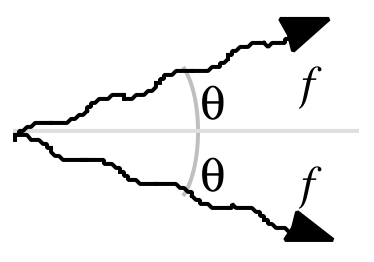
a. Find the velocity of the original particle. [15 т.]
b. Find the rest mass of the original particle. [5 т.]
c. What are the frequencies of the decay photons in the rest frame of the particle? What are their directions of travel in this rest frame? [5 т.]
Отговори
a.
In the positive x-direction.
b.
c. Both photons have frequency f' = f sin θ; one travels along the +y-axis and the other along the −y-axis.
Решение
a. The energy and magnitude of the momentum of a photon of frequency are:
Energy is conserved. Equating the energy of the particle before the decay to the total photon energy after the decay
Momentum is conserved. Equating the momentum of the particle before the decay to the sum of the x-components of the photon momentum after the decay
Dividing (A2-2) by (A2-1)
Or
b. Solving (A2-1) for
and substituting in (A2-3)
c. In this frame, the particle has zero momentum, so the momentum of the final photons must be equal and opposite – one along the +-axis, the other along the --axis. If each photon’s momentum has the same magnitude, the photons must have the same frequency .
In this frame the particles energy is . Applying energy conservation
Solving for and substituting in (A2-4)
Автори
The 2002 Semi-Final Examination questions were written by the coaches of the United States Physics Team. The coaches are: Academic Director, Mary Mogge – Professor of Physics at California State Polytechnic University, Pomona, CA; Senior Coach, Leaf Turner – Physicist in the Theoretical Division of Los Alamos National Laboratory, Los Alamos, NM; Warren Turner – Physics Teacher at Massachusetts Academy of Math and Science, Worcester, MA; Robert Shurtz – Physics Teacher at the Hawken School, Gates Mills, OH; Boris Zbarsky –undergraduate student at MIT, Cambridge, MA; Andrew Lin – undergraduate student at Yale University, New Haven, CT. Questions A2, A4, B1, and B2 were suggested by Leaf Turner and Questions A1 and A3 by Mary Mogge.
Оригинал в Архива: Semifinal 2002.pdf · официални решения: Semifinal 2002 Solutions.pdf