USAPhO 2003, Полуфинал — Задача 3. A3
AAPT / AIP United States Physics Team 2003 — 2003 Semi-Final Exam
Указания
DO NOT OPEN THIS TEST UNTIL YOU ARE TOLD TO BEGIN
Work Part A first. You have 90 minutes to complete all four problems.
After you have completed Part A, you may take a break.
Then work Part B. You have 90 minutes to complete both problems.
Show all your work. Partial credit will be given.
Start each question on a new sheet of paper. Be sure to put your name in the upper right-hand corner of each page, along with the question number and the page number/total pages for this problem. For example,
Doe, Jamie
A1 – 1/3A hand-held calculator may be used. Its memory must be cleared of data and programs. It may not be used in graphing mode. Calculators may not be shared. You may not use any tables, books, or collections of formulas. You may use a ruler or straight edge.
Questions with the same point value are not necessarily of the same difficulty.
Good luck!
Possibly Useful Information
| Gravitational field at the Earth’s surface | |
| Newton’s gravitational constant | |
| Coulomb’s constant | |
| Biot-Savart constant | |
| Speed of light in a vacuum | |
| Boltzmann’s constant | |
| Avogadro’s number | |
| Ideal gas constant | |
| Stefan-Boltzmann constant | |
| Elementary charge | |
| 1 electron volt | |
| Planck’s constant | |
| Electron mass | |
| Binomial expansion | for |
| Small angle approximations | ; |
Условие
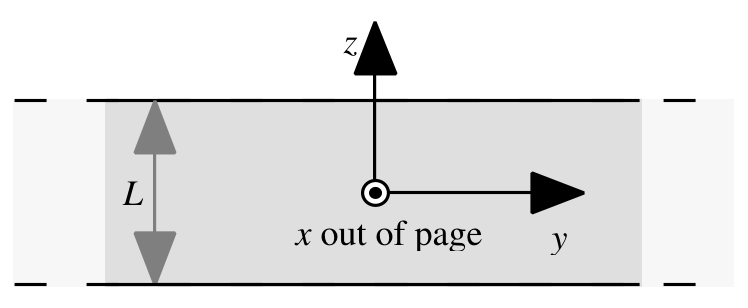
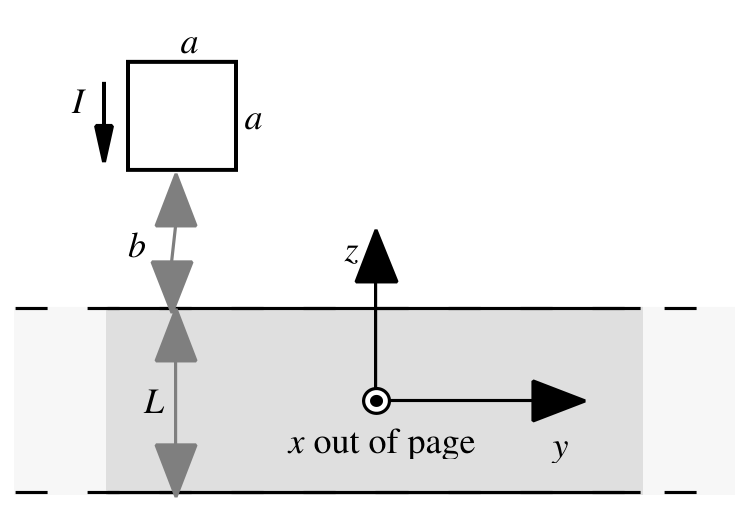
A conducting slab has infinite extent in the and directions and thickness in the direction as shown in Figure a above. The slab is centered at and carries a uniform current density where , , and are unit vectors in the , , and directions, respectively.
a. Find the magnetic field at all points. [10 т.]
b. A square wire loop of side is placed a distance above the slab (as shown in Figure b above). The loop has unit normal vector and applied current . (Figure b depicts the special case .) What is the net force and the net torque on the loop as a function of ? [10 т.]
c. The applied current is now removed from the loop described above and the current density in the slab is reduced to zero over time . The wire used to construct the loop has resistance per unit length . How much charge flows through each cross section of the loop wire due to the reduction in current density? [5 т.]
Отговори
- a. B = ½μ₀JL ĵ for z < −L/2; B = −μ₀Jz ĵ for −L/2 < z < L/2; B = −½μ₀JL ĵ for z > L/2
- b.
- c.
Решение
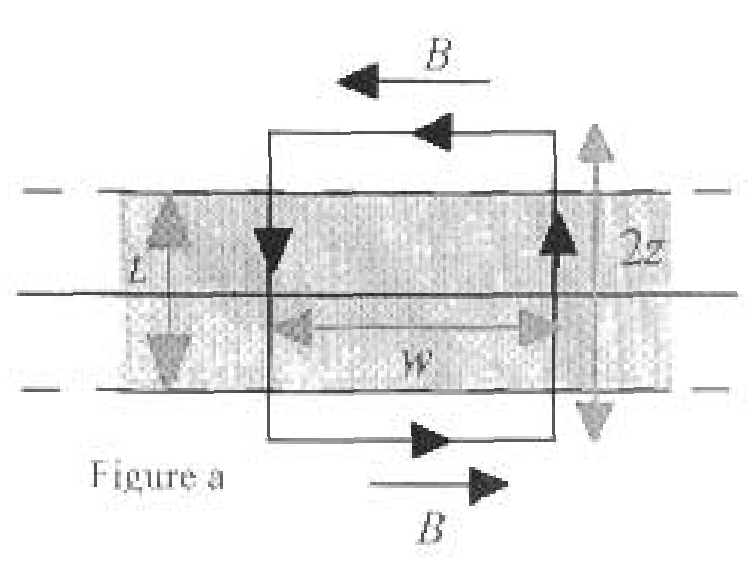
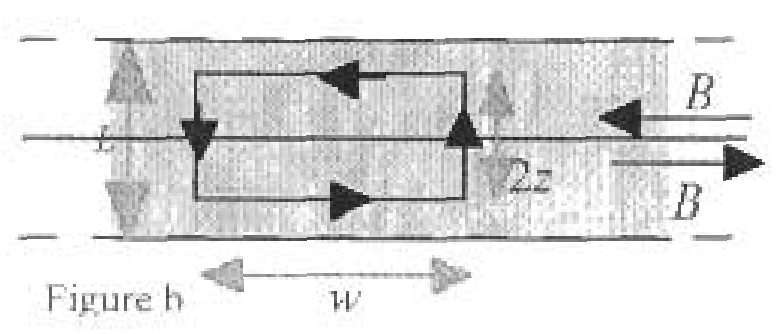
a. The slab has infinite extent in the and direction. Therefore the magnetic field can depend at most on . By the right hand rule and symmetry is to the left for positive and to the right for negative .
can be found from Ampere’s law. To find outside the slab, , use the loop shown in Figure a. The loop segments parallel to the direction are perpendicular to and will not contribute.
To find inside the slab, , use the loop shown in Figure b. Once again, the loop segments parallel to the direction are perpendicular to and will not contribute.
Including the direction,
b. In the region of the loop, is uniform, . The force on the top segment is equal and opposite to the force on the bottom segment. The force on the left segment it equal and opposite to the force on the right segment. The net force on the loop is zero.
The net torque is given by
where , the magnetic dipole moment is
c. is uniform so the flux through the loop is
Using Faraday’s Law, the emf
The emf is also
where
Since has been reduced to zero over time , the charge flowing in time is
Оригинал в Архива: Semifinal 2003.pdf · официални решения: Semifinal 2003 Solutions.pdf