USAPhO 2004, Четвъртфинал — Задача 2
AAPT AIP United States Physics Team 2004 — Preliminary Exam, Open Response Questions · 25 т.
Указания
4 Questions, 60 minutes
DO NOT OPEN THIS TEST UNTIL YOU ARE TOLD TO BEGIN
Show all your work. Partial credit will be given.
Start each question on a new sheet of paper. Be sure to put your name in the upper right-hand corner of each page, along with the question number and the page number/total pages for this problem. For example,
Doe, Jamie
Q1 – 1/3A hand-held calculator may be used. Its memory must be cleared of data and programs. You may use only the basic functions found on a simple scientific calculator. Calculators may not be shared. Cell phones may not be used during the exam or while the exam papers are present. You may not use any tables, books, or collections of formulas.
Each of the four questions is worth 25 points. The questions are not necessarily of the same difficulty.
Good luck!
Possibly Useful Information
| Gravitational field at the Earth’s surface | |
| Newton’s gravitational constant | |
| Average Earth-Sun Distance | 1 Astronomical Unit (A.U.) |
| Binomial expansion | for |
Moment of Inertia about Center of Mass – Uniform Object (will not be provided on the second screening exam)
| Disk | |
| Sphere | |
| Rod |
Solutions to Problems
Any correct solution should be awarded equivalent points. Suggested partial-credit points are presented in square brackets at the right margin. You may further break down the listed points into one point increments. If it is clear they have done an intermediate step, they should get credit for it even if they have not presented it. For example, in 4.a., if a student wrote down , they should get 6 points credit. Students should not be penalized in a subsequent part for using the wrong answer to a previous part. (No double jeopardy.)
Условие
One means of attempting to detect planets orbiting other stars is to look for stellar wobble. This wobble indicates motion of the star about the star-planet center of mass. Assume the mass of the star is , the mass of the planet (), and the distance from the center of the star to the center of the planet is . See accompanying diagram.
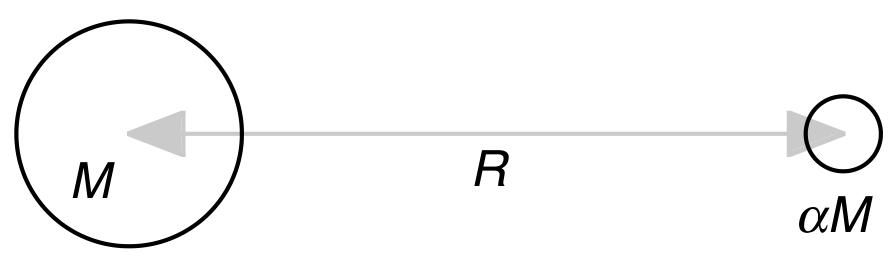
a. Derive an equation for the magnitude of the star’s velocity about the star-planet center of mass in terms of , , , and . Your answer should be given to lowest order in . [20 т.]
Scientists think they can detect stars with speeds as small as .
b. What is the maximum distance a planet with Earth’s mass could be from a star of solar mass and still be detected by stellar wobble? Express your answer in astronomical units (A.U.). [5 т.]
Possibly useful information:
| Mass of sun | |
| for Earth | |
| for Earth | (= 1 A.U.) |
Отговори
- a.
- b. 0.00089 A.U.
Решение
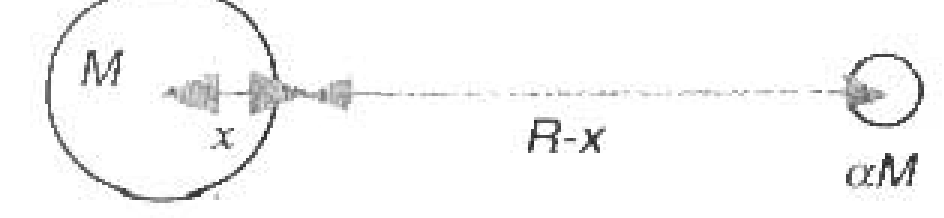
2. a. To find the center of mass of the star planet system, divide the distance into and as shown in the diagram. Placing the origin at the center of mass, the general center of mass equation becomes .
Solving for , the center of star to center of mass distance. . [5]
Using Newton’s Second Law to describe the star’s motion [2]
The net force is the universal gravitational force [3]
(Maximum of [2] if is used in place of .)
For uniform motion in a circle of radius about the center of mass, . [3]
(Maximum of [2] if is used in place of .)
Substituting for , this becomes [1]
Combining these equations [2]
Canceling common factors . [1]
Solving for . [1]
To lowest order in this is [2] (Exact answer required.)
b. Solving for [2]
Inserting the values given with the problem
[2]
Converting to A.U. A.U. [1]
Оригинал в Архива: Quarterfinal 2004.pdf · официални решения: Quarterfinal 2004 Solutions.pdf