USAPhO 2005, Полуфинал — A3
2005 Semi-Final Exam · 25 т.
2005 Semi-Final Exam — Instructions
AAPT / AIP — United States Physics Team 2005.
DO NOT OPEN THIS TEST UNTIL YOU ARE TOLD TO BEGIN
- Work Part A first. You have 90 minutes to complete all four problems.
- After you have completed Part A, you may take a break.
- Then work Part B. You have 90 minutes to complete both problems.
- Show all your work. Partial credit will be given.
- Start each question on a new sheet of paper. Be sure to put your name in the upper right-hand corner of each page, along with the question number and the page number/total pages for this problem. For example: Doe, Jamie; A1 – 1/3.
- A hand-held calculator may be used. Its memory must be cleared of data and programs. You may use only the basic functions found on a simple scientific calculator. Calculators may not be shared. Cell phones, PDA’s, or cameras may not be used during the exam or while the exam papers are present. You may not use any tables, books, or collections of formulas.
- Questions with the same point value are not necessarily of the same difficulty.
- Do not discuss the contents of this exam with anyone until after the submission deadline.
- Good luck!
Possibly Useful Information
| Quantity | Value |
|---|---|
| Gravitational field at the Earth’s surface | N/kg |
| Newton’s gravitational constant | N·m/kg |
| Coulomb’s constant | N·m/C |
| Biot-Savart constant | T·m/A |
| Speed of light in a vacuum | m/s |
| Boltzmann’s constant | J/K |
| Avogadro’s number | (mol) |
| Ideal gas constant | J/(mol·K) |
| Stefan-Boltzmann constant | J/(s·m·K) |
| Elementary charge | C |
| 1 electron volt | J |
| Planck’s constant | |
| Electron mass | |
| Binomial expansion | for |
| Small angle approximations | , |
Copyright © 2005, American Association of Physics Teachers
Условие
A plane wave traveling in the positive -direction can be described by the following wavefunction: , where (the amplitude) and are constants, , , is the frequency, and is the wavelength. The factor is called the phase of the wave. The following relation may be useful:
a.
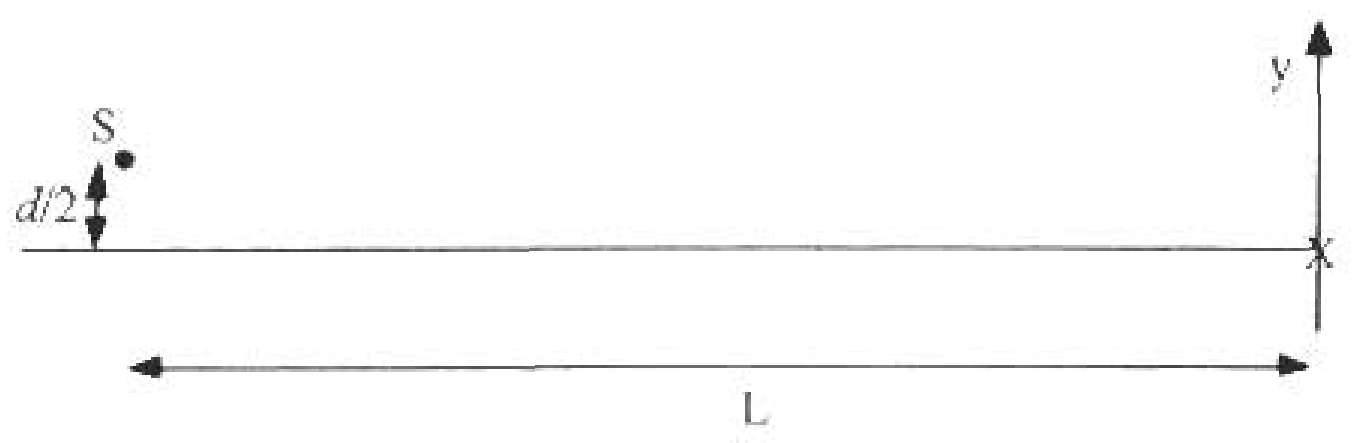
A point source of monochromatic electromagnetic radiation of wavelength is located a distance above a perfectly reflecting surface represented by the solid horizontal line in the diagram above. An interference pattern is formed on the screen a distance from the source, . The point , at the intersection of the screen and the reflecting surface, represented by an X in the diagram, is an interference minimum. Point X is on the surface of the material.
a. The first bright band is located a distance above point X. Find . [10 т.]
b.–c.
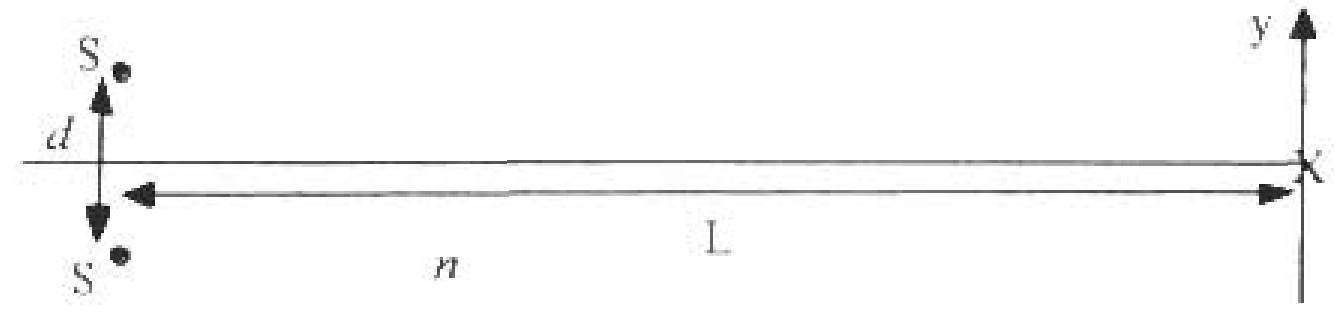
The reflecting surface is replaced by a material that does not reflect but transmits without loss of amplitude. The material has index of refraction . One source is placed a distance above the air-material interface. The other source is embedded in the material a distance below the interface. The two sources are in phase, coherent, emit electromagnetic radiation of the same monochromatic wavelength in vacuum, and are both located a distance from a screen, . Assume that the wave amplitude due to each source individually is the same at point X and that the wave from the lower source travels entirely in the material.
b. What is the resultant wavefunction at point X as a function of time? [8 т.]
c. Let denote the maximum intensity reaching point X, which occurs when . Derive an expression for the time averaged intensity of the electromagnetic radiation at point X as a function of , , , and . [7 т.]
Решение
Source note: (A3-2) repeats the label r1. Equation (A3-5) prints minus pi, followed by the statement n=1 and the final first-maximum expression; these printed forms are mutually inconsistent and are retained. The phase sign also changes between (A3-9) and (A3-11).
a. (10 т.)
We can assume that there is an image of the source S in the perfectly reflecting surface located a distance beneath the surface. The problem then reduces to one of two point sources a distance apart creating an interference pattern on a screen a located a distance away from the sources. We are informed that the midpoint on the screen, , is an interference minimum. Since this would be an interference maximum for two point sources which are in phase, then we can conclude that the phase of the reflected wave is shifted by an amount , so that the location of interference maxima and interference minima are switched relative to the “normal” presentation. Consequently, the location of the first maximum is .
In the event that you forgot the formula, you will need to derive it.
The distance from the object point source to a point on the screen is
The distance from the image point source to a point on the screen is
The path length difference is then
where the approximation is true for .
The relative phase shift due to the path length difference is found by dividing through by the wavelength and multiplying by , so
There is an additional phase shift of from the reflection, so that the overall phase difference between the waves is
Constructive interference occurs when , where is an integer; the smallest value for with constructive interference happens when , or
b. (8 т.)
For the wave from the source above the boundary:
The wave below the boundary travels in a medium that (1) doesn’t affect or , but (2) scales according to , since the wave velocity is changed but the frequency is unaffected. Consequently the wave equation from the second source is
The distance is the same for both, and is approximately equal to for .
Adding the two waves in (A3-7) and in (A3-8) and making use of the given trigonometric identity yields
c. (7 т.)
The intensity is proportional to the wave-function squared, or
The time average is found by integrating the above expression over one period and then dividing by the period, or
Everything inside the sin function can be written compactly as
A change of variables to try would be
Then the expression for the time-averaged intensity becomes
where we have conveniently swallowed all constants into the proportionality. The integral is fairly easy, but it doesn’t matter, since it is also a constant independent of or . So it can be swallowed as well, leaving
This is true for all values of the argument of the cosine function, including the value that maximizes the cosine function, so
gives us the required relation for .
Оригинал в Архива: Semifinal 2005.pdf · официални решения: Semifinal 2005 Solutions.pdf