USAPhO 2006, Четвъртфинал — Задача 1
Preliminary Exam — Open Response Questions · 25 т.
Указания
DO NOT OPEN THIS TEST UNTIL YOU ARE TOLD TO BEGIN
- Show all your work. Partial credit will be given.
- Start each question on a new sheet of paper. Be sure to put your name in the upper right-hand corner of each page, along with the question number and the page number/total pages for this problem. For example,
Doe, Jamie
#1 – P. 1/3
- A hand-held calculator may be used. Its memory must be cleared of data and programs. You may use only the basic functions found on a simple scientific calculator. Calculators may not be shared. Cell phones may not be used during the exam or while the exam papers are present. You may not use any tables, books, or collections of formulas.
- Each of the four questions is worth 25 points. The questions are not necessarily of the same difficulty. Good luck!
- In order to maintain exam security, do not communicate any information about the problems or the solutions on this exam (or on the multiple-choice exam) until after February 13th.
Possibly Useful Information
| Quantity | Value |
|---|---|
| Gravitational field at the Earth's surface | N/kg |
| Newton's gravitational constant | N·m/kg |
| Average Earth-Sun Distance | 1 Astronomical Unit (A.U.) m |
| Binomial expansion | for |
Moment of Inertia about Center of Mass - Uniform Object
(will not be provided on the second screening exam)
| Object | Moment of Inertia |
|---|---|
| Disk | |
| Sphere | |
| Rod |
Copyright © 2006, American Association of Physics Teachers
Solutions to Problems
Each question is worth 25 points. Any correct solution should be awarded equivalent points. Suggested partial-credit points are presented in square brackets in the right margin after the equation number. You may further break down the listed points into one point increments. If it is clear they have done an intermediate step, they should get credit for it even if they have not presented it. Students should not be penalized in a subsequent part for using the wrong answer to a previous part. (No double jeopardy.)
Условие
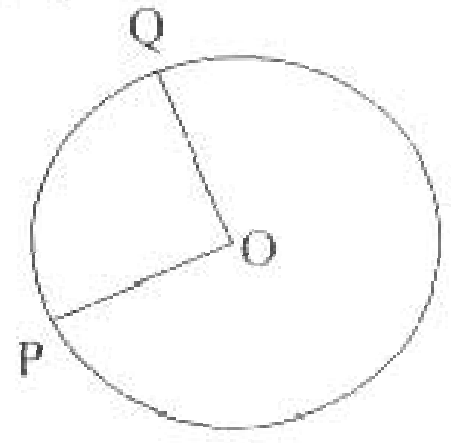
A car starts at point P from rest, with zero initial acceleration, but with a constant rate of change of tangential acceleration of 2 m/s. The car is constrained to travel on a circular track of unknown radius. When the car reaches point Q, the angle between the acceleration and velocity vectors is . The center of the track is point O. What is the angle (in radians) POQ?
Решение
There are at least two ways to approach this problem. Other solution methods may exist as well.
Method 1
Here the focus is on angular rotation variables.
Let m/s. Then the angular acceleration is given by
[3 pt]
and the angular velocity is given by
[3 pt]
and the angular position relative to is given by
[3 pt]
The velocity is always tangential, the acceleration has tangential and radial components, so the tangent of the angle between and is given by
[2 pt]
Now
[2 pt]
and
[2 pt]
so combining Eq. 1-1 through Eq. 1-6.
[6 pt]
Then
[4 pt]
Method 2
Here the focus is on linear variables.
Let m/s. Then the tangential acceleration is given by
[3 pt]
and the tangential velocity is given by
[3 pt]
and the arc length traveled in time is given by
[3 pt]
The radial acceleration is found from Eq. 1-15,
[2 pt]
The angle between the velocity vector and the acceleration vector is found from the dot product:
[2 pt]
where and are the magnitudes of the velocity and acceleration. In unit vector notation,
so
[2 pt]
The magnitude of the acceleration vector found from Eq. 1-14 and Eq. 1-17,
[2 pt]
Combining Eq. 1-18, Eq. 1-22, and Eq. 1-25, and then rearranging,
[4 pt]
Note that is the angle, in radians, between and .
It is stated that , so
[4 pt]
Оригинал в Архива: Quarterfinal 2006.pdf · официални решения: Quarterfinal 2006 Solutions.pdf