USAPhO 2009, Четвъртфинал — Задача 1
2009 Quarter-Final Exam · 25 т.
Important Instructions for the Exam Supervisor
Quarterfinal Exam
DO NOT DISTRIBUTE THIS PAGE
Important Instructions for the Exam Supervisor
- This examination consists of one part.
- The first page that follows is a cover sheet. Examinees may keep the cover sheet during the exam.
- Allow 60 minutes to complete the exam. Examinees may read the cover sheet before beginning the exam, but may not look at the examination questions until the 60 minute time period begins.
- The supervisor must collect all examination questions, including the cover sheet, at the end of the exam, as well as any scratch paper used by the examinees. Examinees may not take the exam questions. The examination questions may be returned to the students after March 8, 2009.
- Examinees are allowed calculators, but they may not use symbolic math, programming, or graphic features of these calculators. Calculators may not be shared and their memory must be cleared of data and programs. Cell phones, PDA’s or cameras may not be used during the exam or while the exam papers are present. Examinees may not use any tables, books, or collections of formulas.
- The examinees will need to use a ruler for one of the questions on this exam. They may not share rulers with other examinees.
- AAPT must receive the students answer papers no later than Thursday, March 5, 2009. Marking of papers will occur that weekend, and the semifinalists will be selected by March 8, 2009. It will not be possible to mark late papers.
Указания
4 QUESTIONS - 60 MINUTES
DO NOT OPEN THIS TEST UNTIL YOU ARE TOLD TO BEGIN
Show all your work. Partial credit will be given.
Start each question on a new sheet of paper. Put your name in the upper right-hand corner of each page, along with the question number and the page number/total pages for this problem. For example,
Doe, Jamie
Prob. 1 - P. 1/3
A ruler will be required on this exam.
A hand-held calculator may be used. Its memory must be cleared of data and programs. You may use only the basic functions found on a simple scientific calculator. Calculators may not be shared.
Cell phones may not be used during the exam or while the exam papers are present. You may not use any tables, books, or collections of formulas.
Each of the four questions is worth 25 points. The questions are not necessarily of the same difficulty. Good luck!
In order to maintain exam security, do not communicate any information about the questions (or their answers or solutions) on this contest until after March 10, 2009.
Условие
Below is an image of Fomalhaut b, the first extrasolar planet to be observed directly by visible light, obtained by the Hubble Space Telescope.
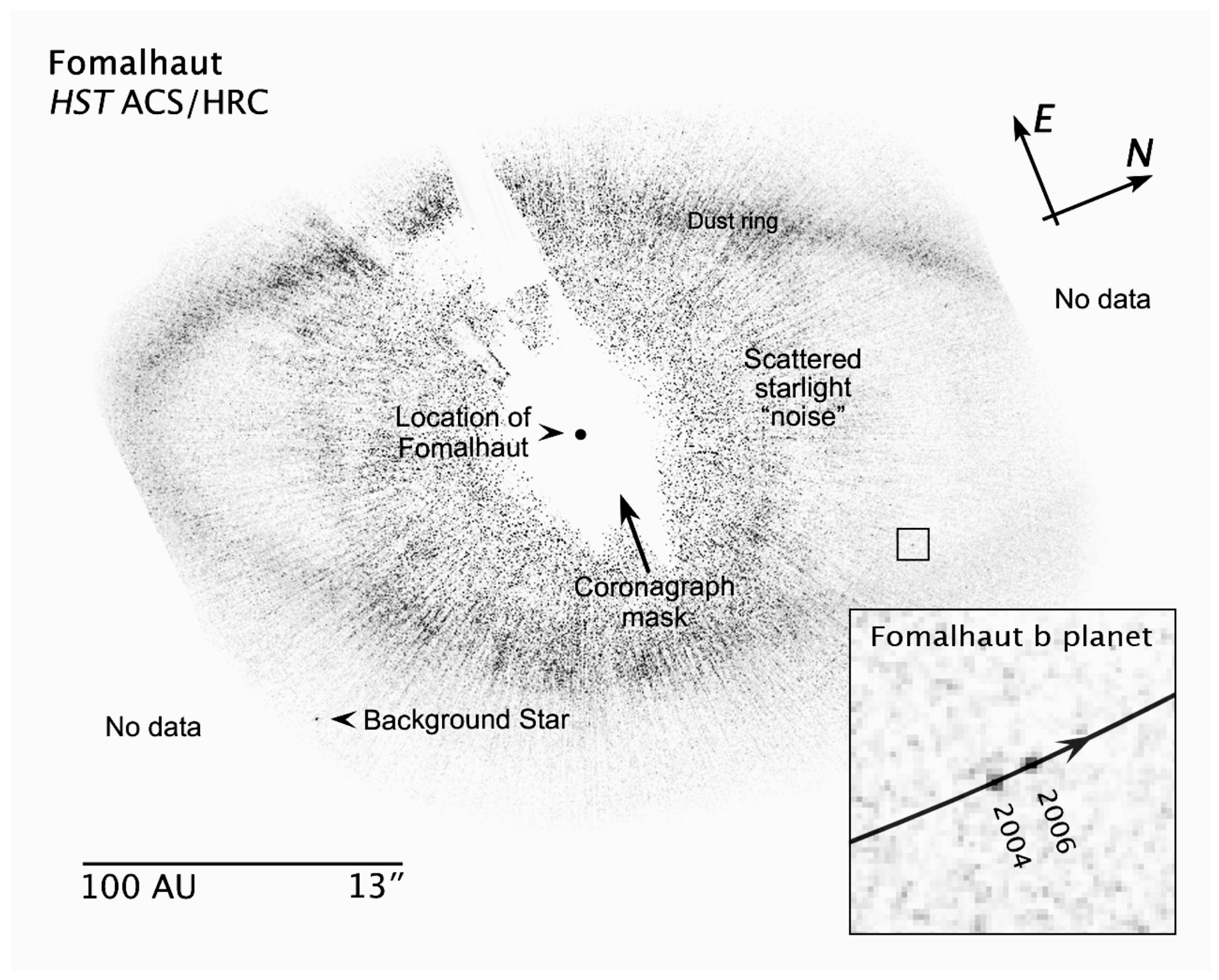
The scale of the larger diagram is shown on the lower left; the 13” refers to the angle, in arc-second, subtended by 100 AU at the distance of Fomalhaut. The scale of the inset can be determined by size of the small box.
(a) A planet is in a circular orbit of radius and period . Derive an expression for the mass of a star in terms of , , and the gravitational constant . You may assume that the mass of the planet is much, much less than the mass of the star.
(b) From the image, estimate the mass of the star Fomalhaut in solar masses. You may assume that the orbit of Fomalhaut b is circular and ignore any errors associated with the fact that the plane of the image is not coincident with the plane of the orbit. Recall that the radius of the Earth’s orbit around the Sun is 1 AU. You do not need to do an error analysis, but the number of significant digits in your answer ought reflect the accuracy of your answer.
Отговори
(a)
The official solution prints the final rearrangement as (G in the numerator), which contradicts its own preceding line ; the answer here follows that preceding line.
(b) 1.4 solar masses
Official solution: ; allowing for 10% error in each measurement, the results would be between 0.87 and 2.2.
Решение
Solution
The force between the star of mass and the planet of mass is given by
Assuming that , then the center of mass of the system is located at the star, and therefore the orbital radius of the planet is effectively . For a circular orbit,
Equating,
or the more familiar Kepler’s law
Rearranging,
To find the mass of Fomalhaut b, in terms of solar masses , we simply require a ratio:
where refers to the planet around Fomalhaut b, while refers to Earth. Then
From the diagram we can obtain the ratios. Note that the 13 arcsecond notation is not needed for this computation, it simply is a comparison of the size of the object as seen from Earth. As such, seen from Earth, the orbital dust ring subtends about the same angle as does the planet Jupiter!
A quick estimate yields , while slightly more work is required for the periods.
The inset box is 10 times the scale of the main image.
The planet moves 1.4 AU during the two year period. Since the orbital circumference is 690 AU, that means it takes 980 years to complete an orbit. Then , and . Allowing for 10% error in each measurement, the results would be between 0.87 and 2.2.
Finally, after marking the quarter-final answers, it was mildly entertaining to consider the range of values obtained, from a minimum of (about kg, or the mass of a pile of rocks some 300 meters tall) to a maximum of (About 1000 times greater than the mass of the universe!).
Оригинал в Архива: 2009_QtrFinal.pdf · официални решения: 2009_QtrFinalSolutions.pdf