USAPhO 2009, Четвъртфинал — Задача 4
2009 Quarter-Final Exam · 25 т.
Important Instructions for the Exam Supervisor
Quarterfinal Exam
DO NOT DISTRIBUTE THIS PAGE
Important Instructions for the Exam Supervisor
- This examination consists of one part.
- The first page that follows is a cover sheet. Examinees may keep the cover sheet during the exam.
- Allow 60 minutes to complete the exam. Examinees may read the cover sheet before beginning the exam, but may not look at the examination questions until the 60 minute time period begins.
- The supervisor must collect all examination questions, including the cover sheet, at the end of the exam, as well as any scratch paper used by the examinees. Examinees may not take the exam questions. The examination questions may be returned to the students after March 8, 2009.
- Examinees are allowed calculators, but they may not use symbolic math, programming, or graphic features of these calculators. Calculators may not be shared and their memory must be cleared of data and programs. Cell phones, PDA’s or cameras may not be used during the exam or while the exam papers are present. Examinees may not use any tables, books, or collections of formulas.
- The examinees will need to use a ruler for one of the questions on this exam. They may not share rulers with other examinees.
- AAPT must receive the students answer papers no later than Thursday, March 5, 2009. Marking of papers will occur that weekend, and the semifinalists will be selected by March 8, 2009. It will not be possible to mark late papers.
Указания
4 QUESTIONS - 60 MINUTES
DO NOT OPEN THIS TEST UNTIL YOU ARE TOLD TO BEGIN
Show all your work. Partial credit will be given.
Start each question on a new sheet of paper. Put your name in the upper right-hand corner of each page, along with the question number and the page number/total pages for this problem. For example,
Doe, Jamie
Prob. 1 - P. 1/3
A ruler will be required on this exam.
A hand-held calculator may be used. Its memory must be cleared of data and programs. You may use only the basic functions found on a simple scientific calculator. Calculators may not be shared.
Cell phones may not be used during the exam or while the exam papers are present. You may not use any tables, books, or collections of formulas.
Each of the four questions is worth 25 points. The questions are not necessarily of the same difficulty. Good luck!
In order to maintain exam security, do not communicate any information about the questions (or their answers or solutions) on this contest until after March 10, 2009.
Условие
A certain electric battery is not quite ideal. It can be thought of as a perfect cell with constant output voltage connected in series to a resistance , but there is no way to remove this internal resistance from the battery.
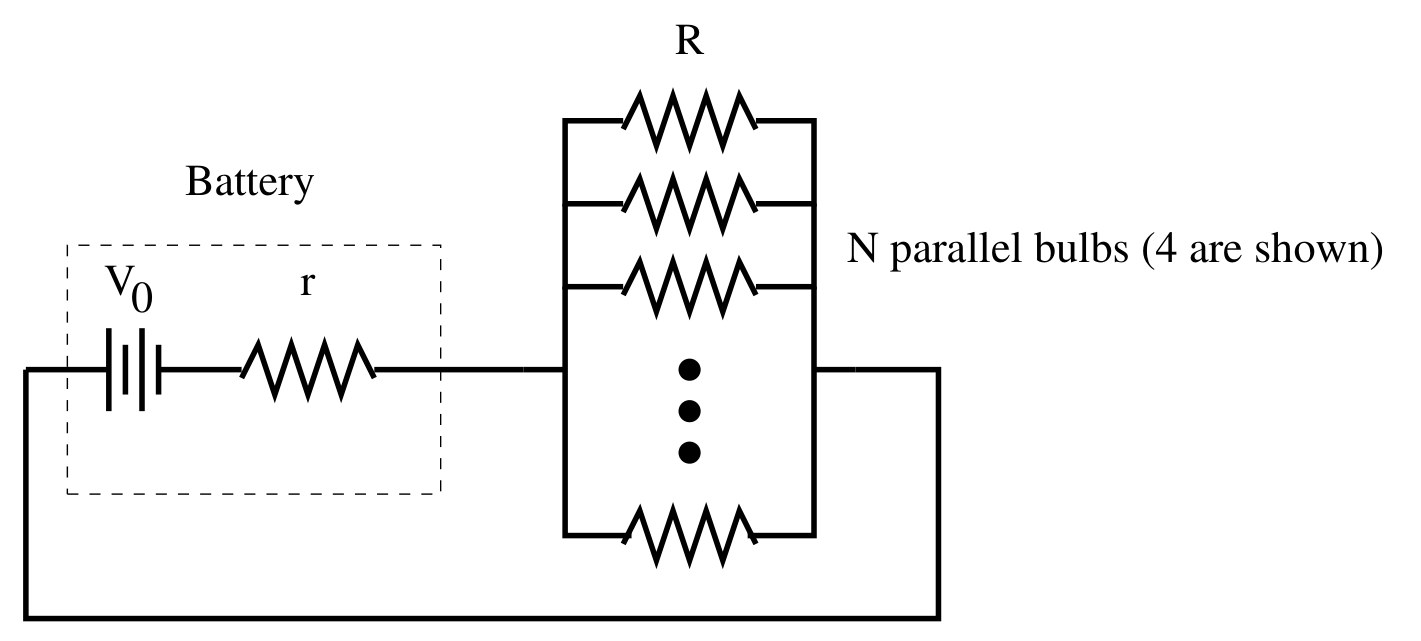
The battery is connected to identical lightbulbs in parallel. The bulbs each have a fixed resistance , independent of the current through them.
(a) Derive an expression for the total power dissipated by the bulbs in terms of , , and .
(b) It is observed that the configuration dissipates more total power through the bulbs when than it does for any other value of . In terms of , what range of values is possible for ?
Отговори
- (a)
- (b)
Решение
Solution
The effective resistance of identical resistors in parallel is
The total resistance of the circuit is the .
The current drawn is then
The power dissipated by the parallel resistance is given by
so
One can simply start with the fact that the maximum power is dissipated when the external resistance is equal to the internal resistance. Or, take the derivative of with respect to and set it equal to zero. In either case, you will get
Don’t assume, however, that the answer is then . Since we can’t have half a bulb, we don’t actually know that the power is a maximum for the circuit, only that it is the maximum configuration. It could be that a larger power output could occur with a resistance between and , or maybe between and .
A rough guess would be to assume
A better estimate would be to assume a quadratic function of with respect to in the vicinity of (think Taylor expansion of ), and then the important point is the halfway point between and , or
So the bounds are
The correct approach is to assume the power outputs at and are equal, and solve for the necessary value of . Then
or
Thankfully, we loose the cubic term
To save space, flip the to the one term that doesn’t have it.
Only positive answers have meaning, so
which give the correct bounds as
If you knew about geometric means, you might have been able to just write this down.
Оригинал в Архива: 2009_QtrFinal.pdf · официални решения: 2009_QtrFinalSolutions.pdf