USAPhO 2009, Полуфинал — Задача 3. Question A3
United States Physics Team 2009 — Semifinal Exam · 25 т.
Important Instructions for the Exam Supervisor
DO NOT DISTRIBUTE THIS PAGE
- This examination consists of two parts.
- Part A has four questions and is allowed 90 minutes.
- Part B has two questions and is allowed 90 minutes.
- The first page that follows is a cover sheet. Examinees may keep the cover sheet for both parts of the exam.
- The parts are then identified by the center header on each page. Examinees are only allowed to do one part at a time, and may not work on other parts, even if they have time remaining.
- Allow 90 minutes to complete Part A. Do not let students look at Part B. Collect the answers to Part A before allowing the examinee to begin Part B. Examinees are allowed a 10 to 15 minutes break between parts A and B.
- Allow 90 minutes to complete Part B. Do not let students go back to Part A.
- Ideally the test supervisor will divide the question paper into 3 parts: the cover sheet (page 2), Part A (pages 3-4), and Part B (pages 6-7). Examinees should be provided parts A and B individually, although they may keep the cover sheet.
- The supervisor must collect all examination questions, including the cover sheet, at the end of the exam, as well as any scratch paper used by the examinees. Examinees may not take the exam questions. The examination questions may be returned to the students after March 31, 2009.
- Examinees are allowed calculators, but they may not use symbolic math, programming, or graphic features of these calculators. Calculators may not be shared and their memory must be cleared of data and programs. Cell phones, PDA’s or cameras may not be used during the exam or while the exam papers are present. Examinees may not use any tables, books, or collections of formulas.
- Please provide the examinees with graph paper for Part A.
Указания
DO NOT OPEN THIS TEST UNTIL YOU ARE TOLD TO BEGIN
Work Part A first. You have 90 minutes to complete all four problems. Each question is worth 25 points. Do not look at Part B during this time.
After you have completed Part A you may take a break.
Then work Part B. You have 90 minutes to complete both problems. Each question is worth 50 points. Do not look at Part A during this time.
Show all your work. Partial credit will be given. Do not write on the back of any page. Do not write anything that you wish graded on the question sheets.
Start each question on a new sheet of paper. Put your school ID number, your name, the question number and the page number/total pages for this problem, in the upper right hand corner of each page. For example,
School ID #
Doe, Jamie
A1 - 1/3
A hand-held calculator may be used. Its memory must be cleared of data and programs. You may use only the basic functions found on a simple scientific calculator. Calculators may not be shared. Cell phones, PDA’s or cameras may not be used during the exam or while the exam papers are present. You may not use any tables, books, or collections of formulas.
Questions with the same point value are not necessarily of the same difficulty.
In order to maintain exam security, do not communicate any information about the questions (or their answers/solutions) on this contest until after March 31, 2009.
Possibly Useful Information. You may use this sheet for both parts of the exam.
| for | |
| for | for |
Условие
Two stars, each of mass and separated by a distance , orbit about their center of mass. A planetoid of mass () moves along the axis of this system perpendicular to the orbital plane.
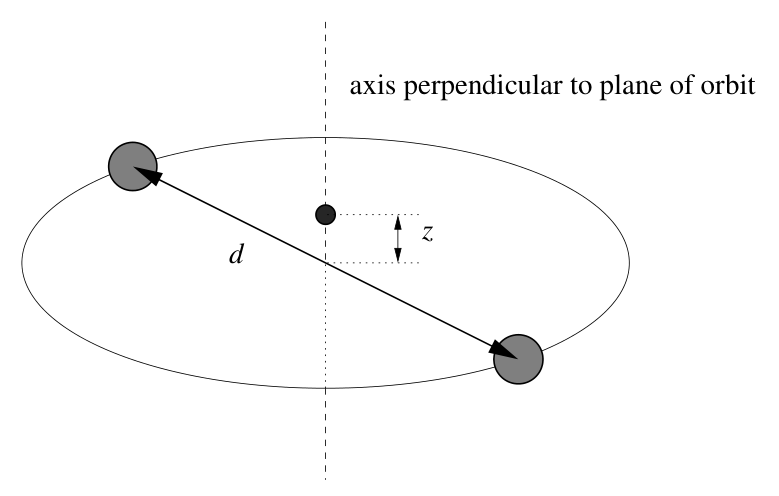
Let be the period of simple harmonic motion for the planetoid for small displacements from the center of mass along the -axis, and let be the period of motion for the two stars. Determine the ratio .
This problem was adapted from a problem by French in Newtonian Mechanics.
Отговори
Решение
The stars orbit about their center of mass, in circles of radius . Setting the gravitational force to the centripetal force,
and solving for the orbital period gives
Now let the planetoid be a distance above the plane. The distance to either star is . Only the part of the force that is perpendicular to the plane survives the vector addition, so the net force is
This expression is exact, but if we have
by the binomial theorem. This is a linear restoring force, so the planetoid will execute simple harmonic motion with period
where is the effective force constant, so
which gives the answer,
Оригинал в Архива: 2009_SemiFinal.pdf · официални решения: USAPhO-2009-Solutions.pdf