USAPhO 2009, Полуфинал — Задача 5. Question B1
United States Physics Team 2009 — Semifinal Exam · 50 т.
Important Instructions for the Exam Supervisor
DO NOT DISTRIBUTE THIS PAGE
- This examination consists of two parts.
- Part A has four questions and is allowed 90 minutes.
- Part B has two questions and is allowed 90 minutes.
- The first page that follows is a cover sheet. Examinees may keep the cover sheet for both parts of the exam.
- The parts are then identified by the center header on each page. Examinees are only allowed to do one part at a time, and may not work on other parts, even if they have time remaining.
- Allow 90 minutes to complete Part A. Do not let students look at Part B. Collect the answers to Part A before allowing the examinee to begin Part B. Examinees are allowed a 10 to 15 minutes break between parts A and B.
- Allow 90 minutes to complete Part B. Do not let students go back to Part A.
- Ideally the test supervisor will divide the question paper into 3 parts: the cover sheet (page 2), Part A (pages 3-4), and Part B (pages 6-7). Examinees should be provided parts A and B individually, although they may keep the cover sheet.
- The supervisor must collect all examination questions, including the cover sheet, at the end of the exam, as well as any scratch paper used by the examinees. Examinees may not take the exam questions. The examination questions may be returned to the students after March 31, 2009.
- Examinees are allowed calculators, but they may not use symbolic math, programming, or graphic features of these calculators. Calculators may not be shared and their memory must be cleared of data and programs. Cell phones, PDA’s or cameras may not be used during the exam or while the exam papers are present. Examinees may not use any tables, books, or collections of formulas.
- Please provide the examinees with graph paper for Part A.
Указания
DO NOT OPEN THIS TEST UNTIL YOU ARE TOLD TO BEGIN
Work Part A first. You have 90 minutes to complete all four problems. Each question is worth 25 points. Do not look at Part B during this time.
After you have completed Part A you may take a break.
Then work Part B. You have 90 minutes to complete both problems. Each question is worth 50 points. Do not look at Part A during this time.
Show all your work. Partial credit will be given. Do not write on the back of any page. Do not write anything that you wish graded on the question sheets.
Start each question on a new sheet of paper. Put your school ID number, your name, the question number and the page number/total pages for this problem, in the upper right hand corner of each page. For example,
School ID #
Doe, Jamie
A1 - 1/3
A hand-held calculator may be used. Its memory must be cleared of data and programs. You may use only the basic functions found on a simple scientific calculator. Calculators may not be shared. Cell phones, PDA’s or cameras may not be used during the exam or while the exam papers are present. You may not use any tables, books, or collections of formulas.
Questions with the same point value are not necessarily of the same difficulty.
In order to maintain exam security, do not communicate any information about the questions (or their answers/solutions) on this contest until after March 31, 2009.
Possibly Useful Information. You may use this sheet for both parts of the exam.
| for | |
| for | for |
Условие
A bowling ball and a golf ball are dropped together onto a flat surface from a height . The bowling ball is much more massive than the golf ball, and both have radii much less than . The bowling ball collides with the surface and immediately thereafter with the golf ball; the balls are dropped so that all motion is vertical before the second collision, and the golf ball hits the bowling ball at an angle from its uppermost point, as shown in the diagram. All collisions are perfectly elastic, and there is no surface friction between the bowling ball and the golf ball.
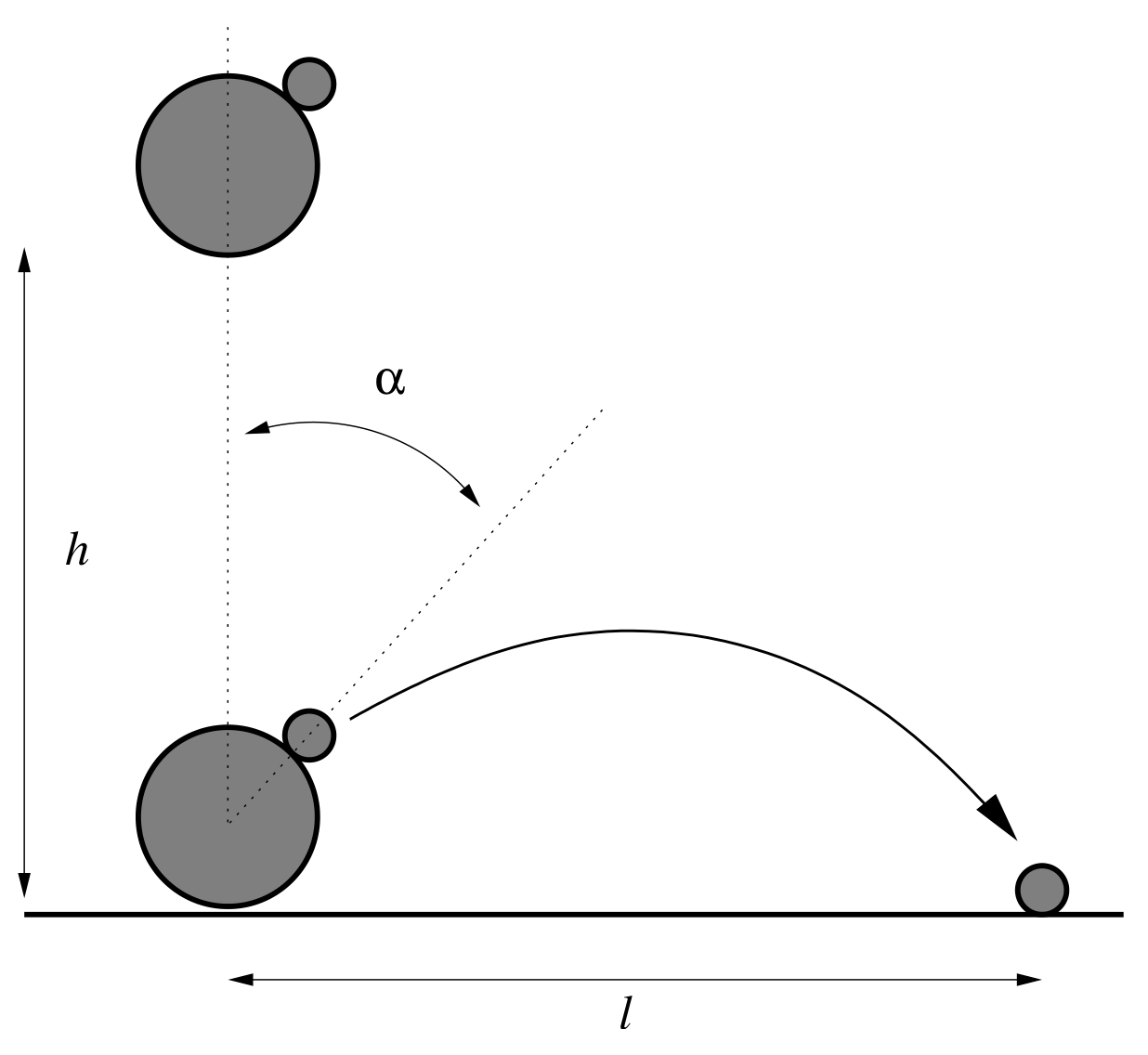
After the collision the golf ball travels in the absence of air resistance and lands a distance away. The height is fixed, but may be varied. What is the maximum possible value of , and at what angle is it achieved?
You may present your results as decimals, but remember that you are not allowed to use graphical or algebraic functions of your calculator.
Отговори
l = 14.08 h, achieved at α = 0.468 = 26.8°
From the official solution: cos 2α = 0.593.
Решение
Both balls arrive at the surface with a speed , which we can determine as usual via conservation of energy:
After the bowling ball collides with the surface, it is traveling upwards at and the golf ball is traveling downwards at . The subsequent collision is most easily understood in the reference frame of the bowling ball; in this frame, the golf ball is traveling downwards at and the bowling ball is stationary. Since the bowling ball is very massive compared to the golf ball, the golf ball will rebound at the same speed . Since there is no surface friction, the angle of reflection will be equal to the angle of incidence. Therefore the golf ball will emerge at an angle to the vertical.
In the bowling ball’s reference frame, the golf ball emerges with horizontal velocity and upward vertical velocity . Transforming these back to the original frame of reference, we obtain the initial conditions for the golf ball’s projectile motion,
The time of flight of the golf ball is given by
and therefore the range is
Combining with our previous result,
For convenience we set . Inserting the expression for ,
Setting this to zero to find the maximum,
This can be rewritten as a quadratic in ,
Taking the positive root,
So at maximum,
which occurs at
Оригинал в Архива: 2009_SemiFinal.pdf · официални решения: USAPhO-2009-Solutions.pdf