USAPhO 2013, Полуфинал — Задача 1. Question A1
UNITED STATES PHYSICS TEAM 2013 — Semifinal Exam · 25 т.
Important Instructions for the Exam Supervisor
DO NOT DISTRIBUTE THIS PAGE
- This examination consists of two parts.
- Part A has four questions and is allowed 90 minutes.
- Part B has two questions and is allowed 90 minutes.
- The first page that follows is a cover sheet. Examinees may keep the cover sheet for both parts of the exam.
- The parts are then identified by the center header on each page. Examinees are only allowed to do one part at a time, and may not work on other parts, even if they have time remaining.
- Allow 90 minutes to complete Part A. Do not let students look at Part B. Collect the answers to Part A before allowing the examinee to begin Part B. Examinees are allowed a 10 to 15 minutes break between parts A and B.
- Allow 90 minutes to complete Part B. Do not let students go back to Part A.
- Ideally the test supervisor will divide the question paper into 3 parts: the cover sheet (page 2), Part A (pages 3-5), and Part B (pages 7-8). Examinees should be provided parts A and B individually, although they may keep the cover sheet.
- The supervisor must collect all examination questions, including the cover sheet, at the end of the exam, as well as any scratch paper used by the examinees. Examinees may not take the exam questions. The examination questions may be returned to the students after April 1, 2013.
- Examinees are allowed calculators, but they may not use symbolic math, programming, or graphic features of these calculators. Calculators may not be shared and their memory must be cleared of data and programs. Cell phones, PDA’s or cameras may not be used during the exam or while the exam papers are present. Examinees may not use any tables, books, or collections of formulas.
- Please provide the examinees with graph paper for Part A. A straight edge or ruler could also be useful.
Указания
DO NOT OPEN THIS TEST UNTIL YOU ARE TOLD TO BEGIN
Work Part A first. You have 90 minutes to complete all four problems. Each question is worth 25 points. Do not look at Part B during this time.
After you have completed Part A you may take a break.
Then work Part B. You have 90 minutes to complete both problems. Each question is worth 50 points. Do not look at Part A during this time.
Show all your work. Partial credit will be given. Do not write on the back of any page. Do not write anything that you wish graded on the question sheets.
Start each question on a new sheet of paper. Put your AAPT ID number, your name, the question number and the page number/total pages for this problem, in the upper right hand corner of each page. For example,
AAPT ID #
Doe, Jamie
A1 - 1/3
A hand-held calculator may be used. Its memory must be cleared of data and programs. You may use only the basic functions found on a simple scientific calculator. Calculators may not be shared. Cell phones, PDA’s or cameras may not be used during the exam or while the exam papers are present. You may not use any tables, books, or collections of formulas.
Questions with the same point value are not necessarily of the same difficulty.
In order to maintain exam security, do not communicate any information about the questions (or their answers/solutions) on this contest until after April 1, 2013.
Possibly Useful Information. You may use this sheet for both parts of the exam.
| for | |
| for | for |
Условие
The flow of heat through a material can be described via the thermal conductivity . If the two faces of a slab of material with thermal conductivity , area , and thickness are held at temperatures differing by , the thermal power transferred through the slab is
A heat exchanger is a device which transfers heat between a hot fluid and a cold fluid; they are common in industrial applications such as power plants and heating systems. The heat exchanger shown below consists of two rectangular tubes of length , width , and height . The tubes are separated by a metal wall of thickness and thermal conductivity . Originally hot fluid flows through the lower tube at a speed from right to left, and originally cold fluid flows through the upper tube in the opposite direction (left to right) at the same speed. The heat capacity per unit volume of both fluids is .
The hot fluid enters the heat exchanger at a higher temperature than the cold fluid; the difference between the temperatures of the entering fluids is . When the fluids exit the heat exchanger the difference has been reduced to . (It is possible for the exiting originally cold fluid to have a higher temperature than the exiting originally hot fluid, in which case .)
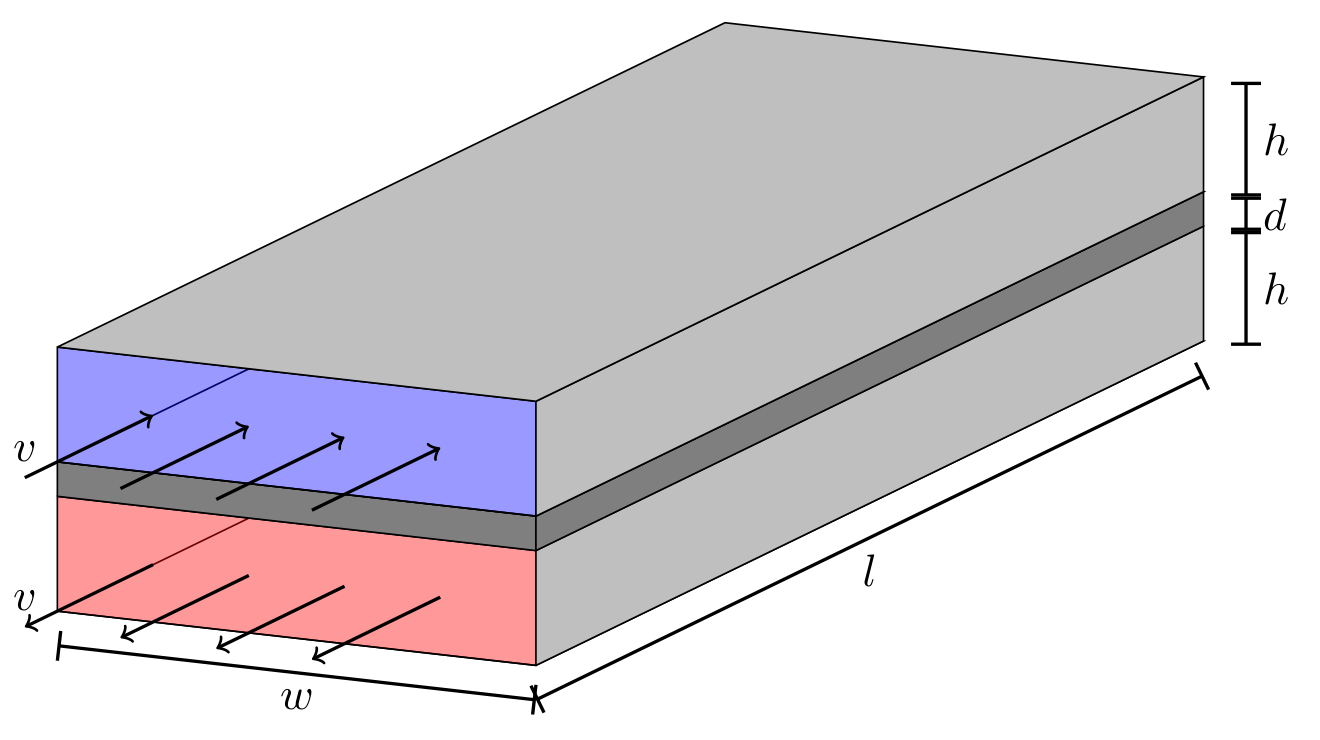
Assume that the temperature in each pipe depends only on the lengthwise position, and consider transfer of heat only due to conduction in the metal and due to the bulk movement of fluid. Under the assumptions in this problem, while the temperature of each fluid varies along the length of the exchanger, the temperature difference across the wall is the same everywhere. You need not prove this.
Find in terms of the other given parameters.
Отговори
Решение
To see why the temperature difference across the wall is the same everywhere along the wall, note that at every point along the wall, the warmer fluid on one side transfers energy to the colder fluid on the other. Since the heat capacities are equal, the temperature of the warmer fluid drops at the same rate the temperature of the colder fluid rises. But since the fluids move at the same speed in opposite directions, this means the temperature difference is constant.
Suppose this temperature difference is . Since the total area of the wall is , the power transferred across the wall is
In a time , the energy transferred is therefore
Meanwhile, suppose the red fluid enters at temperature and the blue fluid at temperature . The red fluid exits at temperature , so the overall temperature change of the red fluid is
In a time , a volume of red fluid enters the pipe, and the same volume leaves, with a temperature higher. Then the total energy transferred to the red fluid is
We would get the same equation if we considered the blue fluid, as expected by energy conservation. However, this requires to be the same for both fluids. If this were not true, we would instead get a contradiction, reflecting the fact that could not be constant.
Equating our two expressions for gives
Because the red fluid exits at and the blue fluid exits at ,
The performance of the heat exchanger is determined by the dimensionless parameter .
There are several ways we can check this result. We can check if is correct by dimensional analysis or common sense; for example, it’s clear that a long pipe improves performance. We also see that in the limit of poor performance, , we find no heat exchange at all, . The best possible performance, attained for , is , a complete reversal of the temperatures of the fluids. This is much better than the best possible performance if the two fluids moved the same direction, which would be . The general idea here is called countercurrent heat exchange, and it appears in both biology and practical engineering.
STOP: Do Not Continue to Part B
If there is still time remaining for Part A, you should review your work for Part A, but do not continue to Part B until instructed by your exam supervisor.
Оригинал в Архива: USAPhO-2013.pdf · официални решения: USAPhO-2013-Solutions.pdf