USAPhO 2013, Полуфинал — Задача 5. Question B1
UNITED STATES PHYSICS TEAM 2013 — Semifinal Exam · 50 т.
Important Instructions for the Exam Supervisor
DO NOT DISTRIBUTE THIS PAGE
- This examination consists of two parts.
- Part A has four questions and is allowed 90 minutes.
- Part B has two questions and is allowed 90 minutes.
- The first page that follows is a cover sheet. Examinees may keep the cover sheet for both parts of the exam.
- The parts are then identified by the center header on each page. Examinees are only allowed to do one part at a time, and may not work on other parts, even if they have time remaining.
- Allow 90 minutes to complete Part A. Do not let students look at Part B. Collect the answers to Part A before allowing the examinee to begin Part B. Examinees are allowed a 10 to 15 minutes break between parts A and B.
- Allow 90 minutes to complete Part B. Do not let students go back to Part A.
- Ideally the test supervisor will divide the question paper into 3 parts: the cover sheet (page 2), Part A (pages 3-5), and Part B (pages 7-8). Examinees should be provided parts A and B individually, although they may keep the cover sheet.
- The supervisor must collect all examination questions, including the cover sheet, at the end of the exam, as well as any scratch paper used by the examinees. Examinees may not take the exam questions. The examination questions may be returned to the students after April 1, 2013.
- Examinees are allowed calculators, but they may not use symbolic math, programming, or graphic features of these calculators. Calculators may not be shared and their memory must be cleared of data and programs. Cell phones, PDA’s or cameras may not be used during the exam or while the exam papers are present. Examinees may not use any tables, books, or collections of formulas.
- Please provide the examinees with graph paper for Part A. A straight edge or ruler could also be useful.
Указания
DO NOT OPEN THIS TEST UNTIL YOU ARE TOLD TO BEGIN
Work Part A first. You have 90 minutes to complete all four problems. Each question is worth 25 points. Do not look at Part B during this time.
After you have completed Part A you may take a break.
Then work Part B. You have 90 minutes to complete both problems. Each question is worth 50 points. Do not look at Part A during this time.
Show all your work. Partial credit will be given. Do not write on the back of any page. Do not write anything that you wish graded on the question sheets.
Start each question on a new sheet of paper. Put your AAPT ID number, your name, the question number and the page number/total pages for this problem, in the upper right hand corner of each page. For example,
AAPT ID #
Doe, Jamie
A1 - 1/3
A hand-held calculator may be used. Its memory must be cleared of data and programs. You may use only the basic functions found on a simple scientific calculator. Calculators may not be shared. Cell phones, PDA’s or cameras may not be used during the exam or while the exam papers are present. You may not use any tables, books, or collections of formulas.
Questions with the same point value are not necessarily of the same difficulty.
In order to maintain exam security, do not communicate any information about the questions (or their answers/solutions) on this contest until after April 1, 2013.
Possibly Useful Information. You may use this sheet for both parts of the exam.
| for | |
| for | for |
Условие
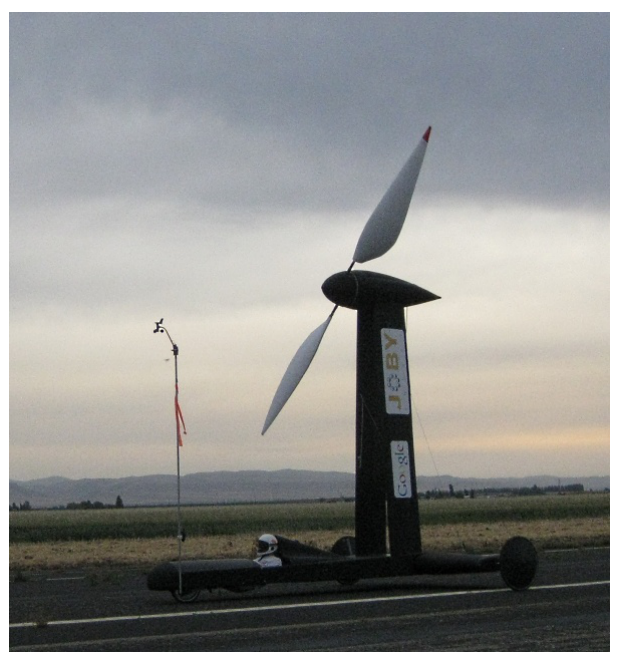
Shown below is the Blackbird, a vehicle built in 2009.
There is no source of stored energy such as a battery or gasoline engine; all of the power used to move the car comes from the wind. The only important mechanism in the car is a gearbox that can transfer power between the wheels and the propeller.
The Blackbird was driven both directly downwind and directly upwind, as shown below. In each case the car remained exactly parallel (or anti-parallel) to the wind without turning. The tests were conducted on level ground, in steady, uniform wind, and continued long enough to reach the steady state.
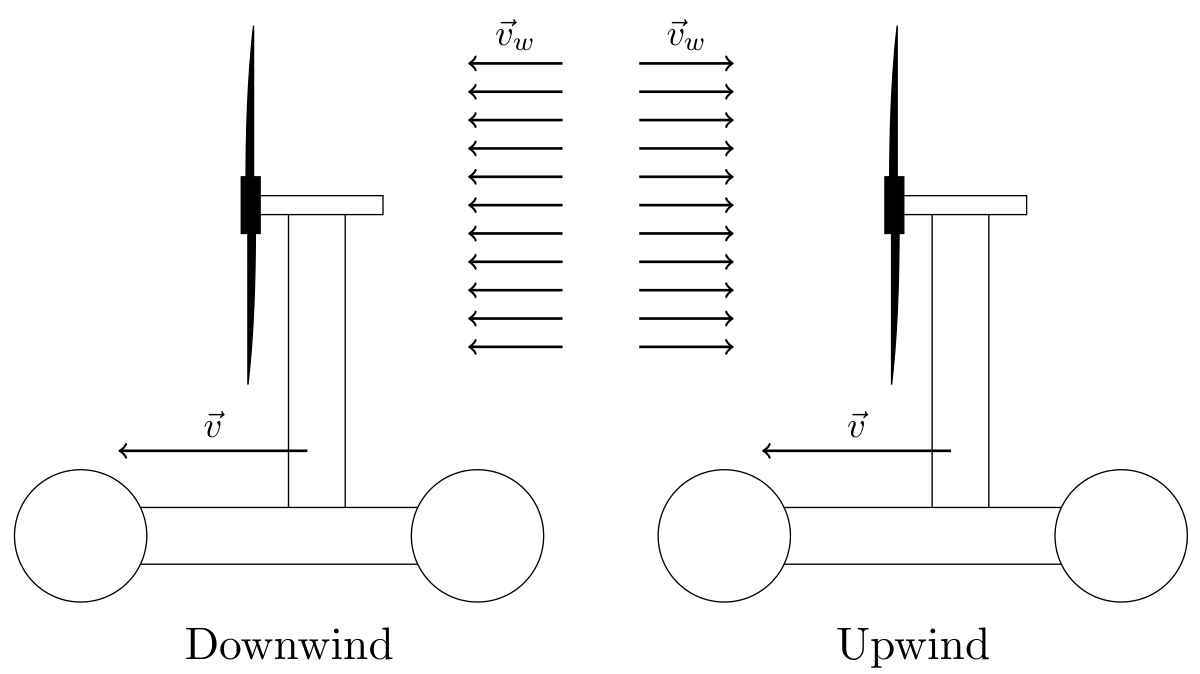
When driving downwind, the builders claim that they were able to drive “faster than the wind”: that is, with , so that the car experienced a relative headwind while traveling. Commenters on the Internet claimed, often angrily, that this was physically impossible and that the Blackbird was a hoax. Some commenters also claimed that the upwind case was physically impossible.
a. Consider first the downwind faster than the wind case.
- Is the motion actually possible as claimed? If not, offer a brief explanation!
- If the motion is possible, is power transferred from the propeller to the wheels or vice versa?
- If the motion is possible, what ground speed is attained? For this question, suppose that when transferring power in either direction between the propeller and the wheels, a fraction of the useful work is lost; let the wind speed be . Neglect all other losses of energy.
b. Answer the previous questions for the upwind case.
Отговори
a.
The motion is possible; power is transferred from the wheels to the propeller.
b.
The motion is possible; power is transferred from the propeller to the wheels.
Решение
Both modes are possible as claimed. The solution uses the idea of “center of mass (CoM) power”, which we will review below for interested readers; the solution itself starts on the next page. For simplicity, we will work in one dimension.
If a particle moves with speed and experiences a force , then the rate of change of its kinetic energy is
Suppose this force is exerted by an interaction with a second particle, which moves with speed . The rate of change of its kinetic energy is
by Newton’s third law, and the total is
where is the relative velocity. If we move into a different reference frame, both and change, but stays the same, as all frames agree on the relative velocity.
This is straightforward, but it becomes more subtle when applied to a system more complicated than a particle. The speed becomes the speed of the point of application of the force, while the power must be generalized to include internal energy. We will write the energy of a system as , where the “center of mass energy” is the kinetic energy associated with the motion of the CoM, and accounts for everything else, such as the rotational energy of a wheel or propeller.
As an example, consider an accelerating bicycle. The force that pushes the bicycle forward is the friction force with the ground. However, if the wheels are rolling without slipping, then at every moment, the relative velocity between the ground and the part of the wheel touching the ground is exactly zero. Thus the power is zero, so is constant. This is because the increase in is compensated by a decrease in the chemical energy of the cyclist, accounted for in . Thus energy arguments appear to tell us nothing useful about the motion of the bicycle. Similarly, energy arguments tell us nothing definite about the Blackbird’s wheels or propellers.
It is more useful here to use “center of mass power”. This concept is not covered in most textbooks, but interested readers can consult section 13.5 of Halliday, Resnick, and Krane, 5 edition. The idea behind CoM power is that the CoM of a system satisfies
where is the total force on the system. This is essentially the same equation as we would have for a single particle of mass , so by the same proof of the work-kinetic energy theory for particles,
The CoM power only contributes to the CoM energy. Crucially, it only depends on the velocity of the center of mass, not on any other details of the system.
Now consider two systems interacting by a force , whose centers of mass move at a relative velocity of . By the same argument as above, the net CoM power is
By conservation of energy, this change in CoM energy must be compensated by an opposite change in the internal energy.
Now we turn to the analysis of the downwind case. We take all velocities to be positive. In the steady state, the velocity of the Blackbird is constant, so the force on the propeller is balanced by a force on the wheels. For the system of the propellers and air, we have
By energy conservation, the internal energy of the propellers and air must change at the rate
Since we have assumed no extraneous energy losses, the internal energy of the air doesn’t increase at all, so this is just the change in the internal energy of the propeller. By similar reasoning, the internal energy of the wheels and ground must change at the rate
and again, since there are no extraneous energy losses, this is the rate of change of the internal energy of the wheels.
Now we determine the sign of . If the Blackbird moves downwind faster than the wind, , then and have opposite signs, with . Thus, the force should be positive, in the direction of the wind, so that is positive and is negative. That is, power is transferred from the wheels to the propeller. In general, power should always be produced by the force with the larger relative velocity.
In the steady state the total internal energy of the Blackbird is constant, so
With sufficiently low energy loss, any speed is possible.
The argument here is somewhat counterintuitive. A tempting (but incorrect) counterargument is that, since the internal energy of the Blackbird ultimately comes from a decrease in the center-of-mass energy of the air, which is slowed down by the propeller, the internal energy must always be supplied by the propeller. One way to see this argument doesn’t work is to note that in the reference frame where the air is still and the ground is moving, the same argument would suggest that internal energy must always be supplied by the wheels. The point is that changes of center-of-mass energy are completely different in different reference frames, as mentioned above. They cannot be used to determine the direction of flow of internal energy, which does not depend on the reference frame. In all frames, the force of the wind slows the rotation of the propeller, and hence power must be transferred from the wheels to the propeller.
We now consider the upwind case. We’ll keep all the sign conventions the same, except we’ll take be the leftward speed of the Blackbird. Then
Since , power is transferred from the propeller to the wheels, and we again have , i.e. in both cases the force on the propeller is in the direction of the wind, as expected. The energy balance equation is
Again, with sufficiently low energy loss, any speed is possible.
STOP: Do Not Continue to Part B
If there is still time remaining for Part A, you should review your work for Part A, but do not continue to Part B until instructed by your exam supervisor.
Оригинал в Архива: USAPhO-2013.pdf · официални решения: USAPhO-2013-Solutions.pdf