USAPhO 2015, Полуфинал — Задача 4. Question A4
USA Physics Olympiad Exam — Part A / Part B · 25 т.
Внимание: Бележка към темата
Original question and matching key disagree at A4: the question uses Tmax and X=C; repeated key statement uses400K and says X need not coincide with C, but actual worked key graph/argument still place C/X/Y together. Both native versions are explicitly retained. B1 question says three independent parts although only a/b exist; repeated key says two. Original mathematical/sign/symbol defects remain printed, with evidence notes.
Important Instructions for the Exam Supervisor — DO NOT DISTRIBUTE THIS PAGE
This examination consists of two parts.
Part A has four questions and is allowed 90 minutes.
Part B has two questions and is allowed 90 minutes.
The first page that follows is a cover sheet. Examinees may keep the cover sheet for both parts of the exam.
The parts are then identified by the center header on each page. Examinees are only allowed to do one part at a time, and may not work on other parts, even if they have time remaining.
Allow 90 minutes to complete Part A. Do not let students look at Part B. Collect the answers to Part A before allowing the examinee to begin Part B. Examinees are allowed a 10 to 15 minutes break between parts A and B.
Allow 90 minutes to complete Part B. Do not let students go back to Part A.
Ideally the test supervisor will divide the question paper into 4 parts: the cover sheet (page 2), Part A (pages 3-7), Part B (pages 9-11), and several answer sheets for one of the questions in Part A (pages 13-13). Examinees should be provided parts A and B individually, although they may keep the cover sheet. The answer sheets should be printed single sided!
The supervisor must collect all examination questions, including the cover sheet, at the end of the exam, as well as any scratch paper used by the examinees. Examinees may not take the exam questions. The examination questions may be returned to the students after April 15, 2015.
Examinees are allowed calculators, but they may not use symbolic math, programming, or graphic features of these calculators. Calculators may not be shared and their memory must be cleared of data and programs. Cell phones, PDA’s or cameras may not be used during the exam or while the exam papers are present. Examinees may not use any tables, books, or collections of formulas.
USA Physics Olympiad Exam — Instructions
DO NOT OPEN THIS TEST UNTIL YOU ARE TOLD TO BEGIN - Work Part A first. You have 90 minutes to complete all four problems. Each question is worth 25 points. Do not look at Part B during this time. - After you have completed Part A you may take a break. - Then work Part B. You have 90 minutes to complete both problems. Each question is worth 50 points. Do not look at Part A during this time. - Show all your work. Partial credit will be given. Do not write on the back of any page. Do not write anything that you wish graded on the question sheets. - Start each question on a new sheet of paper. Put your AAPT ID number, your name, the question number and the page number/total pages for this problem, in the upper right hand corner of each page. For example,
AAPT ID # Doe, Jamie A1 - 1/3
- A hand-held calculator may be used. Its memory must be cleared of data and programs. You may use only the basic functions found on a simple scientific calculator. Calculators may not be shared. Cell phones, PDA’s or cameras may not be used during the exam or while the exam papers are present. You may not use any tables, books, or collections of formulas. - Questions with the same point value are not necessarily of the same difficulty. - In order to maintain exam security, do not communicate any information about the questions (or their answers/solutions) on this contest until after April 15, 2015.
Possibly Useful Information. You may use this sheet for both parts of the exam.
| Information | Value |
|---|---|
| for | |
| for | |
| for |
Условие
A heat engine consists of a moveable piston in a vertical cylinder. The piston is held in place by a removable weight placed on top of the piston, but piston stops prevent the piston from sinking below a certain point. The mass of the piston is , the cross sectional area of the piston is , and the weight placed on the piston has a mass of .
Assume that the region around the cylinder and piston is a vacuum, so you don't need to worry about external atmospheric pressure.
- At point A the cylinder volume is completely filled with liquid water at a temperature and a pressure that would be just sufficient to lift the piston alone, except the piston has the additional weight placed on top.
- Heat energy is added to the water by placing the entire cylinder in a hot bath.
- At point B the piston and weight begins to rise.
- At point C the volume of the cylinder reaches and the temperature reaches . The heat source is removed; the piston stops rising and is locked in place.
- Heat energy is now removed from the water by placing the entire cylinder in a cold bath.
- At point D the pressure in the cylinder returns to . The added weight is removed; the piston is unlocked and begins to move down.
- The cylinder volume returns to . The cylinder is removed from the cold bath, the weight is placed back on top of the piston, and the cycle repeats.
Because the liquid water can change to gas, there are several important events that take place
- At point W the liquid begins changing to gas.
- At point X all of the liquid has changed to gas. This occurs at the same point as point C described above.
- At point Y the gas begins to change back into liquid.
- At point Z all of the gas has changed back into liquid.
When in the liquid state you need to know that for water kept at constant volume, a change in temperature is related to a change in pressure according to
When in the gas state you should assume that water behaves like an ideal gas.
Of relevance to this question is the pressure/temperature phase plot for water, showing the regions where water exists in liquid form or gaseous form. The curve shows the coexistence condition, where water can exist simultaneously as gas or liquid.
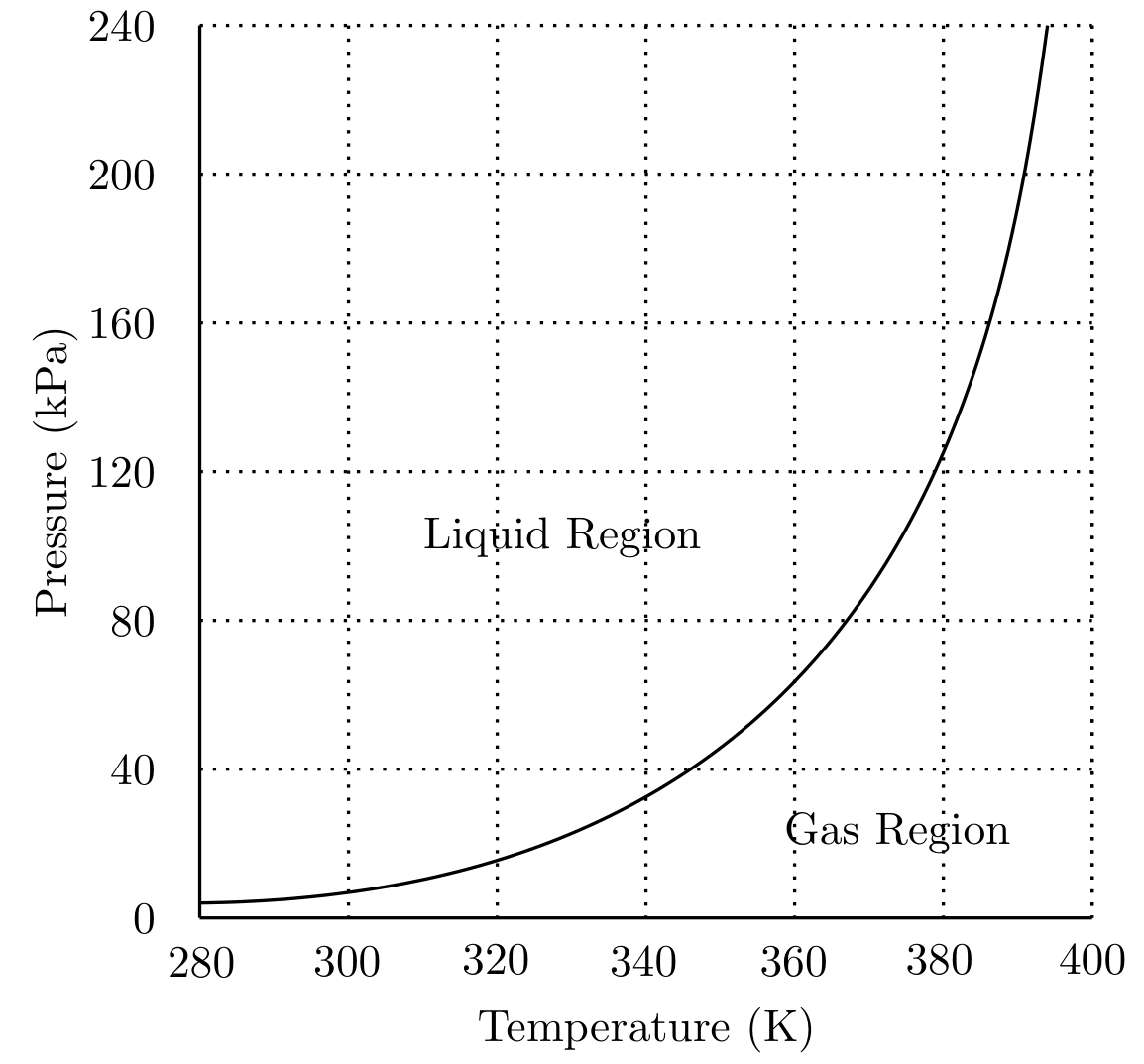
The following graphs should be drawn on the answer sheet provided.
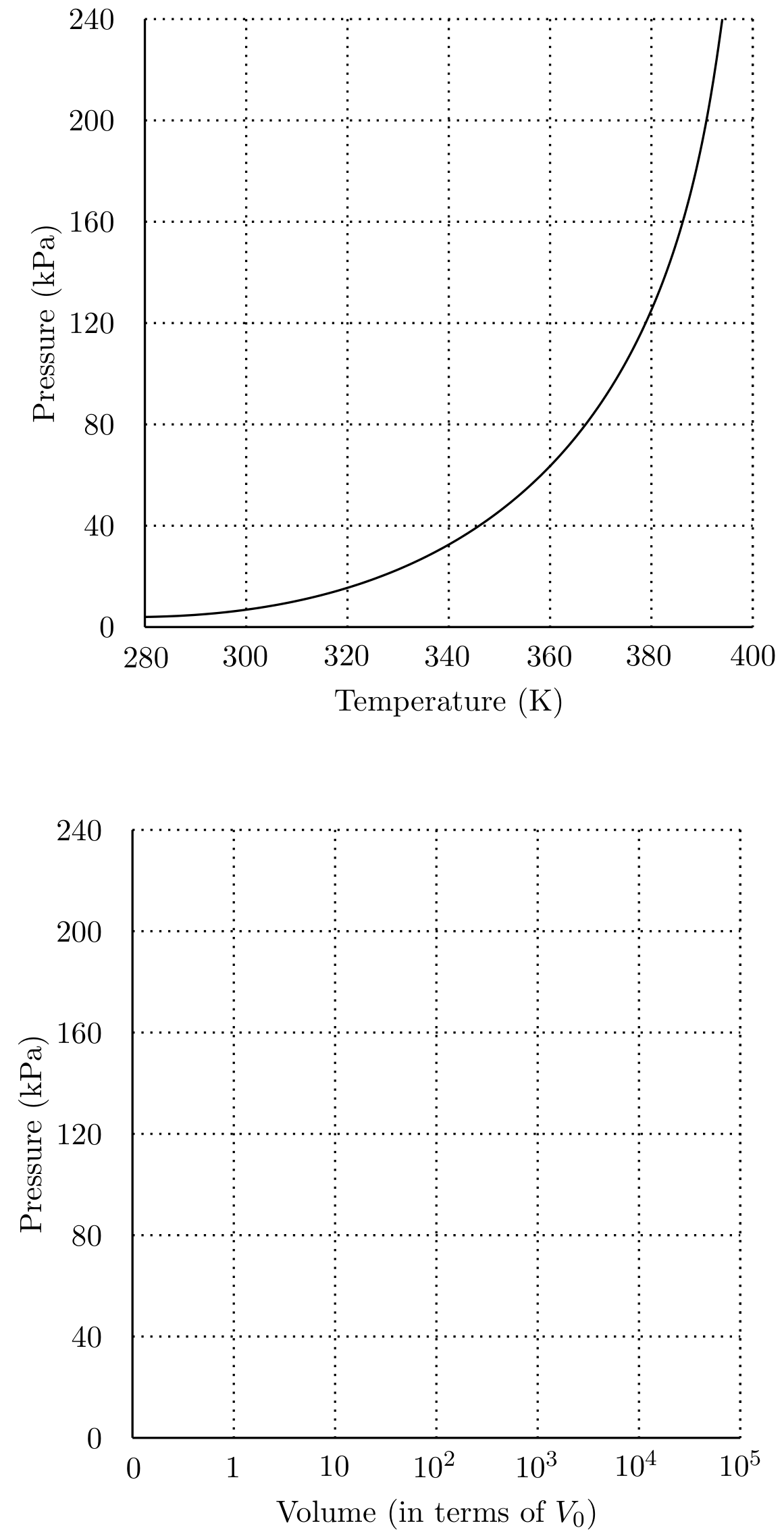
a. Sketch a PT diagram for this cycle on the answer sheet. The coexistence curve for the liquid/gas state is shown. Clearly and accurately label the locations of points B through D and W through Z on this cycle.
b. Sketch a PV diagram for this cycle on the answer sheet. You should estimate a reasonable value for , note the scale is logarithmic. Clearly and accurately label the locations of points B through D on this cycle. Provide reasonable approximate locations for points W through Z on this cycle.
Answer Sheets
Following are answer sheets for some of the graphical portions of the test.
STOP: Do Not Continue to Part B
If there is still time remaining for Part A, you should review your work for Part A, but do not continue to Part B until instructed by your exam supervisor.
Решение
Source variant note. The repeated question in this matching key differs from the original question booklet in two clauses:
At point C the volume of the cylinder reaches and the temperature reaches 400 K. The heat source is removed; the piston stops rising and is locked in place.
At point X all of the liquid has changed to gas. This may not occur the same as point C described above.
The original question above retains its own and wording. The printed worked key below is retained as supplied; its graphs and explanation still put C, X and Y together on the coexistence curve.
Solution
Before we get started solving the problem, let's say a bit about where the data in the problem comes from. We are using the Magnus form to approximate the coexistence curve,
where is measured in centigrade. This is closely related to the result that can be derived from the Clausius-Clapeyron equation for ideal gases,
where we assume the temperature is low compared to the critical temperature and the latent heat is a constant.
To get , we used the cyclic chain rule
where subscripts indicate what is being held constant. Dropping those for convenience,
The specific value is not important; the point is that a very small change in the temperature of the liquid in a fixed volume will result in a very large change in the pressure.
a., b.
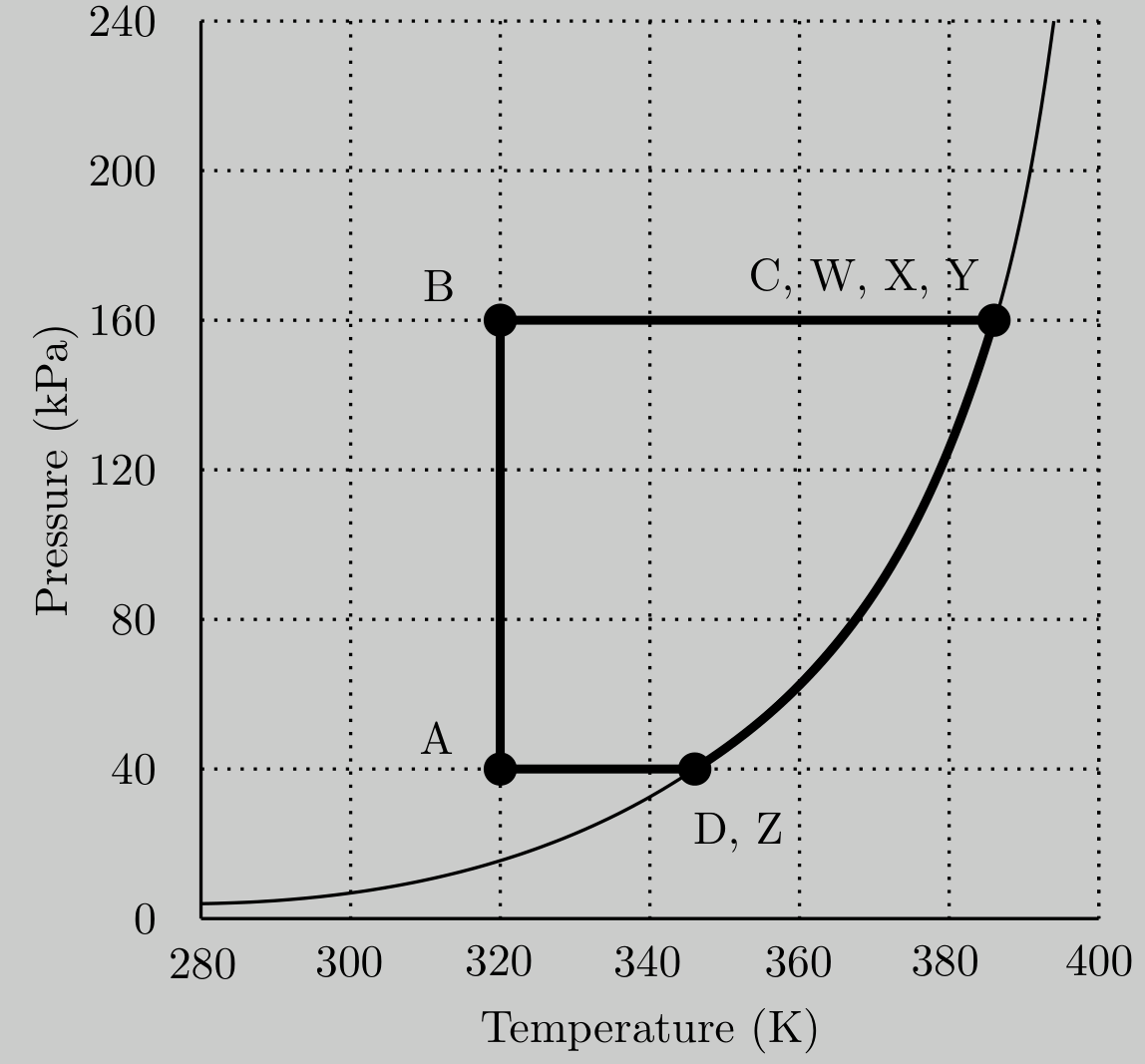
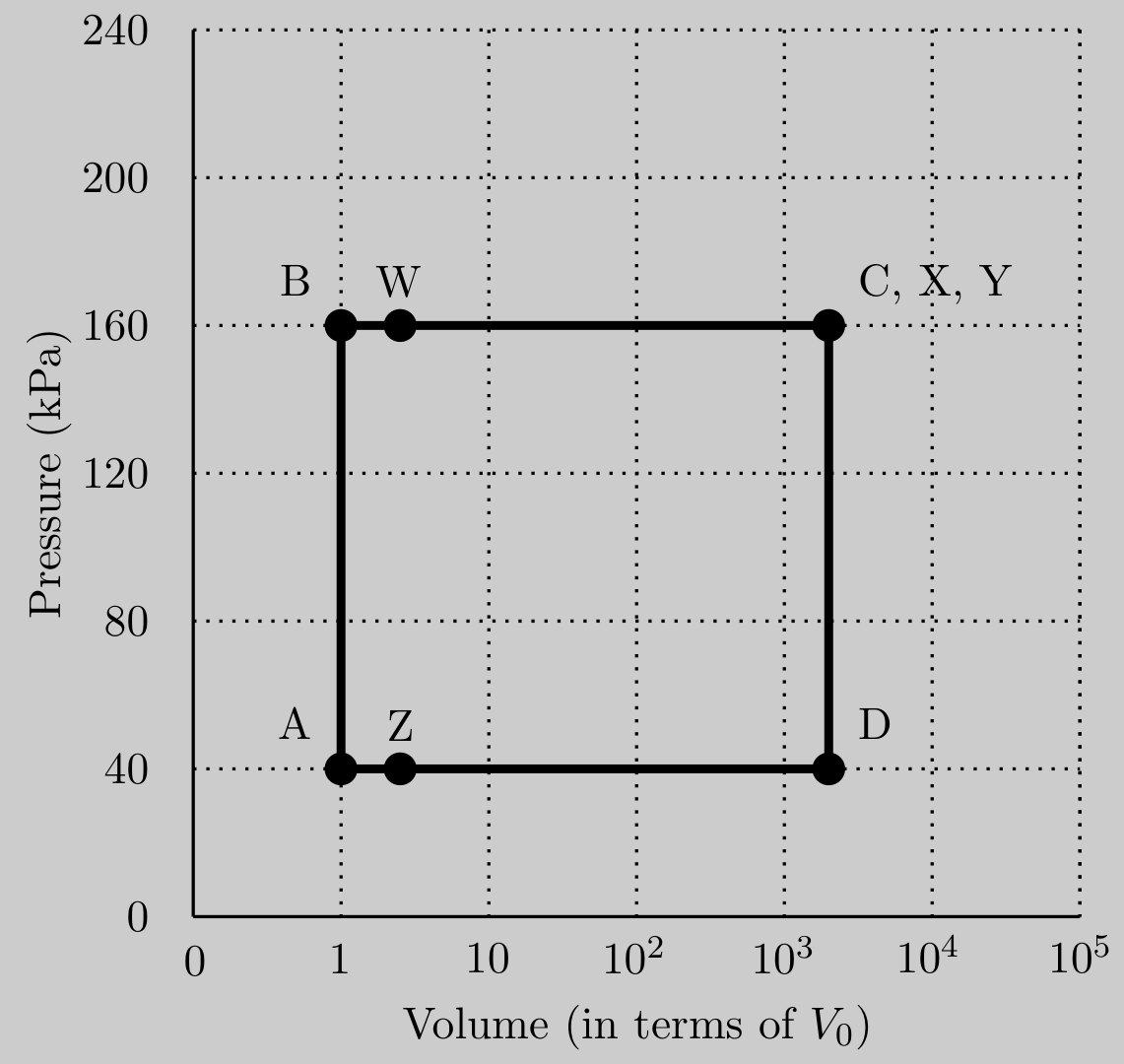
The correct graphs are shown below.
We start by computing pressures. The minimum pressure is attained when only the piston is to be lifted, so
The maximum pressure is attained when lifting the piston with extra weight,
Point A is clearly at on the PT graph.
For liquid water a small temperature increase results in a large pressure increase, so point B is effectively at the same temperature as point A. Process is therefore essentially isothermal, and it is also a constant volume process.
Afterwards, the pressure is sufficient to lift the piston and weight, so the volume expands at constant pressure for the process . However, liquid cannot change to gas until we reach the coexistence curve. This defines the location of point W. On the PT graph we are “stuck” on the coexistence curve until all the liquid has changed into gas, so X and C are also at the same point.
Upon reaching C the piston is locked in place, fixing the volume, and the cylinder is allowed to cool. To figure out what happens, suppose water vapor obeyed the ideal gas law . For a constant volume process, , so the path would be a straight line towards the origin of the PT diagram. This isn't what happens here, because we run into the coexistence curve, and the pressure is decreased by some of the gas condensing to liquid. Thus during the entire process, we follow the coexistence curve downward; it is impossible to cross it until all of the vapor condenses.
The next process is constant volume, but not isothermal. On the PT graph we follow the coexistence curve to the minimum pressure, at which time the piston is freed and allowed to lower at constant pressure. Since Z is the point where all of the gas has changed to liquid, it must be on the coexistence curve. On the PV diagram it is just to the right of point A.
There are a few numbers needed on the PV diagram that are not given in the problem. You should know from everyday experience that liquid water will only expand slightly when heated over this temperature range, so point W must be very close to B on the PV diagram. You might also know that the density of liquid water is about 2,000 times the density of water vapor in these conditions. In terms of grading policy, the points C, X, Y, and D may have volumes in the range on the PV diagram for full credit, while points W and Z may have volumes in the range for full credit and for partial credit.
Оригинал в Архива: USAPhO-2015.pdf · официални решения: USAPhO-2015-Solutions.pdf