USAPhO 2015, Полуфинал — Задача 6. Question B2
USA Physics Olympiad Exam — Part A / Part B · 50 т.
Внимание: Бележка към темата
Original question and matching key disagree at A4: the question uses Tmax and X=C; repeated key statement uses400K and says X need not coincide with C, but actual worked key graph/argument still place C/X/Y together. Both native versions are explicitly retained. B1 question says three independent parts although only a/b exist; repeated key says two. Original mathematical/sign/symbol defects remain printed, with evidence notes.
Important Instructions for the Exam Supervisor — DO NOT DISTRIBUTE THIS PAGE
This examination consists of two parts.
Part A has four questions and is allowed 90 minutes.
Part B has two questions and is allowed 90 minutes.
The first page that follows is a cover sheet. Examinees may keep the cover sheet for both parts of the exam.
The parts are then identified by the center header on each page. Examinees are only allowed to do one part at a time, and may not work on other parts, even if they have time remaining.
Allow 90 minutes to complete Part A. Do not let students look at Part B. Collect the answers to Part A before allowing the examinee to begin Part B. Examinees are allowed a 10 to 15 minutes break between parts A and B.
Allow 90 minutes to complete Part B. Do not let students go back to Part A.
Ideally the test supervisor will divide the question paper into 4 parts: the cover sheet (page 2), Part A (pages 3-7), Part B (pages 9-11), and several answer sheets for one of the questions in Part A (pages 13-13). Examinees should be provided parts A and B individually, although they may keep the cover sheet. The answer sheets should be printed single sided!
The supervisor must collect all examination questions, including the cover sheet, at the end of the exam, as well as any scratch paper used by the examinees. Examinees may not take the exam questions. The examination questions may be returned to the students after April 15, 2015.
Examinees are allowed calculators, but they may not use symbolic math, programming, or graphic features of these calculators. Calculators may not be shared and their memory must be cleared of data and programs. Cell phones, PDA’s or cameras may not be used during the exam or while the exam papers are present. Examinees may not use any tables, books, or collections of formulas.
USA Physics Olympiad Exam — Instructions
DO NOT OPEN THIS TEST UNTIL YOU ARE TOLD TO BEGIN - Work Part A first. You have 90 minutes to complete all four problems. Each question is worth 25 points. Do not look at Part B during this time. - After you have completed Part A you may take a break. - Then work Part B. You have 90 minutes to complete both problems. Each question is worth 50 points. Do not look at Part A during this time. - Show all your work. Partial credit will be given. Do not write on the back of any page. Do not write anything that you wish graded on the question sheets. - Start each question on a new sheet of paper. Put your AAPT ID number, your name, the question number and the page number/total pages for this problem, in the upper right hand corner of each page. For example,
AAPT ID # Doe, Jamie A1 - 1/3
- A hand-held calculator may be used. Its memory must be cleared of data and programs. You may use only the basic functions found on a simple scientific calculator. Calculators may not be shared. Cell phones, PDA’s or cameras may not be used during the exam or while the exam papers are present. You may not use any tables, books, or collections of formulas. - Questions with the same point value are not necessarily of the same difficulty. - In order to maintain exam security, do not communicate any information about the questions (or their answers/solutions) on this contest until after April 15, 2015.
Possibly Useful Information. You may use this sheet for both parts of the exam.
| Information | Value |
|---|---|
| for | |
| for | |
| for |
Условие
The nature of magnetic dipoles.
a.
A “Gilbert” dipole consists of a pair of magnetic monopoles each with a magnitude but opposite magnetic charges separated by a distance , where is small. In this case, assume that is located at and is located at .
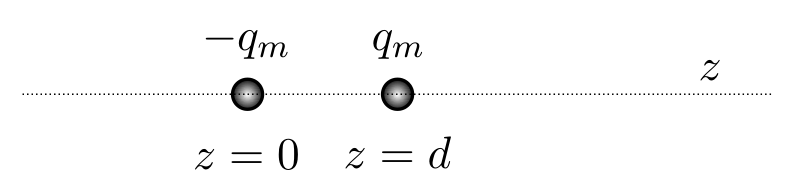
Assume that magnetic monopoles behave like electric monopoles according to a coulomb-like force
and the magnetic field obeys
i. What are the dimensions of the quantity ?
ii. Write an exact expression for the magnetic field strength along the axis as a function of for . Write your answer in terms of , , , and any necessary fundamental constants.
iii. Evaluate this expression in the limit as , assuming that the product is kept constant, keeping only the lowest non-zero term. Write your answer in terms of , , and any necessary fundamental constants.
b.
An “Ampère” dipole is a magnetic dipole produced by a current loop around a circle of radius , where is small. Assume the that the axis is the axis of rotational symmetry for the circular loop, and the loop lies in the plane at .
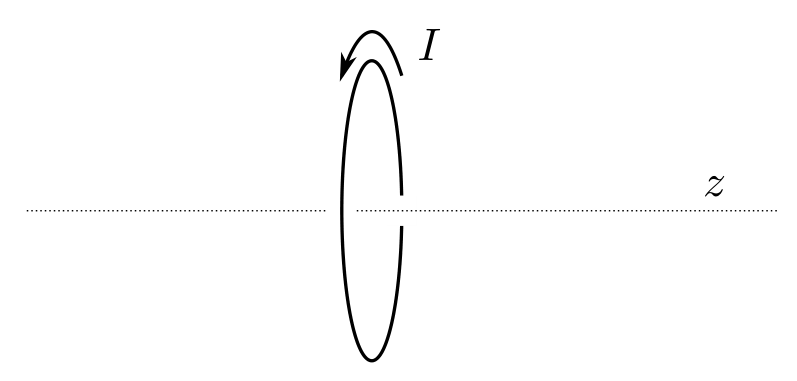
i. Write an exact expression for the magnetic field strength along the axis as a function of for . Write your answer in terms of , , , and any necessary fundamental constants.
ii. Let have dimensions equal to that of the quantity defined above in Part aiii, where and are dimensionless constants. Determine the value of .
iii. Evaluate the expression in Part bi in the limit as , assuming that the product is kept constant, keeping only the lowest non-zero term. Write your answer in terms of , , , and any necessary fundamental constants.
iv. Assuming that the two approaches are equivalent, . Determine the constant in Part bii.
c.
Now we try to compare the two approaches if we model a physical magnet as being composed of densely packed microscopic dipoles.
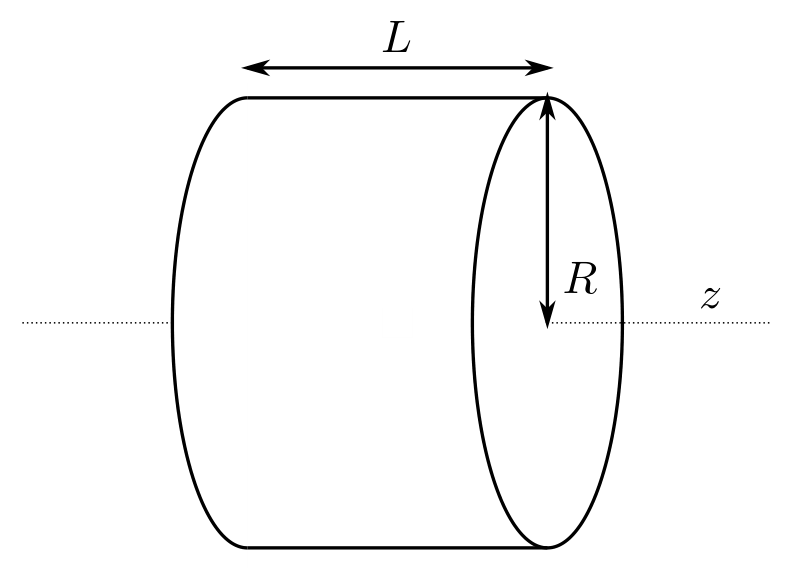
A cylinder of this uniform magnetic material has a radius and a length . It is composed of magnetic dipoles that could be either all Ampère type or all Gilbert type. is a very large number. The axis of rotation of the cylinder and all of the dipoles are all aligned with the axis and all point in the same direction as defined above so that the magnetic field outside the cylinder is the same in either dipole case as you previously determined. Below is a picture of the two dipole models; they are cubes of side and with volume .
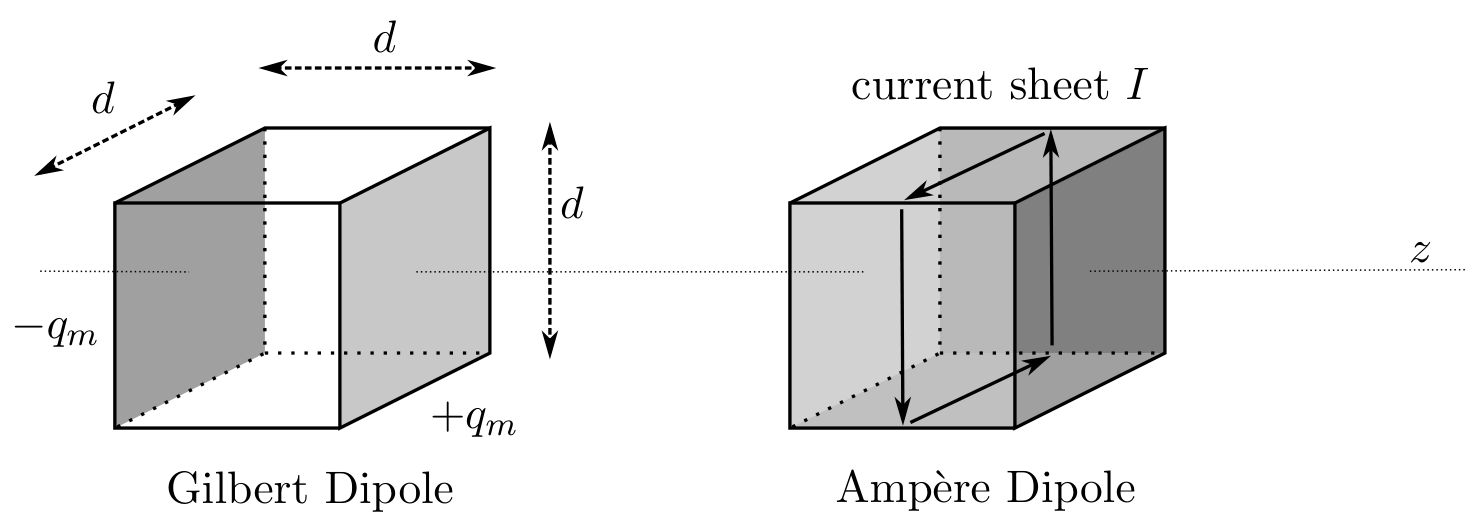
i. Assume that and only Gilbert type dipoles, determine the magnitude and direction of at the center of the cylinder in terms of any or all of , , , , and any necessary fundamental constants.
ii. Assume that and only Ampère type dipoles, determine the magnitude and direction of at the center of the cylinder in terms of any or all of , , , , and any necessary fundamental constants.
Решение
a. i.
By the second expression, must be measured in Newtons per Tesla. But since Tesla are also Newtons per Ampere per meter, then is also measured in Ampere meters.
a. ii.
Adding the two terms,
a. iii.
Simplifying our previous expression,
Thus in the limit we have
b. i.
Applying the Biot-Savart law, with the vector from the point on the loop to the point on the axis,
where is the angle between the point on the loop and the center of the loop as measured by the point on the axis, so
Then we have
b. ii.
We know must have dimensions of Amperes times meters squared, so .
b. iii.
Using our previous result,
b. iv.
By inspection, .
c. i.
The monopoles that make up the dipoles cancel out except on the flat surfaces. Then the cylinder acts like a parallel plate capacitor.
If the size of a dipole is , then the surface density of monopole charge is
Using the analogy with a parallel place capacitor, the magnitude of is
and the direction is to the left.
c. ii.
The currents that make up the dipoles all cancel out except on the cylindrical surfaces. Then the cylinder acts like a solenoid, with
where is the surface current density. The magnitude of is
and the direction is to the right.
Оригинал в Архива: USAPhO-2015.pdf · официални решения: USAPhO-2015-Solutions.pdf