USAPhO 2016, Полуфинал — Задача 3. Question A3
USA Physics Olympiad Exam — Part A / Part B · 25 т.
Внимание: Бележка към темата
The native worked key contains printed mathematical inconsistencies at A1(b), B1 and B2(a)(iii)/(c)(ii); the source formulas and adjacent reasoning are retained as printed. The A3 key graphs omit the requested event-letter labels and do not draw the stopped-rod world-line changes; no new answer labels or lines have been invented. Exact originals and detailed source-defect evidence accompany this transcription.
Important Instructions for the Exam Supervisor — DO NOT DISTRIBUTE THIS PAGE
This examination consists of two parts: Part A has four questions and is allowed 90 minutes; Part B has two questions and is allowed 90 minutes.
The first page that follows is a cover sheet. Examinees may keep the cover sheet for both parts of the exam.
The parts are then identified by the center header on each page. Examinees are only allowed to do one part at a time, and may not work on other parts, even if they have time remaining.
Allow 90 minutes to complete Part A. Do not let students look at Part B. Collect the answers to Part A before allowing the examinee to begin Part B. Examinees are allowed a 10 to 15 minutes break between parts A and B.
Allow 90 minutes to complete Part B. Do not let students go back to Part A.
Ideally the test supervisor will divide the question paper into 4 parts: the cover sheet (page 2), Part A (pages 3-6), Part B (pages 8-9), and several answer sheets for one of the questions in Part A (pages 11-12). Examinees should be provided parts A and B individually, although they may keep the cover sheet. The answer sheets should be printed single sided!
The supervisor must collect all examination questions, including the cover sheet, at the end of the exam, as well as any scratch paper used by the examinees. Examinees may not take the exam questions. The examination questions may be returned to the students after April 15, 2016.
Examinees are allowed calculators, but they may not use symbolic math, programming, or graphic features of these calculators. Calculators may not be shared and their memory must be cleared of data and programs. Cell phones, PDA’s or cameras may not be used during the exam or while the exam papers are present. Examinees may not use any tables, books, or collections of formulas.
USA Physics Olympiad Exam — Instructions
DO NOT OPEN THIS TEST UNTIL YOU ARE TOLD TO BEGIN - Work Part A first. You have 90 minutes to complete all four problems. Each question is worth 25 points. Do not look at Part B during this time. - After you have completed Part A you may take a break. - Then work Part B. You have 90 minutes to complete both problems. Each question is worth 50 points. Do not look at Part A during this time. - Show all your work. Partial credit will be given. Do not write on the back of any page. Do not write anything that you wish graded on the question sheets. - Start each question on a new sheet of paper. Put your AAPT ID number, your name, the question number and the page number/total pages for this problem, in the upper right hand corner of each page. For example,
AAPT ID # Doe, Jamie A1 - 1/3
- A hand-held calculator may be used. Its memory must be cleared of data and programs. You may use only the basic functions found on a simple scientific calculator. Calculators may not be shared. Cell phones, PDA’s or cameras may not be used during the exam or while the exam papers are present. You may not use any tables, books, or collections of formulas. - Questions with the same point value are not necessarily of the same difficulty. - In order to maintain exam security, do not communicate any information about the questions (or their answers/solutions) on this contest until after April 15, 2016.
Possibly Useful Information. You may use this sheet for both parts of the exam.
| Information | Value |
|---|---|
| for | |
| for | |
| for |
Условие
Throughout this problem the inertial rest frame of the rod will be referred to as the rod's frame, while the inertial frame of the cylinder will be referred to as the cylinder's frame.
A rod is traveling at a constant speed of to the right relative to a hollow cylinder. The rod passes through the cylinder, and then out the other side. The left end of the rod aligns with the left end of the cylinder at time and in the cylinder's frame and time and in the rod's frame.
The left end of the rod aligns with the left end of the cylinder at the same time as the right end of the rod aligns with the right end of the cylinder in the cylinder's frame; in this reference frame the length of the cylinder is .
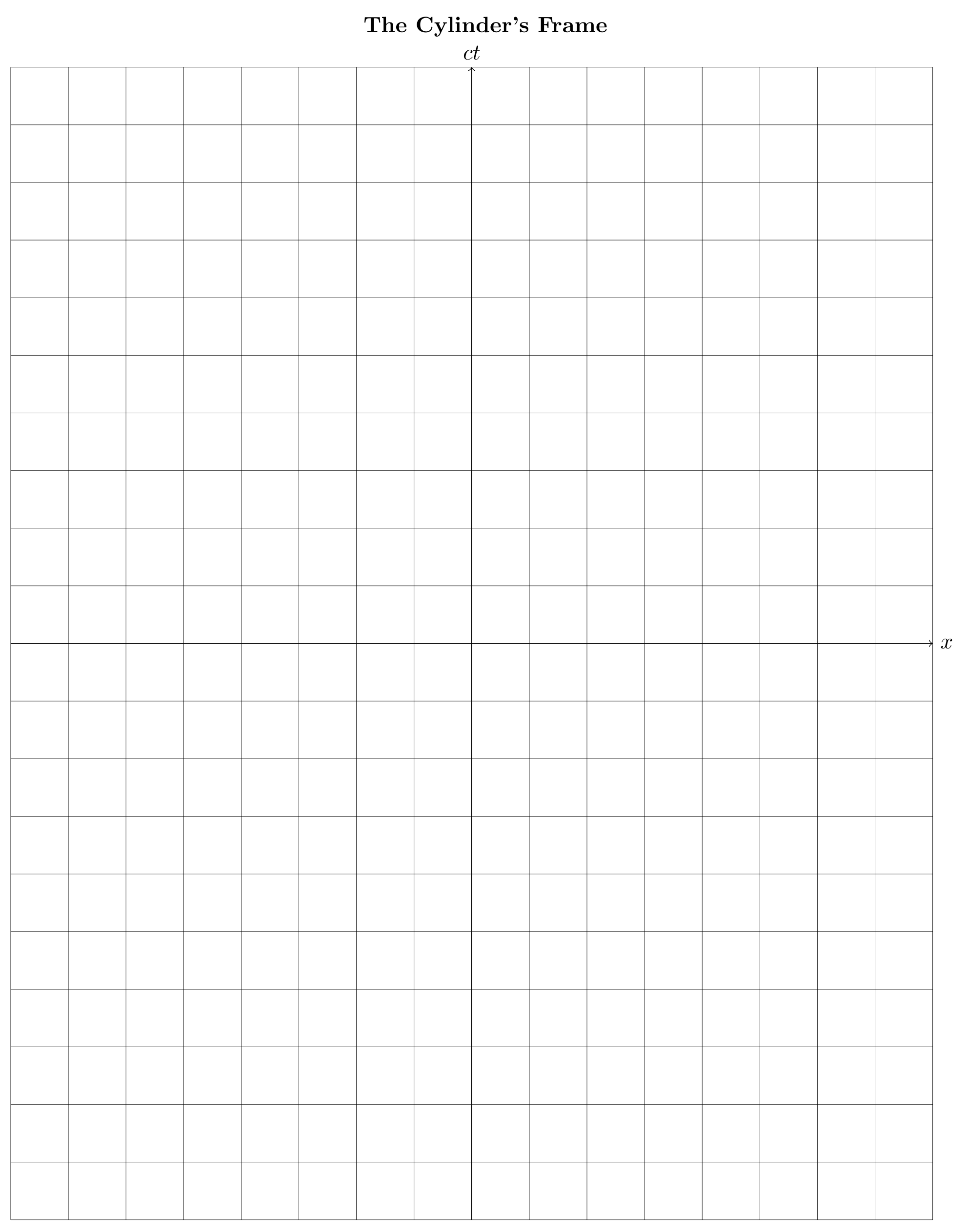
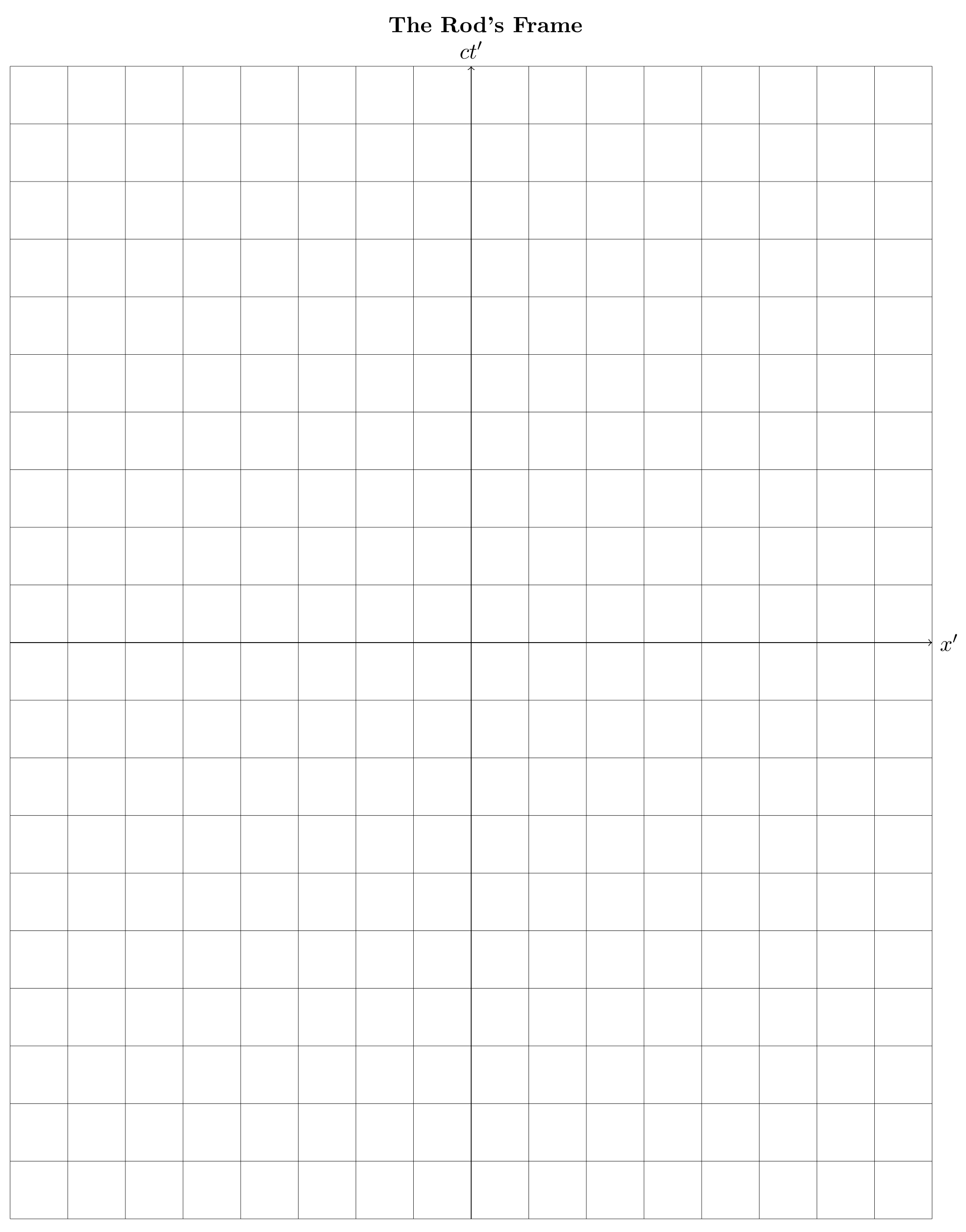
For the following, sketch accurate, scale diagrams of the motions of the ends of the rod and the cylinder on the graphs provided. The horizontal axis corresponds to , the vertical axis corresponds to , where is the speed of light. Both the vertical and horizontal gridlines have meter spacing.
a.
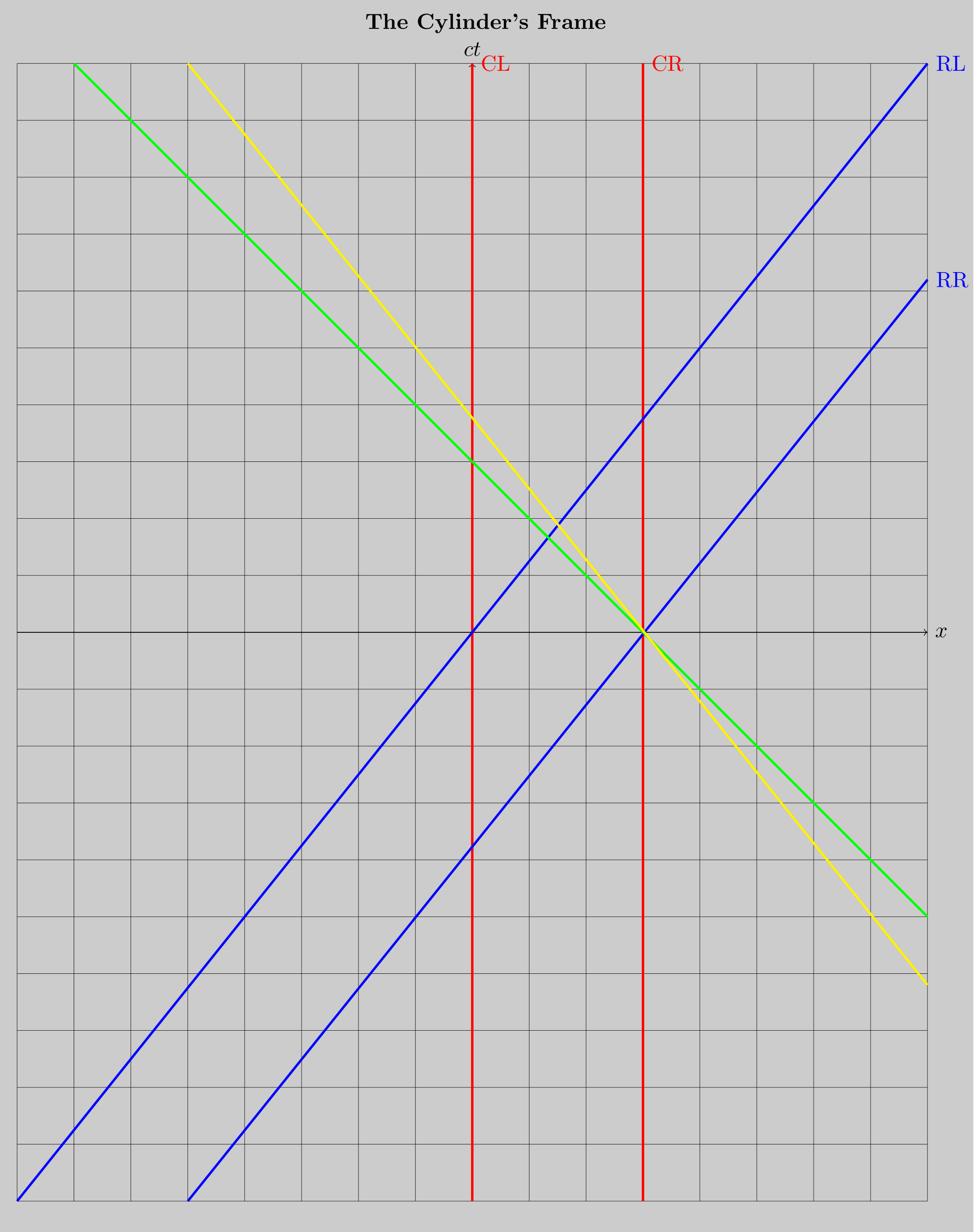
Sketch the world lines of the left end of the rod (RL), left end of the cylinder (CL), right end of the rod (RR), and right end of the cylinder (CR) in the cylinder's frame.
b.
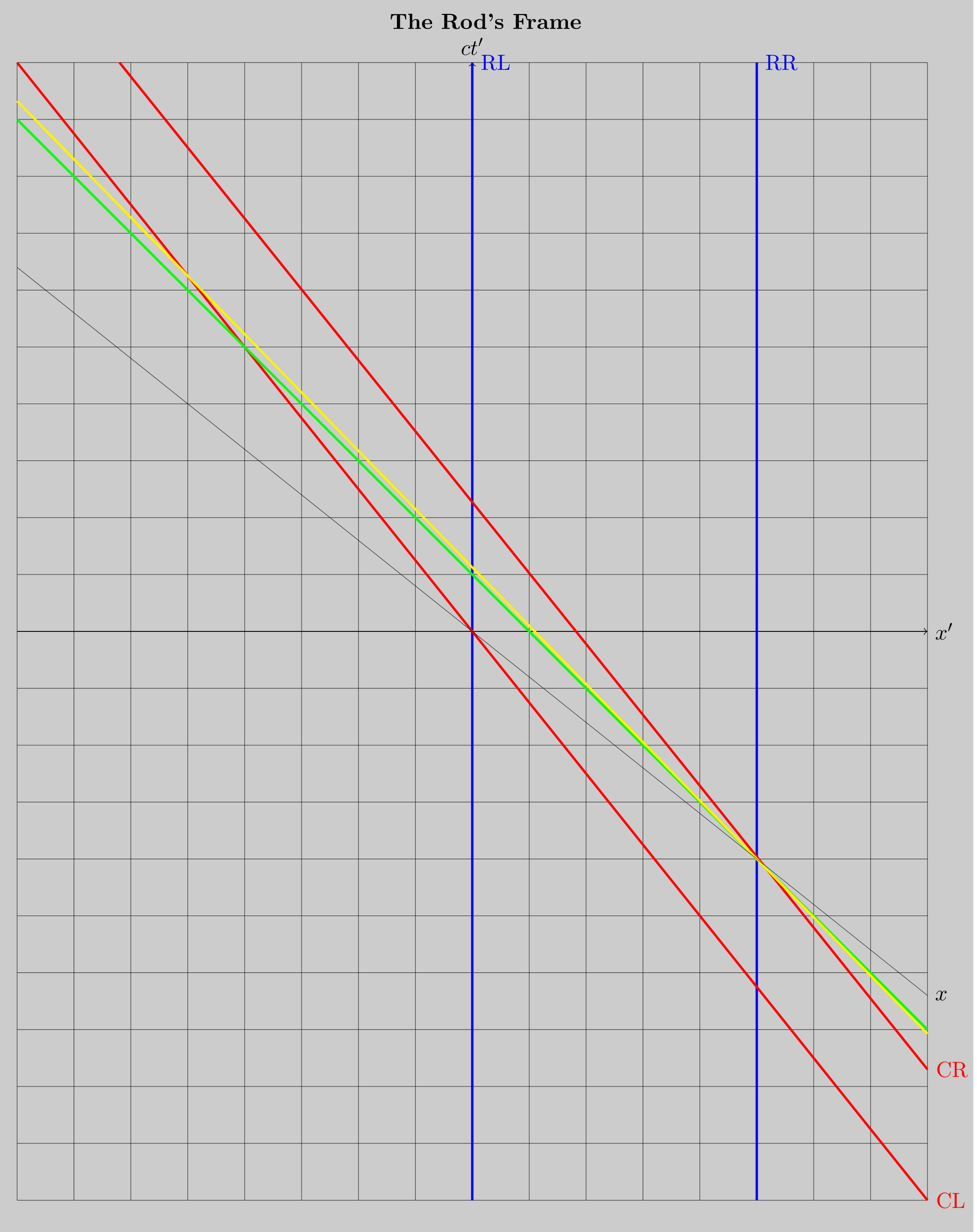
Do the same in the rod's frame.
c.
On both diagrams clearly indicate the following four events by the letters A, B, C, and D.
- A: The left end of the rod is at the same point as the left end of the cylinder
- B: The right end of the rod is at the same point as the right end of the cylinder
- C: The left end of the rod is at the same point as the right end of the cylinder
- D: The right end of the rod is at the same point as the left end of the cylinder
d.
At event B a small particle P is emitted that travels to the left at a constant speed in the cylinder's frame.
i. Sketch the world line of P in the cylinder's frame.
ii. Sketch the world line of P in the rod's frame.
e.
Now consider the following in the cylinder's frame. The right end of the rod stops instantaneously at event B and emits a flash of light, and the left end of the rod stops instantaneously when the light reaches it. Determine the final length of the rod after it has stopped. You can assume the rod compresses uniformly with no other deformation.
Any computation that you do must be shown on a separate sheet of paper, and not on the graphs. Graphical work that does not have supporting computation might not receive full credit.
Answer Sheets
Following are answer sheets for some of the graphical portions of the test.
Решение
The graphs are shown below, where the yellow line is the particle P and the green line is the flash of light. Solutions that used Galilean relativity received partial credit, as long as they were self-consistent. The final length of the rod is simply the distance between the line CR and the intersection of RL and the green line, i.e. . There's no need to apply length contraction, as we're already in the rest frame of the rod at this point. Nonetheless, the way we have chosen to stop the rod has squeezed it shorter.
Оригинал в Архива: USAPhO-2016.pdf · официални решения: USAPhO-2016-Solutions.pdf