USAPhO 2017, Полуфинал — Задача 1. Question A1
USA Physics Olympiad Exam — Part A / Part B · 25 т.
Внимание: Бележка към темата
The source gives different exam-security dates on its supervisor and student pages. Printed key inconsistencies at A1, A4(b), B1(c) and B2(f)/(g) are retained with their native wording and mathematics; no silent corrected formula is substituted. Exact original PDFs and detailed source-defect evidence accompany this transcription.
Important Instructions for the Exam Supervisor — DO NOT DISTRIBUTE THIS PAGE
This examination consists of two parts: Part A has four questions and is allowed 90 minutes; Part B has two questions and is allowed 90 minutes.
The first page that follows is a cover sheet. Examinees may keep the cover sheet for both parts of the exam.
The parts are then identified by the center header on each page. Examinees are only allowed to do one part at a time, and may not work on other parts, even if they have time remaining.
Allow 90 minutes to complete Part A. Do not let students look at Part B. Collect the answers to Part A before allowing the examinee to begin Part B. Examinees are allowed a 10 to 15 minutes break between parts A and B.
Allow 90 minutes to complete Part B. Do not let students go back to Part A.
Ideally the test supervisor will divide the question paper into 3 parts: the cover sheet (page 2), Part A (pages 3-6), Part B (pages 8-10). Examinees should be provided parts A and B individually, although they may keep the cover sheet. The answer sheets should be printed single sided!
The supervisor must collect all examination questions, including the cover sheet, at the end of the exam, as well as any scratch paper used by the examinees. Examinees may not take the exam questions. The examination questions may be returned to the students after April 15, 2017.
Examinees are allowed calculators, but they may not use symbolic math, programming, or graphic features of these calculators. Calculators may not be shared and their memory must be cleared of data and programs. Cell phones, PDA’s or cameras may not be used during the exam or while the exam papers are present. Examinees may not use any tables, books, or collections of formulas.
Copyright ©2017 American Association of Physics Teachers.
USA Physics Olympiad Exam — Instructions
DO NOT OPEN THIS TEST UNTIL YOU ARE TOLD TO BEGIN - Work Part A first. You have 90 minutes to complete all four problems. Each question is worth 25 points. Do not look at Part B during this time. - After you have completed Part A you may take a break. - Then work Part B. You have 90 minutes to complete both problems. Each question is worth 50 points. Do not look at Part A during this time. - Show all your work. Partial credit will be given. Do not write on the back of any page. Do not write anything that you wish graded on the question sheets. - Start each question on a new sheet of paper. Put your proctor’s AAPT ID, your AAPT ID, your name, the question number and the page number/total pages for this problem, in the upper right hand corner of each page. For example, Doe, Jamie student AAPT ID # proctor AAPT ID # A1 - 1/3 - A hand-held calculator may be used. Its memory must be cleared of data and programs. You may use only the basic functions found on a simple scientific calculator. Calculators may not be shared. Cell phones, PDA’s or cameras may not be used during the exam or while the exam papers are present. You may not use any tables, books, or collections of formulas. - Questions with the same point value are not necessarily of the same difficulty. - In order to maintain exam security, do not communicate any information about the questions (or their answers/solutions) on this contest until after April 8, 2017.
Possibly Useful Information. You may use this sheet for both parts of the exam.
| for | |
| for | |
| for | |
| for |
Important Instructions for the Exam Supervisor — DO NOT DISTRIBUTE THIS PAGE
Ideally the test supervisor will divide the question paper into 3 parts: the cover sheet (page 2), Part A (pages 3-13), Part B (pages 15-23). Examinees should be provided parts A and B individually, although they may keep the cover sheet. The answer sheets should be printed single sided!
Условие
Part A
A pair of wedges are located on a horizontal surface. The coefficient of friction (both sliding and static) between the wedges is , the coefficient of friction between the bottom wedge B and the horizontal surface is , and the angle of the wedge is . The mass of the top wedge A is , and the mass of the bottom wedge B is . A horizontal force directed to the left is applied to the bottom wedge as shown in the figure.
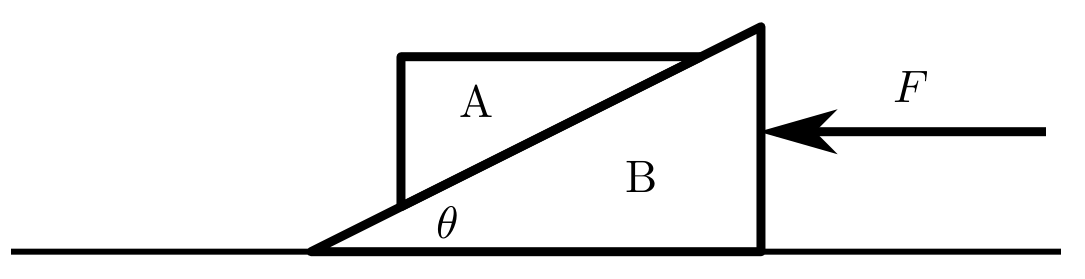
Determine the range of values for so that the the top wedge does not slip on the bottom wedge. Express your answer(s) in terms of any or all of , , , and .
Решение
Solution 1.
Assume the block does not slip. Considering the horizontal forces on the entire system gives
When is small, the top wedge wants to slide downward, so static friction points up the ramp. Considering the horizontal and vertical forces on the block gives
When the minimal force is applied, the friction is maximal, . Eliminating gives
and plugging in our first equation gives
When is large, the top wedge wants to slide upward, so static friction points down the ramp, and
Now setting gives
Therefore, naively the range of forces so that the block will not slip is
However, to get full credit, students must account for two edge cases. First, when , no force is required at all to keep the block in place, so the minimum force is zero. Second, when , the block will not slip up under any circumstances, so there is no maximal force.
Solution 2.
The problem can also be solved geometrically. In general, the no slip condition is
where is the angle between the vertical and the normal to the plane. Working in the noninertial reference frame of the plane, the fictitious force due to the acceleration is equivalent to a tilting of the gravity vector by an angle
where, as in solution 1,
Then the top block will not slip as long as . At the minimum acceleration , , and taking the tangent of both sides gives
This is only meaningful for , otherwise the answer is simply . At the maximum acceleration , , which gives
This is only meaningful for , otherwise the answer is simply .
Exam Statistics
| Question | A1 | A2 | A3 | A4 | B1 | B2 | Total |
|---|---|---|---|---|---|---|---|
| Mean | 11 | 3 | 5 | 6 | 12 | 15 | 53 |
| Standard Deviation | 7 | 4 | 5 | 7 | 10 | 14 | 29 |
| Maximum | 25 | 21 | 25 | 25 | 42 | 50 | 163 |
| Upper Quartile | 18 | 4 | 9 | 8 | 18 | 26 | 73 |
| Median | 10 | 2 | 5 | 5 | 10 | 12 | 49 |
| Lower Quartile | 4 | 0 | 0 | 0 | 3 | 1 | 30 |
| Minimum | 0 | 0 | 0 | 0 | 0 | 0 | 5 |
Some Trivia:
- California had 121 test takers
- New Jersey had 42
- Texas had 38
- Florida, Illinois, Massachusetts, Maryland, New York, and Virginia each had between one dozen and two dozen test takers
- Alabama, Alaska, Colorado, Idaho, Iowa, Louisiana, Montana, North Dakota, South Dakota, and Wyoming did not have a test taker this year.
Оригинал в Архива: 2017-USAPhO-exam-2.pdf · официални решения: USAPhO-2017-Solutions.pdf