USAPhO 2017, Полуфинал — Задача 3. Question A3
USA Physics Olympiad Exam — Part A / Part B · 25 т.
Внимание: Бележка към темата
The source gives different exam-security dates on its supervisor and student pages. Printed key inconsistencies at A1, A4(b), B1(c) and B2(f)/(g) are retained with their native wording and mathematics; no silent corrected formula is substituted. Exact original PDFs and detailed source-defect evidence accompany this transcription.
Important Instructions for the Exam Supervisor — DO NOT DISTRIBUTE THIS PAGE
This examination consists of two parts: Part A has four questions and is allowed 90 minutes; Part B has two questions and is allowed 90 minutes.
The first page that follows is a cover sheet. Examinees may keep the cover sheet for both parts of the exam.
The parts are then identified by the center header on each page. Examinees are only allowed to do one part at a time, and may not work on other parts, even if they have time remaining.
Allow 90 minutes to complete Part A. Do not let students look at Part B. Collect the answers to Part A before allowing the examinee to begin Part B. Examinees are allowed a 10 to 15 minutes break between parts A and B.
Allow 90 minutes to complete Part B. Do not let students go back to Part A.
Ideally the test supervisor will divide the question paper into 3 parts: the cover sheet (page 2), Part A (pages 3-6), Part B (pages 8-10). Examinees should be provided parts A and B individually, although they may keep the cover sheet. The answer sheets should be printed single sided!
The supervisor must collect all examination questions, including the cover sheet, at the end of the exam, as well as any scratch paper used by the examinees. Examinees may not take the exam questions. The examination questions may be returned to the students after April 15, 2017.
Examinees are allowed calculators, but they may not use symbolic math, programming, or graphic features of these calculators. Calculators may not be shared and their memory must be cleared of data and programs. Cell phones, PDA’s or cameras may not be used during the exam or while the exam papers are present. Examinees may not use any tables, books, or collections of formulas.
Copyright ©2017 American Association of Physics Teachers.
USA Physics Olympiad Exam — Instructions
DO NOT OPEN THIS TEST UNTIL YOU ARE TOLD TO BEGIN - Work Part A first. You have 90 minutes to complete all four problems. Each question is worth 25 points. Do not look at Part B during this time. - After you have completed Part A you may take a break. - Then work Part B. You have 90 minutes to complete both problems. Each question is worth 50 points. Do not look at Part A during this time. - Show all your work. Partial credit will be given. Do not write on the back of any page. Do not write anything that you wish graded on the question sheets. - Start each question on a new sheet of paper. Put your proctor’s AAPT ID, your AAPT ID, your name, the question number and the page number/total pages for this problem, in the upper right hand corner of each page. For example, Doe, Jamie student AAPT ID # proctor AAPT ID # A1 - 1/3 - A hand-held calculator may be used. Its memory must be cleared of data and programs. You may use only the basic functions found on a simple scientific calculator. Calculators may not be shared. Cell phones, PDA’s or cameras may not be used during the exam or while the exam papers are present. You may not use any tables, books, or collections of formulas. - Questions with the same point value are not necessarily of the same difficulty. - In order to maintain exam security, do not communicate any information about the questions (or their answers/solutions) on this contest until after April 8, 2017.
Possibly Useful Information. You may use this sheet for both parts of the exam.
| for | |
| for | |
| for | |
| for |
Important Instructions for the Exam Supervisor — DO NOT DISTRIBUTE THIS PAGE
Ideally the test supervisor will divide the question paper into 3 parts: the cover sheet (page 2), Part A (pages 3-13), Part B (pages 15-23). Examinees should be provided parts A and B individually, although they may keep the cover sheet. The answer sheets should be printed single sided!
Условие
A ship can be thought of as a symmetric arrangement of soft iron. In the presence of an external magnetic field, the soft iron will become magnetized, creating a second, weaker magnetic field. We want to examine the effect of the ship's field on the ship's compass, which will be located in the middle of the ship.
Let the strength of the Earth's magnetic field near the ship be , and the orientation of the field be horizontal, pointing directly toward true north.
The Earth's magnetic field will magnetize the ship, which will then create a second magnetic field in the vicinity of the ship's compass given by
where and are positive constants, is the angle between the heading of the ship and magnetic north, measured clockwise, and are unit vectors pointing in the forward direction of the ship (bow) and directly right of the forward direction (starboard), respectively.
Because of the ship's magnetic field, the ship's compass will no longer necessarily point North.
a. Derive an expression for the deviation of the compass, , from north as a function of , , and .
b. Assuming that and are both much smaller than one, at what heading(s) will the deviation be largest?
A pair of iron balls placed in the same horizontal plane as the compass but a distance away can be used to help correct for the error caused by the induced magnetism of the ship.
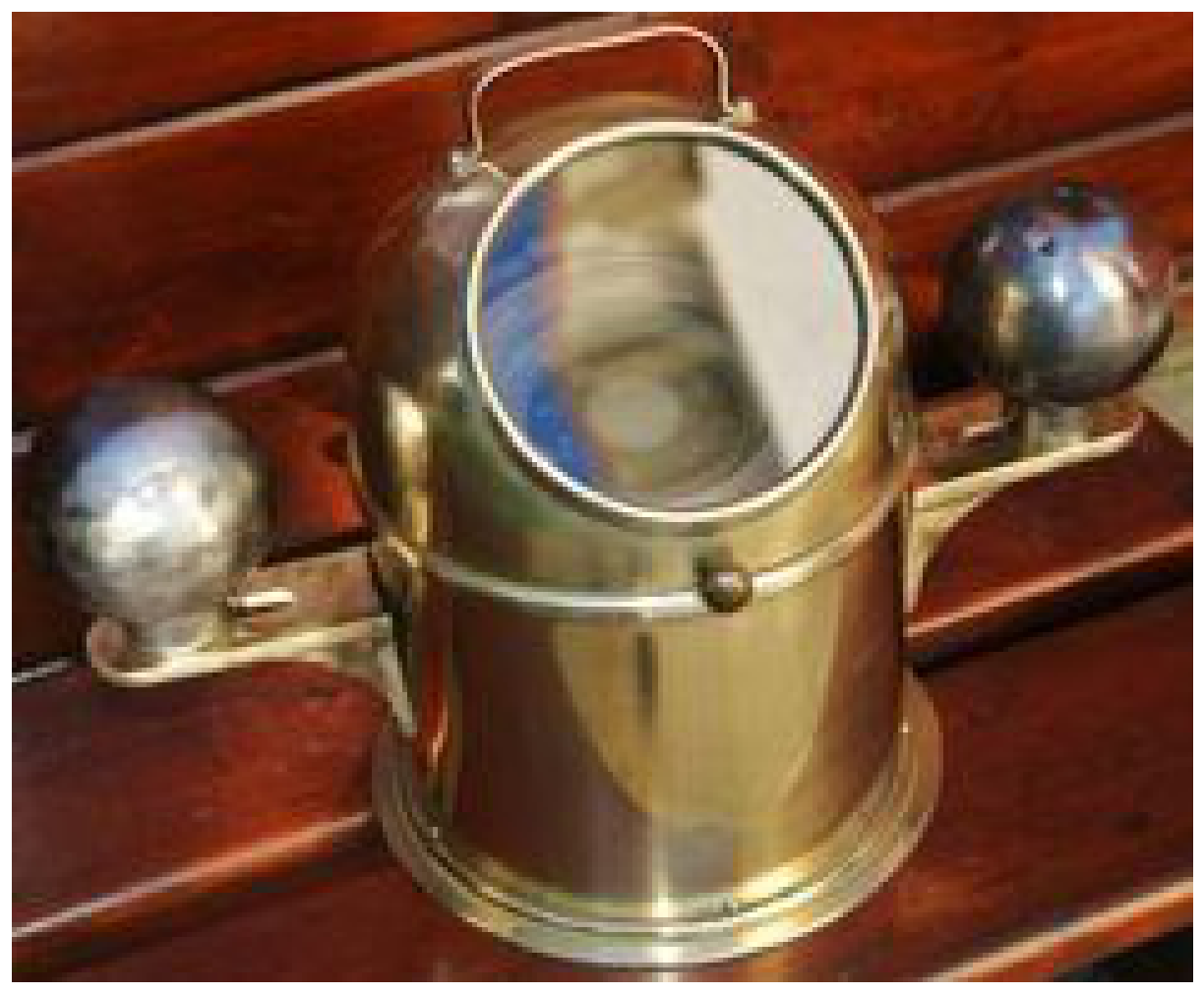
Just like the ship, the iron balls will become magnetic because of the Earth's field . As spheres, the balls will individually act like dipoles. A dipole can be thought of as the field produced by two magnetic monopoles of strength at two different points.
The magnetic field of a single pole is
where the positive sign is for a north pole and the negative for a south pole. The dipole magnetic field is the sum of the two fields: a north pole at and a south pole at , where the axis is horizontal and pointing north. is a small distance much smaller than the radius of the iron balls; in general where is a constant that depends on the size of the iron sphere.
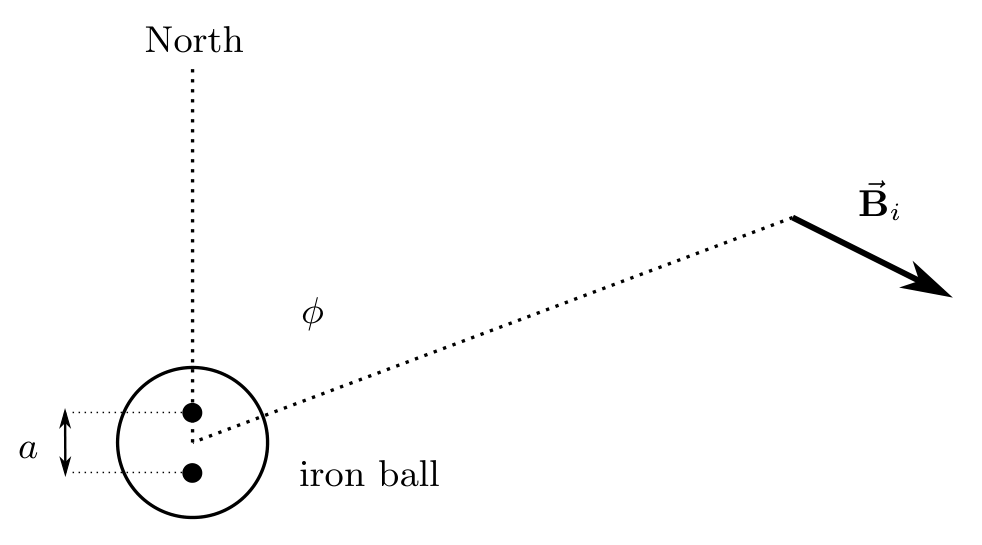
c. Derive an expression for the magnetic field from the iron a distance from the center of the ball. Note that there will be a component directed radially away from the ball and a component directed tangent to a circle of radius around the ball, so using polar coordinates is recommended.
d. If placed directly to the right and left of the ship compass, the iron balls can be located at a distance to cancel out the error in the magnetic heading for any angle(s) where is largest. Assuming that this is done, find the resulting expression for the combined deviation due to the ship and the balls for the magnetic heading for all angles .
Решение
a.
We add the fields to get the local field. The northward component is
while the eastward component is
The deviation is given by
This form is particularly nice, because as we'll see below, and are small enough to ignore in the denominator.
b.
By inspection, will yield the largest deviation. It's also acceptable to list , , , and .
c.
This problem is not nearly as difficult as it looks.
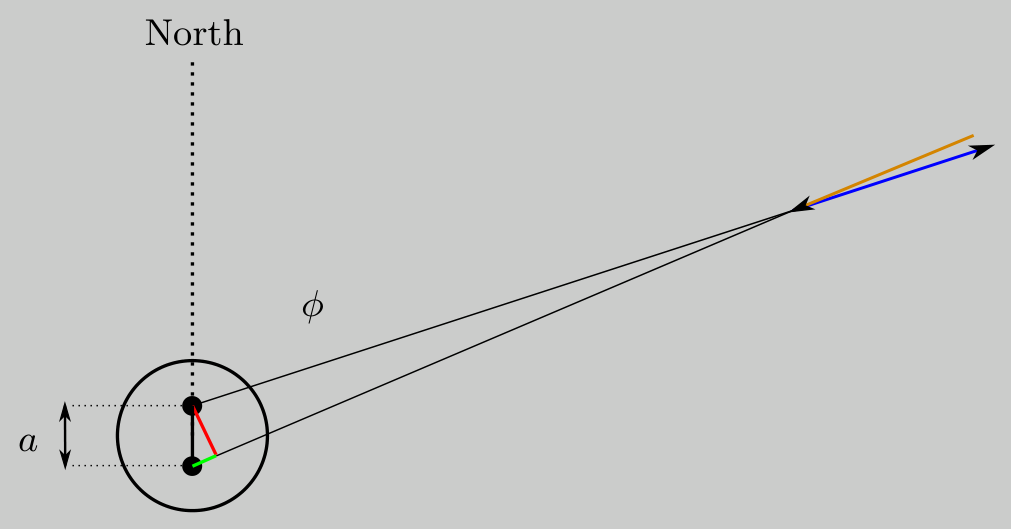
Consider the colored triangle above. The black side has length . The angle between the green and black sides is , so the length of the red side is and the length of the green side is .
The magnetic field strength from one magnetic pole a distance away is given by
The sum of the two fields has two components. The angular component is a measure of the “opening” of the triangle formed by the two vectors, and since the two vectors basically have the same length, we can use similar triangles to conclude
As expected, this component vanishes for .
The radial component is given by the difference in the lengths of the two field vectors, or
where is the length of the green side, so
That wasn't so bad, was it?
d.
Note that the two iron balls create a magnetic field near the compass that behaves like that of the ship as a whole. There is a component directed toward the bow given by
and a component directed toward the starboard given by
where the factors of 2 are because there are two balls. Note that is the ship heading while is the angle between North and the location of the compass relative to one of the balls. Thus, if the field is corrected for the maximum angles it will necessarily cancel out the induced ship field for all of the angles, so that
for all . Effectively, this means placing the balls to make .
Exam Statistics
| Question | A1 | A2 | A3 | A4 | B1 | B2 | Total |
|---|---|---|---|---|---|---|---|
| Mean | 11 | 3 | 5 | 6 | 12 | 15 | 53 |
| Standard Deviation | 7 | 4 | 5 | 7 | 10 | 14 | 29 |
| Maximum | 25 | 21 | 25 | 25 | 42 | 50 | 163 |
| Upper Quartile | 18 | 4 | 9 | 8 | 18 | 26 | 73 |
| Median | 10 | 2 | 5 | 5 | 10 | 12 | 49 |
| Lower Quartile | 4 | 0 | 0 | 0 | 3 | 1 | 30 |
| Minimum | 0 | 0 | 0 | 0 | 0 | 0 | 5 |
Some Trivia:
- California had 121 test takers
- New Jersey had 42
- Texas had 38
- Florida, Illinois, Massachusetts, Maryland, New York, and Virginia each had between one dozen and two dozen test takers
- Alabama, Alaska, Colorado, Idaho, Iowa, Louisiana, Montana, North Dakota, South Dakota, and Wyoming did not have a test taker this year.
Оригинал в Архива: 2017-USAPhO-exam-2.pdf · официални решения: USAPhO-2017-Solutions.pdf