USAPhO 2018, Полуфинал — Задача 2. Question A2
USA Physics Olympiad Exam — Part A / Part B · 25 т.
Внимание: Бележка към темата
The supervisor and student security dates differ in the original packet. The printed diode key retains its positive negative-voltage exponential and positive discharge derivative despite surrounding text/graphs. The radiation-pressure key retains inconsistent intensity/energy-density terminology and its classical electromagnetic definitions. Exact original sources and detailed defect evidence accompany the transcription.
Important Instructions for the Exam Supervisor — DO NOT DISTRIBUTE THIS PAGE
This examination consists of two parts: Part A has three questions and is allowed 90 minutes; Part B also has three questions and is allowed 90 minutes.
The first page that follows is a cover sheet. Examinees may keep the cover sheet for both parts of the exam.
The parts are then identified by the center header on each page. Examinees are only allowed to do one part at a time, and may not work on other parts, even if they have time remaining.
Allow 90 minutes to complete Part A. Do not let students look at Part B. Collect the answers to Part A before allowing the examinee to begin Part B. Examinees are allowed a 10 to 15 minutes break between parts A and B.
Allow 90 minutes to complete Part B. Do not let students go back to Part A.
Ideally the test supervisor will divide the question paper into 3 parts: the cover sheet (page 2), Part A (pages 3-5), Part B (pages 7-9), and several answer sheets for one of the questions in Part A (pages 11-13). Examinees should be provided parts A and B individually, although they may keep the cover sheet. The answer sheets should be printed single sided!
The supervisor must collect all examination questions, including the cover sheet, at the end of the exam, as well as any scratch paper used by the examinees. Examinees may not take the exam questions. The examination questions may be returned to the students after April 21, 2018.
Examinees are allowed calculators, but they may not use symbolic math, programming, or graphic features of these calculators. Calculators may not be shared and their memory must be cleared of data and programs. Cell phones, PDA’s or cameras may not be used during the exam or while the exam papers are present. Examinees may not use any tables, books, or collections of formulas.
Copyright ©2018 American Association of Physics Teachers.
USA Physics Olympiad Exam — Instructions
DO NOT OPEN THIS TEST UNTIL YOU ARE TOLD TO BEGIN - Work Part A first. You have 90 minutes to complete all three problems. Each question is worth 25 points. Do not look at Part B during this time. - After you have completed Part A you may take a break. - Then work Part B. You have 90 minutes to complete three problems. Each question is worth 25 points. Do not look at Part A during this time. - Show all your work. Partial credit will be given. Do not write on the back of any page. Do not write anything that you wish graded on the question sheets. - Start each question on a new sheet of paper. Put your AAPT ID number, your proctor’s AAPT ID number, the question number and the page number/total pages for this problem, in the upper right hand corner of each page. For example,
Student AAPT ID # Proctor AAPT ID # A1 - 1/3
- A hand-held calculator may be used. Its memory must be cleared of data and programs. You may use only the basic functions found on a simple scientific calculator. Calculators may not be shared. Cell phones, PDA’s or cameras may not be used during the exam or while the exam papers are present. You may not use any tables, books, or collections of formulas. - Questions with the same point value are not necessarily of the same difficulty. - In order to maintain exam security, do not communicate any information about the questions (or their answers/solutions) on this contest until after April 13, 2018.
Possibly Useful Information. You may use this sheet for both parts of the exam.
| for | |
| for | |
| for |
Important Instructions for the Exam Supervisor — DO NOT DISTRIBUTE THIS PAGE
Ideally the test supervisor will divide the question paper into 3 parts: the cover sheet (page 2), Part A (pages 3-10), Part B (pages 12-18), and several answer sheets for one of the questions in Part A (pages 20-22). Examinees should be provided parts A and B individually, although they may keep the cover sheet. The answer sheets should be printed single sided!
Условие
For this problem, graphical answers should be drawn on the answer sheets graphs provided. Supporting work is to be written on blank answer sheets. Incorrect graphs without supporting work will receive no partial credit.
The current as a function of voltage for a certain electrical device is
where is the magnitude of the charge on an electron, is Boltzmann's constant, and is the absolute temperature. and are non-zero positive constants. Throughout this problem assume low temperature values .
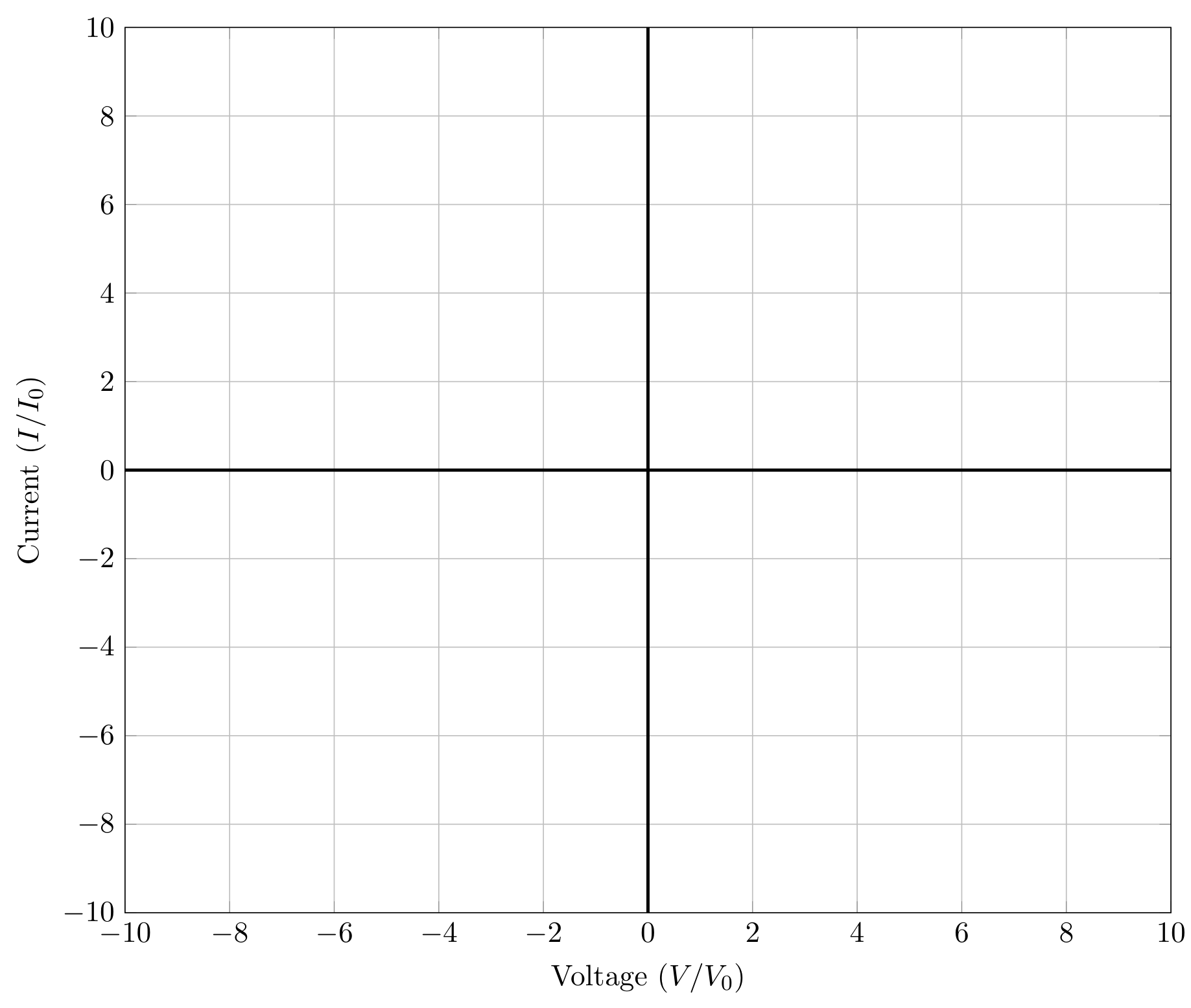
a. On the answer sheets, sketch a graph of the current versus voltage for low temperature values , clearly indicating any asymptotic behavior.
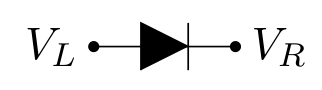
Shown is a schematic for the device. Positive voltage means that the electric potential of the left hand side of the device is higher than the right hand side. For this device, and .
Below is a circuit made up of these elements. The voltage supplied the circuit is sinusoidal, , and is also shown on answer sheets. The resistance is and .
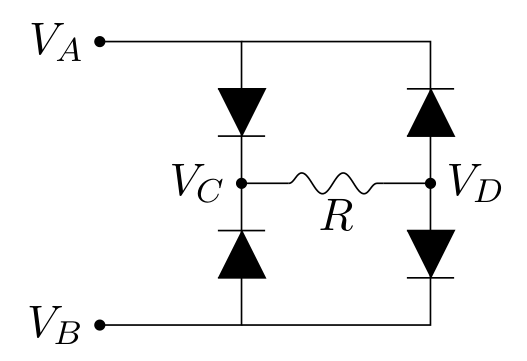
b. Sketch the potential difference as a function of time on the answer sheet. For your convenience, is shown in light gray. Assume that has been running for a long time.
A capacitor is connected to the circuit as shown below. The capacitance is .
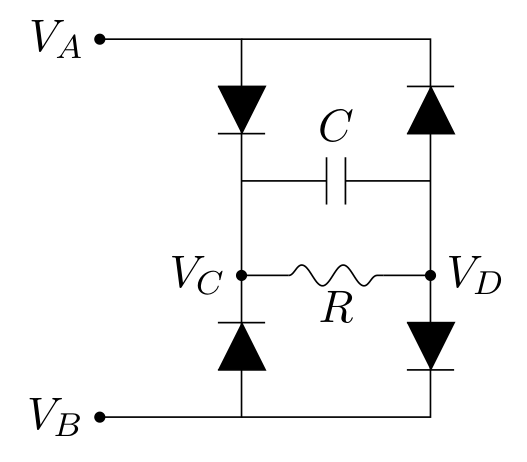
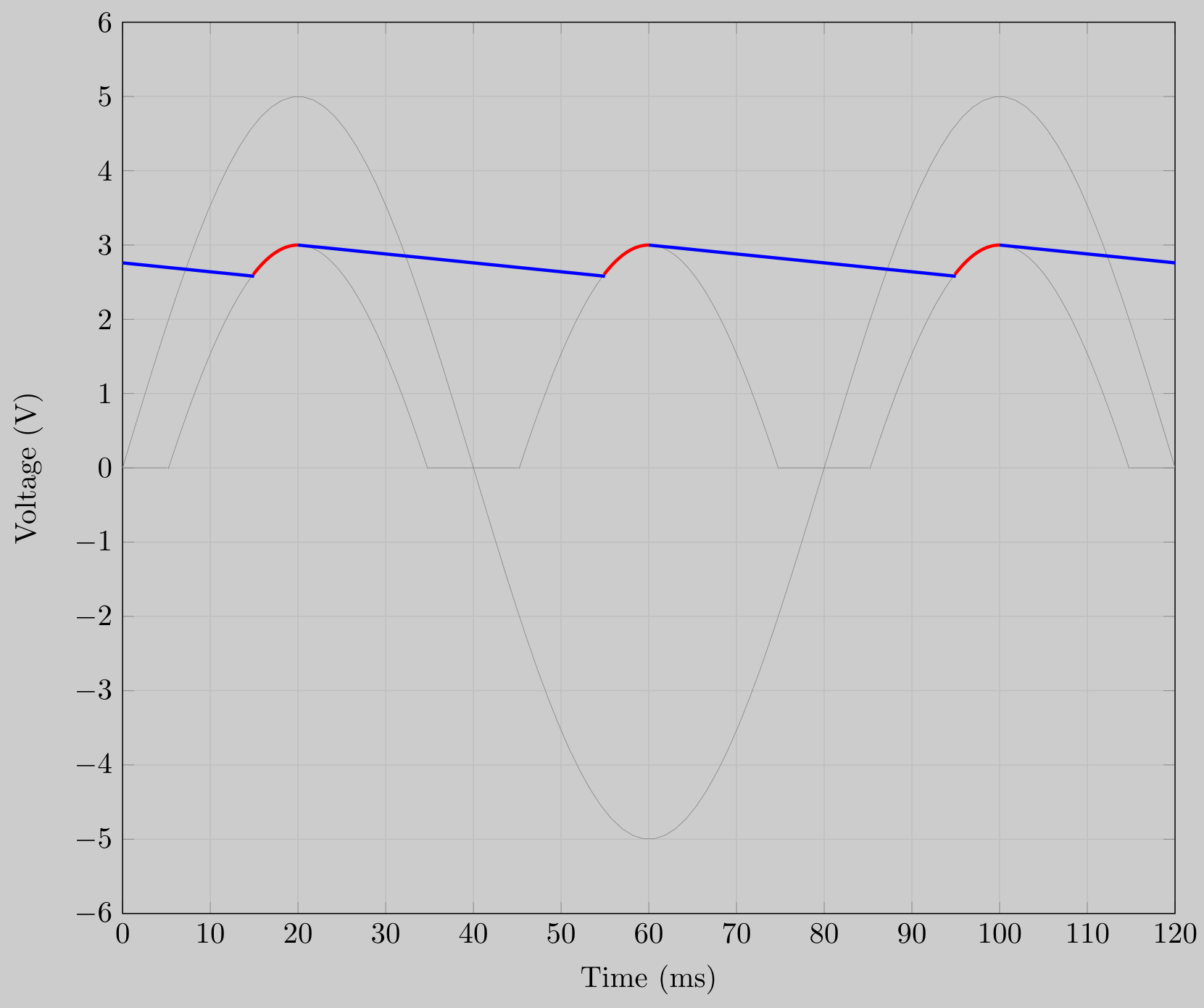
c. Sketch the new potential difference as a function of time on the answer sheet. For your convenience, is shown in light gray. Assume that has been running for a long time.
Answer Sheets
Following are answer sheets for some of the graphical portions of the test.
Student AAPT ID #: ____________________
Proctor AAPT ID #: ____________________
Question A2 — a. Sketch a graph of the current versus voltage for low temperature values , clearly indicating any asymptotic behavior.
Student AAPT ID #: ____________________
Proctor AAPT ID #: ____________________
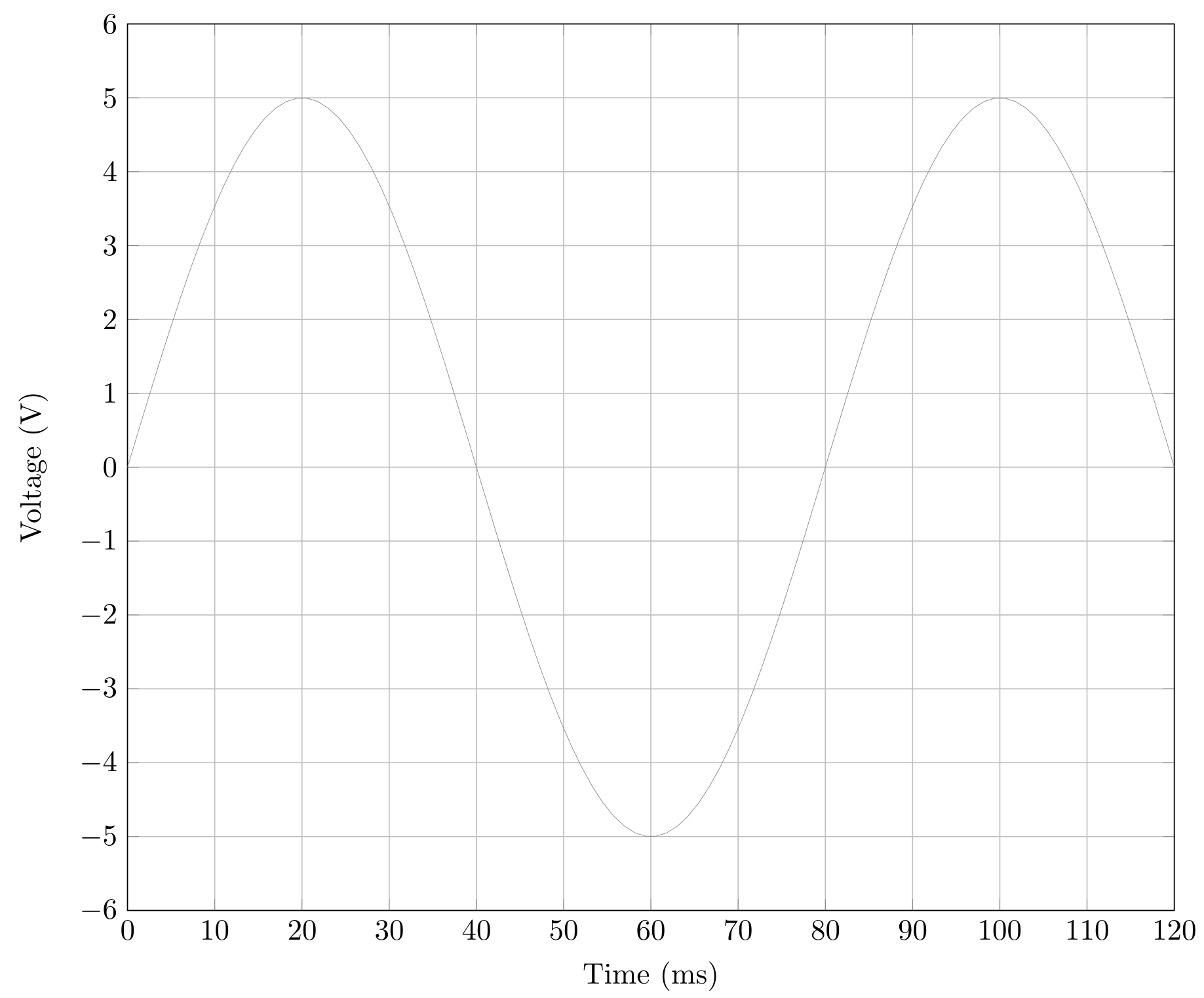
Question A2 — b. Sketch the potential difference as a function of time. For your convenience, is shown in light gray. Assume that has been running for a long time. There is no capacitor in this circuit!
Student AAPT ID #: ____________________
Proctor AAPT ID #: ____________________
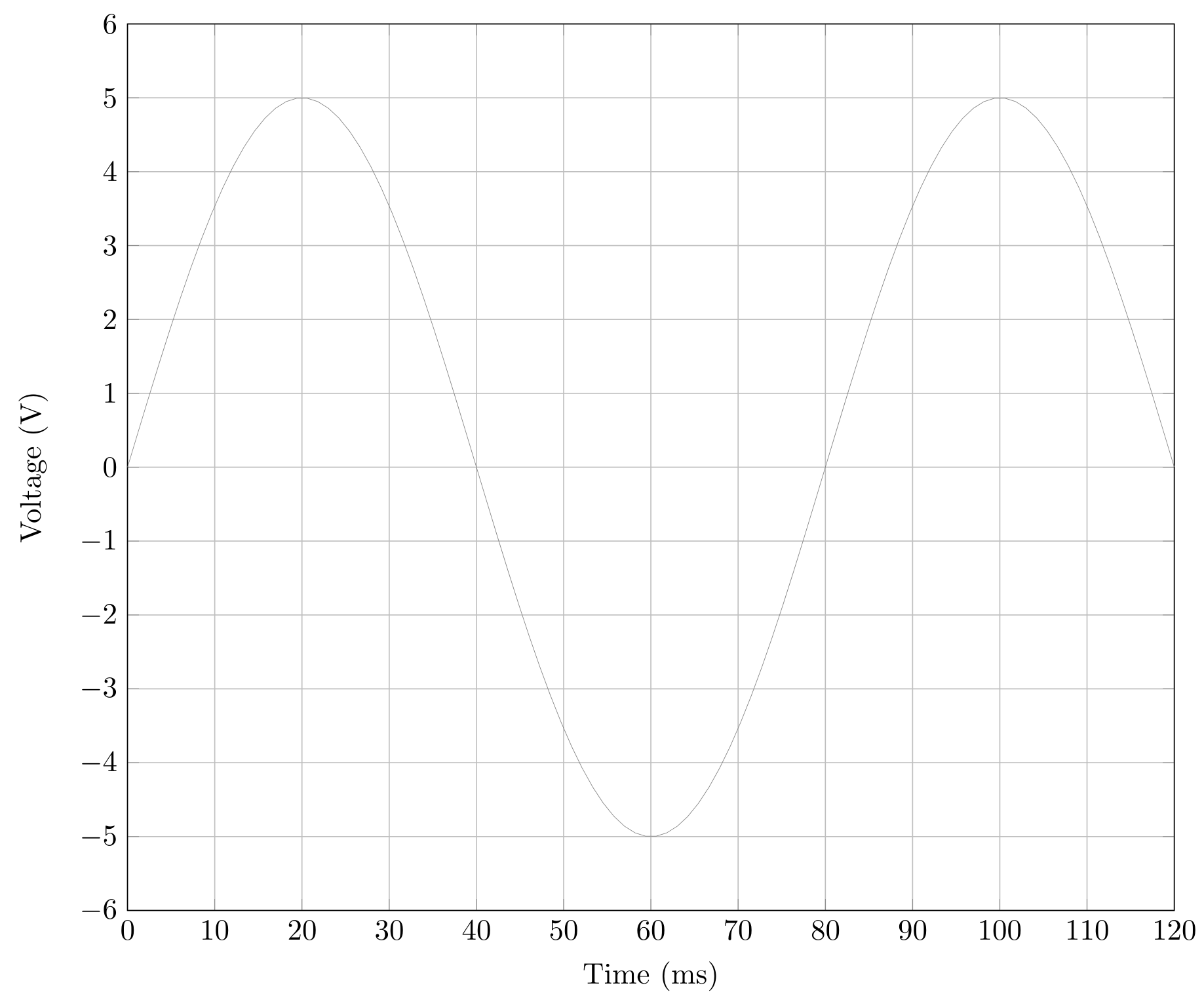
Question A2 — c. Sketch the potential difference as a function of time. For your convenience, is shown in light gray. Assume that has been running for a long time. There is a capacitor in this circuit!
Решение
a.
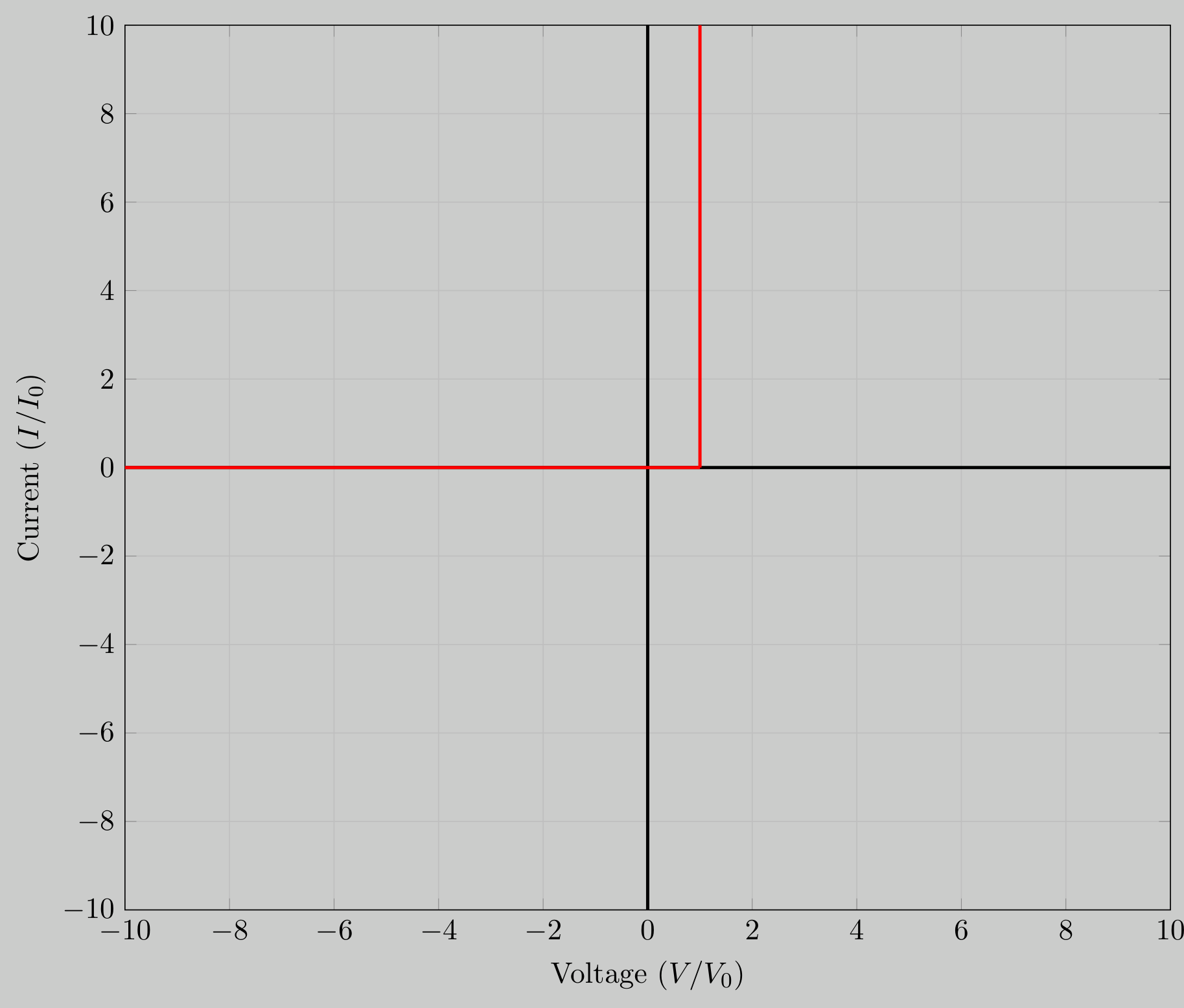
The current is simply proportional to , which is a shifted exponential. Then always has the same sign as , and vanishes when vanishes. The current grows quickly for high and approaches a constant for low .
This answer is acceptable, but we can use the condition to simplify the graph. For negative , we have
which is extremely small. For positive , we have
which is extremely small when and extremely large when . Then
as shown below. Accounting for finite temperature, which is not necessary for full credit, simply rounds the corners in all of the graphs.
b.
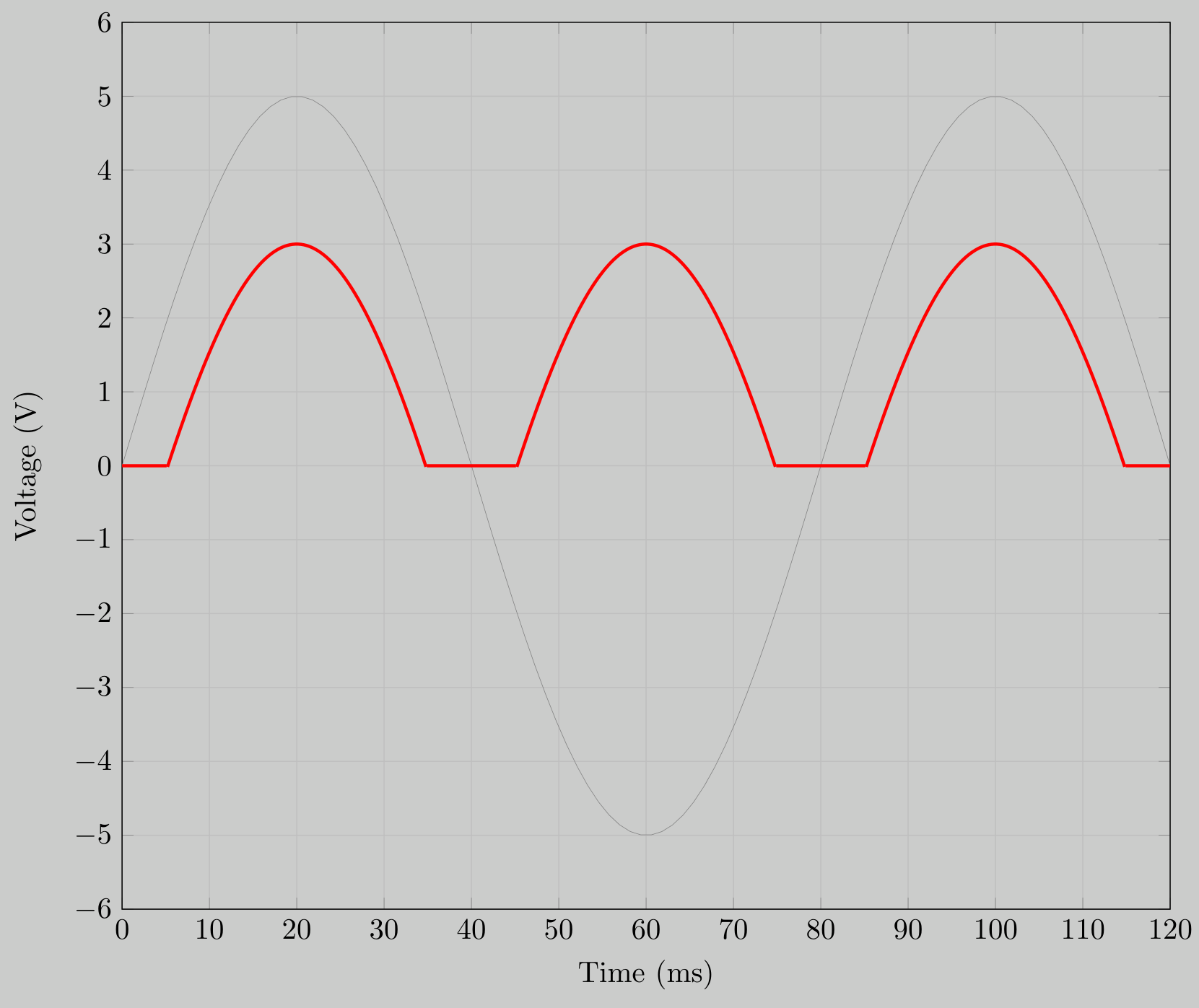
When , no current flows. When , current begins to flow, with each diode subtracting a potential difference of . Note that the current flows in the same direction for both positive and negative . This device is a rectifier.
c.
Let the voltage on the capacitor be . Whenever , current flows through the diodes, charging the capacitor up to voltage . Whenever , no current flows through the diodes, and the capacitor and resistor simply discharge as an RC circuit with time constant .
Since is much longer than the timescale on the answer sheets, the discharge is approximately linear, with
Thus the capacitor charges completely to every cycle, then discharges approximately linearly by about a half volt during the reminder of the cycle. On the graph we show charging as red and discharging as blue.
Оригинал в Архива: USAPhO-2018.pdf · официални решения: USAPhO-2018-Solutions.pdf