USAPhO 2019, Полуфинал — Задача 1. Question A1
USA Physics Olympiad Exam — Part A / Part B · 25 т.
Внимание: Бележка към темата
Original question scan and matching revised key have been read in full. Printed sign/variable/wording defects in A1, A2, A3 and B1 are retained and documented; key alternatives and all answer sheets are preserved. The scanned B2(c) typo remains source faithful, with revised-key wording difference explicitly recorded.
Important Instructions for the Exam Supervisor — DO NOT DISTRIBUTE THIS PAGE
This examination consists of two parts. Part A has three questions and is allowed 90 minutes. Part B also has three questions and is allowed 90 minutes.
Divide the exam paper into 4 parts: the instructions (pages 2–3), Part A (pages 4–6), Part B (pages 8–10), and answer sheets for one of the questions in Part A (pages 12–13). The exam should be printed single-sided to facilitate dividing the test and scanning the answer sheets.
Provide students with the instructions for the competition (pages 2–3). Students can keep the pages for both parts of the exam, as they contain a reference list of physical constants.
Provide students with blank sheets of paper as scratch paper. Students are not allowed to bring their own papers.
Then provide students with Part A and the associated answer sheets, and allow 90 minutes to complete Part A. Do not give students Part B during this time, even if they finish with time remaining. At the end of the 90 minutes, collect the solutions to Part A along with the answer sheets and questions.
Students are allowed a 10 to 15 minute break between Parts A and B. Then allow 90 minutes to complete Part B. Do not let students go back to Part A.
At the end of the exam, the supervisor must collect all papers, including the questions, the instructions, and any scratch paper used by the students. Students may not take the exam questions. The examination questions may be returned to the students after April 8th, 2019.
Students are allowed calculators, but they may not use symbolic math, programming, or graphical features of these calculators. Calculators may not be shared and their memory must be cleared of data and programs. Cell phones, PDAs, or cameras may not be used during the exam or while the exam papers are present. Students may not use any tables, books, or collections of formulas.
We acknowledge the following people for their contributions to this year’s exam (in alphabetical order):
JiaJia Dong, Abijith Krishnan, Brian Skinner, and Kevin Zhou.
Copyright ©2019 American Association of Physics Teachers.
Instructions for the Student
DO NOT OPEN THIS TEST UNTIL YOU ARE TOLD TO BEGIN
At the beginning of the exam, you shall be provided with the instruction sheets, blank papers (both for your answers and scratch work), and the exam packet.
Work on Part A first. You have 90 minutes to complete three problems. Each question is worth 25 points, but they are not necessarily of the same difficulty. Do not look at Part B during this time.
After you have completed Part A you may take a break. You may consider checking your answers to Part A with the remaining time as you will not be allowed to return to Part A once you start Part B.
Then work on Part B. You have 90 minutes to complete three problems. Each question is worth 25 points. Do not look at Part A during this time.
Show your work and reasoning. Partial credit will be given if you make your reasoning clear. Do not write on the back of any page. Further guidance is given on the next page.
A hand-held calculator may be used. Its memory must be cleared of data and programs. You may use only the basic functions found on a simple scientific calculator. Calculators may not be shared. Cell phones, PDAs or cameras may not be used during the exam or while the exam papers are present. You may not use any tables, books, or collections of formulas.
In order to maintain exam security, do not communicate any information about the questions of this exam, or their solutions until after April 8th, 2019.
Possibly useful information. You may use this sheet for both parts of the exam.
| for | |
| for | |
| for |
Instructions for the Student — Further Guidance
Following is some further guidance on formatting your solutions. Start each question on a new sheet of paper. Put your AAPT ID number, your proctor’s AAPT ID number, the problem number and the page number and total number of pages for this problem, in the upper right hand corner of each page. As an example, the second page of your solution to B3 might look as follows.
student AAPT #29485 proctor AAPT #1038 B3: 2/2
Remember to also write the AAPT ID numbers on the provided answer sheets. Write single- sided to facilitate scanning. You may use either pencil or pen, but in either case, make sure to write sufficiently clearly so your work will be legible after scanning. To preserve anonymity of grading, do not write your name on any sheet.
End of Instructions for the Student
DO NOT OPEN THIS TEST UNTIL YOU ARE TOLD TO BEGIN
Important Instructions for the Exam Supervisor — DO NOT DISTRIBUTE THIS PAGE
Divide the exam paper into 4 parts: the instructions (pages 2–3), Part A (pages 4–12), Part B (pages 14–23), and answer sheets for one of the questions in Part A (pages 25–26). The exam should be printed single-sided to facilitate dividing the test and scanning the answer sheets.
Условие
Part A
Collision Course
Two blocks, and , of the same mass are on a fixed inclined plane, which makes a angle with the horizontal. At time , is a distance along the incline above , and both blocks are at rest. Suppose the coefficients of static and kinetic friction between the blocks and the incline are
and that the blocks collide perfectly elastically. Let and be the speeds of the blocks down the incline. For this problem, use , assume both blocks stay on the incline for the entire time, and neglect the sizes of the blocks.
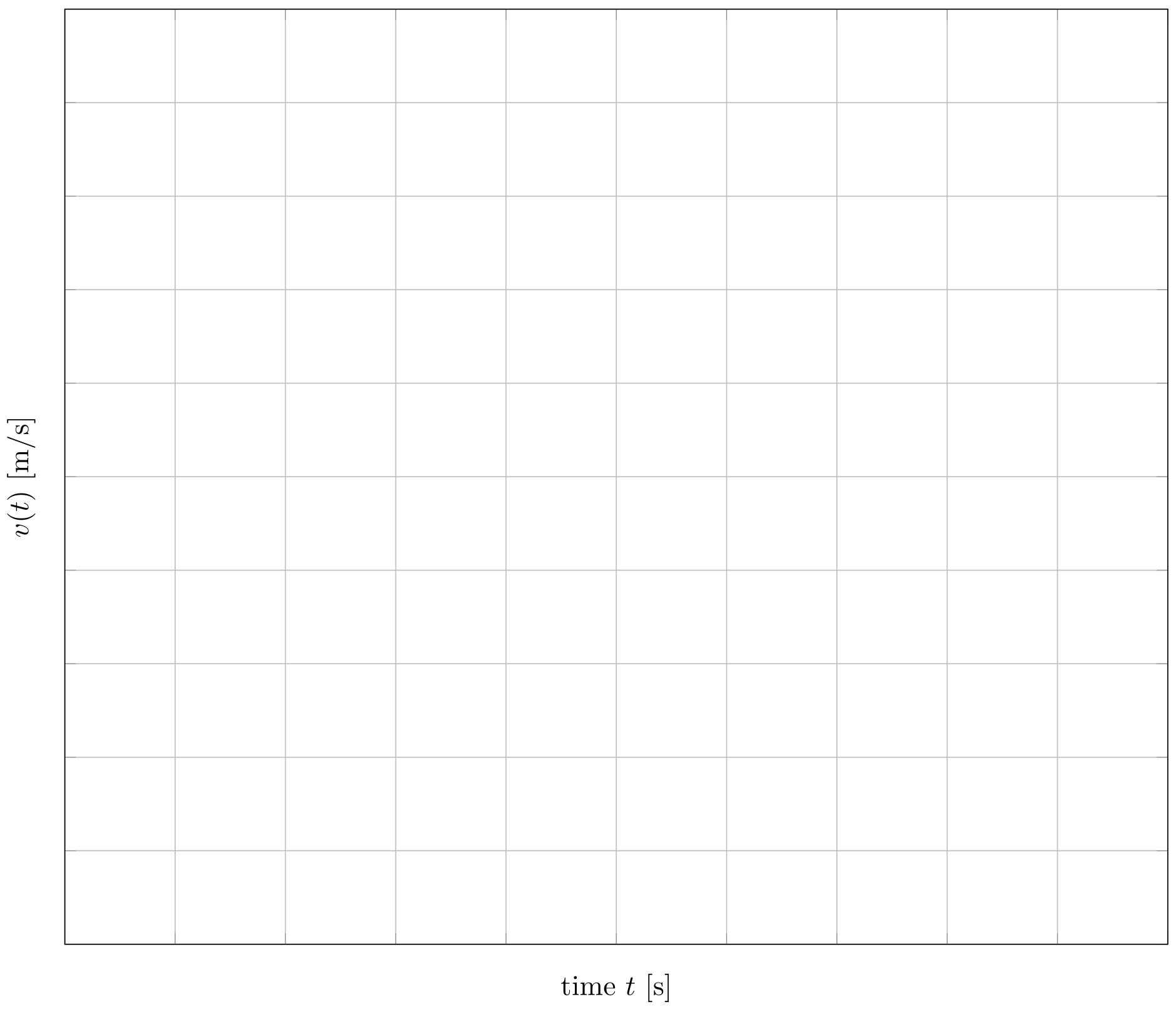
a. Graph the functions and for from 0 to 1 second on the provided answer sheet, with a solid and dashed line respectively. Mark the times at which collisions occur.
b. Derive an expression for the total distance block has moved from its original position right after its collision, in terms of and .
Now suppose that the coefficient of block is instead , while remains the same.
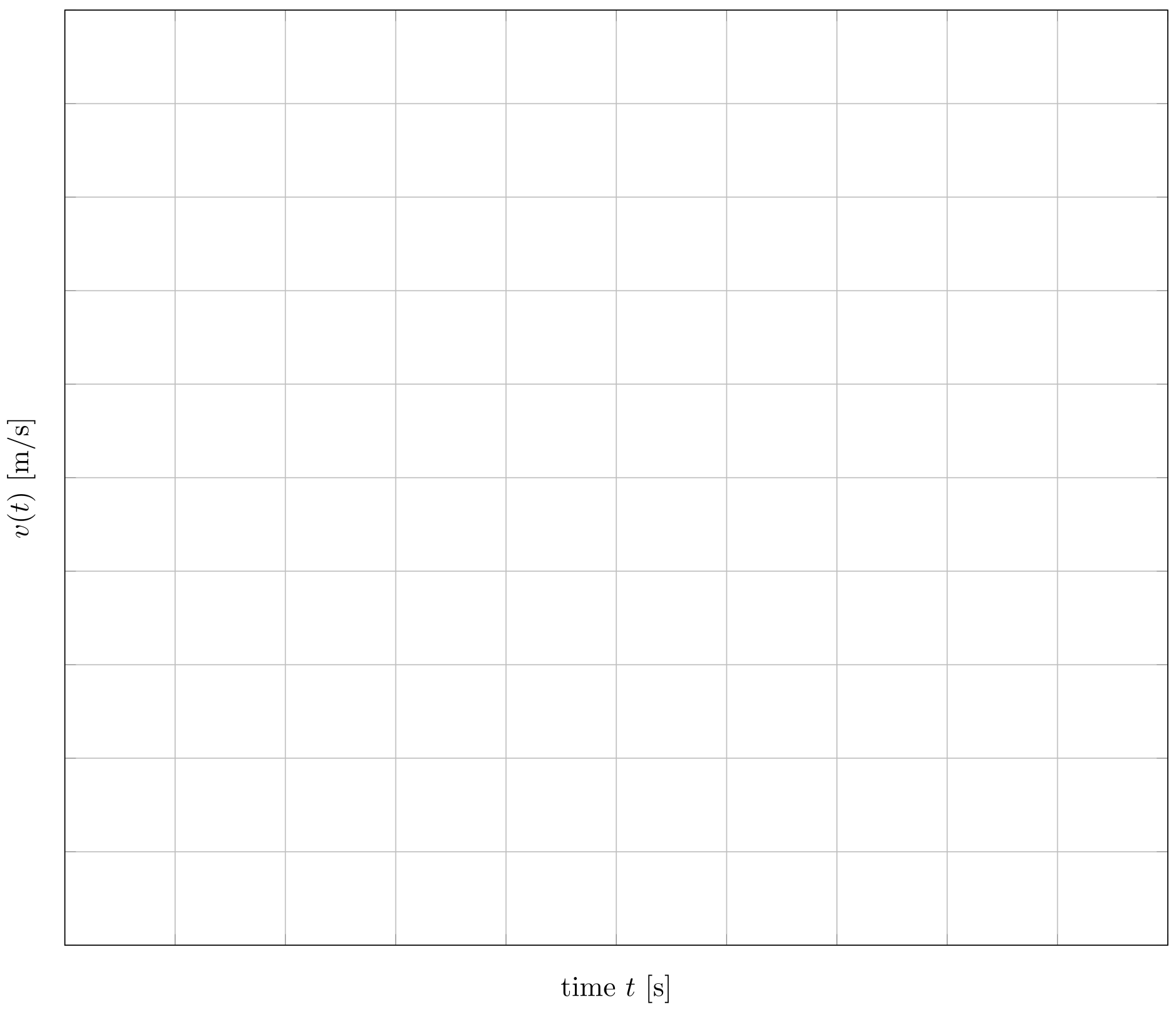
c. Again, graph the functions and for from 0 to 1 second on the provided answer sheet, with a solid and dashed line respectively. Mark the times at which collisions occur.
d. At time , how far has block moved from its original position?
Answer Sheets
Following are answer sheets for the graphing portion of Problem A1.
Student AAPT ID #: ____________________
Proctor AAPT ID #: ____________________
A1: Collision Course
(a)
Student AAPT ID #: ____________________
Proctor AAPT ID #: ____________________
(c)
Решение
a.
Draw a free-body diagram for both blocks and we can find that the acceleration of points down along the incline: . Similarly, .
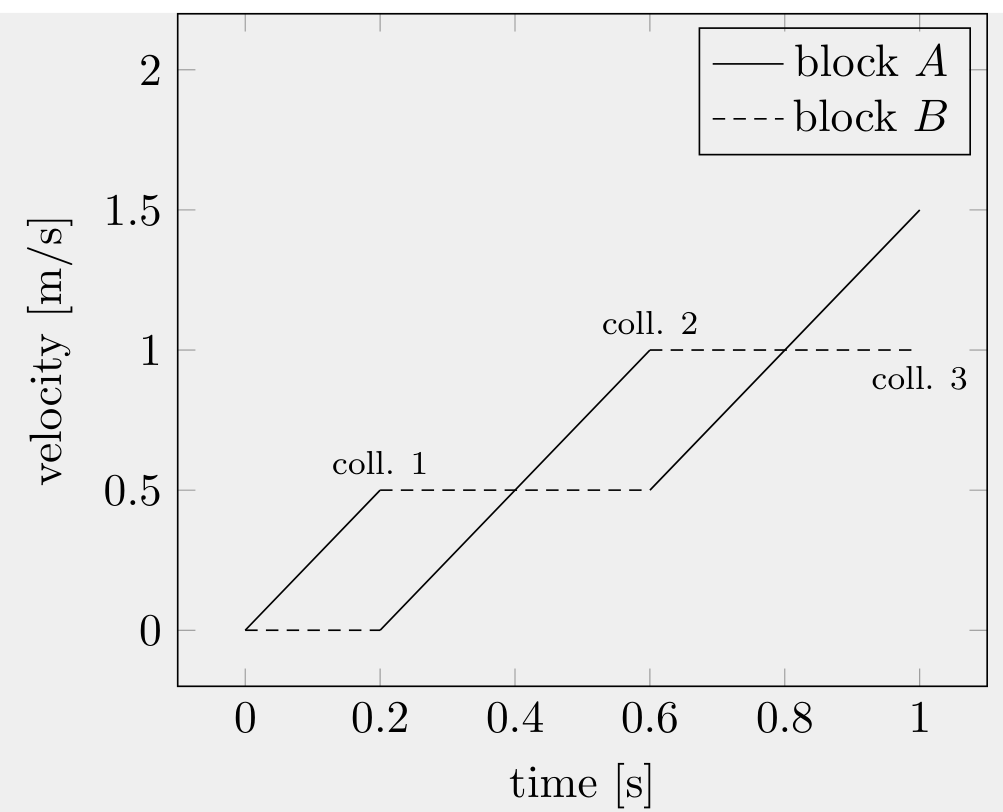
Let's first look at a qualitative picture of the collisions: When slides down the incline before colliding with , it moves with acceleration. When the blocks collide, the total momentum of the system is conserved. Because , the blocks exchange velocity, and thus slides down with constant velocity. After a momentary stop, will again accelerate down the incline, and catches up with , and another collision occurs.
Quantitatively, the first collision happens when travels .
This is when and first collide. Then moves down the incline at constant velocity , while starts from rest and accelerates down the incline with , until catches up with at . At that point,
Using a similar approach, we can find that at .
Graphically, the graphs during the first second are included below.
b.
The easiest way to calculate the total distance after collisions is through the graph, namely the area enclosed by the blue line: When , the distance traveled is , for , , and so on, so
c.
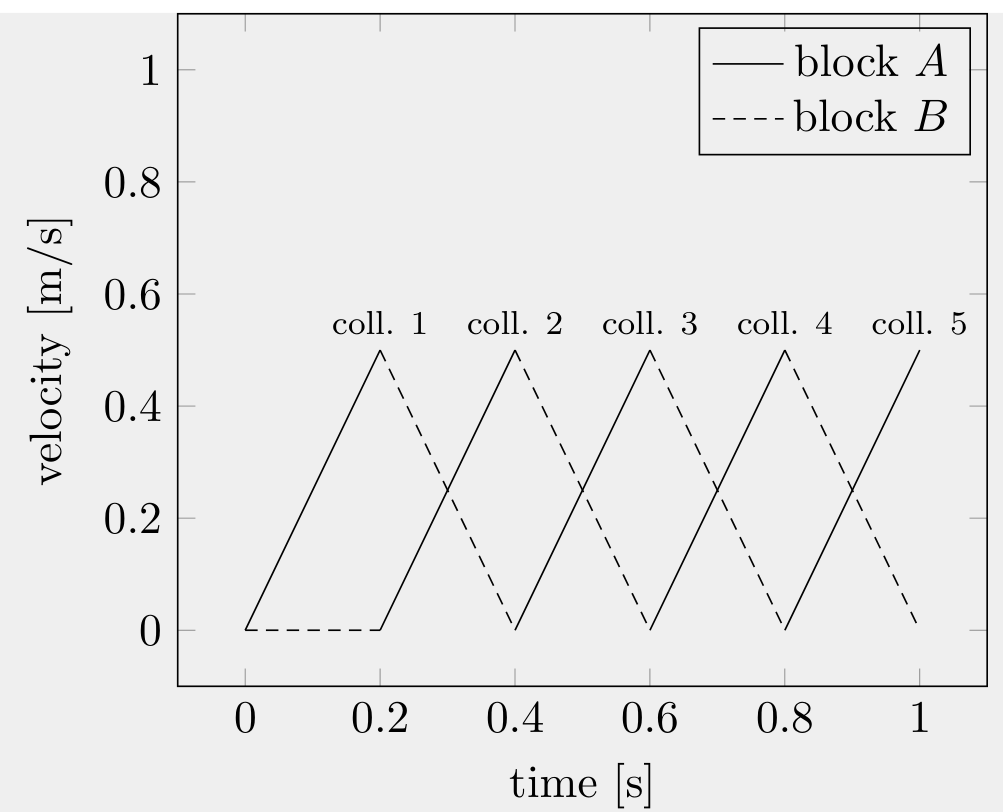
In this case, . In other words, friction is larger than the component of gravity. Once moves, friction acts to stop it.
In this case, will again move down the incline and hit with at . As moves with a deceleration of , accelerates with the same magnitude, colliding again at , and the process repeats. The relevant graphs are shown below.
d.
Again, using the graph, it is easy to see that at , just finished the 5th collision, and the total distance it moved is: .
Оригинал в Архива: 2019_USAPhO.pdf · официални решения: 2019_USAPHO_revised-solutions.pdf