USAPhO 2019, Полуфинал — Задача 6. Question B3
USA Physics Olympiad Exam — Part A / Part B · 25 т.
Внимание: Бележка към темата
Original question scan and matching revised key have been read in full. Printed sign/variable/wording defects in A1, A2, A3 and B1 are retained and documented; key alternatives and all answer sheets are preserved. The scanned B2(c) typo remains source faithful, with revised-key wording difference explicitly recorded.
Important Instructions for the Exam Supervisor — DO NOT DISTRIBUTE THIS PAGE
This examination consists of two parts. Part A has three questions and is allowed 90 minutes. Part B also has three questions and is allowed 90 minutes.
Divide the exam paper into 4 parts: the instructions (pages 2–3), Part A (pages 4–6), Part B (pages 8–10), and answer sheets for one of the questions in Part A (pages 12–13). The exam should be printed single-sided to facilitate dividing the test and scanning the answer sheets.
Provide students with the instructions for the competition (pages 2–3). Students can keep the pages for both parts of the exam, as they contain a reference list of physical constants.
Provide students with blank sheets of paper as scratch paper. Students are not allowed to bring their own papers.
Then provide students with Part A and the associated answer sheets, and allow 90 minutes to complete Part A. Do not give students Part B during this time, even if they finish with time remaining. At the end of the 90 minutes, collect the solutions to Part A along with the answer sheets and questions.
Students are allowed a 10 to 15 minute break between Parts A and B. Then allow 90 minutes to complete Part B. Do not let students go back to Part A.
At the end of the exam, the supervisor must collect all papers, including the questions, the instructions, and any scratch paper used by the students. Students may not take the exam questions. The examination questions may be returned to the students after April 8th, 2019.
Students are allowed calculators, but they may not use symbolic math, programming, or graphical features of these calculators. Calculators may not be shared and their memory must be cleared of data and programs. Cell phones, PDAs, or cameras may not be used during the exam or while the exam papers are present. Students may not use any tables, books, or collections of formulas.
We acknowledge the following people for their contributions to this year’s exam (in alphabetical order):
JiaJia Dong, Abijith Krishnan, Brian Skinner, and Kevin Zhou.
Copyright ©2019 American Association of Physics Teachers.
Instructions for the Student
DO NOT OPEN THIS TEST UNTIL YOU ARE TOLD TO BEGIN
At the beginning of the exam, you shall be provided with the instruction sheets, blank papers (both for your answers and scratch work), and the exam packet.
Work on Part A first. You have 90 minutes to complete three problems. Each question is worth 25 points, but they are not necessarily of the same difficulty. Do not look at Part B during this time.
After you have completed Part A you may take a break. You may consider checking your answers to Part A with the remaining time as you will not be allowed to return to Part A once you start Part B.
Then work on Part B. You have 90 minutes to complete three problems. Each question is worth 25 points. Do not look at Part A during this time.
Show your work and reasoning. Partial credit will be given if you make your reasoning clear. Do not write on the back of any page. Further guidance is given on the next page.
A hand-held calculator may be used. Its memory must be cleared of data and programs. You may use only the basic functions found on a simple scientific calculator. Calculators may not be shared. Cell phones, PDAs or cameras may not be used during the exam or while the exam papers are present. You may not use any tables, books, or collections of formulas.
In order to maintain exam security, do not communicate any information about the questions of this exam, or their solutions until after April 8th, 2019.
Possibly useful information. You may use this sheet for both parts of the exam.
| for | |
| for | |
| for |
Instructions for the Student — Further Guidance
Following is some further guidance on formatting your solutions. Start each question on a new sheet of paper. Put your AAPT ID number, your proctor’s AAPT ID number, the problem number and the page number and total number of pages for this problem, in the upper right hand corner of each page. As an example, the second page of your solution to B3 might look as follows.
student AAPT #29485 proctor AAPT #1038 B3: 2/2
Remember to also write the AAPT ID numbers on the provided answer sheets. Write single- sided to facilitate scanning. You may use either pencil or pen, but in either case, make sure to write sufficiently clearly so your work will be legible after scanning. To preserve anonymity of grading, do not write your name on any sheet.
End of Instructions for the Student
DO NOT OPEN THIS TEST UNTIL YOU ARE TOLD TO BEGIN
Important Instructions for the Exam Supervisor — DO NOT DISTRIBUTE THIS PAGE
Divide the exam paper into 4 parts: the instructions (pages 2–3), Part A (pages 4–12), Part B (pages 14–23), and answer sheets for one of the questions in Part A (pages 25–26). The exam should be printed single-sided to facilitate dividing the test and scanning the answer sheets.
Условие
Pitfall
A bead is placed on a horizontal rail, along which it can slide frictionlessly. It is attached to the end of a rigid, massless rod of length . A ball is attached at the other end. Both the bead and the ball have mass . The system is initially stationary, with the ball directly above the bead. The ball is then given an infinitesimal push, parallel to the rail.
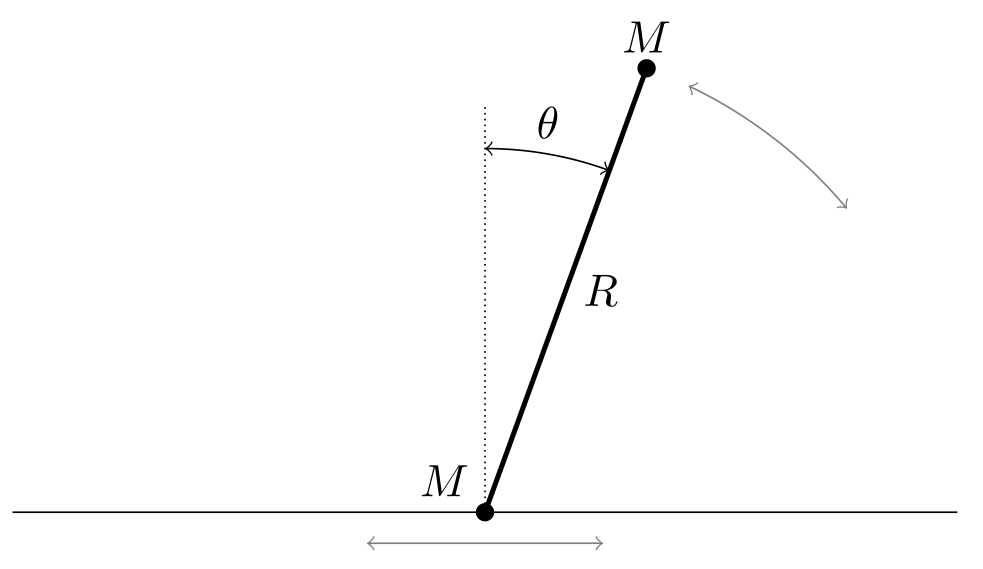
Assume that the rod and ball are designed in such a way (not shown explicitly in the diagram) so that they can pass through the rail without hitting it. In other words, the rail only constrains the motion of the bead. Two subsequent states of the system are shown below.
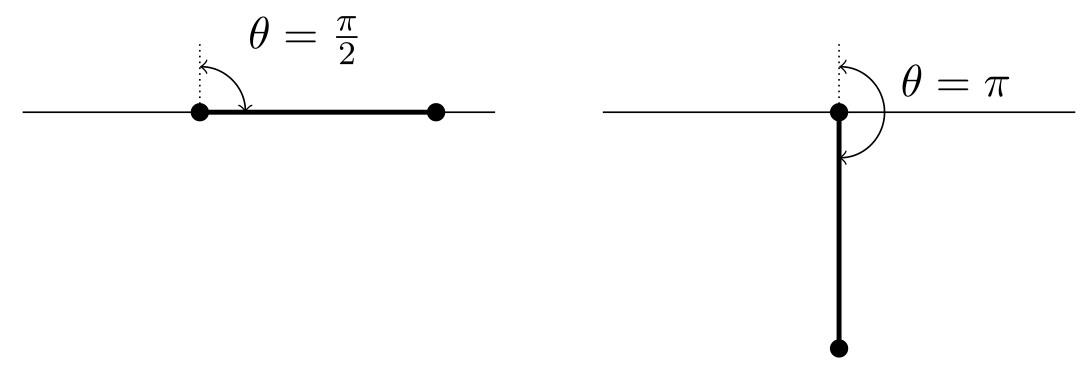
a. Derive an expression for the force in the rod when it is horizontal, as shown at left above, and indicate whether it is tension or compression.
b. Derive an expression for the force in the rod when the ball is directly below the bead, as shown at right above, and indicate whether it is tension or compression.
c. Let be the angle the rod makes with the vertical, so that the rod begins at . Find the angular velocity as a function of .
Решение
a.
Since this problem is subtle, we will present multiple solutions.
First solution: The motion of the rod can be decomposed as a superposition of rotation about the center of mass, and translation of the center of mass. We claim that the bead is stationary at this moment. To see this, note that the bead cannot have a vertical velocity component since it is fixed to the rod. Moreover, it cannot have a horizontal velocity component, because since the system experiences no external forces in the horizontal direction, the motion of the center of mass has no horizontal component.
Therefore, the bead is stationary, and since the released gravitational potential energy is , the speed of the ball obeys
The motion of the system consists of a downward speed of the center of mass, superposed on a rotation about the center of mass which gives the masses speed .
Now consider the forces on the ball. The only horizontal force on the ball is the force in the rod, so we need to find the horizontal acceleration of the ball. Part of this is due to the centripetal force associated with the rotational motion,
Another part of the ball's acceleration is due to the acceleration of the center of mass, but this is purely vertical and hence irrelevant here. A third part is due to the angular acceleration about the center of mass, but this is also associated with a vertical acceleration of the ball and hence irrelevant. Thus the force in the rod is just a tension
A common pitfall to think of the motion of the system as pure rotation about the bead, giving the incorrect answer . The reason this is incorrect is that, while it correctly describes the instantaneous velocity, to compute the acceleration one must also account for the acceleration of the instantaneous pivot point, which is not located at the bead for general times. It is possible to do this, but the computation is much more involved.
Second solution: While the first solution required only two lines of algebra, it also required careful reasoning. Here we present a more complicated, but more straightforward alternative. Let be the horizontal position of the bead. The position of the ball is
By conservation of momentum, the center of mass must be at the same horizontal position as it started, so
Therefore, the position of the ball is
That is, it follows an ellipse whose major axis is twice the minor axis.
Differentiating this twice, the acceleration of the ball is
In this case, and we are only interested in , giving
At this point, one needs to find using conservation of energy. Plugging in the result from either part (c) below or the first solution above gives , which indicates a force of to the left, and hence a tension in the rod. Incidentally, yet another solution is to use where is the instantaneous radius of curvature of the ellipse, which may be computed directly.
Third solution: We can work in the noninertial reference frame of the bead. In this frame, the ball simply rotates around the bead, with the naive centripetal force
However, since the tension accelerates the bead to the right, there is a fictitious force of magnitude pulling the ball to the left in this frame. The real tension force and the fictitious force add up to the centripetal force, so , giving .
b.
First solution: At this point the released gravitational potential energy is , and both masses are moving horizontally with speed , where
Work in the frame moving to the right with speed . In this frame the bead is stationary and the ball has velocity and is instantaneously rotating about the bead, so it must be experiencing a centripetal force
Unlike in part (a), there are no additional contribution from the acceleration of the rotation center, because the bead can only ever accelerate horizontally, and the force in the rod at this moment is vertical. Since the ball also experiences a downward force of due to gravity, the force in the rod is a tension
Second solution: We can also solve the problem using the algebraic approach. Following what we found in the second solution to part (a),
Plugging in the result for , one finds
which, as before, indicates a tension of .
Third solution: Work in the original frame, where the masses are instantaneously rotating about the midpoint of the rod. Because of this motion, the ball must be experiencing a centripetal force
This makes answering a tempting pitfall; to get the right answer, we must also account for the vertical acceleration of the center of mass. The height of the center of mass is , so
At this point, and , so
where we used . Therefore, the total upward acceleration of the ball is , as we found earlier, so the force in the rod is a tension .
In summary, there are many valid ways to arrive at the correct answers of and , but all of them require careful thought. When this exam was given, only about 2% of students successfully found these answers.
c.
The height of the ball is , so the released gravitational potential energy is
The kinetic energy may be decomposed into rotation about the center of mass and translation of the center of mass; this translation is purely vertical by conservation of momentum. The vertical speed of the center of mass is , so the kinetic energy is
Equating these two expressions and simplifying gives
Some students instead treated the motion of the bead and ball separately; this can lead to the correct answer, but it is easy to make a mistake. Another common route was to apply Lagrangian mechanics, solving the Euler-Lagrange equations, or equivalently to solve the equations. These are quite complicated, and nobody managed to integrate them to get the correct answer.
Оригинал в Архива: 2019_USAPhO.pdf · официални решения: 2019_USAPHO_revised-solutions.pdf