USAPhO 2021, Полуфинал — Задача 2. A2 · Flashlight
USA Physics Olympiad Exam — 2021 USAPhO · 19 април 2021 г.
Information About The 2021 USAPhO
The 2021 USAPhO consists of two 90-minute parts taking place on two separate days:
- Part A: Monday, April 19 from 4:00 pm to 5:30 pm Eastern Time
- Part B: Wednesday, April 21 from 4:00 pm to 5:30 pm Eastern Time
The exam is hosted by AAPT on the platform provided by Art of Problem Solving.
This year, we require the exam to be proctored by either your high school science/physics teacher, or your parent/guardian.
Before you start the exam, make sure you are provided with blank paper, both for your answers and scratch work, writing utensils, a hand-held scientific calculator with memory and programs erased, and a computer for you to log into the USAPhO testing page. Then agree to the Honor Policy, and download the USAPhO exam papers.
At the end of the exam, you have 20 minutes to upload solutions to all of the problems for that part. For each problem, scan or photograph each page of your solution, combine them into a single PDF file, and upload them on the testing platform.
USAPhO graders are not responsible for missing pages or illegible handwriting. No later submissions will be accepted.
Thank you for participating in the USAPhO this year under such extraordinary circumstances. We hope that you and your family stay safe, and that you continue to encourage more students like you to study physics and try out the exam hosted by AAPT.
We acknowledge the following people for their contributions to this year’s exam (in alphabetical order):
JiaJia Dong, Mark Eichenlaub, Abijith Krishnan, Kye W. Shi, Brian Skinner, Mike Winer, and Kevin Zhou.
Условие
Alice the Mad Scientist, travelling in her flying car at height above the ground, shoots a beam of muons at the ground. Bob, observing from the ground at distance from Alice’s car, decides to check some facts about special relativity. Assume the muons travel extremely close to the speed of light in Alice’s frame.
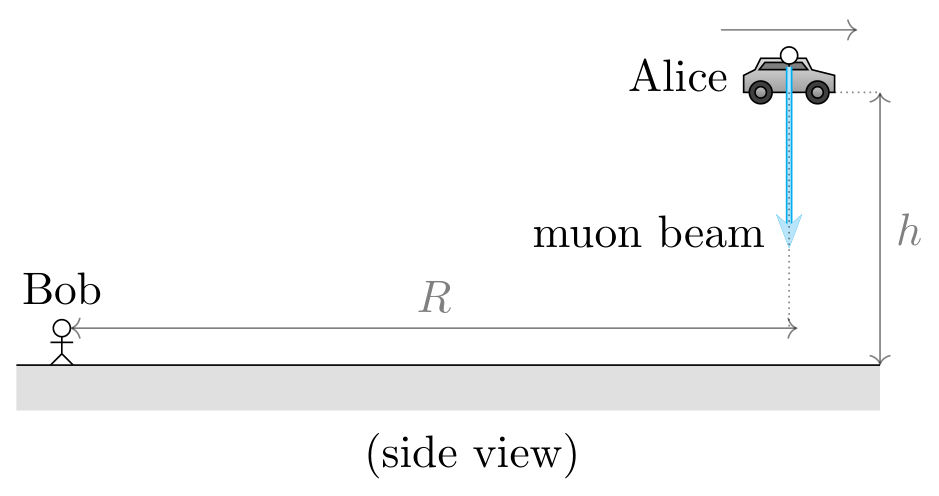
a. Alice’s car flies at horizontal speed . Alice shoots her muon beam straight down, in her reference frame. Express your answers in terms of and fundamental constants.
a. i. What is the horizontal velocity of the muons in Bob’s reference frame?
a. ii. What is the vertical velocity of the muons in Bob’s reference frame?
a. iii. How long does it take the muons to reach the ground in Bob’s reference frame?
Alice’s velocity is directed an angle away from Bob. For the rest of the problem, you may additionally express your answers in terms of .
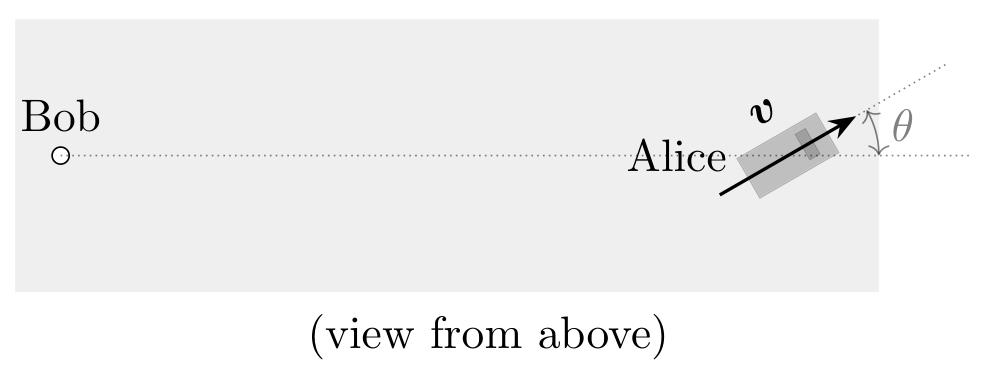
b. In Bob’s reference frame, how much time is there between when he sees Alice first fire the beam, and when he sees the beam first hit the ground? (Hint: remember to account for the travel time of light to Bob’s eyes.)
c. In this part, suppose that . Does there exist a value of so that the time it takes the muons to hit the ground in Alice’s frame is equal to the time taken according to Bob’s eyes, in Bob’s frame? If so, find the value of in degrees. If not, briefly explain why not.
d. Suppose Alice is carrying a radio transmitter set to frequency . To what frequency would Bob have to set his radio receiver in order to receive Alice’s transmission?
Отговори
a. i.
a. ii.
a. iii.
b.
c. 105.5 °
Yes: θ = cos⁻¹(√(β⁻² − 1) − β⁻¹) = 105.5° for β = 0.5.
d.
Решение
a. i.
The muons were fired straight down in Alice’s frame, so in Bob’s frame their horizontal velocity is the same as Alice’s, .
One way to see this is to imagine Alice was carrying a vertical pole with her. In her reference frame, the muons travel along the length of the pole. This must remain true in any frame, so in Bob’s frame the muons must have the same horizontal velocity as Alice.
a. ii.
The muons have speed and horizontal velocity , so they have vertical velocity by the Pythagorean theorem.
a. iii.
The time is the height divided by the vertical velocity of the muons,
b.
In Bob’s frame, during the time the muons take to reach the ground, Alice’s car moves a distance away from Bob, which means the light from the muons hitting the ground takes an extra time to reach Bob. Thus, the time interval Bob sees, with his eyes, is
c.
This will be true if
Solving for , we find
This has a solution as long as the argument of the inverse cosine is less than 1. In the case , it is, and the result is
That is, this value of is low enough so that the motion of Alice towards Bob can make up for the time dilation effect.
d.
The key point is that all the logic in part (b) still works, if we replace Bob’s eyes with the radio receiver. Since the frequency of a wave is the inverse of the time between maxima,
This is the two-dimensional relativistic Doppler shift, and the secret point of this problem was to derive it in a simple way.
Оригинал в Архива: 2021-USAPhO.pdf · официални решения: 2021-USAPhO_Solutions_v3.pdf