USAPhO 2021, Полуфинал — Задача 5. B2 · Hot Pocket
USA Physics Olympiad Exam — 2021 USAPhO · 19 април 2021 г.
Information About The 2021 USAPhO
The 2021 USAPhO consists of two 90-minute parts taking place on two separate days:
- Part A: Monday, April 19 from 4:00 pm to 5:30 pm Eastern Time
- Part B: Wednesday, April 21 from 4:00 pm to 5:30 pm Eastern Time
The exam is hosted by AAPT on the platform provided by Art of Problem Solving.
This year, we require the exam to be proctored by either your high school science/physics teacher, or your parent/guardian.
Before you start the exam, make sure you are provided with blank paper, both for your answers and scratch work, writing utensils, a hand-held scientific calculator with memory and programs erased, and a computer for you to log into the USAPhO testing page. Then agree to the Honor Policy, and download the USAPhO exam papers.
At the end of the exam, you have 20 minutes to upload solutions to all of the problems for that part. For each problem, scan or photograph each page of your solution, combine them into a single PDF file, and upload them on the testing platform.
USAPhO graders are not responsible for missing pages or illegible handwriting. No later submissions will be accepted.
Thank you for participating in the USAPhO this year under such extraordinary circumstances. We hope that you and your family stay safe, and that you continue to encourage more students like you to study physics and try out the exam hosted by AAPT.
We acknowledge the following people for their contributions to this year’s exam (in alphabetical order):
JiaJia Dong, Mark Eichenlaub, Abijith Krishnan, Kye W. Shi, Brian Skinner, Mike Winer, and Kevin Zhou.
Условие
This question consists of two independent parts.
a. It’s winter and you want to keep warm. The temperature is outside and in your room. You have started a fire, which acts as a hot reservoir at temperature .
You want to add a small amount of heat to your room. The simplest method would be to extract heat from the fire and directly transfer it to your room. However, it is possible to heat your room more efficiently. Suppose that you can exchange heat between any pair of reservoirs. You cannot use any external source of work, such as the electrical grid, but the work extracted from running heat engines can be stored and used without dissipation.
a. i. What is the minimum heat extraction required by the laws of thermodynamics to heat up the room by ?
a. ii. Let the “efficiency gain” be the ratio . Assuming is fixed at , make a graph whose axes are and , where varies from to , and varies from to . On the graph, sketch curves corresponding to gain , 5, and 12.
b. When the air at the bottom of a container is heated, it becomes less dense than the surrounding air and rises. Simultaneously, cooler air falls downward. This process of net upward heat transfer is known as convection.
Consider a closed, rectangular box of height filled with air initially of uniform temperature . Next, suppose the bottom of the box is heated so that the air there instantly reaches temperature . The hot parcel of air at the bottom rises upward until it hits the top of the box, where its temperature is instantly reduced to .
You may neglect any heat transfer and friction between the parcel of air and the surrounding air, and assume that the temperature difference is not too large. In addition, you may assume the height is small enough so that the pressure and density of the surrounding air are very nearly constant throughout the container. More precisely, assume that . Express your answers in terms of , , , , and .
b. i. As a parcel of air moves upward, it accelerates. Find a rough estimate for the average speed during its upward motion.
b. ii. In the steady state, warm parcels of air are continuously moving upward from the bottom, and cold parcels of air are continuously moving downward from the top. Find a rough estimate for the net rate of upward energy transfer per area.
Отговори
a. i.
About 0.11 dQ₁ for the given numbers.
a. ii. Sketch: see the official graph in the solution; the gain is high when T₁ approaches T₀ and low when T₂ approaches T₀.
b. i.
b. ii.
Решение
a. i.
The second law of thermodynamics implies that, no matter what you do, you must have , and if your process is to be as efficient as possible, we can assume it is reversible, so
If we do extract any work while allowing heat to transfer between reservoirs, we will later use that work to transfer more heat. So in the entire process, there are only heat transfers, and by conservation of energy,
The entropy change associated with each reversible heat transfer is , so our assumption of zero entropy production becomes
By combining these equations, we can eliminate and solve for , giving
For the provided numbers, this happens to be about . That is, a heat pump can be much more efficient than direct heating. This problem was inspired by Jaynes, E. T, “Note on thermal heating efficiency.”, American Journal of Physics 71.2 (2003): 180-182. (You can also solve the problem by considering an explicit procedure using Carnot engines. But since Carnot engines are reversible, all such procedures will just give the same answer.)
a. ii.
Your graph should look qualitatively like this:
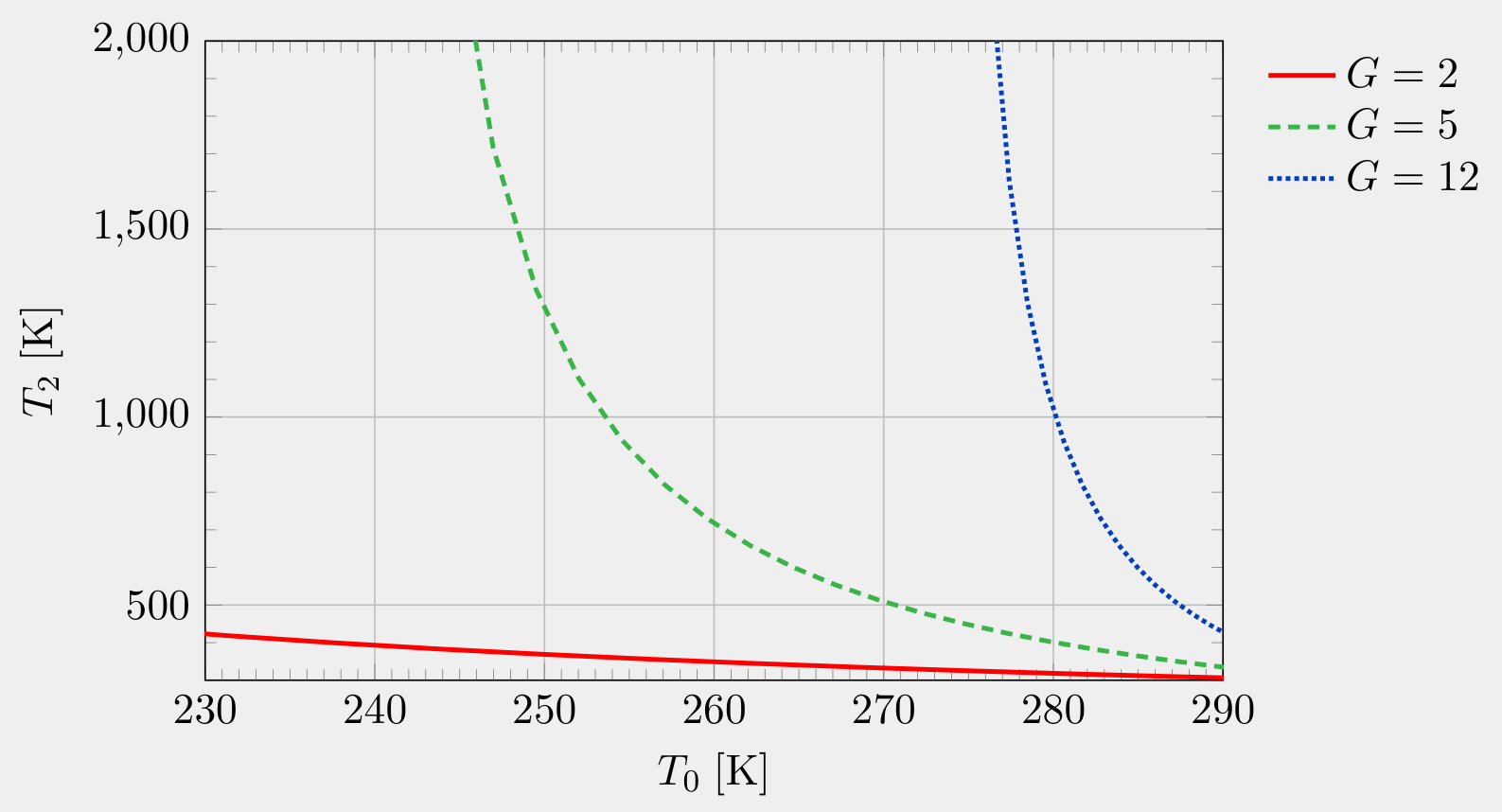
The intuition for the curves is that the efficiency gain becomes high when gets close to , and it becomes low when gets close to .
b. i.
The temperature of the air is higher than its surroundings by a fractional amount of order . Thus, by the ideal gas law, the density is lower than its surroundings by a fraction of order , which means the upward acceleration due to the buoyant force is of order . Since this is roughly uniformly accelerated motion, , which implies
Note that because in hydrostatic equilibrium, the pressure of the surrounding air varies between the bottom and top of the container, by a fractional amount of order . But since we assumed , we can neglect this effect.
b. ii.
The extra energy carried by a parcel of gas is
where is the volume of the parcel. The net volume of warm air transported upward per unit time is of order , where is the cross-sectional area of the box. Thus, the average power per area is roughly
This is a simplified version of the mixing length theory of convection, which is essential for modeling the interiors of stars.
Оригинал в Архива: 2021-USAPhO.pdf · официални решения: 2021-USAPhO_Solutions_v3.pdf