USAPhO 2022, Полуфинал — Задача 3. Question A3
USA Physics Olympiad Exam — Part A / Part B · 25 т.
Внимание: Бележка към темата
Both original question and worked-key packets have been read in full. They refer to a separate answer-sheet packet, including a blank plotting grid, which is not present in the retained question/key sources or the matching catalogue entry. All native question data and the actual key graph are retained. Printed variable/sign/wording defects and grading allowances remain source faithful and are documented.
Important Instructions for the Exam Supervisor — DO NOT DISTRIBUTE THIS PAGE
This examination has two parts. Part A has three questions and lasts for 90 minutes. Part B also has three questions and lasts for 90 minutes.
For each student, print out one copy of the exam and one copy of the answer sheets. Print everything single-sided, and do not staple anything. Divide the exam into the instructions (pages 2–3), Part A questions (pages 4–7), and Part B questions (pages 8–10).
Begin by giving students the instructions and all of the answer sheets. Let the students read the instructions and fill out their information on the answer sheets. They can keep the instructions for both parts of the exam. Also give students blank sheets of paper to use as scratch paper throughout the exam.
Students may bring calculators, but they may not use symbolic math, programming, or graphing features of these calculators. Calculators may not be shared, and their memory must be cleared of data and programs. Cell phones or other electronics may not be used during the exam or while the exam papers are present. Students may not use books or other references.
To start the exam, give students the Part A questions, and allow 90 minutes to complete Part A. Do not give students Part B during this time, even if they finish with time remaining. At the end of the 90 minutes, collect the Part A questions and answer sheets.
Then give students a 5 to 10 minute break. Then give them the Part B questions, and allow 90 minutes to complete Part B. Do not let students go back to Part A.
At the end of the exam, collect everything, including the questions, the instructions, the answer sheets, and the scratch paper. Students may not keep the exam questions, but they may be returned to the students after April 19th, 2022.
After the exam, sort each student’s answer sheets by page number. Scan every answer sheet, including blank ones.
We acknowledge the following people for their contributions to this year’s exam (in alphabetical order):
Tengiz Bibilashvilli, Abijith Krishnan, Brian Skinner, and Kevin Zhou.
Copyright ©2022 American Association of Physics Teachers.
Instructions for the Student
You should receive these instructions, the table on the next page, answer sheets, and blank paper for scratch work. Read this page carefully before the exam begins.
You may use a calculator, but its memory must be cleared of data and programs, and you may not use symbolic math, programming, or graphing features. Calculators may not be shared. Cell phones or other electronics may not be used during the exam or while the exam papers are present. You may not use books or other outside references.
When the exam begins, your proctor will give you the questions for Part A. You will have 90 minutes to complete three problems. Each question is worth 25 points, but they are not necessarily of the same difficulty. If you finish all of the questions, you may check your work, but you may not look at Part B during this time.
After 90 minutes, your proctor will collect the questions and answer sheets for Part A. You may then take a short break.
Then you will work on Part B. You have 90 minutes to complete three problems. Each question is worth 25 points. Do not look at Part A during this time. When the exam ends, you must return all papers to the proctor, including the exam questions.
Do not discuss the questions of this exam, or their solutions, until after April 19th, 2022. Violations of this rule may result in disqualification. Below are instructions for writing your solutions.
This year, all of your solutions will be written on official answer sheets. Nothing outside these answer sheets will be graded. Before the exam begins, write your name, student AAPT number, and proctor AAPT number as directed on the answer sheets.
There are several answer sheets per problem. If you run out of space for a problem, you may use the extra answer sheets, which are at the end of the answer sheet packet. To ensure this work is graded, you must indicate, at the bottom of your last answer sheet for that problem, that you are using these extra answer sheets.
Only write within the frame of each answer sheet. To simplify grading, we recommend drawing a box around your final answer for each subpart. You should organize your work linearly and briefly explain your reasoning, which will help you earn partial credit. You may use either pencil or pen, but sure to write clearly so your work will be legible after scanning.
You may have to fit a line to data, which you can plot on the answer sheet with grid lines. You may use a ruler, pencil, pen, or piece of paper as a straightedge.
Reference table of possibly useful information
| for | |
| for | for |
You may use this sheet for both parts of the exam.
End of Instructions for the Student
DO NOT OPEN THIS TEST UNTIL YOU ARE TOLD TO BEGIN
Important Instructions for the Exam Supervisor — Key Packet Pagination
For each student, print out one copy of the exam and one copy of the answer sheets. Print everything single-sided, and do not staple anything. Divide the exam into the instructions (pages 2–3), Part A questions (pages 4–13), and Part B questions (pages 14–22).
Условие
Rainbow Road
In geometric optics, a caustic is a bright curve of light that appears when many incoming light rays are focused in the same outgoing direction. The most famous example of a caustic is a rainbow, which occurs when light interacts with spherical water droplets. Consider a spherical liquid droplet of radius with index of refraction , suspended in air with index of refraction .
a.
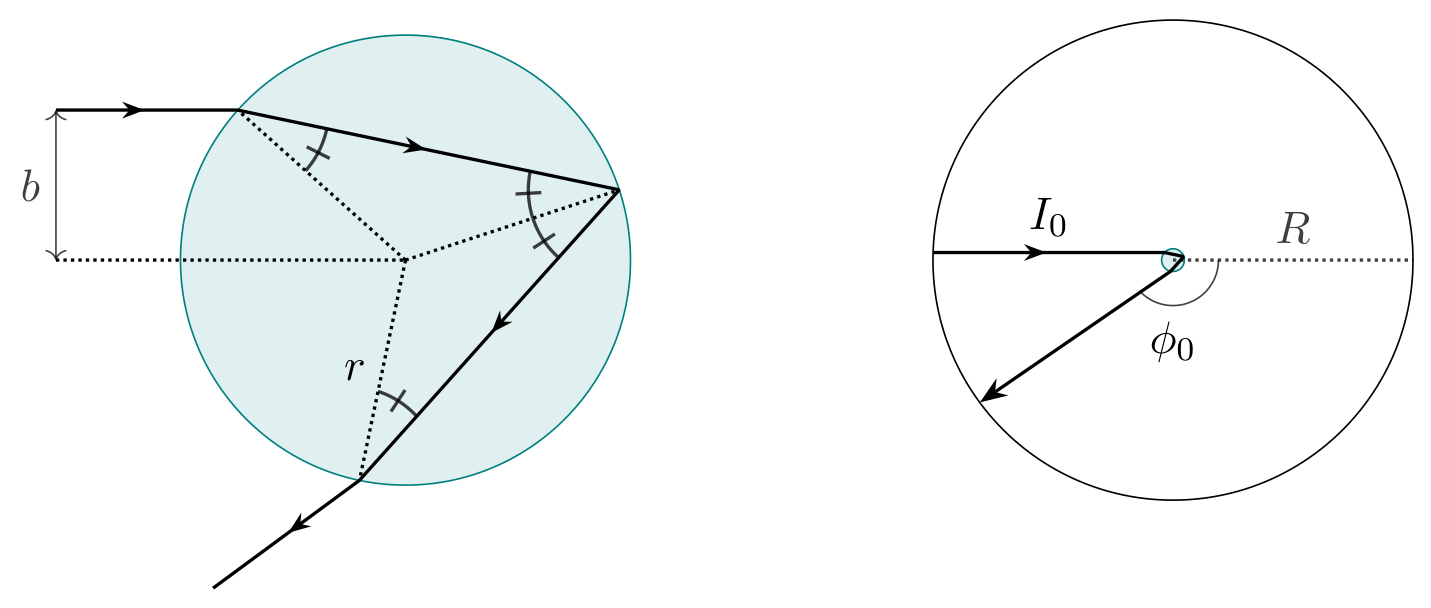
Consider a light ray that enters the droplet with impact parameter , reflects once off the inside surface of the droplet, then exits, as shown at left below. Give your answers in terms of the dimensionless impact parameter . (Hint: the four marked angles are congruent.)
i. Find the angle by which the light ray is deflected at the first refraction.
ii. Find the angle by which the light ray is deflected at the reflection.
iii. Find the angle by which the light ray is deflected at the second refraction.
The sum of these three quantities is the net deflection angle . (The light can also reflect inside more than once, or never enter at all, but for simplicity we will ignore these other paths.)
b.
Next, we consider when caustics form in general. Suppose the droplet is uniformly illuminated by parallel light rays of intensity , and sits at the center of a spherical screen of radius , as shown at right above. Consider the light that enters near dimensionless impact parameter , and exits near angle .
i. What is the power incident on the droplet at ?
ii. What is the area on the screen illuminated by the outgoing rays, at ?
iii. A caustic occurs when the intensity of light on the screen diverges. Assume that and . Under what conditions does light incident at lead to a caustic at ? Express your answer as a condition on the function .
c.
Find the angle of the rainbow in terms of . (Hint: the derivative of is .)
d.
For water, the index of refraction of red light is 1.331, and the index of refraction of blue light is 1.340. Find the angular width of the rainbow on the screen and give your answer in degrees.
e.
A glory is an optical phenomenon which involves light scattered directly backward, at , leading to an apparent halo around the shadow of an observer’s head. For what values of is there a caustic at ? Can glories from water droplets be explained in terms of caustics?
STOP: Do Not Continue to Part B
If there is still time remaining for Part A, you should review your work for Part A, but do not continue to Part B until instructed by your exam supervisor.
Once you start Part B, you will not be able to return to Part A.
Решение
a.
The angle the incoming light ray makes with the normal of the droplet is . By Snell’s law, the angle to the normal inside the droplet is .
i. The first refraction causes a deflection of .
ii. The reflection keeps the angle to the normal the same, and causes a deflection of .
iii. At this point, the angle to the normal is still , and by Snell’s law, it reverts to outside the droplet. This causes a deflection of , with the same sign as in part (i).
Thus, we conclude
The definition of is convention-dependent, so answers that differed by a minus sign and/or a factor of were also accepted.
b.
i. The region with impact parameters in this region is a thin annulus with radius and cross-sectional width . Then, the power is
ii. By similar reasoning to the previous part, the area is
iii. By dividing our two answers, the intensity on the screen is
This diverges when the denominator becomes zero, which in this case only occurs when vanishes. That is, a caustic will occur at if
Intuitively, this condition means that a broad range of incoming light rays end up focused on a narrow curve on the screen.
c.
The condition for a caustic is , which implies
Solving for gives
In particular, this implies that a caustic will appear for the entire range of considered in this problem. Now, substituting this back into gives
d.
Substituting these two indices of refraction into the above equation and subtracting the results yields .
e.
Referring to our answer above, we have a caustic whenever the denominator vanishes, and vanishes for . Therefore, we will have a caustic at as long as light can be reflected backwards at all, i.e. whenever there is a solution to . That is because at this angle, all the outgoing light is directed at a single point on the screen.
We thus need to solve
Taking the sine of both sides and using the double angle formula gives
Solving for gives
As the impact parameter yielding the backward caustic ranges from 0 to 1, the value of ranges from a minimum of 2 to a minimum of . Thus,
The index of refraction of water is outside this range, so glories from water droplets cannot be explained in terms of caustics. The reason glories are visible is still under debate, though all proposed mechanisms rely on the wave nature of light. For example, one proposed solution invoking “light tunneling” is explored in this paper. This problem was inspired by Berry, Contemporary Physics 56:1 (2015): 2-16.
Оригинал в Архива: 2022-USAPhO-Exam.pdf · официални решения: 2022-USAPhO-solutions.pdf