USAPhO 2022, Първи кръг, вариант A — Задача 1. 2022 F = ma Exam A
2022 F = ma Exam A · 25 т.
Указания
25 QUESTIONS - 75 MINUTES
DO NOT OPEN THIS TEST UNTIL YOU ARE TOLD TO BEGIN
- Use throughout this contest.
- You may write in this booklet of questions. However, you will not receive any credit for anything written in this booklet. You may only use the scratch paper provided by the proctor.
- This test contains 25 multiple choice questions. Select the answer that provides the best response to each question. Please be sure to use a No.2 pencil and completely fill the box corresponding to your choice. If you change an answer, the previous mark must be completely erased. Only the boxes preceded by numbers 1 through 25 are to be used on the answer sheet.
- All questions are equally weighted, but are not necessarily of the same level of difficulty.
- Correct answers will be awarded one point; incorrect answers or leaving an answer blank will be awarded zero points. There is no additional penalty for incorrect answers.
- A hand-held calculator may be used. Its memory must be cleared of data and programs. You may use only the basic functions found on a simple scientific calculator. Calculators may not be shared. Cell phones may not be used during the exam or while the exam papers are present. You may not use any tables, books, or collections of formulas.
- The question booklet, answer sheet and scratch paper will be collected at the end of this exam.
- In order to maintain exam security, do not communicate any information about the questions (or their answers or solutions) on this contest until after February 25, 2022.
DO NOT OPEN THIS TEST UNTIL YOU ARE TOLD TO BEGIN
We acknowledge the following people for their contributions to this year’s exams (in alphabetical order):
Tengiz Bibilashvili, Abi Krishnan, Andrew Lin, Kris Lui, Kye Shi, Brian Skinner, Mike Winer and Kevin Zhou
Условие
Use throughout this contest.
1. A projectile is thrown upward with speed . By the time its speed has decreased to , it has risen a height . Neglecting air resistance, what is the maximum height reached by the projectile?
(A)
(B)
(C)
(D)
(E) [1 т.]
2. A car is moving at 60 miles per hour (mph), when the driver notices an obstacle ahead. Hitting the brakes, the driver decelerates at a constant rate, and manages to come to a stop just barely before hitting the obstacle. If the car had instead been moving at 70 mph, and started decelerating at the same place and at the same rate, with what speed would it have hit the obstacle?
(A) 10 mph
(B) 14 mph
(C) 28 mph
(D) 36 mph
(E) There is not enough information to decide. [1 т.]
3. Two blocks of mass have an inelastic one-dimensional collision. Initially, the first block is moving with speed 5 m/s, and the second is at rest. After the collision, the first block is moving with speed 2 m/s. What percentage of the system’s original kinetic energy was lost during the collision?
(A) 16%
(B) 42%
(C) 48%
(D) 52%
(E) 84% [1 т.]
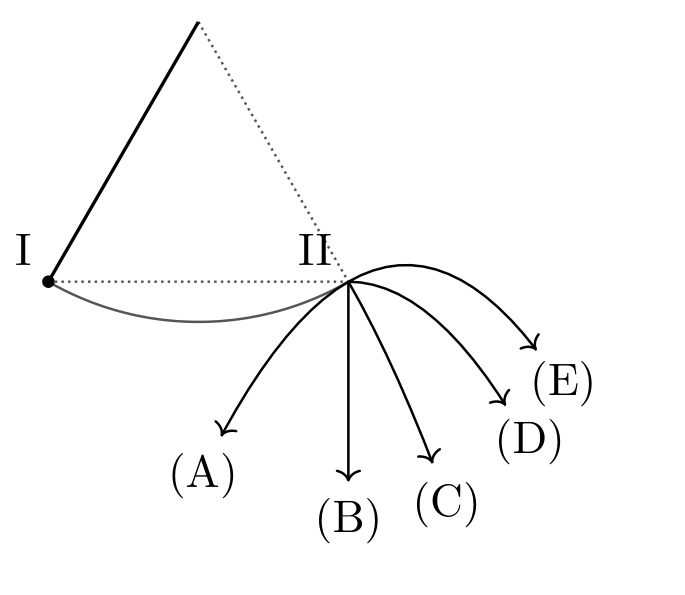
4. A mass on an ideal pendulum is released from rest at point I. It swings over to point II, at which point the string suddenly breaks. Which of the following shows the trajectory of the mass? [1 т.]
5. A uniform solid ball with mass kg and radius cm rolls without slipping on a horizontal plane, so that its center of mass has velocity m/s. What is the ball’s total kinetic energy?
(A) 0.2 J
(B) 0.5 J
(C) 0.7 J
(D) 1 J
(E) 1.4 J [1 т.]
6. A bob of mass hangs from a rigid, massless rod, forming an ideal pendulum. The rod is held horizontally and released from rest. What is its maximum tension during its swing?
(A)
(B)
(C)
(D)
(E) [1 т.]
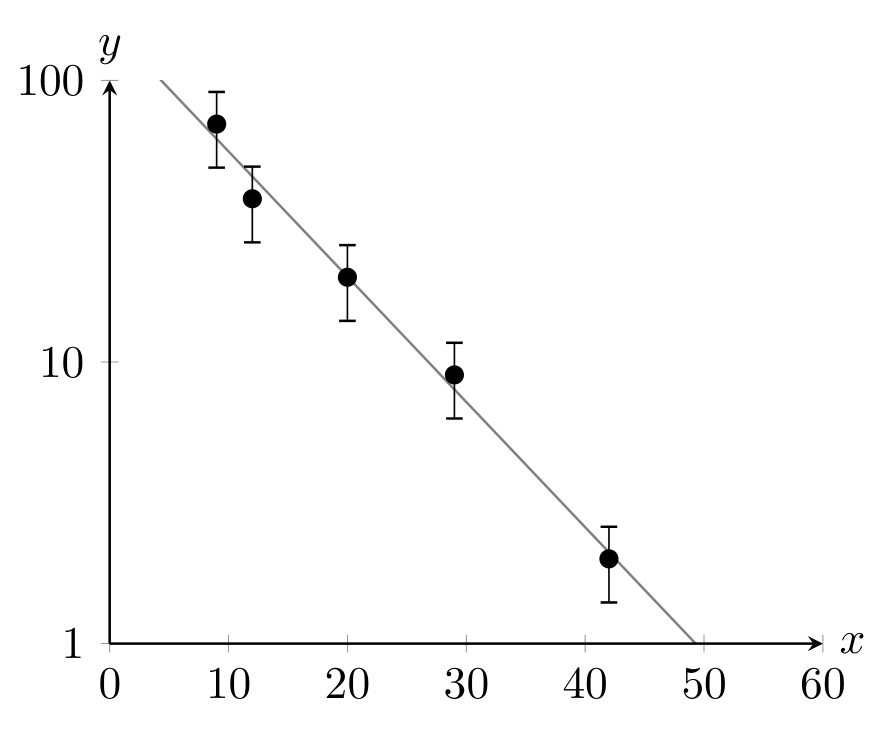
7. The following graph shows the results of measurements of two physical quantities, and . What is the following best describes the functional dependence of on ? Below, and are positive constants. [1 т.]
(A)
(B)
(C)
(D)
(E)
8. A block of mass is placed on a wedge of mass , inclined at an angle to the horizontal. [1 т.]
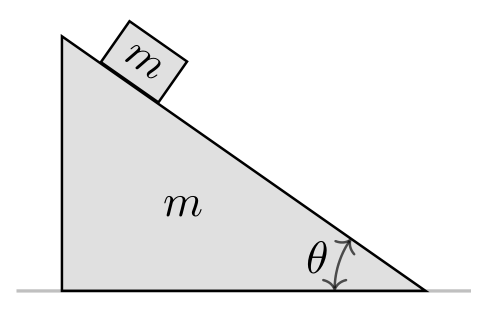
The coefficients of friction between the block and wedge, and the wedge and ground, are high enough for both the block and the wedge to remain static. What is the magnitude of the friction force of the ground on the wedge?
(A)
(B)
(C)
(D)
(E) 0
9. A person is holding a massless rope, on which hangs a mass , as shown at left. To pull the end of the rope with constant upward velocity , the person must exert a force . To pull the end of the rope with constant upward acceleration , the person must exert a force . Now the rope is wrapped around a fixed, massless pulley, and the mass is doubled to , as shown at right. [1 т.]
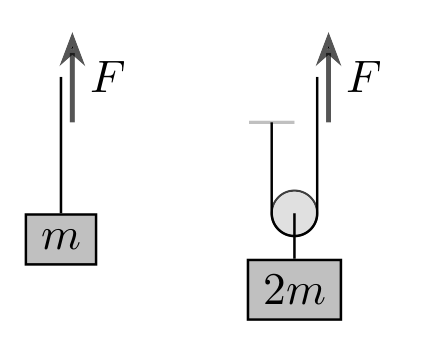
Compared to the original setup, how do the forces and needed to pull the end of the rope with a given upward velocity and acceleration change? In both cases, ignore friction and air resistance.
(A) stays the same, and decreases.
(B) Both and stay the same.
(C) stays the same, and increases.
(D) increases, and stays the same.
(E) Both and increase.
10. The two ends of a uniform rod of length are hung on massless strings of length . [1 т.]
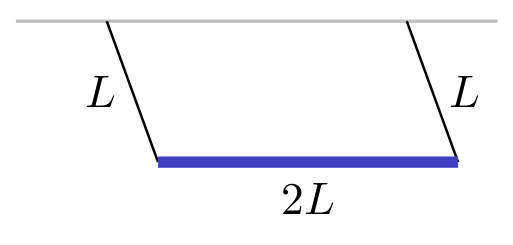
If the strings are attached to the ceiling, and the rod is pulled a small distance horizontally and released as shown, what is the period of oscillation?
(A)
(B)
(C)
(D)
(E)
11. Two identical spherically symmetric planets, each of mass , are somehow held at rest with respect to each other. Each planet has radius , and the distance between the centers of the planets is . If a rocket is launched from the surface of one planet with speed , what is the minimum speed so that the rocket can reach the other planet?
(A)
(B)
(C)
(D)
(E) [1 т.]
12. A pulley is constructed by attaching two concentric cylinders, with the larger cylinder having twice the radius. Ropes are wrapped around both cylinders, a mass is hung from each rope, and the system is released from rest. [1 т.]
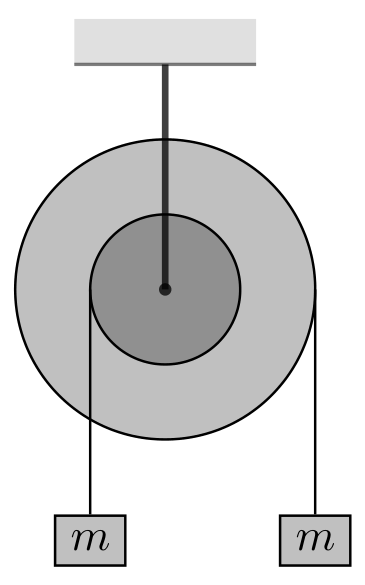
Neglect the masses of the cylinders and ropes. Each mass experiences both a gravitational and a tension force. If the net force experienced by the left mass is , and the net force experienced by the right mass is , what is the ratio ?
(A)
(B)
(C) 1
(D) 2
(E) 4
13. Consider a laptop made of two identical uniform plates, each of mass , connected by a hinge. The hinge is locked when the screen makes an angle to the vertical, as shown, fixing the angle between the two pieces. [1 т.]
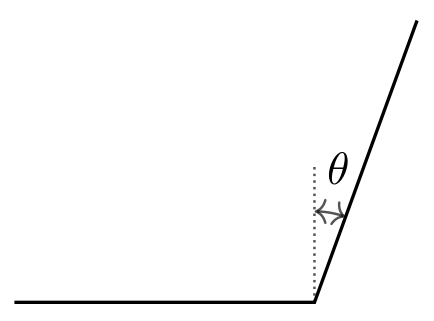
Assuming the laptop does not slip, what is the minimum force that can be exerted on the top of the laptop, in the plane of the page, to cause the bottom of the laptop to lift off the ground?
(A)
(B)
(C)
(D)
(E)
14. A small block is released from rest on the rim of a fixed, frictionless hemispherical bowl. [1 т.]
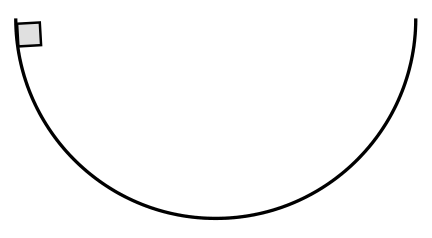
From the time the block is released, until it reaches the bottom of the bowl, which of the following is true?
I. The speed of the block never decreases.
II. The magnitude of the horizontal component of the velocity of the block never decreases.
III. The magnitude of the vertical component of the velocity of the block never decreases.
(A) Only I.
(B) Only III.
(C) I and II.
(D) I and III.
(E) I, II, and III.
15. An egg is launched with speed from the ground, a distance from a vertical wall. [1 т.]
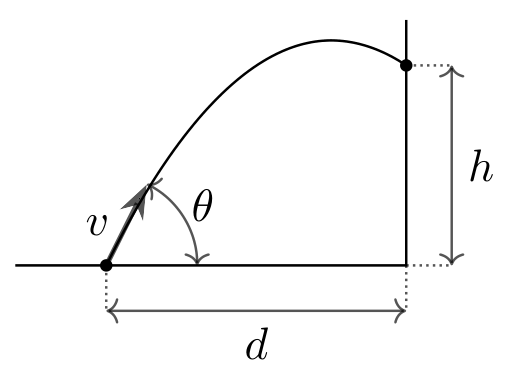
If is high enough for the egg to hit the wall, which of the following could describe the angle that maximizes the height at which the egg hits the wall?
(A)
(B)
(C)
(D)
(E)
16. A hexagonal pencil of uniform density lies at rest on a horizontal table. It is pushed horizontally with a steadily increasing force halfway up its height, as shown. [1 т.]
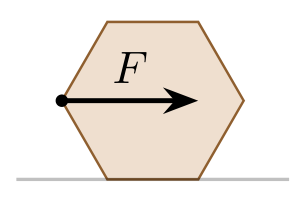
What is the minimum value of the coefficient of static friction between the floor and pencil, so that the pencil will eventually begin to roll?
(A) 0
(B)
(C)
(D)
(E)
17. A thin rod has a nonuniform density. It is mounted on an axle passing perpendicular to it, through its center of mass, as shown, and is then rotated about the axle. [1 т.]

The axle divides the rod into two parts, one on each side of it. Which of the following must be true, no matter how the mass in the rod is distributed?
(A) The two parts have the same mass.
(B) The magnitudes of the momenta of the two parts are equal.
(C) The magnitudes of the angular momenta of the two parts, about the center of mass, are equal.
(D) The kinetic energies of the two parts are equal.
(E) At least two of the above are true.
18. A cylindrical piece of cork of density , height , and cross-sectional area is in a larger empty cylindrical container of cross-sectional area . Water of density is slowly poured into the empty container. What is the height of the water in the container when the cork starts to float?
(A)
(B)
(C)
(D)
(E) [1 т.]
19. A toy elephant is standing on the bottom of a fish tank. The fish tank is filled with water to a depth of , completely covering the toy. The elephant’s legs are perfectly polished, so that there is no water between the bottom of the legs and the tank’s floor, and the total area of contact is . The water has density , the toy has uniform density , the atmospheric pressure is , and the toy has total mass . What is the total hydrostatic force that the water exerts on the toy? [1 т.]
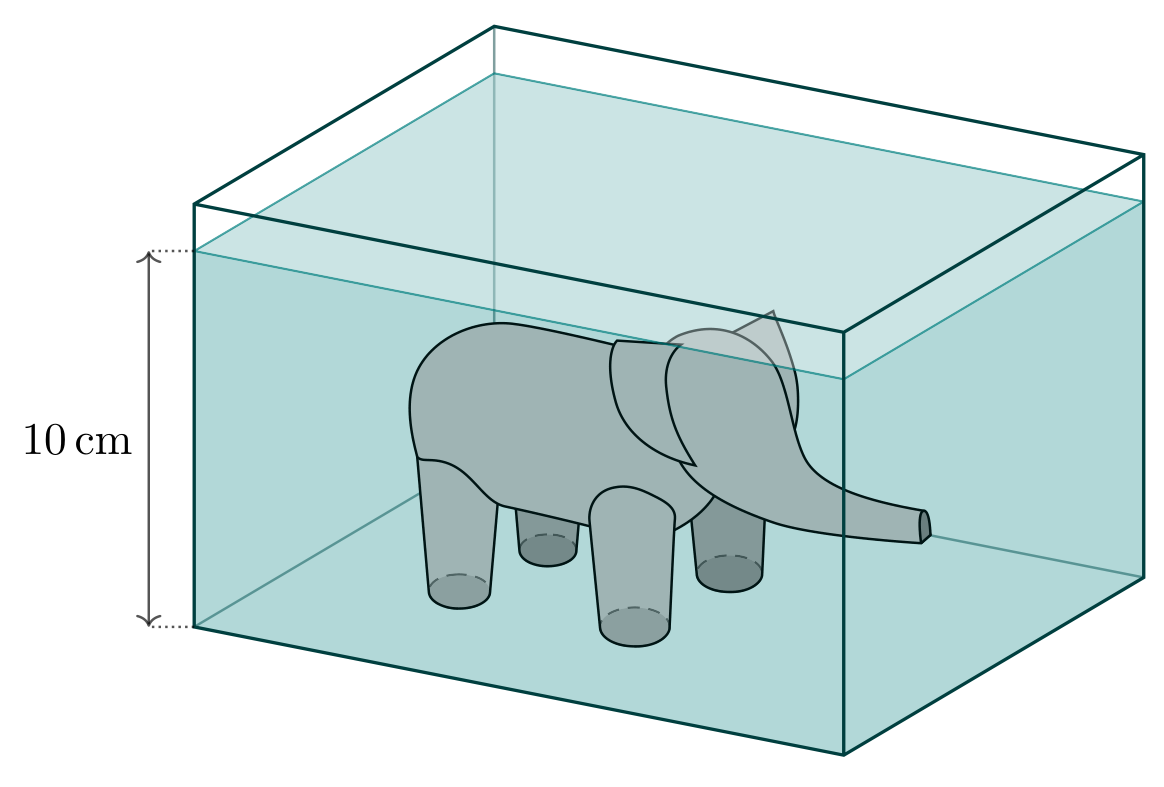
(A) 1 N, down
(B) 0.6 N, down
(C) 0 N
(D) 0.6 N, up
(E) 1 N, up
20. A bead is threaded on a frictionless wire and launched horizontally from height with speed , as shown. If the shape of the wire is steep, as in curve I, then the normal force from the wire on the bead will point inward. If it is shallow, as in curve II, then the normal force will point outward. [1 т.]
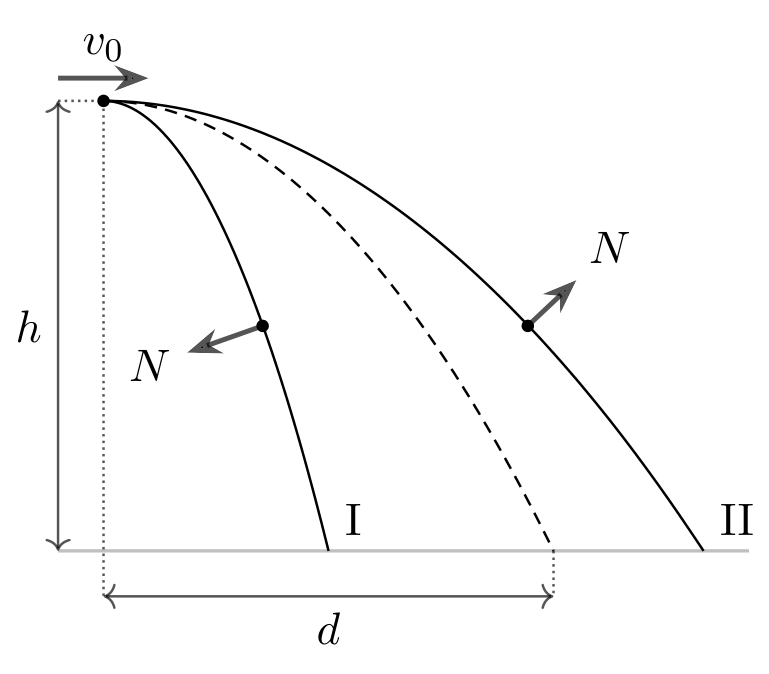
There is exactly one possible shape of wire, shown as a dotted line, for which the normal force of the wire on the bead is always equal to zero. What is the horizontal displacement of the bead when it travels along this wire?
(A)
(B)
(C)
(D)
(E)
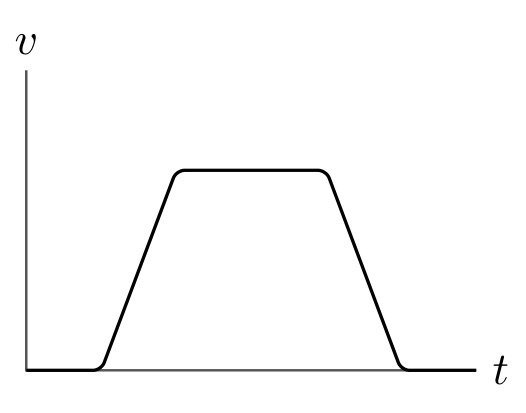
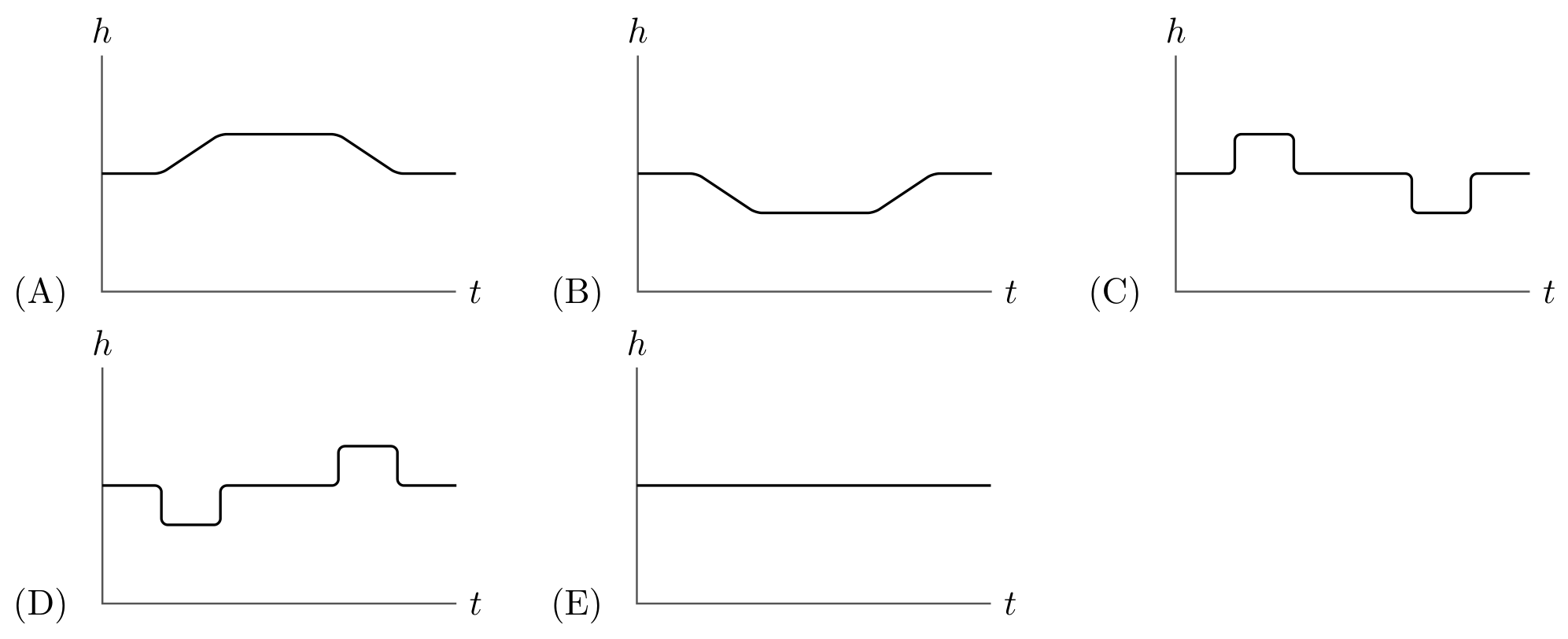
21. A cork floating in a cup filled with a viscous fluid is placed in an elevator. Below is a plot of the velocity of the elevator as a function of time . Which of the following plots best describes the height of the cork in the cup as a function of time? Assume that the fluid is viscous enough to dampen all oscillations, that the fluid does not slosh as the elevator accelerates, and that both the cork and fluid are incompressible. [1 т.]
22. A block of mass is placed symmetrically on two identical wedges of mass , as shown. [1 т.]
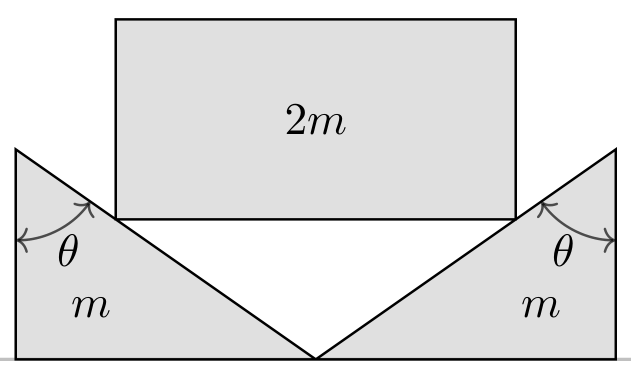
All surfaces are frictionless, and the wedges have angle to the vertical. If the system is released from rest, what is the downward acceleration of the block?
(A)
(B)
(C)
(D)
(E)
23. For objects moving through air, the force of air resistance can be modeled as proportional to the speed (“linear drag”) or proportional to the square of the speed (“quadratic drag”), depending on the circumstances. Two identical objects, and , are dropped from the same height simultaneously, but object is given an initial horizontal velocity . The objects hit the ground at times and . Accounting for air resistance, which of the following is true?
(A) For both linear drag and quadratic drag, .
(B) For linear drag, , while for quadratic drag, .
(C) For linear drag, , while for quadratic drag, .
(D) For both linear drag and quadratic drag, .
(E) For both linear drag and quadratic drag, the answer depends on and . [1 т.]
24. A satellite is in orbit around a planet of mass . Its maximum distance from the center of the planet is , and at this point, it is traveling at a speed of . What is the area of the satellite’s orbit?
(A)
(B)
(C)
(D)
(E) [1 т.]
25. A cylinder is placed with its axis vertical, and a rubber band of mass and tension is wrapped horizontally around it. What is the minimum coefficient of static friction between the rubber band and the cylinder such that the band will not slide down the cylinder?
(A)
(B)
(C)
(D)
(E) [1 т.]
Отговори
- 1. B
- 2. D
- 3. C
- 4. B
- 5. C
- 6. D
- 7. E
- 8. E
- 9. A
- 10. A
- 11. D
- 12. D
- 13. C
- 14. C
- 15. B
- 16. D
- 17. B
- 18. B
- 19. A
- 20. B
- 21. E
- 22. E
- 23. C
- 24. B
- 25. A
Решение
1. (B)
We use the basic kinematic equation . The maximum height is , while the height reached by the time the speed falls to is . Therefore, the maximum height is .
2. (D)
For an object decelerating at a constant rate over a distance , the initial and final velocities, and , are related by . In the case where the car was traveling with an initial speed , this equation gives . In the case where the car was traveling with an initial speed , this equation gives . Thus, , or .
3. (C)
We must consider two cases: either the first block is traveling in the same direction as before, or in the opposite direction. If it is traveling in the opposite direction, the other block must have speed 7 m/s by momentum conservation, so the kinetic energy is higher than before the collision, which is impossible. Therefore, the other block has speed 3 m/s, so the fraction of energy lost is .
4. (B)
When the string breaks, the mass has zero velocity by energy conservation, so it just falls straight down. Thus, the answer is (B).
5. (C)
The translational kinetic energy is . The rotational kinetic energy is , where is the moment of inertia of a uniform ball. Using gives a rotational kinetic energy of , for a total of .
6. (D)
The maximum tension occurs at the bottom of the swing. If the pendulum has length , then by energy conservation,
Thus, the centripetal acceleration at the bottom is
The tension plus the weight together provide this centripetal acceleration, so the tension is .
7. (E)
The plot shows a linear relationship between and , which means that is an exponential in . Since decreases as increases, the answer must be (E).
8. (E)
Gravity exerts a force downward on the block, which means that the wedge must exert a force upward on the block. Thus, the block exerts a force downward on the wedge, and gravity also exerts a force downward on the wedge. Since these forces have no horizontal components, no friction with the ground is necessary to keep the wedge static.
9. (A)
To pull the rope with constant velocity, the forces on the mass must be balanced, which means originally, and with the pulley, so stays the same. In the original setup, the acceleration of the mass must be , so we have . With the pulley, the acceleration of the mass only needs to be , and furthermore any extra force acting on it is doubled. We have , which means , which is smaller than before.
10. (A)
The sum of the tension forces on this pendulum act exactly like the tension force on an ordinary pendulum of length . Thus, the period of oscillation must still be . (Unlike a physical pendulum, the moment of inertia of the rod doesn’t matter, because it never rotates about its center.)
11. (D)
The gravitational force vanishes at the midway point between the planets, so the rocket only needs to have enough energy to get there. The initial and final gravitational potential energies are
Thus, the initial kinetic energy needed is
which implies
12. (D)
This unusual pulley is called a windlass. Since and the right mass is wound around a cylinder of twice the radius, the right mass has twice the acceleration. Since , we have .
13. (C)
When the bottom of the laptop is about to lift off, the normal force is concentrated at the hinge, so we take torques about that point. If the plates have length , the net torque due to gravity is , while the torque due to the applied force is . Therefore, .
14. (C)
Choice III isn’t true, because the vertical velocity starts at zero and ends at zero, so its magnitude must increase and then decrease. Choice I is true because the block is never moving upward, so its potential energy never increases. Choice II is true because the only horizontal force the block experiences is the horizontal component of the normal force, which never points to the left.
15. (B)
This problem is meant to be solved with limiting cases. When , we should have . This rules out choices (A) and (E). When , it is just barely possible to hit the wall at all, and the projectile must be launched at to do this. This rules out choices (C) and (D), leaving choice (B).
16. (D)
If the pencil is about to start rolling, the normal force on it will be concentrated at the far end of the pencil. Taking torques about this point, the torque of the applied force must balance the torque due to gravity. If the pencil has side length , then this implies , which implies . For the pencil to be able to roll, the pencil must not be slipping at this point, which implies .
17. (B)
For simplicity, let’s suppose the rod is made of discrete masses, though the reasoning is exactly the same if the rod is continuous. By the definition of the center of mass, if is the distance of mass from the center of mass, then
The total mass, momentum, angular momentum, and kinetic energy are
Only the momentum has the sum of the same form, so the magnitudes of the momenta are equal, and in general none of the other quantities are equal. (Another easy way to tell that the momenta are equal is that they must be opposite, because we know the total momentum of the rod is zero.)
18. (B)
We will show two alternative solutions.
Archimedes’ principle: The weight of the water displaced has to equal the weight of the cork for the cork to start floating. If the height of the water in the container is , then the weight of the displaced water is
The weight of the cork is
Therefore, we require
Energy: The cork will start floating once the potential energy increase from adding water with the cork touching the bottom of the container is larger than the potential energy increase from the cork floating. Suppose we add a volume of water to the container, when the water level is already . The former costs energy
The latter costs energy
where is the rise in the cork’s height. Equating the two energies gives us the same result: .
19. (A)
If the elephant’s legs weren’t perfectly polished, then the buoyant force would be equal to the weight of the water displaced. Since the elephant’s density is twice that as water, the force would be upward.
However, since the elephant’s legs perfectly contact the floor, they experience no upward hydrostatic pressure. Therefore, we should subtract an upward force , which means the net hydrostatic force is downward.
20. (B)
If the normal force always vanishes, then the bead is only experiencing gravity. In other words, it behaves just like a projectile, and the corresponding shape of the wire is a parabola. The bead travels for a time , so the horizontal displacement is .
21. (E)
By Archimedes’ principle, the fraction submerged only depends on the ratio of densities between the cork and the fluid, so the answer is (E).
The statement of Archimedes’ principle is that the buoyant force is equal to the weight of the water displaced, and the cork floats when its weight equals the buoyant force. The elevator’s acceleration affects the buoyant force and cork weight equally in the noninertial frame of the elevator (both forces are weights), so the fraction submerged does not change.
22. (E)
If the block is moving down with speed , then the wedges need to be moving with speed . This means the total kinetic energy is
This is the same energy as an object of mass would have alone. But when the block moves down by an amount , a gravitational potential energy is released. Thus, the acceleration is .
23. (C)
For linear drag, the horizontal and vertical components of the motion are completely independent,
for some drag coefficient . That means the time to hit the ground, which depends on the vertical motion, is independent of the initial horizontal velocity, so . On the other hand, for quadratic drag,
which means the upward drag force is larger when the horizontal velocity is larger, so .
24. (B)
This problem can be solved in many ways; we will show two alternative solutions.
Geometry: By conserving angular momentum and energy, we find that the distance of closest approach to the planet is . By the basic geometrical properties of ellipses, the semimajor axis is and the semiminor axis is . The area of an ellipse is .
Kepler’s laws: By the vis-viva equation (or by the same steps as in the previous solution), the semimajor axis is . By Kepler’s third law, the period obeys . Finally, by Kepler’s second law, the satellite sweeps out area at a constant rate, which is initially . Therefore,
25. (A)
Suppose the band has area and normal force exerts a pressure outward on the band. Imagine expanding the band slightly, so its radius increases by a small amount . The volume enclosed by the band increases by , whereas its length increases by . But because the band is in mechanical equilibrium, the total work done
must be zero. Thus the outward pressure is
Now, focus on any small patch of the band of area . Because the band is uniform, the weight of this patch is proportional to its area:
The normal force on the patch is , so the force of static friction satisfies
Thus static friction can balance gravity () if
Оригинал в Архива: 2022_Fma_Exam_A.pdf · официални решения: 2022_Fma_Exam_A_Solutions.pdf