USAPhO 2022, Първи кръг, вариант B — Задача 23
2022 F = ma Exam B · 1 т.
Указания
25 QUESTIONS - 75 MINUTES
DO NOT OPEN THIS TEST UNTIL YOU ARE TOLD TO BEGIN
- Use throughout this contest.
- You may write in this booklet of questions. However, you will not receive any credit for anything written in this booklet. You may only use the scratch paper provided by the proctor.
- This test contains 25 multiple choice questions. Select the answer that provides the best response to each question. Please be sure to use a No.2 pencil and completely fill the box corresponding to your choice. If you change an answer, the previous mark must be completely erased. Only the boxes preceded by numbers 1 through 25 are to be used on the answer sheet.
- All questions are equally weighted, but are not necessarily of the same level of difficulty.
- Correct answers will be awarded one point; incorrect answers or leaving an answer blank will be awarded zero points. There is no additional penalty for incorrect answers.
- A hand-held calculator may be used. Its memory must be cleared of data and programs. You may use only the basic functions found on a simple scientific calculator. Calculators may not be shared. Cell phones may not be used during the exam or while the exam papers are present. You may not use any tables, books, or collections of formulas.
- The question booklet, answer sheet and scratch paper will be collected at the end of this exam.
- In order to maintain exam security, do not communicate any information about the questions (or their answers or solutions) on this contest until after February 25, 2022.
DO NOT OPEN THIS TEST UNTIL YOU ARE TOLD TO BEGIN
Acknowledgements
We acknowledge the following people for their contributions to this year’s exams (in alphabetical order):
Tengiz Bibilashvili, Abi Krishnan, Andrew Lin, Kris Lui, Kye Shi, Brian Skinner, Mike Winer and Kevin Zhou
Условие
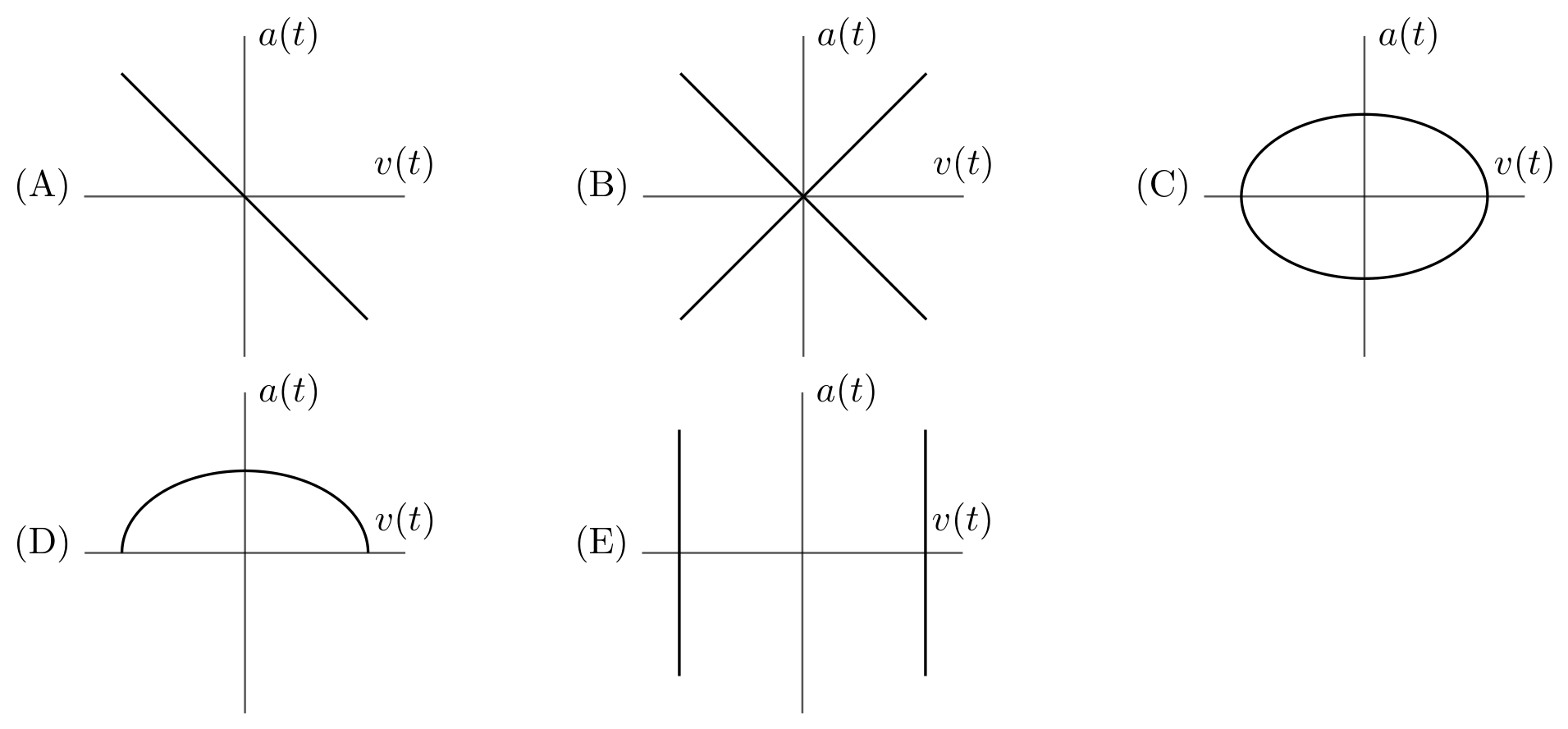
A mass attached to a spring is performing simple harmonic motion, with velocity and acceleration . Which of the following could be a graph of the curve over a complete oscillation?
Отговори
C
The official key marks (C) (the ellipse); the printed solution text ends with “giving choice (B)”, a slip in the source.
Решение
By conservation of energy, . In addition, the acceleration is , which implies that . Therefore, when is plotted against , the result is an ellipse. All combinations of signs of and are possible, so the ellipse occupies all four quadrants, giving choice (B).
Оригинал в Архива: 2022_Fma_Exam_B.pdf · официални решения: 2022_Fma_Exam_B_Solutions.pdf