USAPhO 2024, Полуфинал — Задача 3. Question A3 · Tilt Shift
AAPT AIP UNITED STATES PHYSICS TEAM 2024 — USA Physics Olympiad Exam · 25 т.
Important Instructions for the Exam Supervisor
DO NOT DISTRIBUTE THIS PAGE
- This examination has two parts. Each part has three questions and lasts for 90 minutes.
- For each student, print out one copy of the exam and one copy of the answer sheets. Print everything single-sided, and do not staple anything. Divide the exam into the instructions (pages 2–3), Part A questions (pages 4–7), and Part B questions (pages 8–10). Page 11 is a graph page, in case students wish to use it as an additional page for problem B3.
- Begin by giving students the instructions and all of the answer sheets. Let the students read the instructions and fill out their information on the answer sheets. They can keep the instructions for both parts of the exam. Also give students blank sheets of paper to use as scratch paper throughout the exam.
- Students may bring calculators, but they may not use symbolic math, programming, or graphing features of these calculators. Calculators may not be shared, and their memory must be cleared of data and programs. Cell phones or other electronics may not be used during the exam or while the exam papers are present. Students may not use books or other references.
- To start the exam, collect signed Honesty Policy, give students the Part A questions, and allow 90 minutes to complete Part A. Do not give students Part B during this time, even if they finish with time remaining. At the end of the 90 minutes, collect the Part A questions and answer sheets.
- Then give students a 5 to 10 minute break. Then give them the Part B questions, and allow 90 minutes to complete Part B. Do not let students go back to Part A.
- At the end of the exam, collect everything, including the questions, the instructions, the answer sheets, and the scratch paper. Give them the Honor Code Certification and collect signed Codes. Students may not keep the exam questions.
- After the exam, sort each student’s answer sheets by page number. Scan every answer sheet, including blank ones. Everybody may discuss the questions after April 3rd. Until April 19th, hold on to all of the answer sheets in the event that your scans are lost or illegible.
We acknowledge the following people for their contributions to this year’s exam (in alphabetical order):
Tengiz Bibilashvili, Kellan Colburn, Natalie LeBaron, Rishab Parthasarathy, Elena Yudovina, and Kevin Zhou.
Instructions for the Student
- You should receive these instructions, the reference table on the next page, answer sheets, and blank paper for scratch work. Read this page carefully before the exam begins.
- You may use a calculator, but its memory must be cleared of data and programs, and you may not use symbolic math, programming, or graphing features. Calculators may not be shared. Cell phones or other electronics may not be used during the exam or while the exam papers are present. You may not use books or other outside references.
- When the exam begins, your proctor will give you the questions for Part A. You will have 90 minutes to complete three problems. Each question is worth 25 points, but they are not necessarily of the same difficulty. If you finish all of the questions, you may check your work, but you may not look at Part B during this time.
- After 90 minutes, your proctor will collect the questions and answer sheets for Part A. You may then take a short break.
- Then you will work on Part B. You have 90 minutes to complete three problems. Each question is worth 25 points. Do not look at Part A during this time. When the exam ends, you must return all papers to the proctor, including the exam questions.
- Do not discuss the questions of this exam, or their solutions, until April 4. Violations of this rule may result in disqualification.
Below are instructions for writing your solutions.
- All of your solutions must be written on the official answer sheets. Nothing outside these answer sheets will be graded. Before the exam begins, write your name, student AAPT number, and proctor AAPT number as directed on the answer sheets.
- There are several answer sheets per problem. If you run out of space for a problem, you may use the extra answer sheets, which are at the end of the answer sheet packet. To ensure this work is graded, you must indicate, at the bottom of your last answer sheet for that problem, that you are using these extra answer sheets.
- Only write within the frame of each answer sheet. To simplify grading, we recommend drawing a box around your final answer for each subpart. You should organize your work linearly and briefly explain your reasoning, which will help you earn partial credit. You may use either pencil or pen, but sure to write clearly so your work will be legible after scanning.
Fundamental Constants
Useful Approximations
You may use this sheet for both parts of the exam.
End of Instructions for the Student
DO NOT OPEN THIS TEST UNTIL YOU ARE TOLD TO BEGIN
Условие
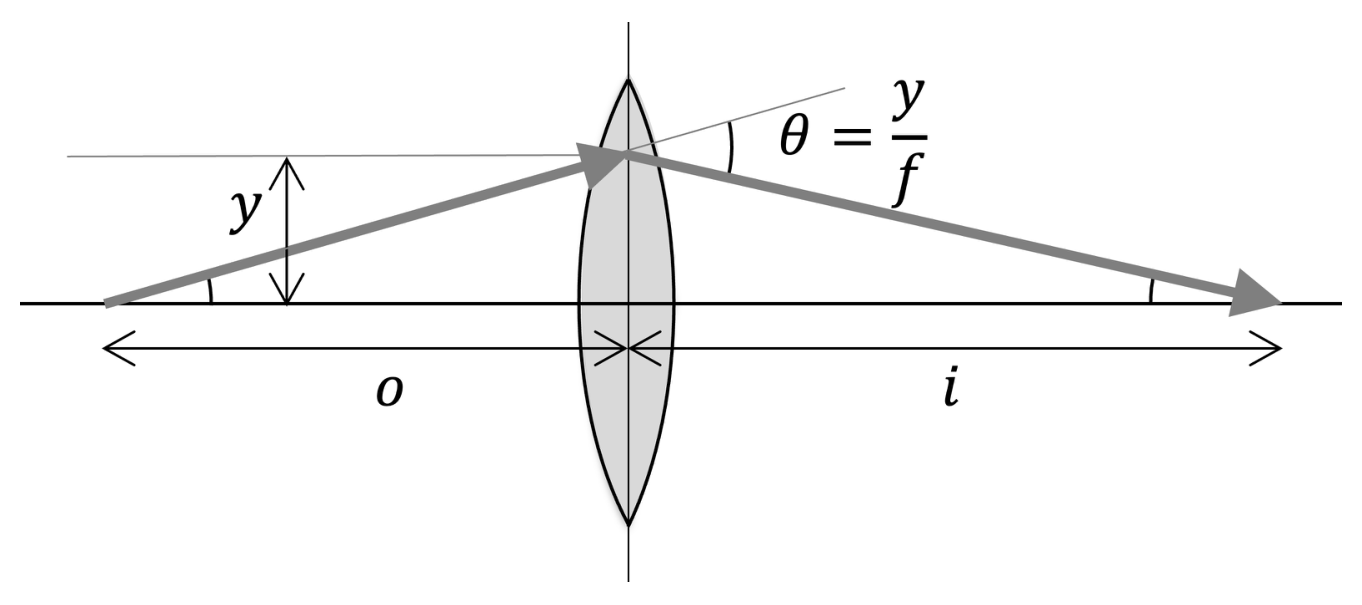
An ideal converging lens of focal length is centered at with its axis of symmetry aligned with the -axis. A light ray incident at height will be tilted inward by an angle . In this problem, we will consider objects at , where . The lens will produce a real image of the object at , where .
Even for an ideal lens, the image of a finite-sized object will generally be distorted.
a. Consider a pointlike object at and . If it moves to the right a small distance , its image moves to the right a distance . If it moves up a small distance , its image moves up a distance . Find and in terms of and .
b. Suppose the object is a short stick, tilted an angle to the -axis. In terms of , , and , what is the angle its image makes with the -axis?
To produce a simple camera, we put the lens right next to a circular aperture of diameter , and place a movable screen behind the lens. Suppose the location of the screen is chosen so that light from very distant objects will be focused to a point on the screen.
c. The light from a pointlike object at finite distance will produce a finite-sized spot of radius on the screen. Find in terms of , , and , assuming .
d. If the camera primarily sees light of wavelength , find a rough estimate for the additional spread of any image on the screen due to diffraction, in terms of , , and .
e. Assuming the typical numbers , , and , find the numeric values of for which the blurring due to geometric effects exceeds the blurring due to diffraction.
Real photos are noisy because light is made of discrete photons, with energy . Suppose the camera is illuminated uniformly with light of intensity , its sensor has pixels, and every photon passing through the aperture is detected, with equal probability, by one pixel in the sensor. This implies that if the expected number of photons arriving at a pixel on the sensor is , the standard deviation of that number is .
f. If the aperture opens for time to take a photo, find the numeric value of for which the standard deviation of the brightness of each pixel is 1% of the mean.
Отговори
- a.
- b.
- c.
- d.
- e. o < 25 m (o ~ D²/(2λ) = 25 m); any answer within an order of magnitude is acceptable
- f. 0.002 s
Решение
a. To compute , it suffices to draw a ray going from through the center of the lens until it hits the image plane at . From similar triangles, we immediately conclude . To find , we take the differential of the lens equation, giving
The quantity is just , so we read off .
b. This follows immediately from the previous part. We have
from which we conclude
This is equivalent to the statement that if you extend the stick and its image, then they will meet at the lens plane , which is called the Scheimpflug principle. It is used in “tilt shift” photography to produce focused images of objects tilted relative to the camera’s plane, by tilting the camera’s screen.
c. Such an object produces an image at
Since we are assuming the camera is focused on infinitely distant objects, the screen is a distance from the lens, so the image of this object is behind the lens. By drawing similar triangles, we conclude .
Alternatively, by drawing similar triangles (or by doing a bit more algebra), you can show that this is the exact answer: , without approximating .
d. In general, diffraction will spread out light in an angle . Thus, it will arrive at the screen spread out by . Any answer within an order of magnitude is acceptable.
e. Setting our previous two expressions equal gives . So for objects at distance , the geometric blurring dominates. Any answer within an order of magnitude is acceptable.
f. On average, the number of photons hitting each pixel is
For the standard deviation to be 1% of the mean, we need to be at least . Plugging in the numbers yields , which is a typical camera shutter speed in good lighting.
Оригинал в Архива: USAPhO_Exam_24.pdf · официални решения: 2024-USAPhO-Exam_solutions.pdf