USAPhO 2024, Полуфинал — Задача 6. Question B3 · Quality Quest
AAPT AIP UNITED STATES PHYSICS TEAM 2024 — USA Physics Olympiad Exam · 25 т.
Important Instructions for the Exam Supervisor
DO NOT DISTRIBUTE THIS PAGE
- This examination has two parts. Each part has three questions and lasts for 90 minutes.
- For each student, print out one copy of the exam and one copy of the answer sheets. Print everything single-sided, and do not staple anything. Divide the exam into the instructions (pages 2–3), Part A questions (pages 4–7), and Part B questions (pages 8–10). Page 11 is a graph page, in case students wish to use it as an additional page for problem B3.
- Begin by giving students the instructions and all of the answer sheets. Let the students read the instructions and fill out their information on the answer sheets. They can keep the instructions for both parts of the exam. Also give students blank sheets of paper to use as scratch paper throughout the exam.
- Students may bring calculators, but they may not use symbolic math, programming, or graphing features of these calculators. Calculators may not be shared, and their memory must be cleared of data and programs. Cell phones or other electronics may not be used during the exam or while the exam papers are present. Students may not use books or other references.
- To start the exam, collect signed Honesty Policy, give students the Part A questions, and allow 90 minutes to complete Part A. Do not give students Part B during this time, even if they finish with time remaining. At the end of the 90 minutes, collect the Part A questions and answer sheets.
- Then give students a 5 to 10 minute break. Then give them the Part B questions, and allow 90 minutes to complete Part B. Do not let students go back to Part A.
- At the end of the exam, collect everything, including the questions, the instructions, the answer sheets, and the scratch paper. Give them the Honor Code Certification and collect signed Codes. Students may not keep the exam questions.
- After the exam, sort each student’s answer sheets by page number. Scan every answer sheet, including blank ones. Everybody may discuss the questions after April 3rd. Until April 19th, hold on to all of the answer sheets in the event that your scans are lost or illegible.
We acknowledge the following people for their contributions to this year’s exam (in alphabetical order):
Tengiz Bibilashvili, Kellan Colburn, Natalie LeBaron, Rishab Parthasarathy, Elena Yudovina, and Kevin Zhou.
Instructions for the Student
- You should receive these instructions, the reference table on the next page, answer sheets, and blank paper for scratch work. Read this page carefully before the exam begins.
- You may use a calculator, but its memory must be cleared of data and programs, and you may not use symbolic math, programming, or graphing features. Calculators may not be shared. Cell phones or other electronics may not be used during the exam or while the exam papers are present. You may not use books or other outside references.
- When the exam begins, your proctor will give you the questions for Part A. You will have 90 minutes to complete three problems. Each question is worth 25 points, but they are not necessarily of the same difficulty. If you finish all of the questions, you may check your work, but you may not look at Part B during this time.
- After 90 minutes, your proctor will collect the questions and answer sheets for Part A. You may then take a short break.
- Then you will work on Part B. You have 90 minutes to complete three problems. Each question is worth 25 points. Do not look at Part A during this time. When the exam ends, you must return all papers to the proctor, including the exam questions.
- Do not discuss the questions of this exam, or their solutions, until April 4. Violations of this rule may result in disqualification.
Below are instructions for writing your solutions.
- All of your solutions must be written on the official answer sheets. Nothing outside these answer sheets will be graded. Before the exam begins, write your name, student AAPT number, and proctor AAPT number as directed on the answer sheets.
- There are several answer sheets per problem. If you run out of space for a problem, you may use the extra answer sheets, which are at the end of the answer sheet packet. To ensure this work is graded, you must indicate, at the bottom of your last answer sheet for that problem, that you are using these extra answer sheets.
- Only write within the frame of each answer sheet. To simplify grading, we recommend drawing a box around your final answer for each subpart. You should organize your work linearly and briefly explain your reasoning, which will help you earn partial credit. You may use either pencil or pen, but sure to write clearly so your work will be legible after scanning.
Fundamental Constants
Useful Approximations
You may use this sheet for both parts of the exam.
End of Instructions for the Student
DO NOT OPEN THIS TEST UNTIL YOU ARE TOLD TO BEGIN
Условие
The quality factor is a dimensionless number which quantifies how efficiently a system stores energy and how strongly it responds on resonance. For a circuit consisting of a capacitor , an inductor , and a small resistance in series, the resonant frequency is approximately , and the quality factor, assumed to be large throughout this problem, is
In this problem, we explore several ways to measure . Uncertainty analysis is not required.
a. Alice measures by seeing how oscillations in the circuit damp over time. Suppose that initially, the charge on the capacitor is and the current is zero. The next time the current is zero, the charge is . Find an approximate expression for , in terms of and .
b. Bob and Charles drive their circuits with a sinusoidal voltage . It can be shown that in the steady state, the voltage across the capacitor oscillates with amplitude
The circuits Bob and Charles have are similar, but are not precisely the same.
b. i. Bob fixes the value of so that the highest value of at any frequency is precisely . His equipment can precisely compare the amplitudes of a small DC and AC voltage. He thus performs two very accurate voltage measurements.
| (rad/s) | 0.0 | 183.3 |
|---|---|---|
| (Volts) | 0.1219 | 0.1219 |
Using this data, find the numeric values of and as accurately as possible.
b. ii. Charles can precisely tune , but cannot precisely measure small voltages. He thus fixes to some other value and takes data near the resonance, where is relatively large.
| (rad/s) | 133.0 | 133.5 | 134.0 | 134.5 | 135.0 | 135.5 | 136.0 | 136.5 | 137.0 |
|---|---|---|---|---|---|---|---|---|---|
| (Volts) | 3.64 | 4.76 | 6.52 | 8.53 | 8.18 | 6.06 | 4.44 | 3.42 | 2.75 |
Using this data, find the numeric values of and as accurately as possible. (Hint: you may use the graph paper in the answer sheets, but full credit is attainable without graphing. To find , you should first find , then simplify the equation above using .)
c. The gain function of this circuit is defined as , where is the amplitude of the voltage across the resistor, as shown below.
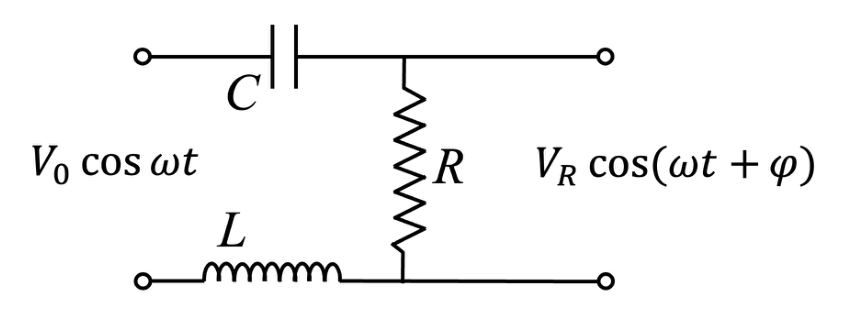
c. i. Find an expression for in terms of , , and .
c. ii. This setup can be used to reject voltages at certain frequencies. Qualitatively describe the range(s) of frequencies for which is small.
Отговори
a.
b. i.
b. ii.
The official solution takes ω₀ = 134.7 rad/s (any answer within 0.1 rad/s accepted); its two-point analysis gives Q = 89.3, against the true answer Q = 88.0 (a good result is within ±3).
c. i.
c. ii. G is small everywhere except for a narrow band of frequencies around ω₀, whose width is of order ω₀/Q.
Решение
a. In the absence of resistance, the charge on the capacitor and the current are
The total energy dissipated in the resistor is approximately
On the other hand, we also have
Equating the two yields
b. i. Note that at , we simply have , while on resonance, we have . Thus, in this case we can directly read off the quality factor as
As for the other data point, it also has , which implies
This can be simplified by recognizing a difference of squares, giving
and solving for gives
Alternatively, since we know , we know that the term is negligible, to the precision at which we’re working. Simply dropping that term gives , which gives the same numeric answer, up to the four significant figures used in this part.
b. ii. The maximum value of is attained at . Looking at the data, we can see that is between 134.5 and , and slightly closer to the former; we therefore take . This result is already as precise as the precision of the data allows, so there’s no point in trying to improve it further. Any answer within is acceptable.
The next step is to extract . Since all the data is taken near resonance, , we have
We don’t know , so we divide through to get
So plotting vs. gives a line with slope and intercept , from which we find . It would take too long to apply this to all of the data points, so let’s just select one near the resonance and one at the ends, as such a pair yields maximal sensitivity to the slope and intercept.
| (rad/s) | (V) | () | |
|---|---|---|---|
| 134.5 | 8.53 | 0.01374 | |
| 137.0 | 2.75 | 0.1322 |
The slope of this line is , from which we compute an intercept , and a quality factor . This is a very rough analysis, but it gets pretty close to the true answer of .
There are many ways to do this problem. You can get decent accuracy (i.e. within of the true answer) just by eyeballing the graph. A good result will be within of the true answer. The analysis above is more than twice as precise as that, and you can do even better by repeating the analysis using the point at the other end, , and averaging the results. Ideally, this will give you the same answer, but in practice there are errors on and at , which averaging would partially cancel out.
c. i. This is simplest using complex impedances. We note that
Simplifying a bit gives the final answer,
c. ii. This setup is a frequency filter. The gain is small everywhere except for a narrow band of frequencies around , whose width is of order .
Оригинал в Архива: USAPhO_Exam_24.pdf · официални решения: 2024-USAPhO-Exam_solutions.pdf