USAPhO 2024, Първи кръг — Задача 17
2024 Exam · 1 т.
Указания
25 QUESTIONS - 75 MINUTES
DO NOT OPEN THIS TEST UNTIL YOU ARE TOLD TO BEGIN
- Use throughout, unless otherwise specified.
- You may write in this question booklet and the scratch paper provided by the proctor.
- This test has 25 multiple choice questions. Select the best response to each question, and use a No.2 pencil to completely fill the box corresponding to your choice. If you change an answer, completely erase the previous mark. Only use the boxes numbered 1 through 25 on the answer sheet.
- All questions are equally weighted, but are not necessarily equally difficult.
- You will receive one point for each correct answer, and zero points for each incorrect or blank answer. There is no additional penalty for incorrect answers.
- You may use a hand-held calculator. Its memory must be cleared of data and programs. You may use only the basic functions found on a simple scientific calculator. Calculators may not be shared. Cell phones may not be used during the exam or while the exam papers are present. You may not use any external references, such as books or formula sheets.
- The question booklet, answer sheet and scratch paper will be collected at the end of this exam.
- To maintain exam security, do not communicate any information about the questions or their solutions until after February 24, 2024.
DO NOT OPEN THIS TEST UNTIL YOU ARE TOLD TO BEGIN
We acknowledge the following people for their contributions to this year’s exams (in alphabetical order):
Tengiz Bibilashvili, Orhun Ciftcioglu, Kellan Colburn, Natalie LeBaron, Brian Skinner, Elena Yudovina and Kevin Zhou
Условие
Consider the following system of massless and frictionless pulleys, ropes, and springs.
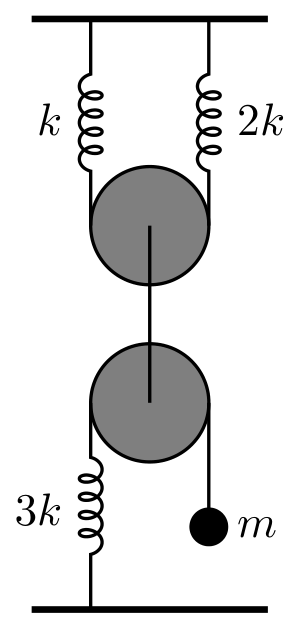
Initially, a block of mass is attached to the end of a rope, and the system is in equilibrium. Next the block is doubled in mass, and the system is allowed to come to equilibrium again. During the transition between these equilibria, how far does the end of the rope (where the block is suspended) move?
(A)
(B)
(C)
(D)
(E)
Отговори
- \dfrac{11}{6}\dfrac{mg}{k}
Решение
When the block is doubled in mass, it increases the tension in the bottom string by , so the third spring’s length increases by . Since the bottom pulley has two ropes pulling down on it, the downward force on it increases by , which means the upward force on the top pulley also has to increase by , so the tension in the top string also increases by . Then the first and second springs increases in length by and .
Finally, by considering how changes in length of each spring affect the position of the mass, we conclude
Оригинал в Архива: 2024_F-ma_Exam.pdf · официални решения: 2024_F-ma_Solutions.pdf