USAPhO 2024, Първи кръг — Задача 7
2024 Exam · 1 т.
Указания
25 QUESTIONS - 75 MINUTES
DO NOT OPEN THIS TEST UNTIL YOU ARE TOLD TO BEGIN
- Use throughout, unless otherwise specified.
- You may write in this question booklet and the scratch paper provided by the proctor.
- This test has 25 multiple choice questions. Select the best response to each question, and use a No.2 pencil to completely fill the box corresponding to your choice. If you change an answer, completely erase the previous mark. Only use the boxes numbered 1 through 25 on the answer sheet.
- All questions are equally weighted, but are not necessarily equally difficult.
- You will receive one point for each correct answer, and zero points for each incorrect or blank answer. There is no additional penalty for incorrect answers.
- You may use a hand-held calculator. Its memory must be cleared of data and programs. You may use only the basic functions found on a simple scientific calculator. Calculators may not be shared. Cell phones may not be used during the exam or while the exam papers are present. You may not use any external references, such as books or formula sheets.
- The question booklet, answer sheet and scratch paper will be collected at the end of this exam.
- To maintain exam security, do not communicate any information about the questions or their solutions until after February 24, 2024.
DO NOT OPEN THIS TEST UNTIL YOU ARE TOLD TO BEGIN
We acknowledge the following people for their contributions to this year’s exams (in alphabetical order):
Tengiz Bibilashvili, Orhun Ciftcioglu, Kellan Colburn, Natalie LeBaron, Brian Skinner, Elena Yudovina and Kevin Zhou
Условие
A particle travels in a straight line. Its velocity as a function of time is shown below.
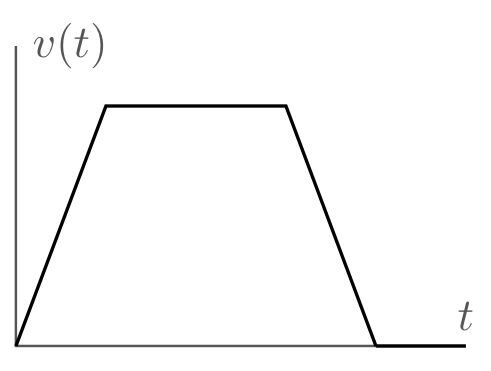
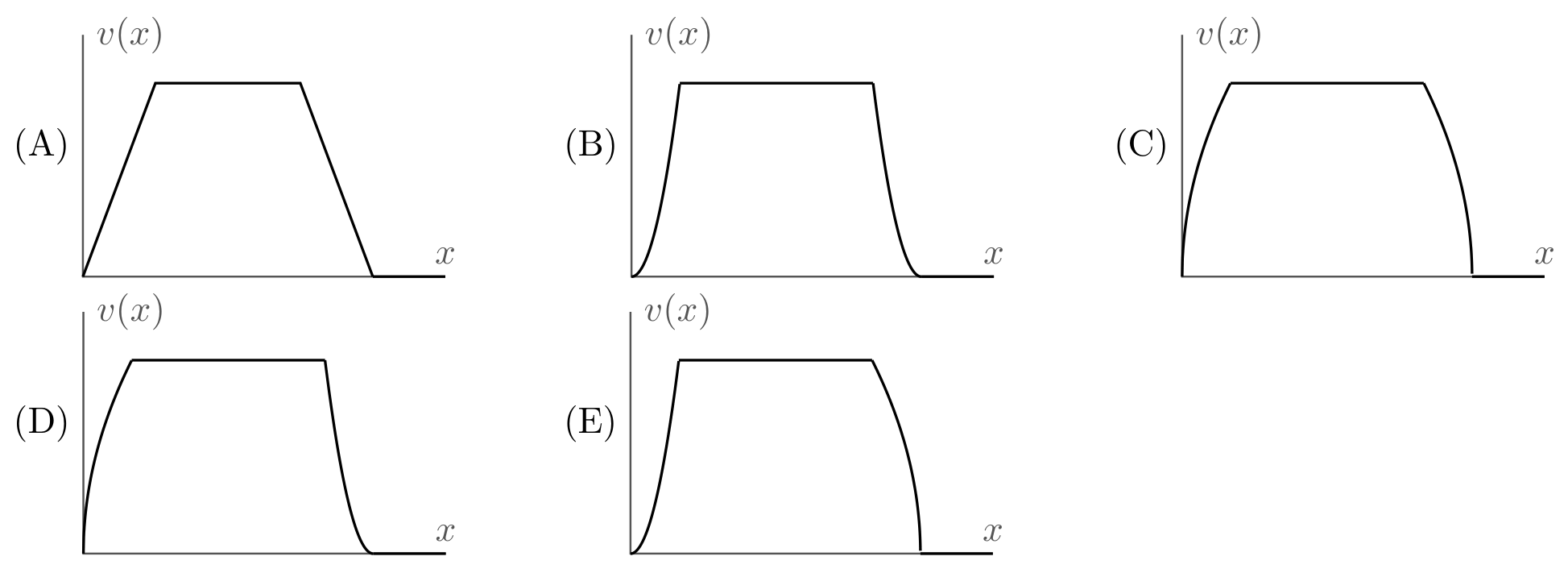
Which of the following shows the velocity as a function of distance from its initial position?
Отговори
- (C)
Решение
The particle accelerates uniformly, then travels at a constant velocity for some time, then decelerates uniformly down to resting. As a function of distance, then, the velocity must also increase, then stay constant for some time, then decrease down to 0. Since velocity vs. time is symmetric, velocity vs. distance must be symmetric as well; if the movie were played backwards, it should look the same. When the particle is accelerating uniformly, its velocity is proportional to , while the distance is proportional to (e.g. as in free fall): consequently, velocity is proportional to the square root of distance.
Оригинал в Архива: 2024_F-ma_Exam.pdf · официални решения: 2024_F-ma_Solutions.pdf