USAPhO 2025, Полуфинал — A1. Shake It
2025 USA Physics Olympiad Exam · 25 т.
Внимание: Бележка към темата
The supplied archive folder contains the complete question packet and the official interleaved solution packet. The separate problem cover sheets and blank response paper named in the instructions are absent. Printed source errors are retained: A2 refers to “part 1” and “part 5” despite its lettered subparts; A3's key uses in the wire-segment force although the question uses ; B1's key changes inertia symbols from to and prints ; B3's key uses a sum from to in its finite-mode derivation, and its Taylor expansion uses for the cubic sine term. The source is transcribed as printed, without mathematical corrections.
AAPT UNITED STATES PHYSICS TEAM — AIP 2025; USA Physics Olympiad Exam — Instructions for the Student
All smartphones, tablets, smartwatches, and other internet-connected devices must be handed in before the exam begins. You may only use the desktop computer, laptop, or Chromebook designated for taking the exam.
You must remain in the exam room for the entire testing period.
You should receive:
- This instruction page
- A reference sheet (on the next page)
- Problem cover sheets
- Blank paper for solutions and scratch work
Read this page carefully before the exam begins.
You may use a calculator, provided its memory has been cleared. You may not use any symbolic math, programming, or graphing features. Calculators may not be shared. Cell phones or any other unauthorized electronics may not be used at any time while the exam is in progress or while exam materials are present. Outside books or references are not allowed.
When the exam begins, click on the link for Part A. Once you click “Start,” a timer will begin. You will have 90 minutes to complete three problems. Each problem is worth 25 points, but they may differ in difficulty. When finished, you may review your work, but do not proceed to Part B.
After 90 minutes, your proctor will collect your Part A answer sheets. Do not include scratch work. You will then have a short break.
After the break, click on the link for Part B. You will again have 90 minutes to complete three problems. Each is worth 25 points.
At the end of Part B, you must return:
- Your Part B answer sheets (no scratch work)
- All blank and used scratch paper
- These instruction pages
Copyright ©2025 American Association of Physics Teachers
Instructions for Writing Your Solutions
- Do not discuss any part of the exam until April 11th. Any violation may result in disqualification.
Instructions for Writing Your Solutions
All work must be done on the provided blank pages. You may use as many plain and/or graph sheets as needed for each problem. Work outside of these pages will not be graded.
To help with grading, please draw a clear box around your final answer to each subpart.
Organize your work clearly and explain your reasoning concisely. Partial credit may be awarded for well-reasoned work, even if the final answer is incorrect.
You may write in either pencil or pen, but make sure your work is legible and scan-friendly.
Copyright ©2025 American Association of Physics Teachers
REFERENCE SHEET
Fundamental Constants
Useful Approximations
Useful Identities
You may use this sheet for both parts of the exam.
End of Instructions for the Student
DO NOT CLICK THE LINK FOR PART A UNTIL YOU ARE TOLD TO BEGIN
We acknowledge the US Physics Team coaches and other people for their contributions to this year’s exam (in alphabetical order):
Tengiz Bibilashvili, Kellan Colburn, Natalie LeBaron, Rishab Parthasarathy, Mai Qi, Kye Shi, Heng Yuan and Elena Yudovina.
Copyright ©2025 American Association of Physics Teachers
Условие
Most hairy mammals shake after getting wet; shaking the water off is energetically advantageous to waiting for it to dry on its own. In this problem, we investigate the mechanics of shaking off water. For simplicity, we will model animals as solid cylinders with the sides covered in fur. You may ignore gravity throughout the problem.
a. We can model the shaking by assuming that the angular position of the cylinder undergoes a sinusoidal oscillation: . (The rotation is about the axis of rotational symmetry.) Letting the radius of the cylindrical animal be , derive an expression for the magnitude of the acceleration of a point on the surface of the animal under such a motion.
b. For the rest of this problem, rather than modeling sinusoidal motion, we will assume that the cylindrical animal is simply spinning at constant angular speed . Wet fur tends to separate into cylindrical clumps of radius . A droplet of water on the end of a clump of fur will be separated from it if the centripetal force overcomes the forces due to surface tension. Derive an approximate relationship (valid up to scalar numerical constants) between the surface tension , the radius of the fur clump, the radius of the animal, the angular speed , and the density of water. The diagram below show the cross-section of the animal, showing four clumps of fur with droplets on their end.
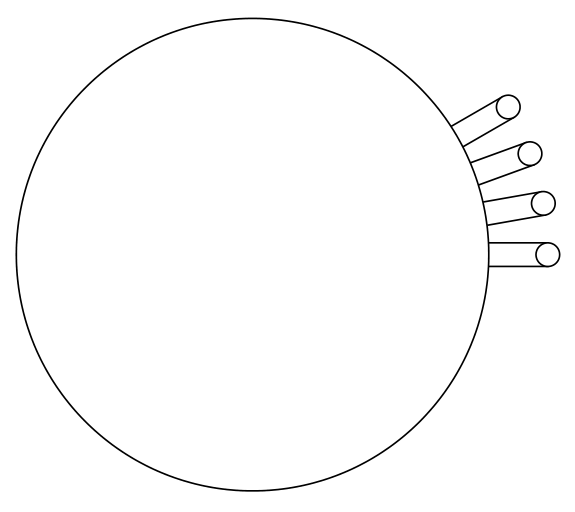
c. Experimentally, it is observed that all mammalian fur forms clumps of similar radius. Under the assumption that different animals all have the same density and are simply scaled copies of each other (i.e. larger animals are both longer and fatter), the relationship between an animal's mass and its angular velocity of shaking is of the form : find the value of .
d. Shaking requires energy, which we can crudely model as the rotational energy of the corresponding cylinder. An alternative strategy for the animal is to simply air-dry their fur, which requires energy to evaporate the water. Assume a wet animal has approximately 5% of their body weight in water, and has to supply all the energy for evaporating the water. Our model predicts that for some animal sizes, it will be energetically advantageous to air dry themselves: estimate the range of animal masses for which this is true. You may use the following facts: a mouse weighs 20 g, has a radius of 1 cm, and shakes itself with angular velocity . The latent heat of vaporization of water at room temperature is .
Решение
a. Since we're ignoring gravity, there's two components to the acceleration: radial, , and tangential, . (Terms involving vanish, since the radius is constant.) They add in quadrature, so the magnitude is
b. At first glance this doesn't look like a valid dimensional analysis problem, since there are two lengths involved ( and ). However, the surface tension force can depend only on and , while the centripetal force depends only on , , and the mass of the droplets . Since surface tension has units of force per linear distance, the two forces scale as and , and we write .
Note that the surface tension term "should" be proportional to , since the circumference of the fur clump (rather than its radius) is the relevant linear dimension; but this doesn't change the scaling behavior.
c. Since , , and are constant, we simply have . Since the animals are proportional cylinders, we have , so .
d. Since we found , the energy of shaking scales as , while the energy of air-drying simply scales with the animal mass. So, for large enough animals, air drying should be energetically advantageous. However, constants are important!
For a cylindrical mouse, we find that the energy of shaking is
and the energy of evaporating the water is
For an arbitrary cylindrical animal, we have
and
For these to become equal, we must have
or . This is the right order of magnitude for the mass of an asteroid (and many orders of magnitude too heavy to be a land mammal), so it's not surprising that just about all mammals prefer to remove the water mechanically instead!
This analysis was based on the article Dickerson, Andrew K et al. "Wet mammals shake at tuned frequencies to dry." Journal of the Royal Society, Interface vol. 9,77 (2012): 3208-18, accessible online at https://pmc.ncbi.nlm.nih.gov/articles/PMC3481573/
Оригинал в Архива: USAPhO_Exam_25.pdf · официални решения: 2025-USAPhO-Exam_solutions.pdf