USAPhO 2025, Полуфинал — B1. Scroll ’n’ Roll
2025 USA Physics Olympiad Exam · 25 т.
Внимание: Бележка към темата
The supplied archive folder contains the complete question packet and the official interleaved solution packet. The separate problem cover sheets and blank response paper named in the instructions are absent. Printed source errors are retained: A2 refers to “part 1” and “part 5” despite its lettered subparts; A3's key uses in the wire-segment force although the question uses ; B1's key changes inertia symbols from to and prints ; B3's key uses a sum from to in its finite-mode derivation, and its Taylor expansion uses for the cubic sine term. The source is transcribed as printed, without mathematical corrections.
AAPT UNITED STATES PHYSICS TEAM — AIP 2025; USA Physics Olympiad Exam — Instructions for the Student
All smartphones, tablets, smartwatches, and other internet-connected devices must be handed in before the exam begins. You may only use the desktop computer, laptop, or Chromebook designated for taking the exam.
You must remain in the exam room for the entire testing period.
You should receive:
- This instruction page
- A reference sheet (on the next page)
- Problem cover sheets
- Blank paper for solutions and scratch work
Read this page carefully before the exam begins.
You may use a calculator, provided its memory has been cleared. You may not use any symbolic math, programming, or graphing features. Calculators may not be shared. Cell phones or any other unauthorized electronics may not be used at any time while the exam is in progress or while exam materials are present. Outside books or references are not allowed.
When the exam begins, click on the link for Part A. Once you click “Start,” a timer will begin. You will have 90 minutes to complete three problems. Each problem is worth 25 points, but they may differ in difficulty. When finished, you may review your work, but do not proceed to Part B.
After 90 minutes, your proctor will collect your Part A answer sheets. Do not include scratch work. You will then have a short break.
After the break, click on the link for Part B. You will again have 90 minutes to complete three problems. Each is worth 25 points.
At the end of Part B, you must return:
- Your Part B answer sheets (no scratch work)
- All blank and used scratch paper
- These instruction pages
Copyright ©2025 American Association of Physics Teachers
Instructions for Writing Your Solutions
- Do not discuss any part of the exam until April 11th. Any violation may result in disqualification.
Instructions for Writing Your Solutions
All work must be done on the provided blank pages. You may use as many plain and/or graph sheets as needed for each problem. Work outside of these pages will not be graded.
To help with grading, please draw a clear box around your final answer to each subpart.
Organize your work clearly and explain your reasoning concisely. Partial credit may be awarded for well-reasoned work, even if the final answer is incorrect.
You may write in either pencil or pen, but make sure your work is legible and scan-friendly.
Copyright ©2025 American Association of Physics Teachers
REFERENCE SHEET
Fundamental Constants
Useful Approximations
Useful Identities
You may use this sheet for both parts of the exam.
End of Instructions for the Student
DO NOT CLICK THE LINK FOR PART A UNTIL YOU ARE TOLD TO BEGIN
We acknowledge the US Physics Team coaches and other people for their contributions to this year’s exam (in alphabetical order):
Tengiz Bibilashvili, Kellan Colburn, Natalie LeBaron, Rishab Parthasarathy, Mai Qi, Kye Shi, Heng Yuan and Elena Yudovina.
Copyright ©2025 American Association of Physics Teachers
Условие
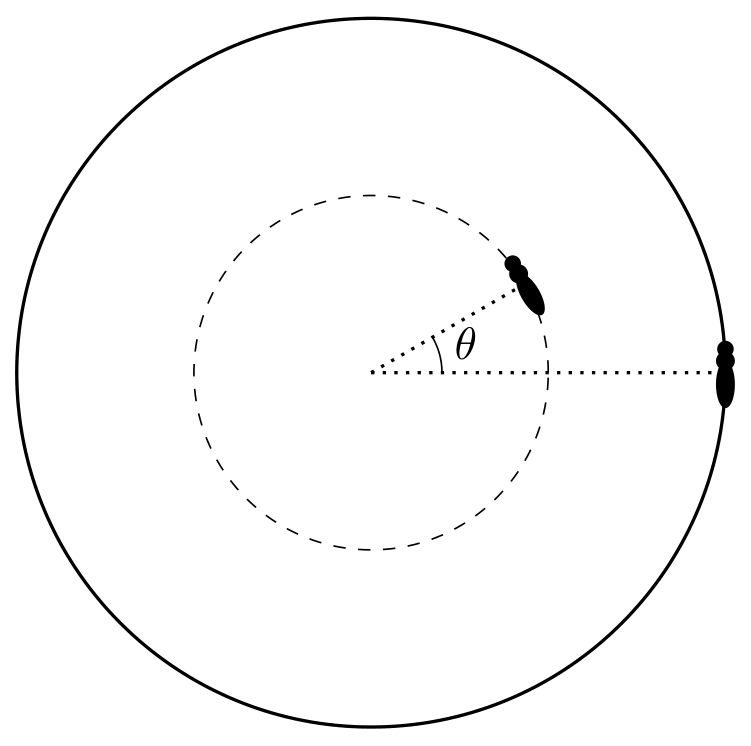
Consider a disk with mass and radius placed on a large and frictionless table. An ant with mass is placed on top of the disk. The ant can move freely without sliding on the disk.
a. Initially, the ant starts on the edge of the disk, and both the ant and the disk are at rest (relative to the table). Then, the ant starts walking across the disk's diameter, such that in the frame of the disk, the ant has (constant) velocity . What is ant's velocity in the frame of the table?
b. Suppose instead that the ant walks counterclockwise along the edge of the disk at constant speed in the frame of the disk. What is the ant's speed in the frame of the table?
c. Now there are two ants on the disk! The second ant (also of mass ) starts at distance from the center of the disk, with an angle offset by from the first ant. The second ant walks counterclockwise around this circle with radius at speed (relative to the disk). Find all such that the second ant is stationary in the frame of the table.
Решение
a. Initially, the ant starts on the edge of the disk, and both the ant and the disk are at rest (relative to the table). Then, the ant starts walking across the disk's diameter, such that in the frame of the disk, the ant has (constant) velocity . What is ant's velocity in the frame of the table?
By conservation of momentum,
The ant's velocity is .
b. Suppose instead that the ant walks counterclockwise along the edge of the disk at constant speed in the frame of the disk. What is the ant's speed in the frame of the table?
For the solution, we're considering the disk to be the unit disk, and the ant to be positioned at crawling counterclockwise (which is also the direction).
We can decompose the movement of the disk into a rotation about the (fixed) disk-ant center of mass, and a rotation about its own center. Write for the angular velocity of the disk about the combined center of mass, and for the angular velocity of the disk about its center.
Letting be the ant's speed in the table's reference frame, we find
Conservation of linear momentum and conservation of angular momentum give
where is the moment of inertia of the disk about its own center of mass, and is the moment of inertia of the disk about the combined center of mass. By the parallel axis theorem,
Solving everything, we find
and therefore
c. Now there are two ants on the disk! The second ant (also of mass ) starts at distance from the center of the disk, with an angle offset by from the first ant. The second ant walks counterclockwise around this circle with radius at speed (relative to the disk). Find all such that the second ant is stationary in the frame of the table.
First, if , the second ant is starting out at the center of mass; we claim this means that he doesn't affect the movement of the system. Since the disk is rotating at about its center, the original position of the ant would be moving at velocity relative to the center of the disk; hence, by moving at relative to the center of the disk, the ant manages exactly to stay in place.
Now suppose there is some other such angle . Consider the triangle formed by the two ants and the center of the circle. The description of the ants' movement ensures that this triangle moves as a rigid body (the relative positions of the ants and the center of the disk remain fixed). The center of mass of the system, which is at the center of this triangle, is fixed in the reference plane of the table. If we were to also fix the second-ant vertex in place, the system simply wouldn't be able to move. The only way out is to make the "center of the triangle" and the "vertex" coincide, by placing the second ant at the center of mass.
Оригинал в Архива: USAPhO_Exam_25.pdf · официални решения: 2025-USAPhO-Exam_solutions.pdf