USAPhO 2026, Полуфинал — A1. 404 Vision Not Found
2026 USA Physics Olympiad Exam
Внимание: Бележка към темата
The supplied archive folder contains the full question packet and the official interleaved key. The cover titled “Instructions for the Student” contains only a reference sheet and acknowledgements; no administrative instructions, timing, point allocations or blank answer sheets are supplied. These values remain unspecified. Printed source inconsistencies are preserved: A3's key changes to , prints an empty equation label (0-5), has a plus sign in radial force balance (0-12) followed by a positive pressure gradient (0-13), and gives the exterior pressure without any radial dependence. B2 refers to “part (2)” despite lettered subparts, and its key uses the angle between the asymptote rays as the deflection angle. B3 refers to “part (1)” despite lettered subparts. The original key is transcribed without mathematical corrections.
AAPT UNITED STATES PHYSICS TEAM — AIP 2026; USA Physics Olympiad Exam — Instructions for the Student — REFERENCE SHEET
Fundamental Constants
Useful Approximations
You may use this sheet for both parts of the exam.
We acknowledge the US Physics Team coaches and other people for their contributions to this year’s exam (in alphabetical order):
Tengiz Bibilashvili, Eddie Chen, Kellan Colburn, Evan Erickson, Harry Kroft, Natalie LeBaron, Rishab Parthasarathy.
Условие
A robot is equipped with an eye containing an adjustable thin lens mounted at the front. A small flat retina-like sensor is mounted on the optical axis at the back of the eye. The distance from the lens to the sensor is
The circular aperture of the lens (the pupil) has diameter
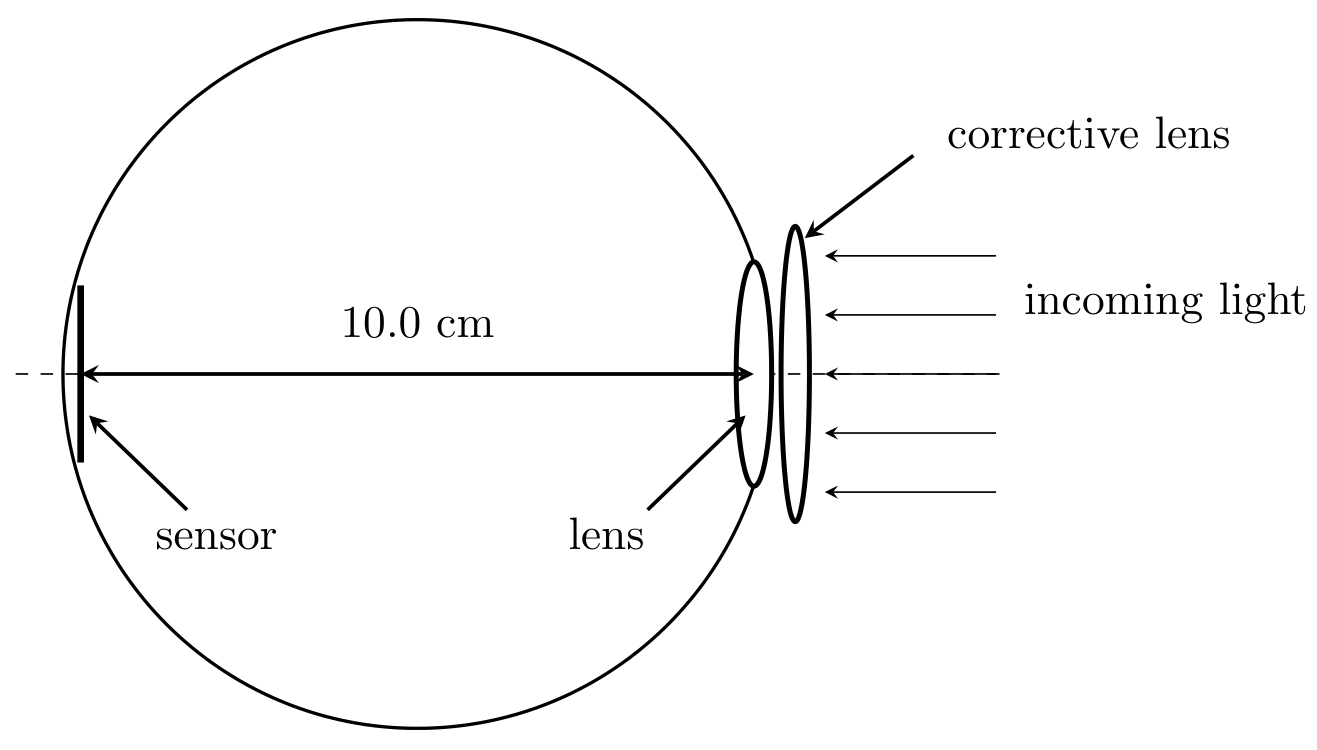
By adjusting its internal lens, the robot can focus sharply on objects whose distances lie between
In this problem, treat all lenses as thin.
(a)
Find both the range of focal lengths and the range of optical powers through which the internal lens is adjustable.
The robot is to be adapted for two new functions:
- observing stars (objects at infinity),
- reading printed material at a distance of 25.0 cm.
To do this, a thin corrective lens is placed immediately in front of the eye. Neglect the separation between this corrective lens and the eye lens.
(b)
Find the range of optical powers of the corrective lens that allows the robot to observe stars.
(c)
Can a single corrective lens allow the robot to both observe stars and read at 25.0 cm? Explain your answer.
(d)
Estimate the diffraction-limited maximum print resolution (in dots per inch, dpi) when viewing a page at 25.0 cm. Use light of wavelength
(e)
When viewing a stellar object, the eye lens is adjusted so that the image forms on the sensor. The total optical power collected by the pupil is . Due to diffraction at the pupil, the image is a central bright spot (Airy disk).
(i) Estimate the intensity at the sensor in terms of , , and the parameters of the eye.
(ii) By what factor does the intensity change if, while observing the same object, the pupil diameter is reduced from 5.0 mm to 2.0 mm?
Решение
(a) The image distance is fixed at m. The thin lens equation gives . Since optical power is , we have . For m, D. For m, D. Thus, D. Since , the focal-length range is cm.
(b) For stars, , so the corrective lens must form a virtual image at a distance that lies within the robot's normal focusing range: . For the corrective lens, . Since , . Thus, D.
(c) To read at 25.0 cm, the total optical power required is D. The internal lens can provide powers in the range D. Thus, the corrective lens must provide , which gives D. From part (b), observing stars requires D. These intervals do not overlap, so no single corrective lens can perform both functions.
(d) The diffraction-limited angular resolution is approximately . Using m, m, we get rad. At a viewing distance m, the smallest resolvable spacing is m. Thus, .
(e) (i) The diffraction-limited spot has characteristic size . Thus the area scales as . Hence .
(ii) Since , we have . Thus, , so the intensity decreases by a factor of about 39.
Оригинал в Архива: 2026-USAPhO.pdf · официални решения: 2026-USAPhO-Solutions.pdf