WoPhO 2011, Теория — Задача 3. Theoretical 3: Mirage
Edwin Soeryadjaya Problem. Theoretical 3: Mirage
Условие
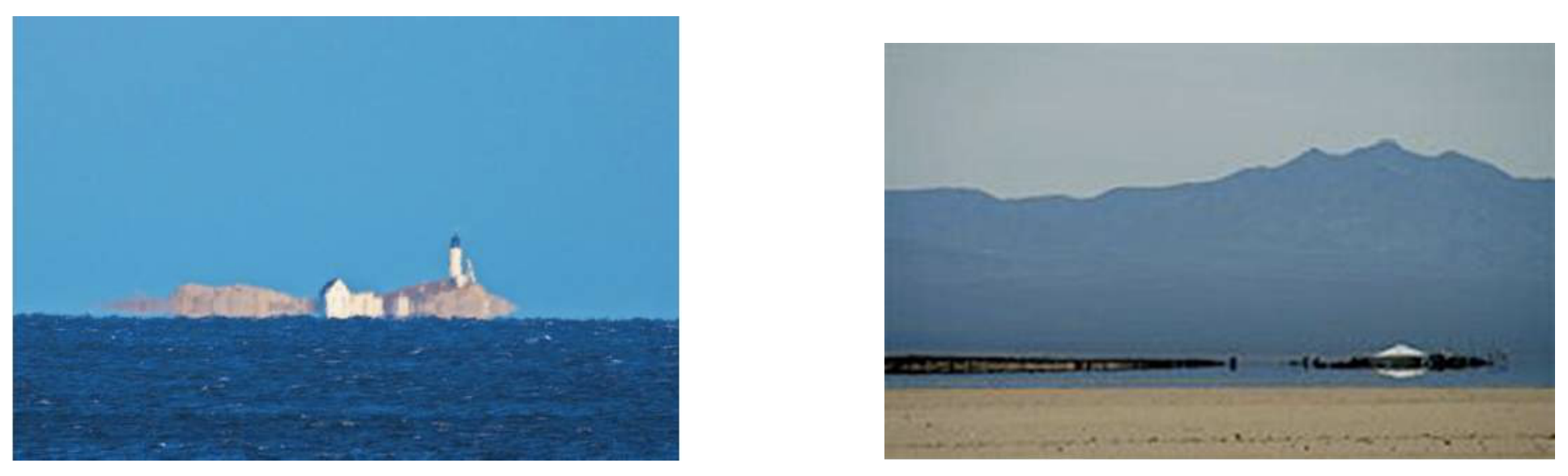
The refractive index of the air varies with temperature. Cold air is denser than warm air and has therefore a greater refractive index. Thus a temperature gradient in the atmosphere is always associated with a gradient of the refractive index. Under certain conditions, this gradient of the refractive index could be strong enough so that light rays are bent to produce a displaced image of distant objects. This amazing phenomenon is called a mirage. Mirages can be categorized as ”inferior” and ”superior”. Inferior mirages can be seen on deserts and highways, and superior mirages occur over the sea.
To describe in detail the phenomenon of the mirage, we need to analyze the path of light rays in media with a refractive index gradient.
1 The path of a light ray and the trajectory of a mass point
Media with a refractive index gradient can be treated as being formed from thin homogeneous layers with different refractive indices. The path of a light ray can be determined then by analyzing refractions of the light ray at interfaces between these thin homogeneous layers. But there exists a more convenient way for determining the path of a light ray in media with a refractive index gradient. Instead of analyzing the propagation of the light, one may study the motion of a mass point that moves along the path of the light ray, driven by a conservative force. The potential energy of the conservative force field depends on the distribution the refractive index. Once the potential energy is established, one may study the motion of the mass point by using well developed tools in classical mechanics, and find the trajectory of a mass point which is also the path of the light ray.
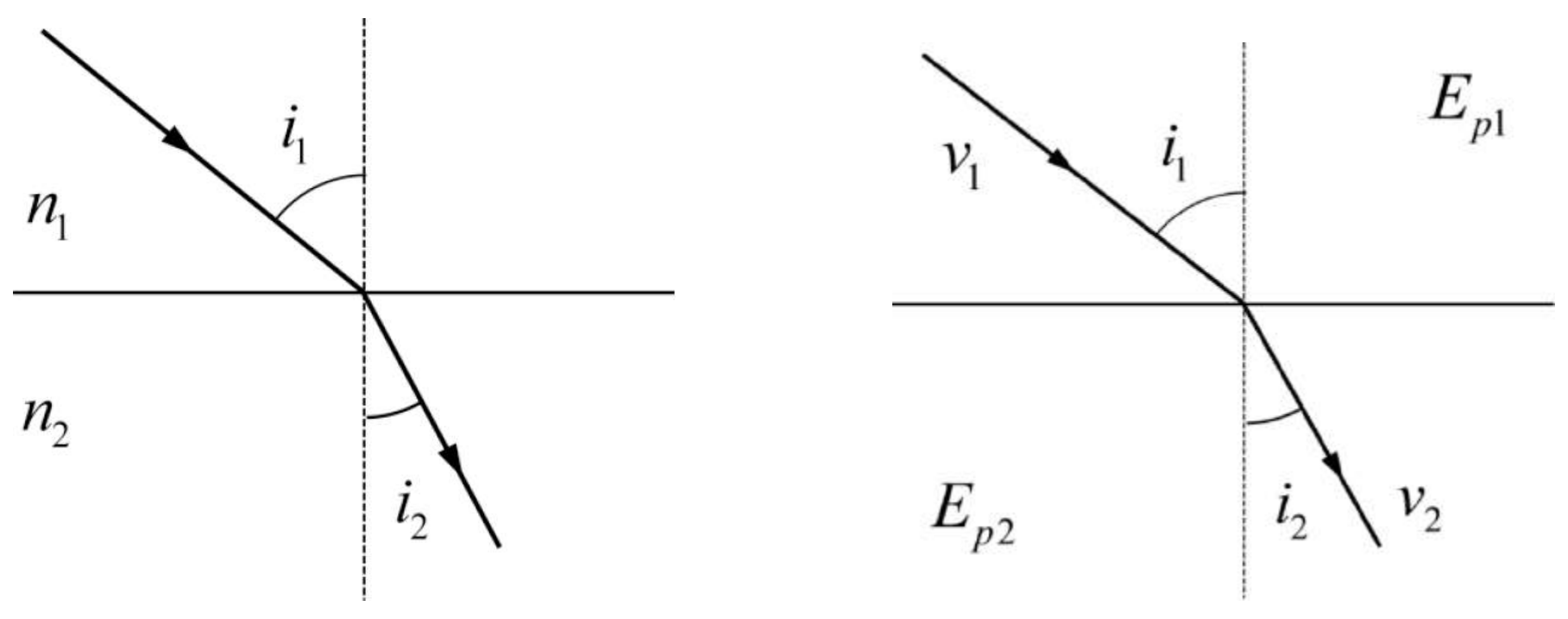
1(a) Refraction of a light ray at the interface between a medium with a refractive index and a medium with a refractive index is shown in Fig. 2a. The angles and obey the Snell’s law
The path of a mass point in a conservative force field is illustrated in Fig. 2b. The speed of the mass point is in the region with the potential energy , and in the region with the potential energy . Find expressions for and so that the relation hold also for the trajectory of the mass point. You may use an arbitrary constant expressions with the dimension of speed in your expressions. (0.2 points)
1(b) Assume that the mass of the mass point is , and the total energy of the mass point equals to zero. Find the potential energies and in , and . (0.2 points)
1(c) The trajectory of a mass point with a mass in a conservative force field is the same as the path of a light ray in a medium with a refractive index which is a function of the position. The total energy of this mass point is zero. Find expressions for the potential energy of the conservative force field and the speed of the mass point . (0.4 points)
1(d) To describe the motion of a mass point, one expresses the position of the mass point as a function of time: . To describe the trajectory of a mass point, one needs to express the position of the mass point as a function of the distance traveled by the mass point from the start point of the trajectory to the current position: . Derive a differential equation for the trajectory of a mass point with a mass and a total energy that moves in a conservative force field. (0.6 points)
Hint: in a conservative force field, satisfies Newtons second law:
where
[0,6 т.]
1(e) Derive the light ray equation (a differential equation for the path of a light ray) by using the results obtained in (c) and (d). (0.6 points)
Hint: [0,6 т.]
2 The inferior mirage
When an inferior mirage appears, an image of a distant object can be seen under the real object. A direct image of that object is seen because some of the light rays enter the eye in a straight line without being refracted. The double images seem to be that of the object and its upside-down reflection in water. For exhausted travelers in the desert it seems like that there is a lake of water in front of them.
An inferior mirage occurs when a strong positive gradient of refractive index is present near the ground. We use the following model to describe the variation of the refractive index of the air with elevation:
with and .
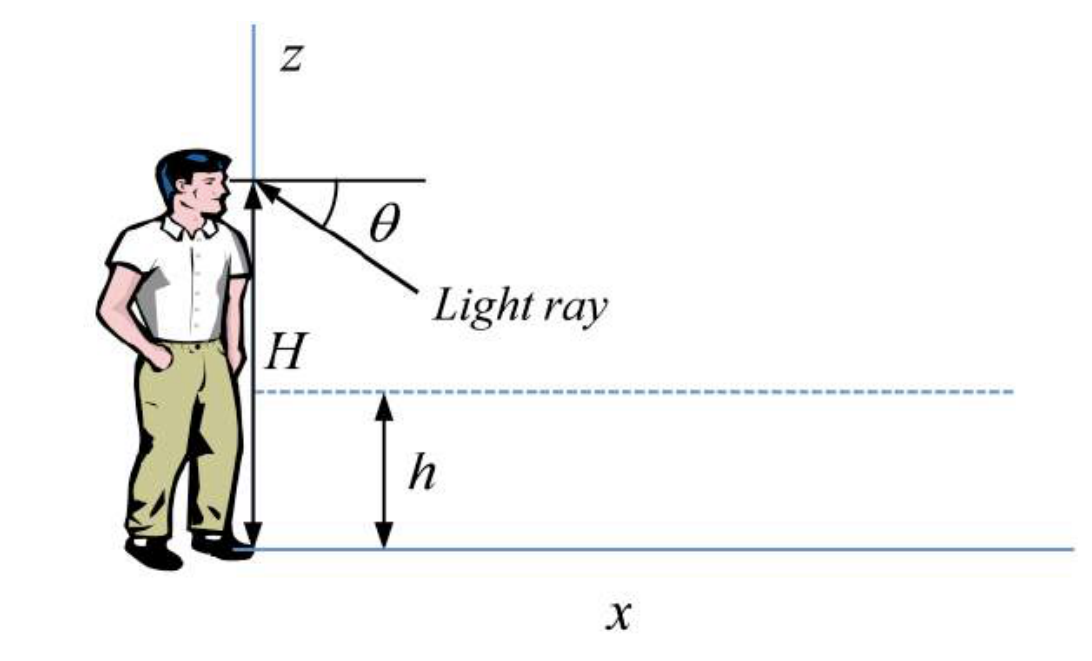
2(a) Find the path of a light ray (i.e. as a function of ) that enters in an observer’s eye at an angle (see Fig. 3). The height of the observers eye is . (1.9 points)
2(b) Due to the inferior mirage, the observer can see an inverted image of the upper part of a camel at a large distance. The parameters for the refractive index of the air are , . The height of the observers eye is , and the height of the camel is . Find the minimum values for the distance between the observer and the camel so that the observer still can see the inverted image of the upper part of the camel. You may use the approximation . (0.7 points)
2(c) As a result of the light refraction in the region with refractive index gradient, the observer cannot see the lower part of the camels legs. Find the height of the lowest point () on the camel at the distance that can still be seen by the observer. (0.7 points)
2(d) Find the distance between the observer and the imaginary lake of water. (0.3 points)
3 The superior mirage
When a superior mirage occurs, light rays that were originally directed above the line of sight of the observer will reach the observer’s eyes. Thus, an object ordinarily below the horizon will be apparently above the horizon.
A superior mirage occurs when a negative gradient of refractive index is present over a body of water or over large sheets of ice. We use the following model to describe the refractive index of the atmosphere (see Fig. 4):
where is the radius of the earth, and .
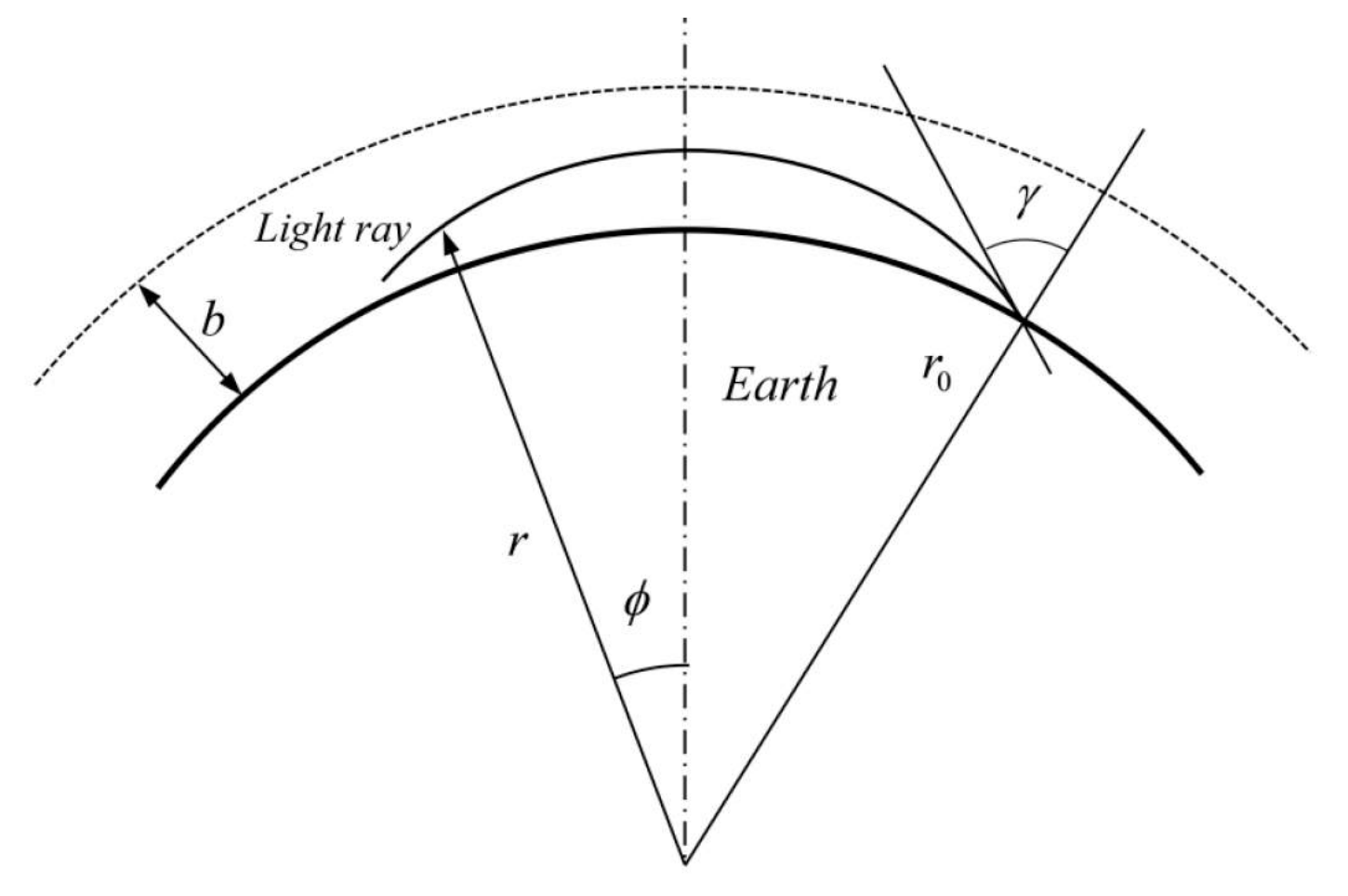
3(a) Find the path of a light ray (i.e. as a function of ) within the range . Use , the angle between the light ray and the vertical direction at the sea level as the parameter of the path. (1.4 points)
Hint: The trajectory of a mass point with mass , angular momentum and total energy in a conservative force field with
is
where
We also have
[1,4 т.]
3(b) Find the minimum value of () at which the superior mirage occurs. Use the following values for and : , . (0.8 points)
3(c) Under a certain atmospheric condition, with and , calculate the largest distance at which the surface of the sea can be seen by an observer at an altitude ( is the altitude of the observer’s eye). (1.4 points)
Useful formula: for . [1,4 т.]
3(d) For comparison, calculate the largest distance at which the surface of the sea can be seen by an observer at the same altitude , when the refractive index of the air is constant. (0.3 points)
3(e) Calculate the angular difference between the apparent horizon when a superior mirage occurs as described in 3(c) and the apparent horizon in a normal day as described in 3(d), seen at the same altitude . (0.5 points)
Отговори
1(a)
1(b)
1(c)
1(d)
The official solution prints the accompanying speed as ; from energy conservation it should be . Kept as printed in the solution text.
1(e)
2(a) Piecewise path: for ; for ; for , with and .
2(b)
2(c) 0.475 m
2(d) ≈ m
3(a)
3(b)
3(c)
3(d)
3(e) 0.0069 rad
The official solution also gives .
Решение
Solution
1 The path of a light ray and the trajectory of a mass point
1.1 The component of the conservative force parallel to the interface is null, thus
This relation becomes
if
(0.2 point)
1.2 and (0.2 point)
1.3 (0.2 point)
and
(0.2 point)
1.4 , thus . (0.2 point)
The equation for the trajectory is
with (0.4 point)
1.5 becomes
(0.2 point)
But and
Therefore
(0.4 point)
2 The inferior mirage
2.1 The path of light ray is a straight line for
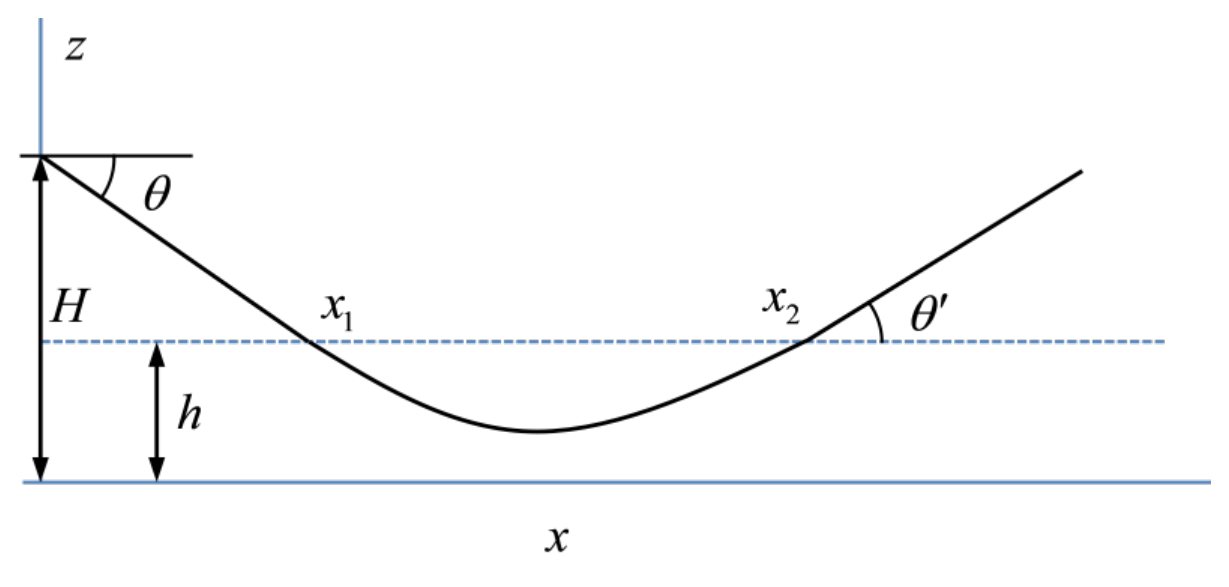
Thus
(0.2 point)
with
(0.1 point)
For , the corresponding potential energy is
(0.2 point)
The equation of motion of the corresponding mass point is then
(0.2 point)
With the initial condition
(0.2 point)
So we have
(0.2 point)
By eliminating in above equations, we obtain
(0.2 point)
This expression can also be written as
This path may reach in the region with if
or
(0.2 point)
The value of can determined by the following condition
We find
(0.1 point)
We also have
(0.1 point)
Then we have for
(0.2 point)
We can express the path of light ray as
with
and
2.2 Let be the coordinate of the camel. To see the inverted image of the upper part of a camel we must have
(0.1 point)
and
(0.1 point)
Substituting the expression for we find
(0.2 point)
For small , decreases with , so is minim for
Thus
(0.3 point)
2.3 Let be the height of a point on the camel. If the observer can see this point, then we must have
(0.1 point)
with . As so We also have and
(0.1 point)
Let , we have then
To find to minim of we need to calculate the derivative
(0.1 point)
The condition for minim is then
This equation can be solved numerically. Let and
We found
| 1 | 2 | 3 | 4 | 5 | |
|---|---|---|---|---|---|
| 0.0455 | 0.0499 | 0.0504 | 0.0505 | 0.0505 |
Thus reaches minim at
(0.4 point)
2.4 If a refracted light ray enters the observer’s eye at the angle , the observer will consider the ray being reflected from a water surface at a distance equal to . The minim value of this distance is the distance between the observer and the “lake”. Thus
(0.3 point)
3 The superior mirage
3.1 For
(0.1 point)
with
(0.2 point)
and
(0.2 point)
The angular momentum equals to
(0.2 point)
And the total energy . Thus the path is given by
(0.1 point)
with
(0.3 point)
and
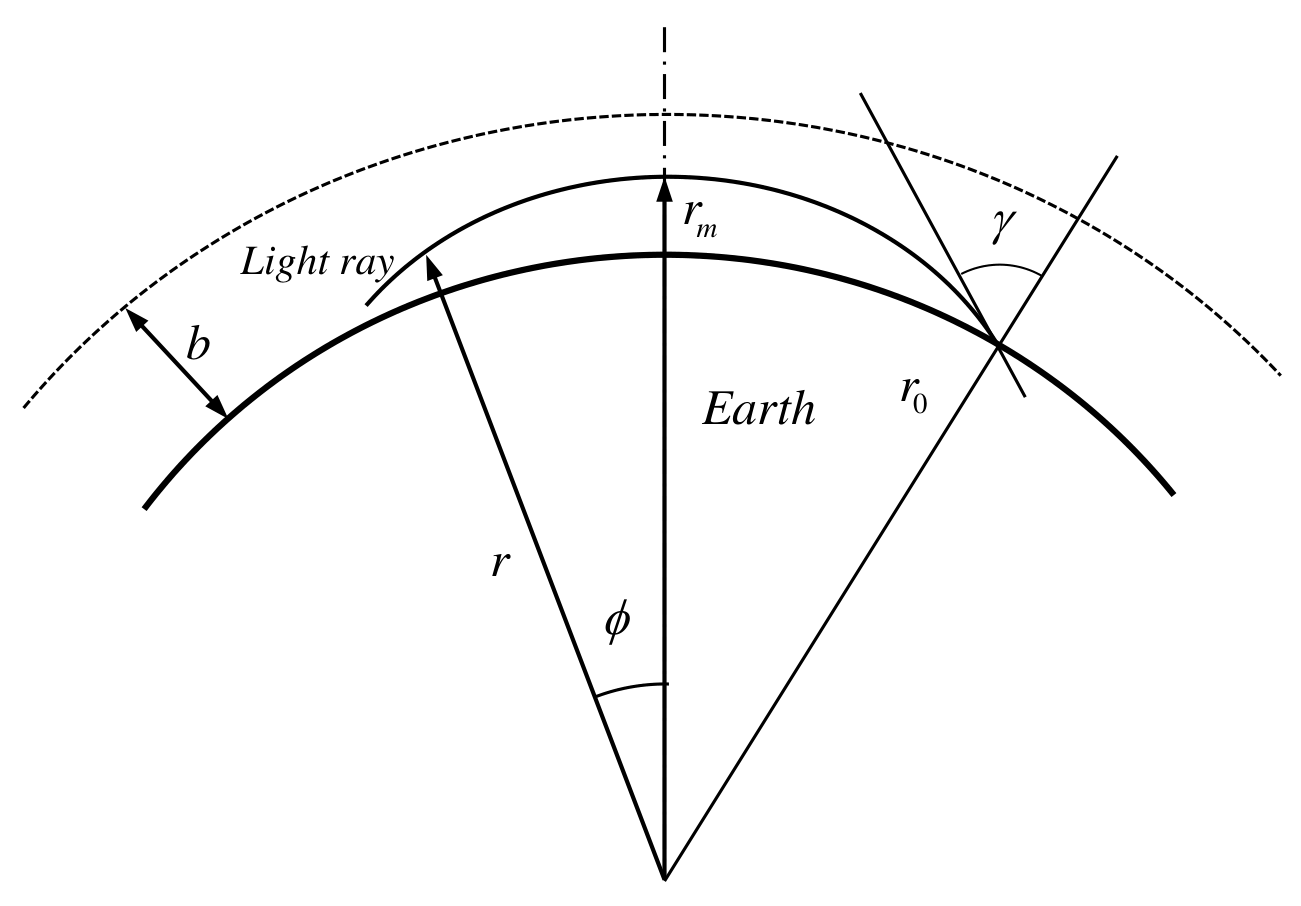
(0.3 point)
3.2 Let be the maxim value of . When the superior mirage occurs, we have . The angular momentum is constant
(0.2 point)
Thus
That implies
But
So we must have
(0.4 point)
Therefore
(0.2 point)
3.3 The maxim distance is given by the maxim values of and
(0.1 point)
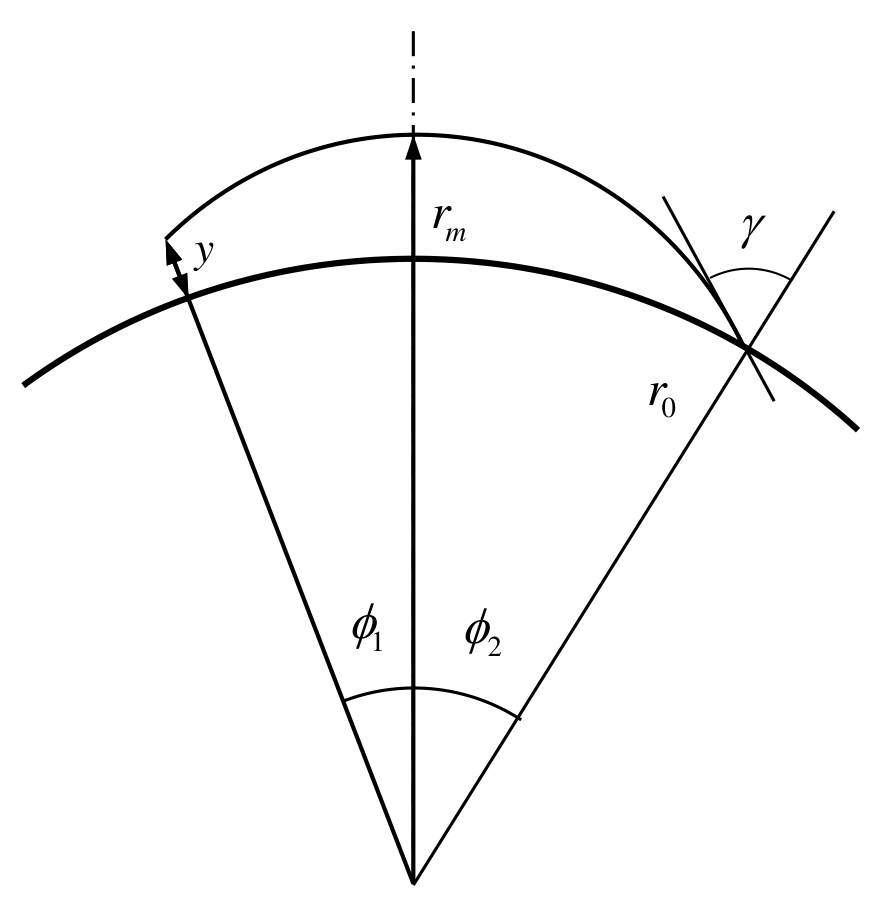
According to expression for the path of light ray, we have
(0.1 point)
(0.1 point)
and
(0.1 point)
From above relations, we obtain
By eliminating we find
Thus
and
(0.4 point)
Similarly
and
(0.4 point)
Therefore
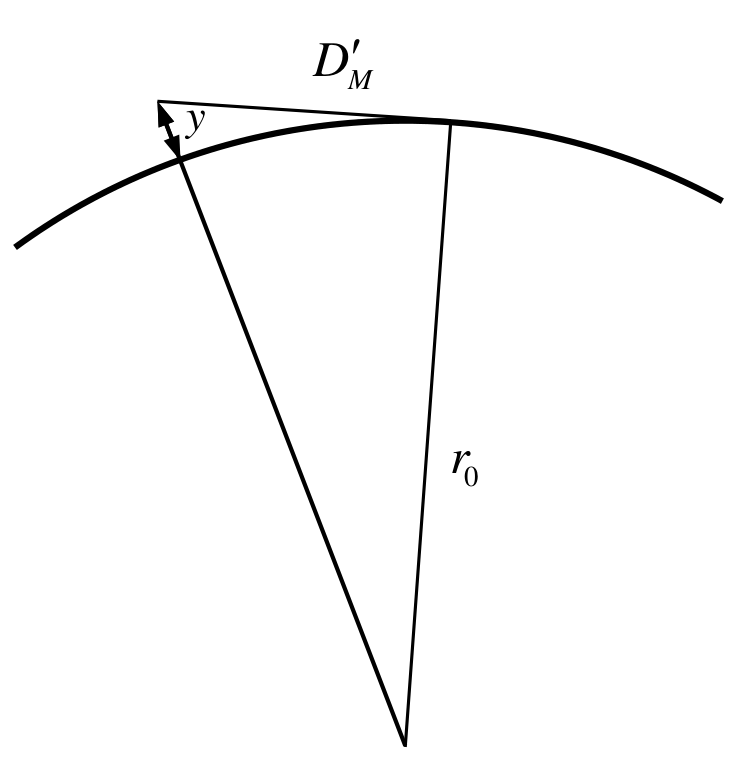
(0.2 point)
3.4
Thus
(0.3 point)
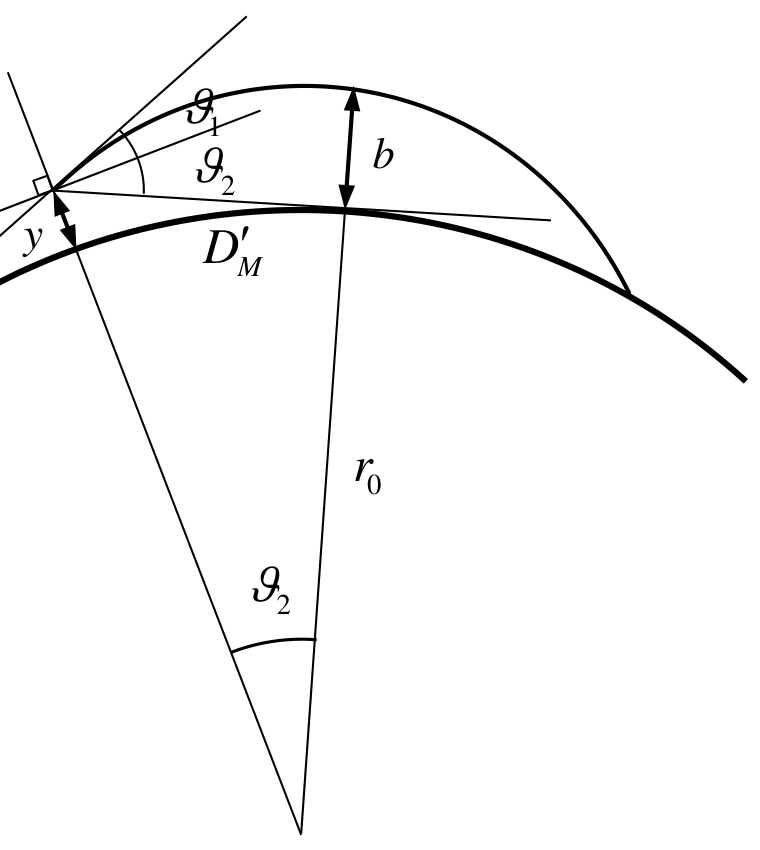
3.5 we have
where
(0.1 point)
and
Thus
So
(0.3 point)
Therefore
(0.1 point)
Оригинал в Архива: WoPhO_2011_Q13.pdf · официални решения: WoPhO_2011_S13.pdf