WoPhO 2012, Теория — Задача 1. Basic Concepts
Theoretical 2: Physics of the Oil and Gas Production
Условие
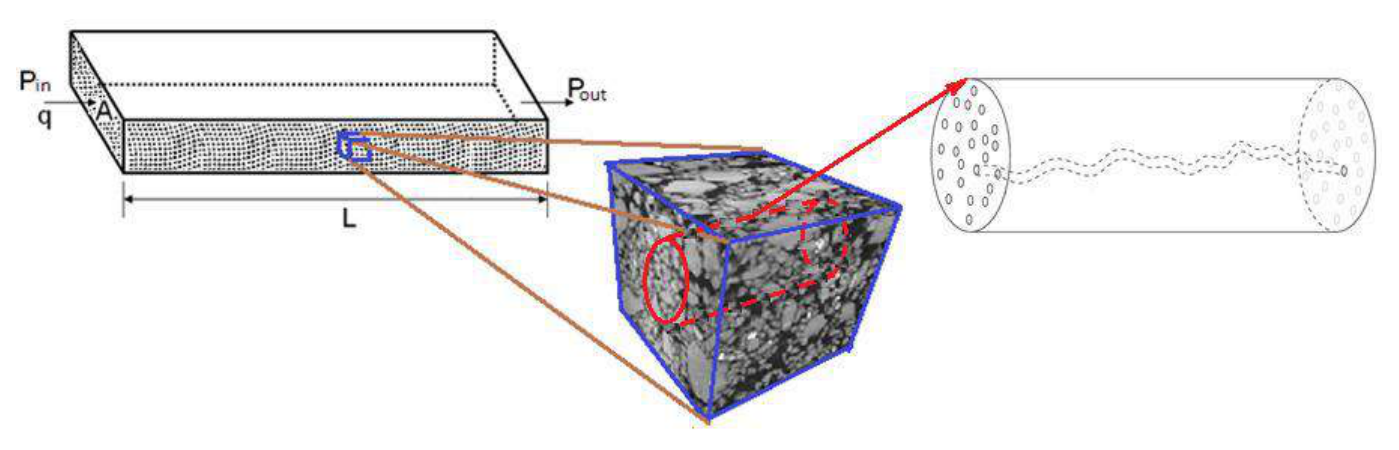
It is a common misunderstanding that oil is located in the form of an underground lake. Actually, it is found in very small pores with a size comparable to the diameter of human hair. Void space between particles of sand is filled with oil like a sponge is filled with water. If one pushes on the sponge, water comes out. A similar thing occurs with oilsaturated rocks, which are located a few kilometers beneath the surface of the Earth. When all the rocks above the reservoir exert a huge pressure on the petroleum sponge, the oil flows to the surface (see Figure 1). In this problem we neglect capillary and gravity effects on the fluid flow.
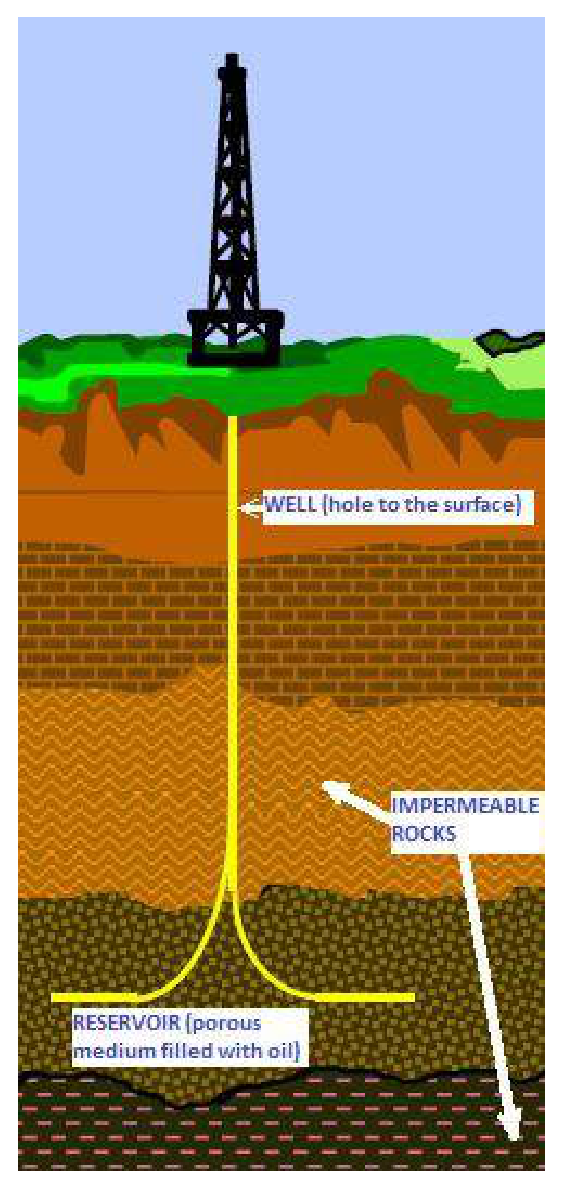
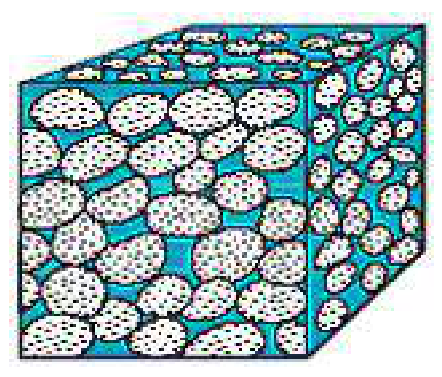
(a) One of the most important characteristics of the reservoir is porosity, which is the fraction of the void space in the rock to the total volume:
where stands for the volume.
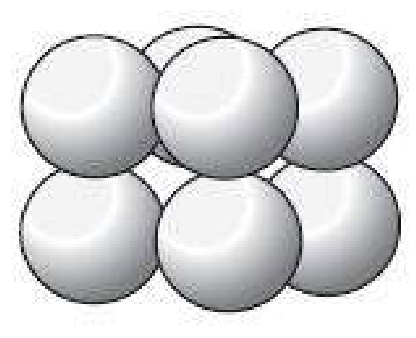
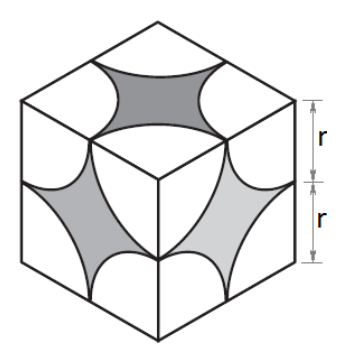
To understand meaning of this concept, imagine identical balls (grains of sand) that put in a pile as shown in Figure 3.
Find the porosity of the system if the number of balls is infinitely large. [0,3 т.]
(b) A fluid flow between the grains of sand is controlled by viscosity and permeability. Consider a flow of the viscous fluid through a tube with length and radius (Figure 4). Fluid molecules moves along free paths and collide with each other. However, this process is not uniform. Close to the solid boundary molecules are stuck, while in other regions velocity varies, with a profile similar to the sketch shown in Figure 4, where is measured from the axis of the tube.
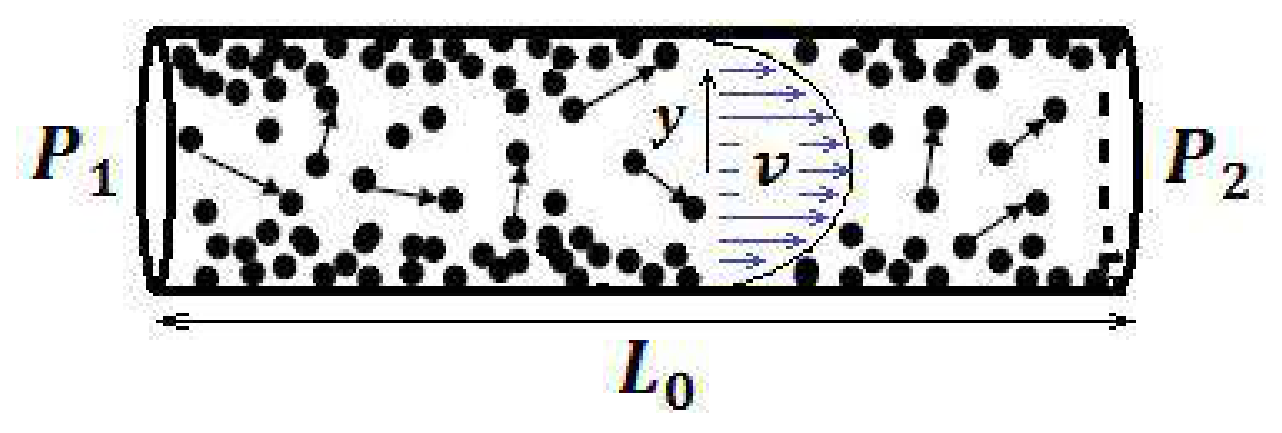
The reason for this effect is the internal friction of the fluid, or viscosity. If two adjacent layers of fluid flow with slightly different speeds, the random sidewise intrusion of some faster molecules into the slower stream will tend to speed up the slower stream, whereas intrusion of slower molecules into the faster stream will tend to slow down the faster stream. This effect could be quantified with following well-known equation:
where is a friction force which occurs between two thin layers of the fluid separated by a small distance , which have differences in velocities ; is a contact area on which applied the internal friction force; is the fluid property called coefficient of viscosity.
Find the velocity distribution in terms of , , , and . Assume that a mean free path of molecules is much smaller than the radius of the tube. [0,6 т.]
(c) Under described conditions fluid will flow through the tube with a flow rate:
Calculate coefficient in Poiseuille equation. [0,3 т.]
(d) A fluid flow through a porous medium is governed by Darcy’s law:
where is the amount of fluid transferred through the rock in some period of time; are the cross-sectional area and length of the sample shown in Figure 5; is the pressure drop; is the permeability and is the property of the rock
(You can easily recognize some similarity with Fouriers Law for heat transfer. Using analogies with heat transfer could significantly help in solution of this problem, because approaches are very similar).
Porous medium can be modeled as a system of twisted tubes (Figure 5), with permeability Where is permeability of a straight capillary; accounts for nonlinearity of the tubes in a porous medium with porosity .
Estimate permeability of the system described in 1.a, with radiuses of the balls equal to m. [0,1 т.]
(e) Usually, rock properties are not uniform throughout the reservoir. However, it is possible to apply an averaging procedure to find an effective permeability . This means that the initial system could be replaced with a new model that has the same sizes and fluid flow parameters with the only difference in permeability, which is uniform throughout the new homogeneous sample. To examine this issue, we consider a sample consisting of two different rock types as shown in Figure 6. An incompressible fluid flows through that system with a flow rate and viscosity .
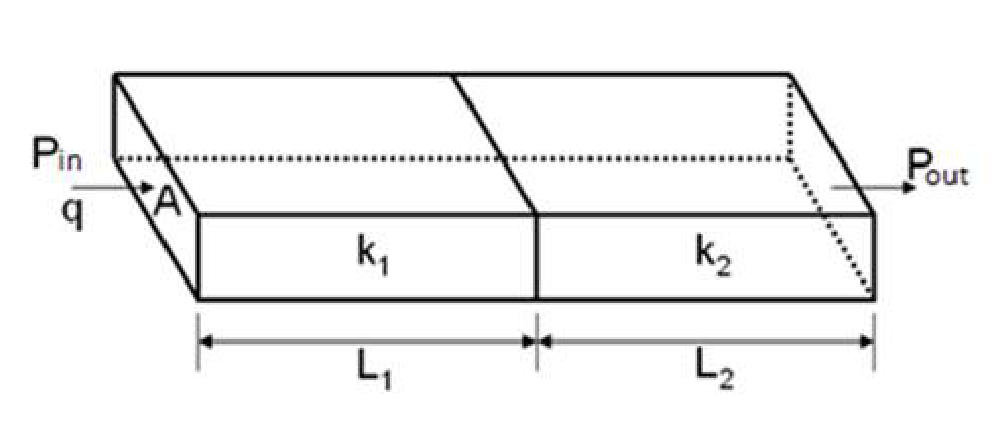
Calculate pressure at the boundary between two different rocks in terms of , , and parameters shown in Figure 6. [0,8 т.]
(f) Find the effective permeability of the system . [0,4 т.]
Отговори
(a) 0.476
(47.6%)
(b)
(c)
(d) m²
(e)
(f)
Решение
1.1 Let’s cut a cube from the pile of balls, as shown in figure on the right. Using definition of porosity:
1.2 If fluid is incompressible, fluid velocity along the tube is constant. It varies in the radial direction only, what is due to viscous forces. Let’s consider a part of the fluid with a cylindrical shape, with radius , which is coaxial to the cylinder with radius . Using definition of the internal friction, force balance could be written in the following way:
After rearranging variables
which results in velocity distribution:
1.3 Total fluid volume, flowing through the tube in a unit of time:
Comparing with Poiseuille equation
1.4 For estimations one can assume that porous medium could be modeled as tubes with the radiuses equal to the size of balls:
1.5 From law of conservation of mass and the condition that fluid is incompressible can be concluded that flow rate is constant everywhere:
1.6 Using Eq. (1.5.1)
Оригинал в Архива: WoPhO_2012_Q12.pdf · официални решения: WoPhO_2012_S12.pdf