WoPhO 2012, Теория — Задача 4. Fractured Reservoir
Theoretical 2: Physics of the Oil and Gas Production
Условие
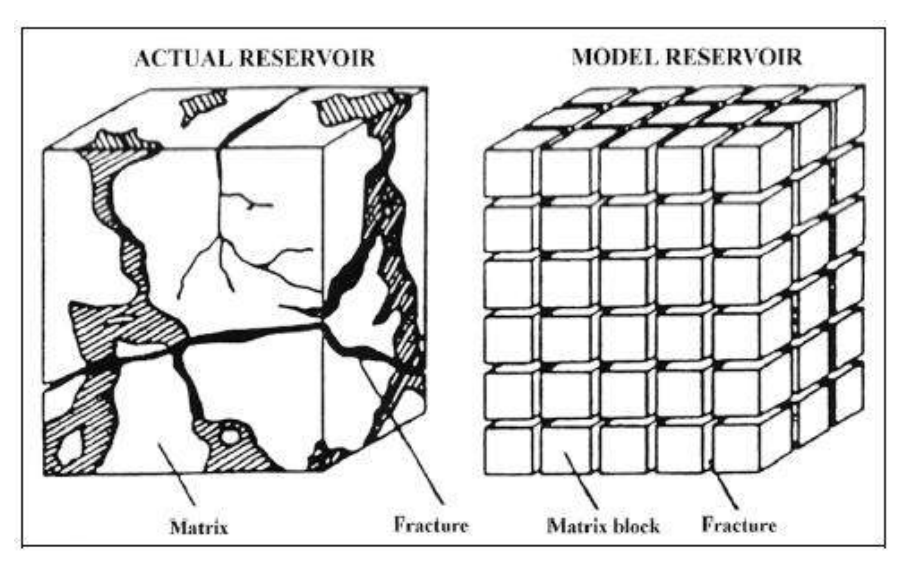
Most of the world’s largest oil reservoirs have a different structure, which is not a pile of small balls with fluid between, but a very complex system of porous medium and fractures as shown in Figure 9 (left). Fortunately, such reservoirs could be easily modeled with a stack of sugar cubes, as in Figure 9 (right).
In the model supposed that the production from fractured reservoir goes from the matrix to the fracture and therefrom to the well. Thus, matrix does not produce directly into the well. Such a simple model gives incredibly good results for oil production forecasts with an equation:
where is a flow rate from matrix to fracture, is average pressure at the matrix, is pressure at fracture, near the boundary of the sugar cube with a side , and is shape factor, related to the dimensions of the sugar cubes.
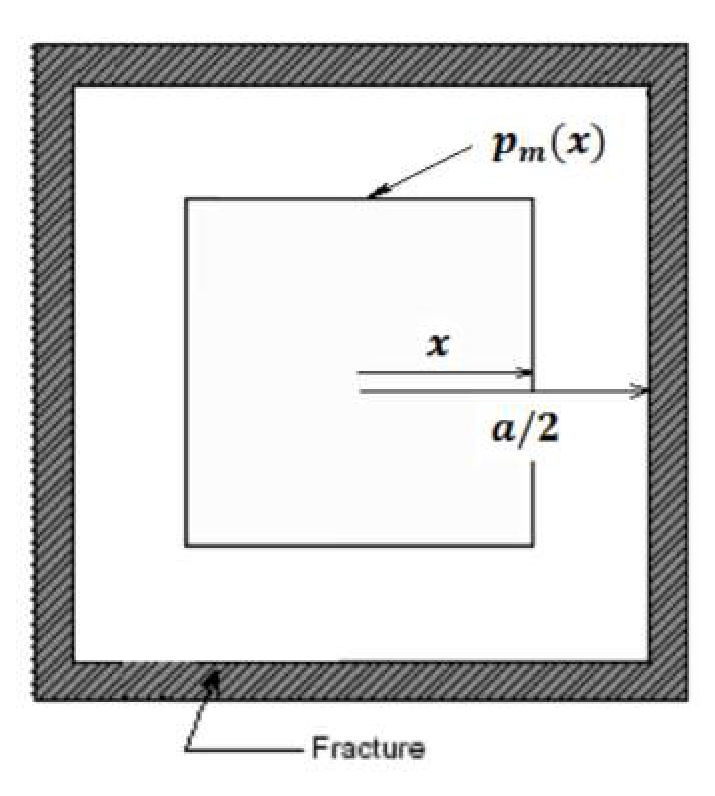
The goal of this part of the problem is to estimate shape factor . Consider a cube with the side filled with a porous medium with porosity , permeability , and compressibility . Oil flows with a constant rate symmetrically from the center of the cube to its boundaries, where pressure is equal , which changes with time . Furthermore, if the well producing at constant flow rate then the cell pressure will decline in such a way that
(a) Calculate pressure distribution inside the cube in terms of and, . [2,2 т.]
(b) What is the shape factor for the cube with side ? [0,5 т.]
Отговори
- (a)
- (b)
Решение
4.1 At first let’s find the constant for pressure decline. The condition allows to write the following:
Or
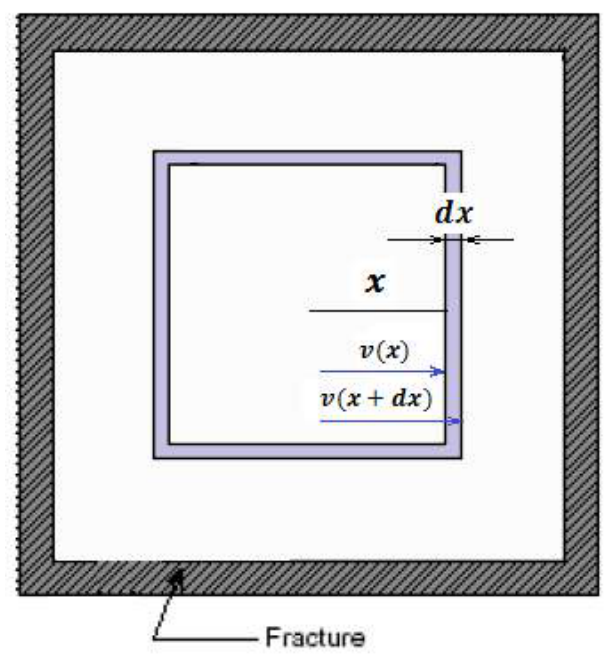
Material balance equation for the thin layer, shown in figure above:
A – stands for area; V – is volume of the analyzed thin layer with thickness dx. Using definition of compressibility, Eq. (4.1.2) can be simplified as
Using Eq. (4.1.1) and Darcy’s law, Eq. (4.1.3) can be rewritten as
where is some constant
Eq. (4.1.5) will have meaning for the center of the cube () only if , otherwise pressure gradient , which corresponds to the velocity in the center of the cube, will be infinite, what is meaningless from the point of physics. Thus,
Integrating one more time
4.2 Calculate average pressure in the matrix with using Eq.(4.1.7)
Definition of the shape factor:
Substituting Eq. (4.2.1) into (4.2.2) results in
Оригинал в Архива: WoPhO_2012_Q12.pdf · официални решения: WoPhO_2012_S12.pdf