WoPhO 2013, Теория — Задача 2. Two-Ball Body
Two-Ball Body · 10 т.
Условие
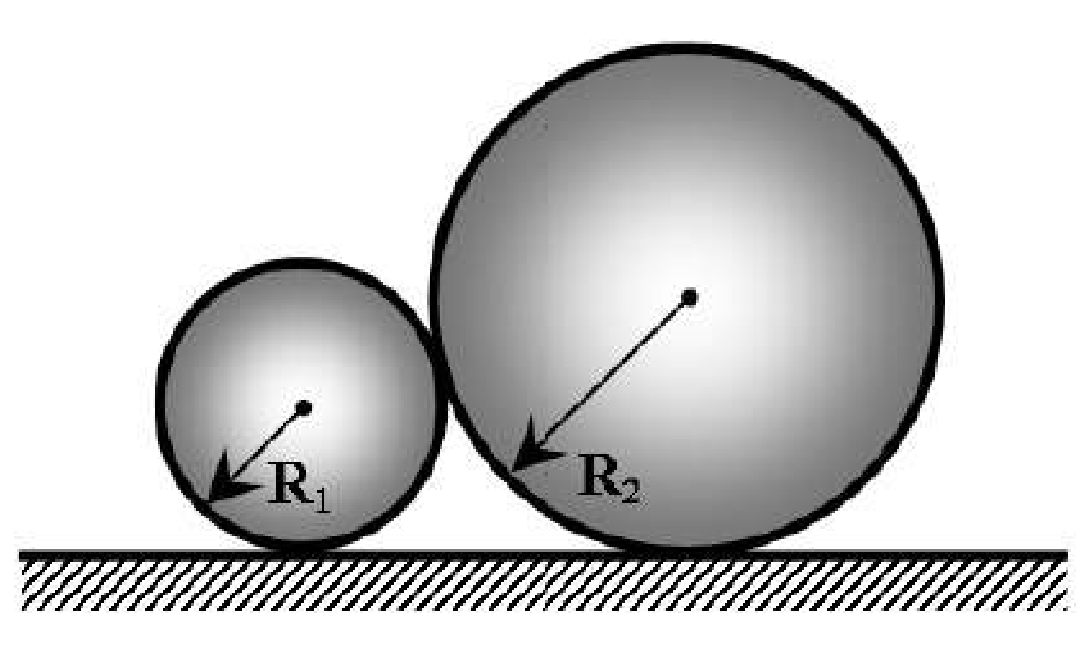
Two uniform balls 1 and 2 of radii and respectively are made of the same material of the mass density . They are firmly glued together to form a rigid body as shown in Figure 1. In this problem you will have to investigate various kinds of motions of that rigid body called the two-ball body.
Part A
A1 Find the distance from the center-of-mass of the two-ball body to the center of ball 1. [0,4 т.]
A2 Find the moment of inertia of the two-ball body about the axis that passes through balls’ centers. [0,6 т.]
A3 Find the moment of inertia of the two-ball body about the axis that passes through its center-of-mass and goes perpendicular to the line connecting the balls’ centers. [1 т.]
Warning! At the solution of the following parts of this problem it is desirable to derive analytical answers to the questions. Use to simplify the expression. However, if you find this difficult, you may calculate and provide numerical values only for each step of your solution.
Part B
Let the two-ball body be placed on the flat horizontal surface as shown in Figure 2. The smaller ball is right under the larger one such that the line connecting the centers of the two balls is strictly perpendicular to the surface. It is obvious that such an equilibrium position is unstable and an insignificant random deflection will set the two-ball body into a motion due to gravity whose acceleration is .
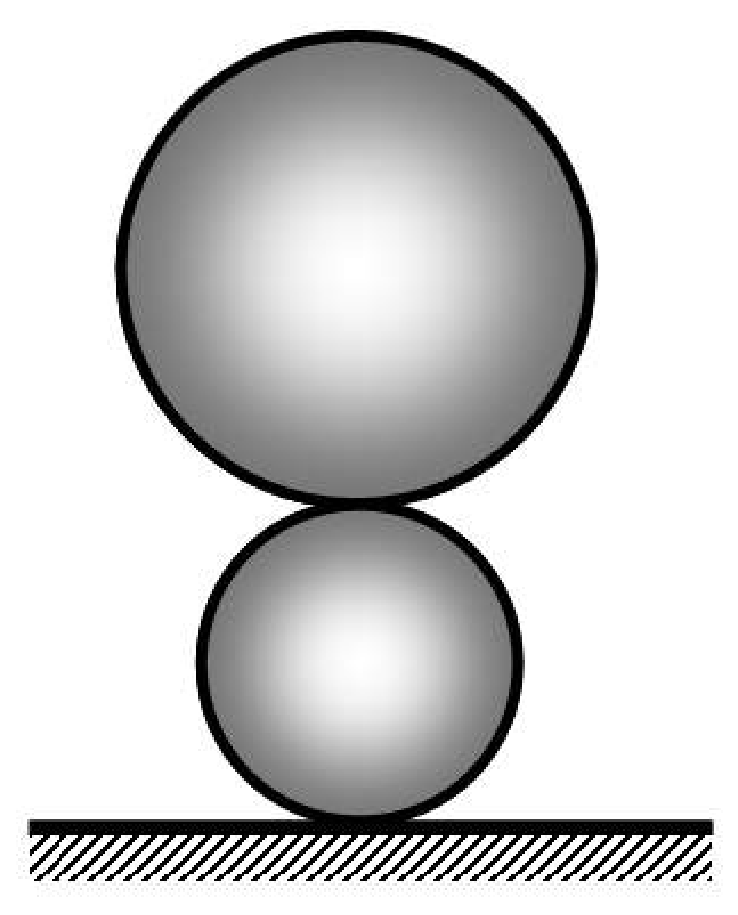
B1 Assume that the friction between the lower ball and the surface is so strong that there is no slipping at all times. Find the velocities of balls’ centers at the time moment right before the larger ball hits the ground. Draw a sketch with the depicted velocities of balls’ centers. [1,5 т.]
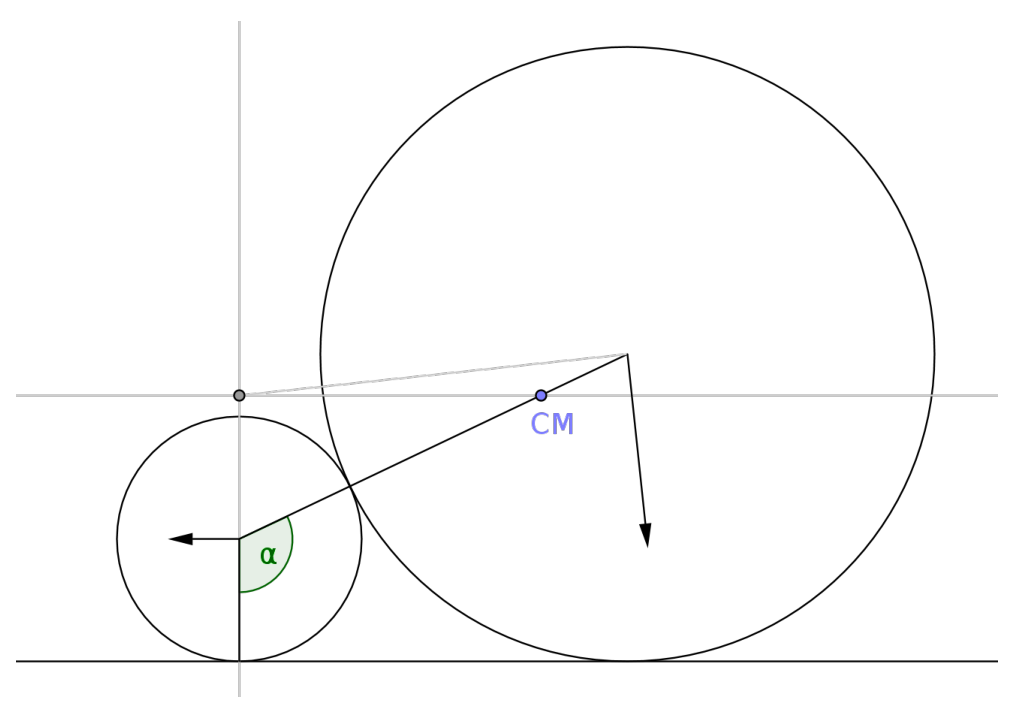
B2 Assume now that there is no friction at all between the lower ball and the surface. Find the velocities of balls’ centers at the time moment right before the larger ball hits the ground. Draw a sketch with the depicted velocities of balls’ centers. [2,5 т.]
Part C
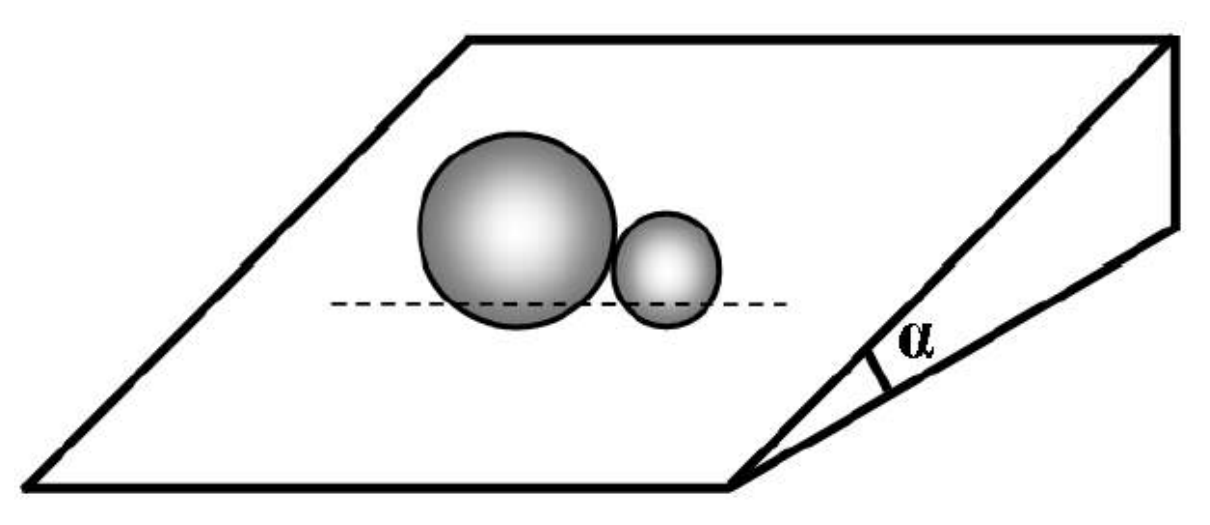
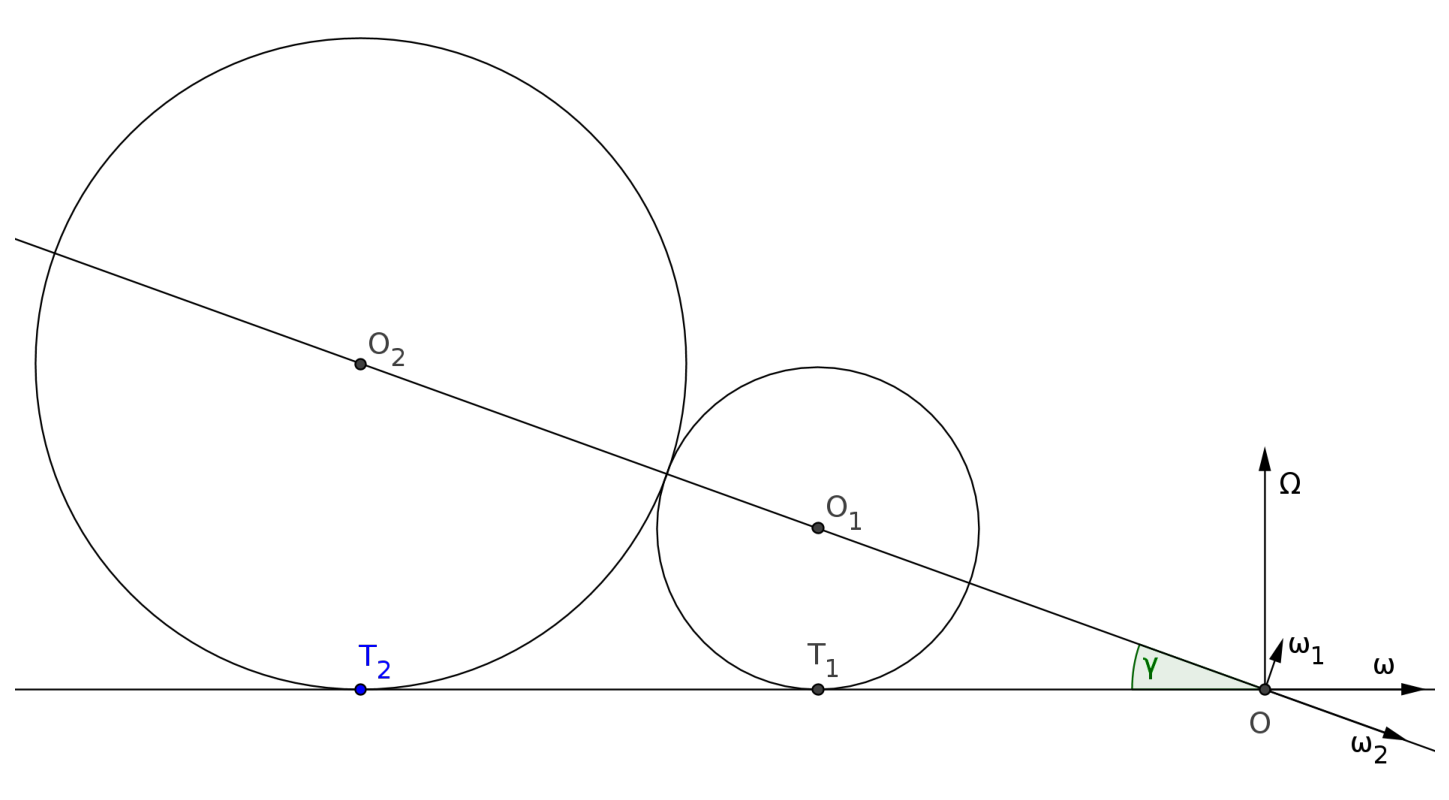
Let the two-ball body be placed on an inclined plane set at an angle against the horizontal. At the initial time moment the line connecting balls touching points with the surface is exactly parallel to the lower edge of the inclined plane as shown in Figure 3. In this Part assume that the friction between the balls and the surface is so strong that there is no slipping at all times. The two-ball body is released.
C1 Find the maximal velocities of balls’ centers. [2 т.]
C2 Find the angular acceleration of the two-ball body when the velocities of balls’ centers are maximal. [1,2 т.]
Now assume that the two-ball body is at rest on the inclined plane such that the line connecting balls’ touching points with the surface is exactly perpendicular to the lower edge of the inclined plane as shown in Figure 4.
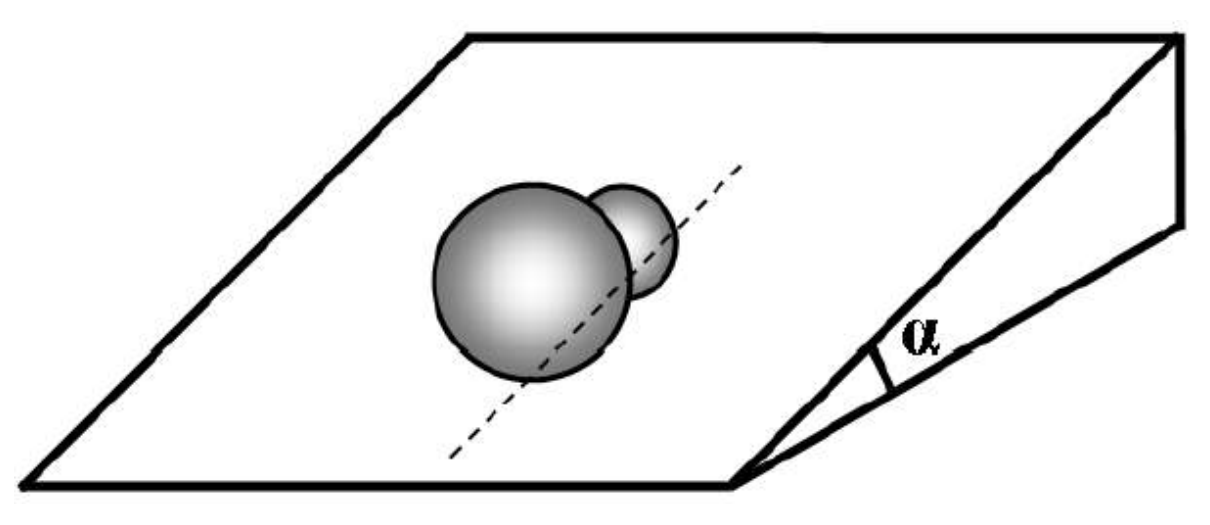
C3 Find the angular frequency of small oscillations of the two-ball body around the equilibrium position shown in Figure 4. [0,8 т.]
Отговори
- A1 ≈ cm
- A2 ≈ kg m²
- A3 ≈ kg m²
- B1 v1 = 0.2386 m/s, v2 = 0.8264 m/s (each perpendicular to the line joining the center with the ground contact point)
- B2 v1 = 0.2519 m/s (horizontal), v2 = 0.8022 m/s at β = −87.75° to the positive x-axis
- C1 v1,max} = 0.4517 m/s, v2,max} = 0.9033 m/s
- C2 ≈ s⁻²
- C3 ≈ s⁻¹
Решение
WoPhO Selection Round Problem 2
Two-ball body
Attila Szabó, Grade 12
Leőwey Klára High School
Pécs, Hungary
Part A
1
2 This axis is a CM axis of both balls, therefore
3 The parallel CM axes of the spheres are respectively and away from the examined axis, thus according to Steiner’s theorem
Part B
1 The body will constitute pure rolling, therefore the contact point with the ground will always be a momentary rotation center of the motion. The kinetic energy of the body is therefore where is the moment of inertia with respect to that point. Now we’re going to calculate this moment of inertia at the moment of the collision. The cosine of in the figure is clearly . From the law of cosines we get for the distance of the CM and the rotation center ; by Steiner’s theorem
The kinetic energy is on the other hand the change of gravitational potential energy of the system: that of the lower ball doesn’t vary as its CM moves only horizontally, but the potential energy of the upper ball changes from (with choosing at ground level) to . By the conservation of energy:
The velocities of the balls’ centers can be found from the fact that the ground contact point is the momentary center of rotation, therefore the velocity of each point of the body is where is the distance of this point and the ground contact point and the velocity vector is perpendicular to the line joining them (this is shown in the sketch). The distance of the center of ball 1 to the ground contact point is , thus its velocity is
that for ball 2 is , thus
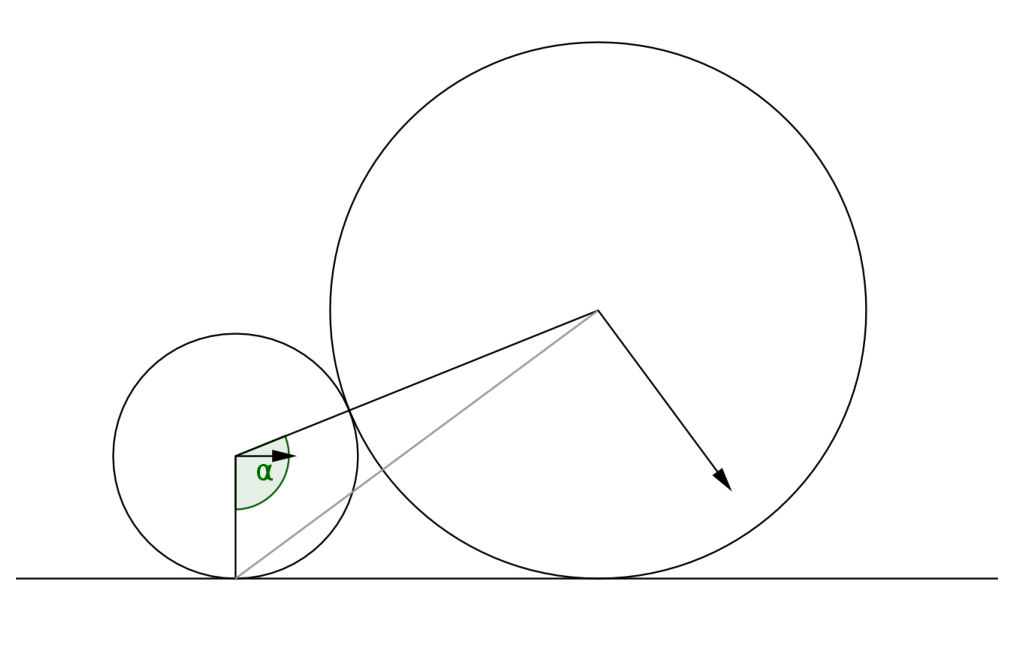
2 As there is no friction in the system, there is no horizontal force at all, therefore the horizontal component of the system’s momentum is conserved and since it was 0 initially, it will be 0 in the final setup as well. Consequently, the horizontal component of the CM’s velocity is 0, thus it will move vertically. The center of the lower ball must have a purely horizontal velocity, as the contact point with the ground can only move so and its relative velocity to the mentioned center is horizontal too (it is a peripheral speed related to a vertical position vector).
The vector from the CM to the center of the lower ball in the final state (Figure 2) is , thus the vector of the relative velocity is . The only way to decompose this into the difference of a horizontal and a vertical velocity vector (as required by the above conditions) gives the velocity of the CM as (and that of the center of the lower ball as ).
The kinetic energy of the system right before the collision is given as the sum of the translational kinetic energy due to and the rotational energy: this must be equal to the reduction of potential energy, which is (see above):
(We have used that .)
The velocity of the center of the lower ball is horizontal and its magnitude is
The distance vector from the center of ball 1 to that of ball 2 is so the relative velocity of the center of ball 2 to that of ball 1 is ; since the velocity vector of the center of ball 1 is , that of ball 2 is
The angle between this vector and the positive -axis is given by
while its magnitude is
The specialities of the velocities are indicated in Figure 2. (Note that the momentary center of rotation will be the intersection of the vertical through the center of ball 1 and the horizontal through the CM: this follows from the directions of the velocities of the center of ball 1 and the CM.)
Part C
Both contact points with the ground will move without slipping. Consequently, if the body rotates about its symmetry axis by some angle, these points will move by distances the ratio of which is : this means that the orbits of these points are two concentrical circles with radii of this ratio. The common center of these circles will be a permanent center of the rotation, therefore we will calculate with respect to axes passing through this point. Now we determine the distance of this center to the CM. As the center must be the intersection point of the symmetry axis and the plane the body is placed on, we can write down the following equation due to the similar right triangles and :
However, the line joining the touching points of the body and the plane is the momentary rotational axis of the body due to the slipless motion. Therefore, the angular velocity vector must be in this line. The angle in the figure can simply be expressed by , so the components of this vector in the principal coordinate system are and . The moments of inertia with respect to axes passing through this point are and , respectively.
Now we’re going to write down the total energy of the system. The kinetic energy can be written solely as rotational energy with respect to point : using the above expressions of the moments of inertia and angular velocities we find
The CM of the system is moving on a circle in a plane somewhat above the inclined plane and parallel to it. The radius of this circle is . Let be the angle between the line joining the touching points and the horizontal edge of the plane. If we choose the zero level of the gravitational potential energy at the state , we can simply express the potential energy as
As there is no energy loss due to friction, the total energy is constant.
1 The energy initially is 0 as and : due to the conservation of energy, this will hold all along the motion. Therefore, the less is the potential energy, the more is the kinetic energy and so the velocities. From the expression of we can see that the minimal potential energy at is , the opposite of which is the maximal kinetic energy:
as the distances of the centers of the balls to the rotational axis are and , the maximal velocities of these centers are
2 The magnitude of is maximal in this point, therefore it doesn’t change in the first order. However, its direction is varying over time, and this causes an angular acceleration like in the case of centripetal acceleration. We are now going to calculate the angular velocity of the rotation of the axis : as its vector is perpendicular to the inclined plane, we find and so .
It is easy to see that the velocities of the points lying on the axis of the body can be expressed as peripheral speeds due to and as well. In the special case of the CM we’ll find them as , thus . Consequently, the requested “centripetal” angular acceleration is (we have used that )
3 We have the equation ; substituting this into the conservation of energy yields that
is constant, therefore its time derivative is 0. As the only parameter varying by time is , we’ll have a differential equation in . This equation may be simplified and as is very small, we may use first-order approximations. Using these simplifications we’ll get
from this harmonic equation we can easily get the angular frequency:
Оригинал в Архива: WoPhO_2013_Q2.pdf · официални решения: WoPhO_2013_S2.pdf