WoPhO 2013, Теория — Задача 3. Particles in the magnetosphere
Particles in the magnetosphere. Deadline: April 3rd, 2013
Внимание: Бележка към темата
The archived worked solution is by contestant Attila Szabó; its full printed text and calculations are retained. It mentions integrand.m and integrator.m, but neither original script is present in the archived 2013 event folder. The numerical result is transcribed from the supplied PDF; the missing scripts have not been reconstructed.
Условие
Earth is a very interesting magnetic system. Earth is frequently approximated as a huge magnetic dipole and therefore its magnetic field is not uniform. Due to this non-uniformity there are some zones in the magnetosphere in which charged particles get trapped. These zones are known as Van Allen belts and particles inside them have three main movements: gyration around each magnetic field line (Gyro motion), movement along the field line (Bounce motion), and rotation of lines around the magnetic axis of the Earth (ignored in this question).
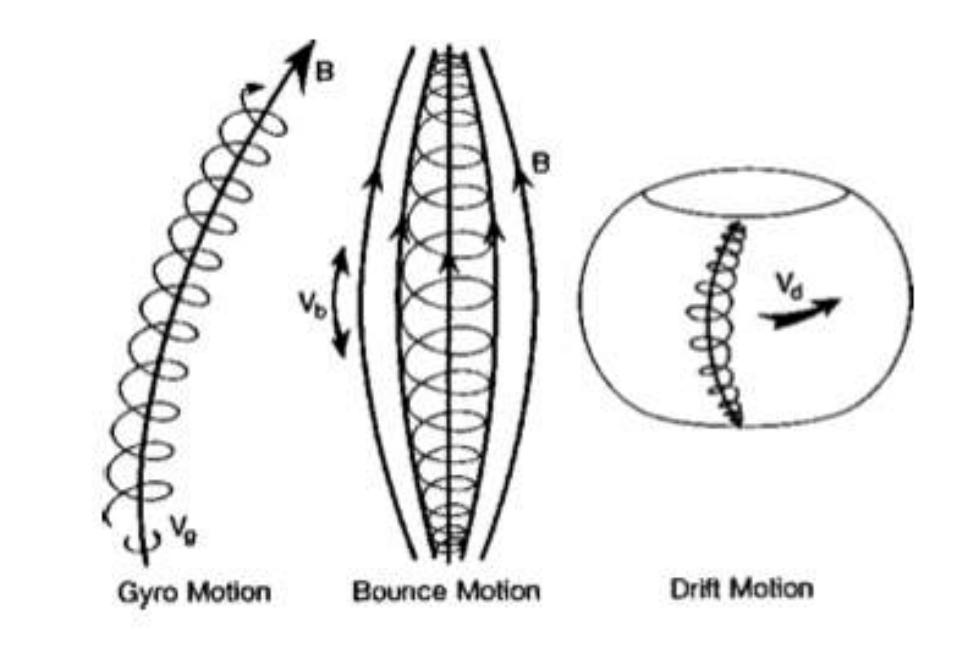
Due to the first two movements, particles travel along a helical path around the field lines. A key parameter to define such movement is the pitch angle , which is the ratio of the perpendicular and the parallel velocity components to the field line :
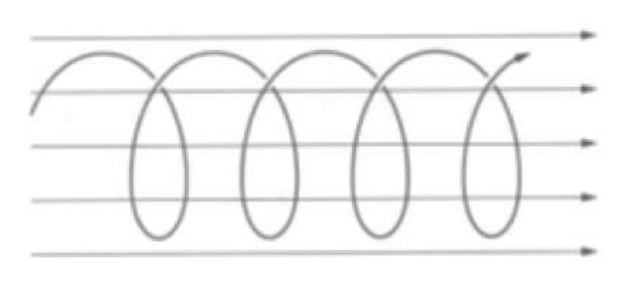
1 Path around field lines
The modulus of Earths magnetic dipole moment is . Earths magnetic field can be expressed in spherical coordinates as a function of the latitude and the distance to the center of the planet:
where and are unitary vectors pointing radial and polar directions respectively, with azimuthal symmetry. However, for our purposes it will be useful to express the field modulus value along one of the field lines. These lines follow the equation where is the distance from the line to the center of the Earth at Equator. Moreover, the distance can also be expressed as a function of the parameter . With this notation, we can identify a field line with the parameter .
(a) Determine the modulus of the magnetic field along a field line as a function of the variables and . The magnetic field in the surface of the Earth at the Equator is . [1,5 т.]
(b) Calculate the gyrofrequency and the gyroradius of the path of the protons around a field line as a function of , , , and its kinetic energy . [2 т.]
2 Mirror points
When a proton rotates around a field line it generates a magnetic moment which remains constant along its path. When the proton reaches some latitude the parallel velocity becomes zero and the particle starts its path backwards. This latitude is known as the mirror point.
(a) Determine the magnetic moment created by a proton when it rotates around a magnetic field line as a function of , and the pitch angle of a particle at Equator . [0,8 т.]
(b) Determine the relation between the mirror point latitude and . Compute its value numerically when . [2 т.]
3 Particle collision
If the mirror point lies not far from the surface of the Earth the proton collides with the particles of the atmosphere. This distance is small compared with Earth radius (), so we will assume that the particles will collide when the mirror point is in the surface of the Earth.
(a) Determine the minimum equatorial pitch angle , below which a proton would collide with the surface of the Earth as a function of . [1,2 т.]
(b) Determine the time that it takes for a proton to complete a whole cycle of the bouncing movement between the mirror points, with , and . [1,2 т.]
(c) Compute the length of the helical path of the proton in a whole cycle, taking into account the two movements we have considered in this problem. [0,8 т.]
Отговори
1 Path around field lines, (a)
1 Path around field lines, (b)
2 Mirror points, (a)
2 Mirror points, (b) 33.15 °
Relation: sin²αEq = cos⁶λm / √(1 + 3 sin²λm).
3 Particle collision, (a)
The supplied contestant solution calls this bound the maximal equatorial pitch angle for which the collision takes place, while the problem asks for the 'minimum equatorial pitch angle'.
3 Particle collision, (b) 2.924 s
3 Particle collision, (c) m
Решение
WoPhO Selection Round Problem 3
Particles in the magnetosphere
Attila Szabó, Grade 12
Leőwey Klára High School
Pécs, Hungary
Part 1. Path around field lines
(a) The unit magnetic field is . Using this unit, the modulus of the magnetic field is (noting that thus we can use the Pythagorean theorem for adding the components:
(b) The Lorentz force acting on the particle is : this force should hold the particle on the circular orbit by maintaining the centripetal acceleration . Newton’s equation in this case: , from this,
As , , thus and . By the definition of kinetic energy and angular velocity, and , thus
Part 2. Mirror points
(a) The gyrating proton will resemble a current enclosing an area of . The magnetic moment of such a current is
(b) At the Equator, and , thus . At the mirror point, , thus and ; in this case, . As and doesn’t vary (magnetic field doesn’t do any work on charges),
If , the numeric solution of the above equation gives .
Part 3. Particle collision
(a) The collision takes place if ; however, , thus the condition is . From Part 2b we have
This is the maximal equatorial pitch angle needed for the collision to take place.
(There cannot be any minimal such angle. If this were the case, a proton with a pitch angle of would collide with Earth as well: this is impossible, since the proton wouldn’t have any field-directed velocity to move towards the Earth. In general, the pitch angle grows with the magnetic field getting stronger.)
(b) We’re going to express the time required to change by in order to integrate it. The velocity component of the proton parallel with the field line is . Therefore we need to express from the conservation of : by simplifying with the common terms it gives
The distance to be travelled along the field line is the line element in the polar coordinates specified by the problem:
The time element to cover this distance is consequently
We need to integrate this time element along the cycle: due to symmetry it splits into four identical sections, one being between from to ( in our case, knowing the value of from Part 2b, thus the proton turns back at the mirror point rather than at the surface of the Earth). Using this, the period is
The integral can only be evaluated numerically; its value according to GNU Octave (scripts for quadrature attached) is 0.999729 rounded to 6 decimal places. Substituting this and the numeric values of variables into the expression of gives .
(c) As the kinetic energy is constant all along the path (magnetic field does no work on the proton), the velocity is constant as well. The total distance covered by the proton, i.e. the length of the path is simply this velocity times the period:
its numeric value is .
Attached files
integrand.m, integrator.m: the GNU Octave scripts that describe the integrand and do the integration; setting the working directory of Octave into their directory and calling integrator gives the value of the requested integral.
Оригинал в Архива: WoPhO_2013_Q3.pdf · решение от архива: WoPhO_2013_S3.pdf