WoPhO 2013, Теория — Задача 4. Atmospheric evaporation by Jeans escape
4: Atmospheric evaporation by Jeans escape
Условие
Thermal atmospheric escape is a process in which small gas molecules reach speeds high enough to escape the gravitational field of the Earth and reach outer space. Particles in a gas collide with each other due to their thermal energy. These collisions constantly accelerate and decelerate particles, varying their speed continuously. Particles might be accelerated until they reach the so-called escape velocity and leave the atmosphere. This process, known as Jeans escape, is critical for the formation and maintenance or the evaporation of the atmosphere of a planet. It is believed that it played an important role in the loss of water from Venus and Mars atmospheres, due to their lower escape velocity.
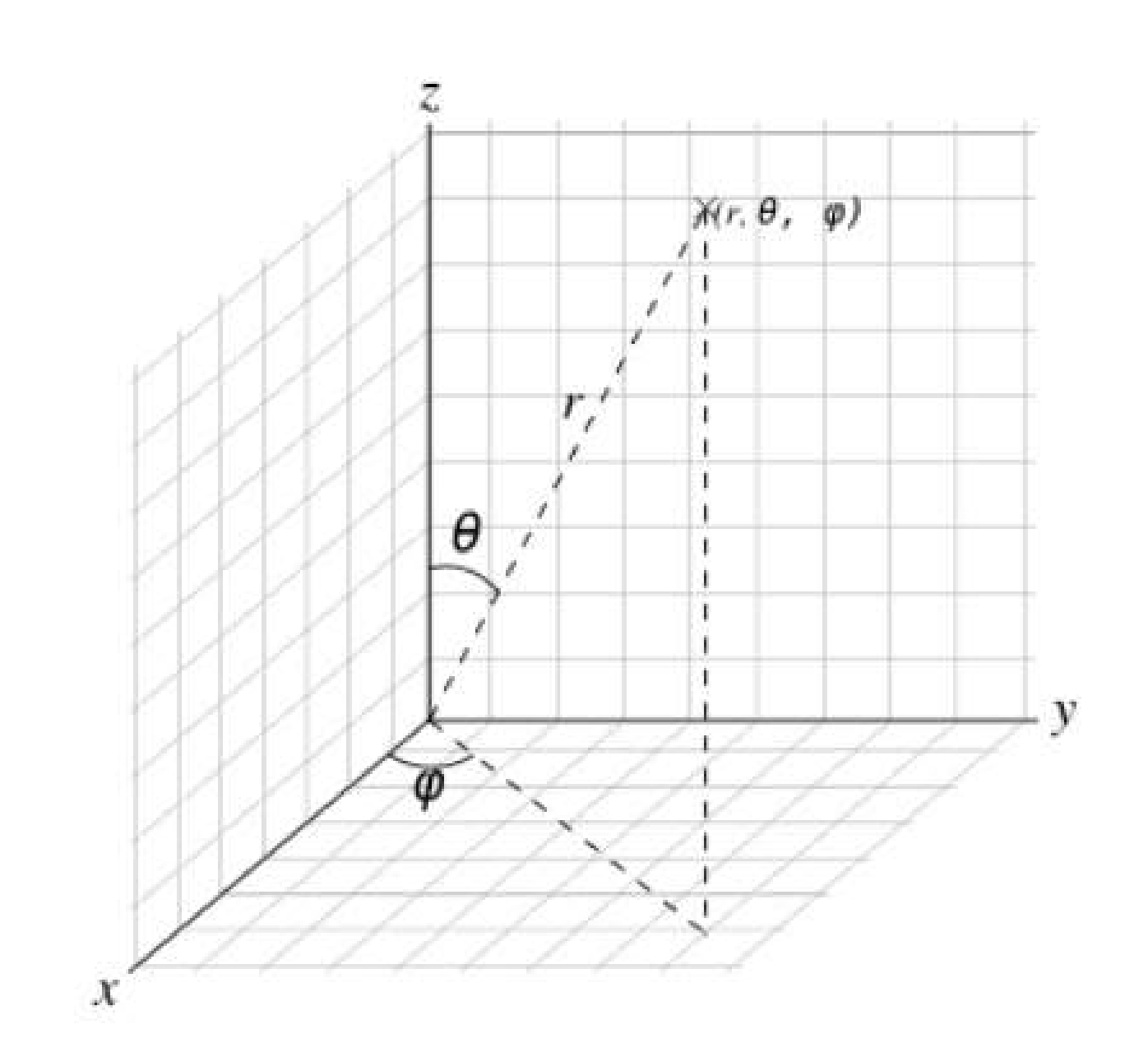
In this problem we will quantify the scattering (collisions between gas particles) and rate of loss of hydrogen in Earths atmosphere. The modulus and direction velocity distribution of the molecules of a gas of mass and at a temperature is given by the Maxwellian distribution:
where is the velocity differential. In spherical coordinates it is expressed as .
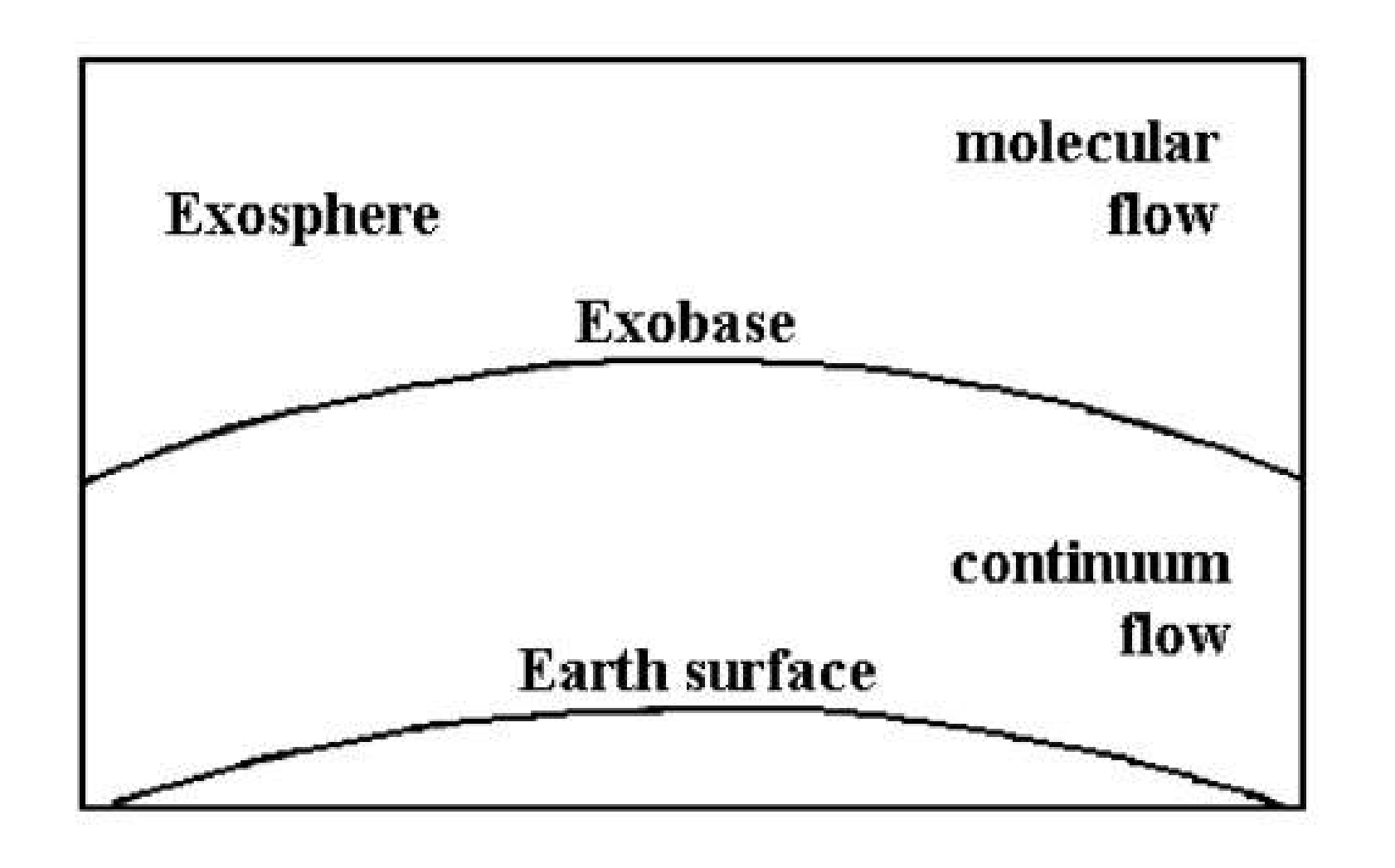
Thus at any temperature there can always be some molecules whose velocity is greater than the escape velocity. A molecule located in the lower part of the atmosphere would not, in general, be able to escape to outer space even though its velocity is greater than the limit velocity because it would soon collide with other molecules, losing a big part of its energy. In order to escape, these molecules need to be at a certain height such that density is so low that their probability of colliding is negligible. The region in the atmosphere where this condition is satisfied is called exosphere and its lower boundary, which separates the dense zone from the exosphere, is called exobase. The temperature at the exobase is roughly .
1 Exobase height
Exobase is defined as the height above which a radially outward moving particle will suffer less than one backscattering collision on average. This means that the mean free path has to be equal to the scale height, which is defined as the height where the atmospheres density is lower than on Earths surface (). The mean free path is the average distance covered by a moving particle in a gas (that we consider to be ideal) between two consecutive collisions and this can be expressed by the following equality:
where is the effective cross sectional area for the collision hydrogen atom-atmosphere and is the number of molecules per unit volume. Atmospheres density decreases with exponentially from altitude :
where we know that at an altitude of , the pressure is Pa. is the scale height, and its value is .
1 (a) Determine the air particles mean free path at the altitude of 250 km. [0,8 т.]
1 (b) Determine the exobase height . [1,2 т.]
2 Atmospheric escape flux
Particles in the exobase with enough outwards velocity will escape gravitational attraction.
2 (a) Assuming a Maxwellian distribution, determine the probability that a hydrogen atom has a velocity greater than the escape velocity in the exobase. [2 т.]
2 (b) Determine the hydrogen atoms flux (number of particle per unit area and per unit time) that will escape the atmosphere, knowing that the concentration of hydrogen atoms in the exobase is . Be careful with the dimensions [2 т.]
3 Evaporation of the atmosphere
Thermal atmospheric escape is one of the processes that explain why some gases are present in the atmosphere and some others are not. Currently the atmospheric pressure is approximately and a fraction of of the atmosphere molecules are hydrogen molecules. When these molecules reach a certain height (lower than ) they split into two atoms due to solar radiation. Concentration of hydrogen atoms in the exobase can be considered constant over time.
3 (a) Knowing that the average molar mass of the atmosphere is , estimate the number of hydrogen atoms present in the Earths atmosphere. Assume that the gravity near earth surface is [1 т.]
3 (b) Find out how much time would it take for half of the hydrogen atom to escape the Earths atmosphere. [1,5 т.]
3 (c) Find also this time for Helium atoms on Earth, knowing that their concentration in the exobase is . Helium atoms are the of the atmosphere. [1,5 т.]
Jeans escape is not the only atmospheric escape process and there are also other reactions on the surface on Earth that may produce atmospheric gases. Yet this calculations should show the difference in orders of magnitude of the escape of different gases
Отговори
1 (a) 3.288 km
1 (b) 424.2 km
2 (a) 0.002589
2 (b) m⁻² s⁻¹
3 (a)
3 (b) s
The official solution gives 1.41 · 10¹¹ s = 4465 years (constant-flux assumption); its remark gives 1.95 · 10¹⁰ s for an exponential decay.
3 (c) s
The official solution gives 2.19 · 10¹⁹ s = 6.95 · 10¹¹ years (constant-flux assumption).
Решение
WoPhO Selection Round Problem 4
Atmospheric evaporation by Jeans escape
Attila Szabó, Grade 12
Leőwey Klára High School
Pécs, Hungary
Part 1. Exobase height
(a) According to the ideal gas law: . The mean free path is consequently , specially, for the height of 250 km, and , thus .
(b) By definition, ; according to the above expression, , so . It follows from the provided pressure function that , thus .
Part 2. Atmospheric escape flux
(a) By integration with respect to between and and with respect to between and (these are the domains of the respective angular variables) we get the following distribution for the modulus of the velocity:
The probability of the velocity being more than a given value is the integral . Consequently, the requested probability is
using the numeric values of , , and .
(b) Consider a surface element of the normal vector of which is radial. It is easy to see that if a gas particle has a velocity greater than the escape velocity, it will escape, regardless of its direction, having it has a radial component pointing upwards. This is true since in the exosphere we may ignore any collision that would turn the particle back.
Now we calculate the volume out of which a particle with velocity can go through is a short time . It is clearly a prism, the vector of the generator of which is . The altitude of such a prism is if is the angle of to the radial upward direction (i.e. we choose the direction to point radially upwards), therefore the volume of this prism is . The particles of velocity will go through the chosen area segment during out of such a volume.
The number of hydrogen atoms in this volume is and according to the Maxwellian distribution, the number of atoms having a velocity vector among them is:
Integration with respect to between and (since only the upward moving particles are interesting now) and with respect to between and gives the following number-of-atoms differential:
So many atoms of velocity between and will leave through the area in time . Therefore, the differential of the flux, which is the number of atoms going through unit surface in unit time is
The flux of escaping atoms is the integral of this flux differential between and :
with the same numeric values as above.
Part 3. Evaporation of the atmosphere
(a) The force acting on the surface of the Earth by the atmosphere is which obviously comes from the gravity acting on the atmosphere: , so . The number of molecules in the atmosphere is therefore , so the number of hydrogen molecules is , thus the number of hydrogen atoms is
(b) As the concentration of hydrogen atoms won’t change at the exobase, the flux of escaping atoms is constant as well; for the total surface of Earth, the number of escaping atoms in unit time is , so the time required for the evaporation of half of the hydrogen atmosphere is
(c) Doing the integral as in Part 2b, but with the data and we find , thus . The number of helium atoms is . The atmospheric half-life of helium is thus
Remark. The assumption that the concentration of atoms remains constant over the disappearing of a large part of those atoms is really weird. It’s more realistic to assume that the hydrogen concentration is proportional to the total number of hydrogen atoms. In this case, if the number of atoms at a moment is , the intensity of evaporation is : it is easy to see, that this intensity is the negative time derivative of , so we get the following differential equation:
thus the half-life is
We can see that the half-life in this case differs by a factor of , which is totally acceptable since with the roughly given input data we can only give an order-of-magnitude estimate and the sought effect is of 9 orders of magnitude, way larger than this factor.
Оригинал в Архива: WoPhO_2013_Q4.pdf · официални решения: WoPhO_2013_S4.pdf