WoPhO 2013, Подборен кръг — Задача 5. Motion in the electrostatic field of a Dipole
Motion in the electrostatic field of a Dipole
Бележка от източника
The official solution identifies this as Selection Round Problem 5. The three numbered headings are consecutive parts of one problem. The question footer says “Magnetic Monopole”, while the title and all content concern an electric dipole. The original wording that the oscillation period is “large enough” is retained. No point allocation or time limit is printed in the supplied question/key.
Условие
The characterization of point object motion, when both radial and tangential forces are applied, is usually rather complicated, and requires advanced mathematical tools. However, some systems such as a motion of a point charge near an electric dipole, which have a very specific electrostatic field, provide interesting results, even for the case when an angular momentum is not conserved.
Assume that the relativistic and the electromagnetic radiation effects can be neglected, unless otherwise stated.
1. Movement of the dipole
Start with a case, where a point small charged object with a charge is fastened to the table. The center of the dipole is fixed at the distance from the charged object (see Figure 1). The dipole consists of two identical small balls fastened to the tiny, rigid rod with a length , , so that the moment of inertia can be ignored. Each of the balls has a mass and have charge and . The dipole can rotate around its center in a plane parallel to the surface of the smooth table.

1. Calculate the period of the small oscillations of the dipole around its stable equilibrium axis in the electrostatic field of the charged object.
Now, the dipole freely moves around the charged object, which is still fastened to the table. The dipole is launched with an initial velocity , as shown in Figure 2. The parameters of the system are chosen in such a way that the period of oscillation of the dipole in the electrostatic field of the fixed object is large enough to assume that the dipole is always oriented along the line between the dipole and the charged object.
2. Determine the magnitude of tangential and normal components of the velocity of the dipole in terms of , , , , , and . ( is the distance from the center of the dipole to the charged object).
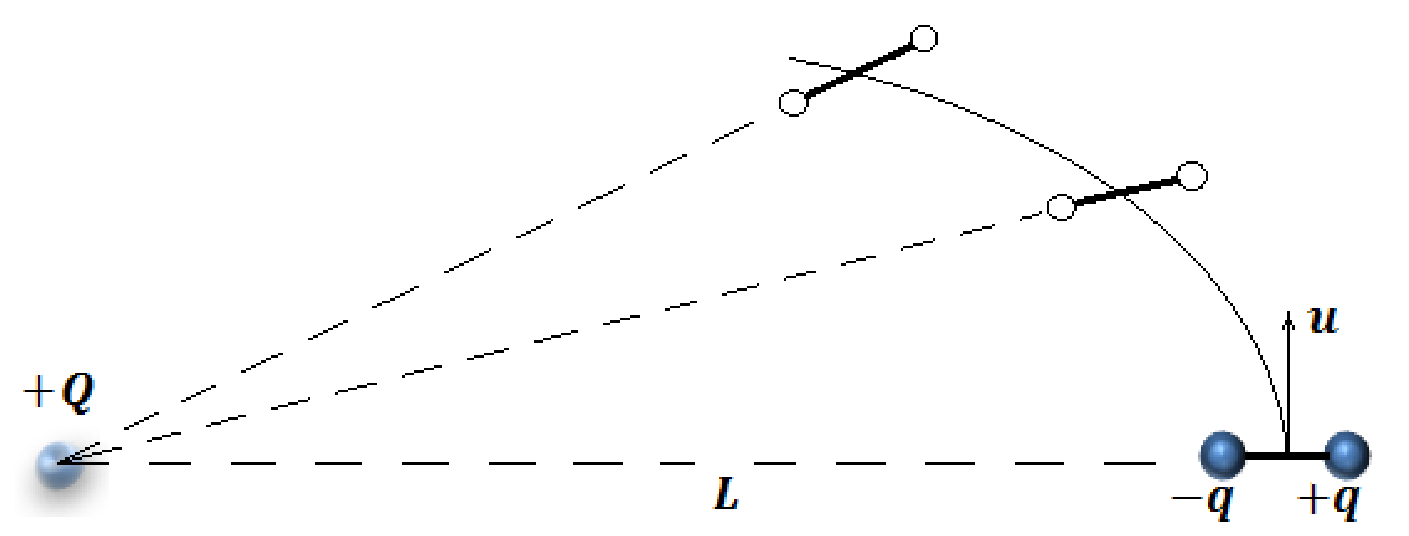
In order for the dipole to get closer to the charged object, its initial velocity should be less than some critical value .
3. Find this critical initial velocity .
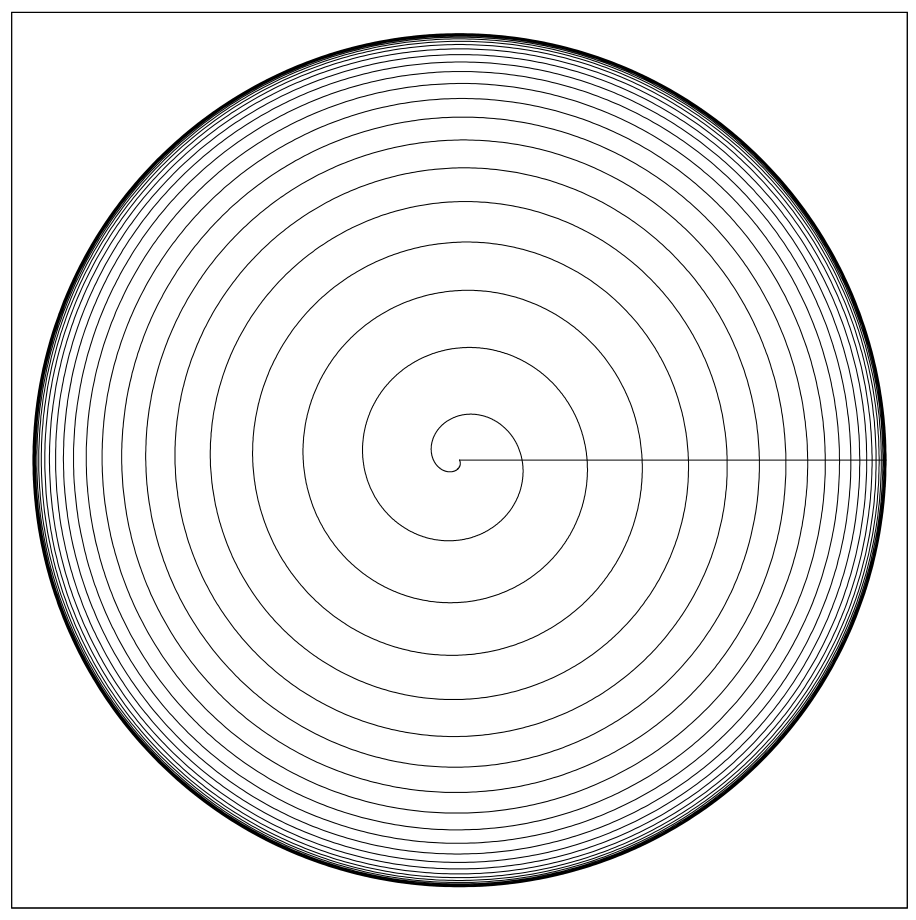
4. Sketch the trajectory of the center mass of the dipole for the case when the dipole is launched with the critical initial velocity , considering a very long time (radiation effects take place).
Suppose that the condition is applied and radiation effects are very small.
5. What time is required to reduce the distance between the dipole and the charged body to half of the original distance?
2. Motion around the fixed dipole
In this part, analyze a situation when an angular momentum is not conserved. The system is the same in the previous part with the only difference that the dipole is fixed and the charged small object with a mass is moving around the dipole. The electrostatic field of the dipole is easier to describe in the polar system of coordinates, which is defined with the distance from the center of the dipole, and angle counted counterclockwise, as shown in Figure 3.
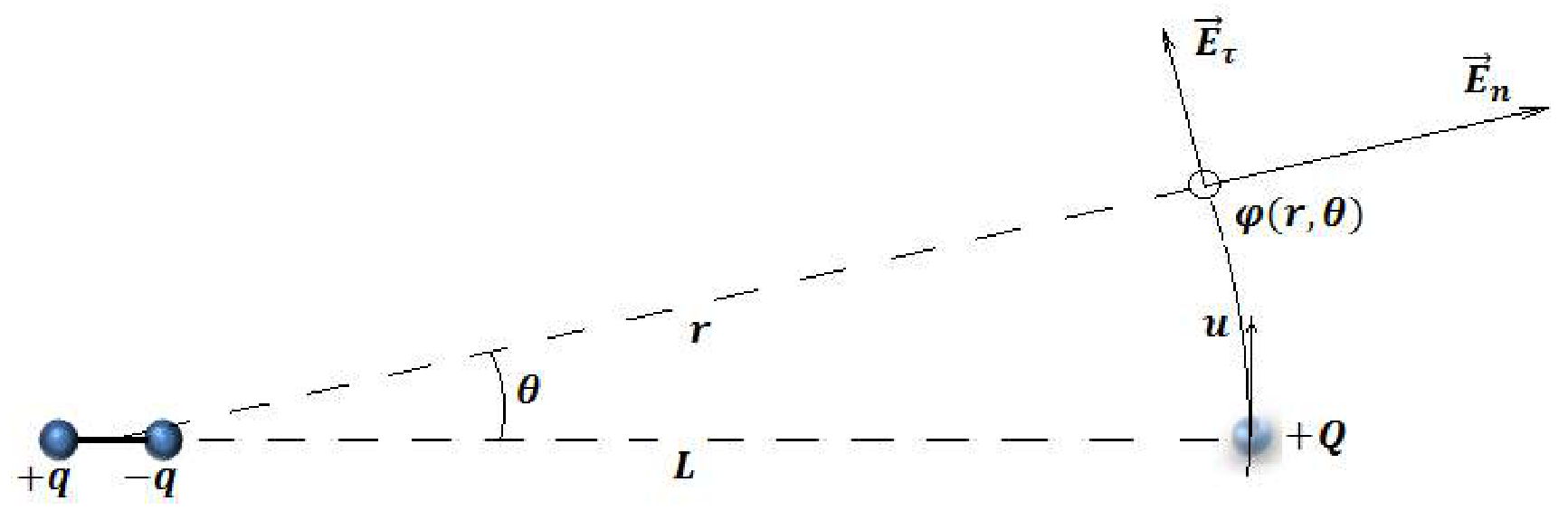
1. Determine the electrostatic potential at a distance from the dipole, as a function of .
2. Find the components of the electric field and in terms of , , and .
3. What torque is applied to the moving object counting from the center of the dipole when the object is at the distance and angle from the dipole?
4. Determine tangential component of the velocity of the charged object as a function of coordinates and . Hint: angular velocity
5. Calculate the normal component of the velocity of the moving object.
Now it is time to compare results with the first part.
6. Find the time to reduce the distance between the dipole and the charged body to .
3. Circular motion
In this part the peculiarity of the circular motion around the dipole is analyzed. Initially, the system is the same as in Part 2, with the exception that the charged object is connected to the center of the dipole with a light, rigid insulating rod with the length . This rod easily rotates around the axis, which is perpendicular to the surface of the table. Thus, the charged object moves around the dipole along circular trajectory with radius .
1. What is the maximum and minimum velocity of the charged object and during circular motion around the dipole?
2. Derive an expression for the force acting from the moving object on the rod in terms of , , , , and .
3. With what initial velocity should the charged object be launched, so that it will move around the dipole along a circular trajectory, even without the rigid rod?
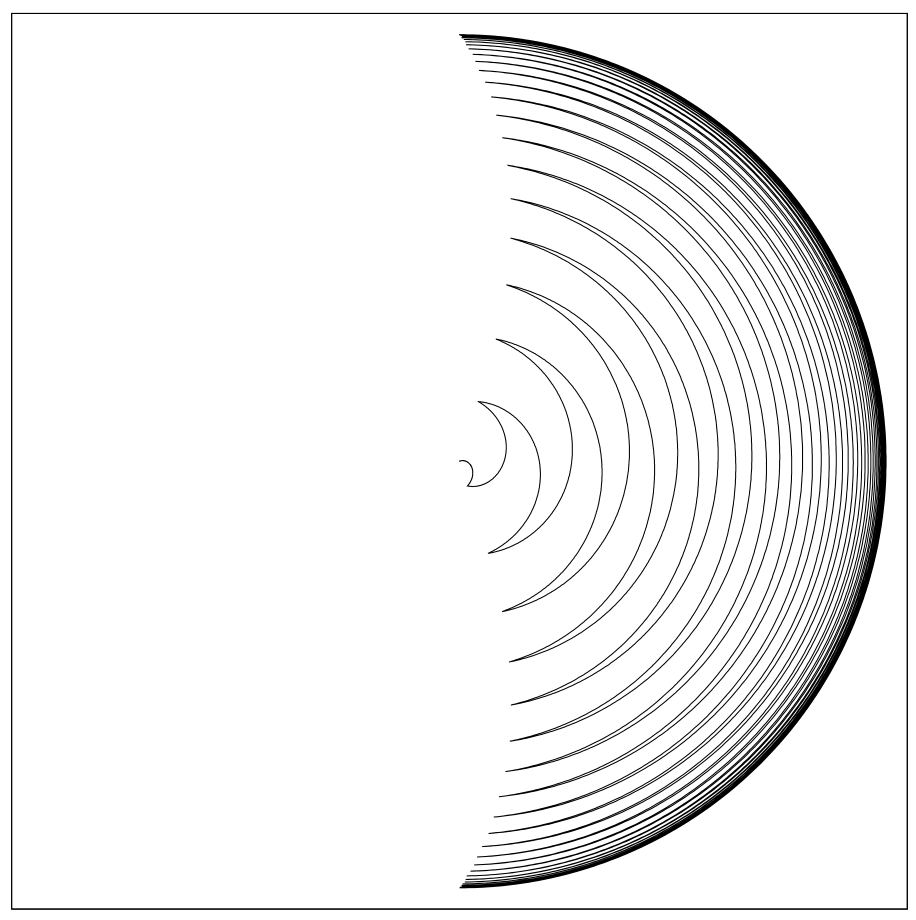
4. Sketch the orbit of the charged object for the situation described in 3 after a long time (radiation effects make their impact on the motion).
Useful math:
where and are some constants.
Решение
WoPhO Selection Round Problem 5 — Motion in the electrostatic field of a dipole.
Attila Szabó, Grade 12, Leőwey Klára High School, Pécs, Hungary.
Transcription note: The supplied key contains several printed algebra and sign inconsistencies. Its formulas are retained below, with notes beside the affected steps. No separate marking rubric or point values are supplied.
Part 1. Motion of the dipole
1. The torque acting on an electric dipole is given in the vector form by , where is the moment of the dipole, and is the electric field at the centre of the dipole. Let be the angle between the line joining the point charge to the centre of the dipole and . Using this notation, the magnitude of torque becomes
which equals to , where is the moment of inertia. Using the standard small-angle approximations the equation of rotation becomes
This is a harmonic equation, the solution of which is a harmonic oscillation with angular frequency , the period is therefore
2. As the force acting on each point charges are in the line joining them to the charge , there is no torque exerted on the dipole with respect to that charge. Consequently, the angular momentum with respect to the fixed point charge is constant, I’ll denote it by as is used already. Initially, , at a distance , : equating them gives
The electric potential energy of the dipole is given by (using first-order approximations in )
The conservation of energy between the initial and the examined state:
3. If , the second factor in the above expression is negative; as the square root must real, the first factor must be negative as well, that is, . The critical value of is then
4. Initially, the distance won’t change, but as radiation effects start to take place, the energy of the system will decrease: we may interpret it as becoming lower, lower than . This means, that the dipole diverts from the circular orbit and as the radial velocity becomes larger with becoming smaller, the distance will converge to0 with an increasing speed: this is shown in the sketch.
5. As in the case , must be lower than , the radial velocity will point towards the fixed charge, i.e. . Substituting the expression for into this differential equation:
Source note: the second square root in the first displayed line is printed without the minus sign present before the first square root. This printed inconsistency is retained.
Integrating both sides:
(I have used the given value in the last step. Note that the dipole will get to the point charge in a finite time, , this reasons that in the previous sketch the dipole eventually reaches the fixed charge.)
Part 2. Motion about the fixed dipole
1. The distance between the charge and the respective charges of the dipole using first-order approximations in :
Using these expressions we obtain the formula of the electric potential:
2. ; using the cylindrical expression of the gradient:
3.
4. The angular momentum of the charge with respect to the centre of the dipole is . The time derivative of is
Integrating both sides with respect to time gives
Using the condition at we get and gives
Source note: the intermediate displayed line prints , while the immediately preceding expression for contains . The missing power of is retained as printed.
5. Using the conservation of energy:
Source note: the third displayed line prints in both denominators, although the preceding and following lines depend on . This printed denominator inconsistency is retained.
6. As I have noted at the end of the previous part, , thus the differential equation to be written down is the same in the two cases as well, like the solutions. Therefore,
where as in Part 1.
Part 3. Circular motion
1. We may use the formula for derived in Part 2 as the rod doesn’t exert any torque upon the point charge. Taking the restriction into account gives for the tangential (and thus total) velocity
It’s easy to see that the greater is the greater is , therefore the maximal velocity belongs to and is . The minimal velocity is bit more difficult to find. If is real then the charge will reach this position with minimal and this expression gives the minimal velocity. However, if the above expression is imaginary (i.e. is negative) then the charge won’t reach the mentioned state but turns back halfway. In this case, is0. With a small mathematical trick we can get a unified expression for :
2. The centripetal acceleration of the point charge is : this acceleration must be provided by the normal electric force and the rod force:
which is independent of .
Source note: the question asks for the force from the moving object on the rod; this key introduces through the force balance on the moving charge. The original convention is retained.
3–4. If the force needed to hold the charge on course is0, then it will be able to move along it without the rod. The condition is thus , from which,
being not too surprising knowing the found similarities of the motion.
We need to consider that , thus the charge cannot go along a full circle. Solving the equation
gives , thus . Therefore, the point charge will initially bounce back and forth between . Due to radiation, the object will lose energy, this can be taken into account by slightly decreasing : in the equation
this will result in a slight decreasing of and so that of . As gets smaller than , the charge is going to approach the dipole faster and faster (compare with Part 2.6). These specialities of the motion (the decreasing of may be exaggerated) are indicated in the sketch.
Source note: the key prints the numeral3 and continues into the radiation discussion and sketch without a separate numeral4. The combined label3–4 here identifies that continuation. The discussion says decreases while the displayed expression retains .
Оригинал в Архива: WoPhO_2013_Q5.pdf · официални решения: WoPhO_2013_S5.pdf