APhO 2000, Теория — Задача 1. Eclipses of the Jupiter’s Satellite
1st ASIAN PHYSICS OLYMPIAD — THEORETICAL COMPETITION · 25 април 2000 г.
READ THIS FIRST
- Use only the pen provided.
- Use only the marked side of the paper
- Each problem should be answered on separate sheets
- In your answers please user primarily symbols, equations, numbers, graphs, tables and as little text as possible.
- Write at the top of every sheet in your report:
- Your candidate number (APhO identification number).
- The problem number and section identification, e.g.2/a.
- Number each sheet consecutively.
- Write on the front page the total number of sheets in your report
Условие
A long time ago before scientists could measure the speed of light accurately, O Römer, a Danish astronomer studied the time eclipses of the Jupiter’s satellite. He was able to determine the speed of light from observed periods of a satellite around the planet Jupiter. Figure 1 shows the orbit of the earth E around the sun S and one of the satellites M around the planet Jupiter. (He observed the time spent between two successive emergences of the satellite M from behind Jupiter).
A long series of observations of the eclipses permitted an accurate evaluation of the period of M. The observed period T depends on the relative position of the earth with respect to the frame of reference SJ as one of the coordinate axes. The average time of revolution is = 42h 28 m 16s and maximum observed period is ( + 15)s.
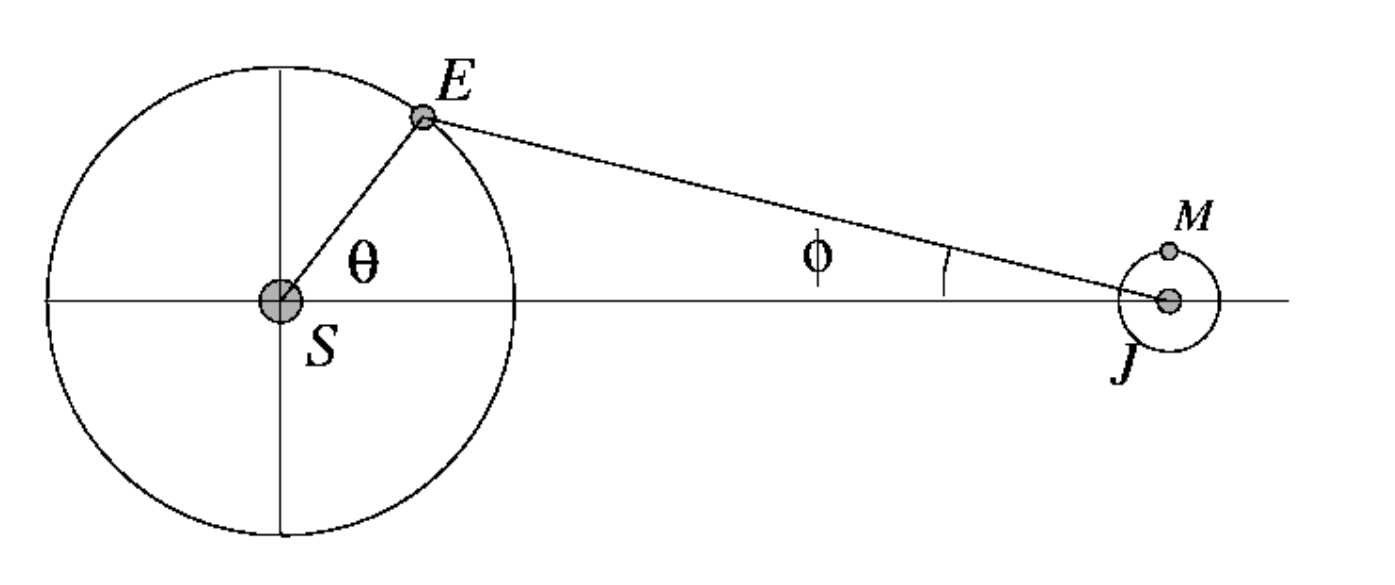
The average distance of the earth E to the Sun is = 149.6 x . The maximum distance is = 1.015 . The period of revolution of the earth is 365 days and of Jupiter is 11.9 years. The distance of the satellite M to the planet Jupiter = 422 x km.
a. Use Newton’s law of gravitation to estimate the distance of Jupiter to the Sun. Determine the relative angular velocity of the earth with respect to the frame of reference Sun-Jupiter (SJ). Calculate the speed of the earth with respect to SJ. [1 т.]
b. Take a new frame which Jupiter is at rest with respect to the Sun. Determine the relative angular velocity of the earth with respect to the frame of reference Sun-Jupiter ( SJ). Calculate the speed of the earth with respect to SJ. [1 т.]
c. Suppose an observed saw M begin to emerge from the shadow when his position was at and the next emergence when he was at , k = 1,2,3,… From these observations he got the apparent periods of revolution T ( ) as a function of time from Figure 1 and then use an approximate expression to explain how the distance influences the observed periods of revolution of M. Estimate the relative error of your approximate distance. [3 т.]
d. Derive the relation between d ( ) and T ( ). Plot period T ( ) as a function of time of observation . Find the positions of the earth when he observed maximum period, minimum period and true period of the satellite M. [2 т.]
e. Estimate the speed of light from the above result. Point out sources of errors of your estimation and calculate the order of magnitude of the error. [2 т.]
f. We know that the mass of the earth = 5.98 x kg and 1 month = 27d 7h 3m. Find the mass of the planet Jupiter.
Отговори
a. km
Distance of Jupiter to the Sun, km, as printed in the official solution.
b. 0.0157 rad/day
Relative angular velocity. The official solution gives the relative velocity as km/day, then prints “= 27.3×10³ km” (the unit /s is missing in the source).
c.
Relative error of the approximation of the order of (official solution).
d.
e. 278000 km/s
Printed in the official solution as “C=2.78 x 10⁵ km/s”.
Решение
Внимание: Непълно решение
The official solutions contain no solution for part f (mass of Jupiter).
a. ( Total Point : 1 ) Assume the orbits of the earth and Jupiter are circles, we can write the centripetal force = equal gravitational attraction of the Sun.
(0.5 point)
where
G = universal gravitational constant
= mass of the Sun
= mass of the Earth
= mass of the Jupiter
= radius of the orbit of the Earth
= velocity of the Earth
= velocity of Jupiter
Hence
We know
we get
( 0.5 point )
b. ( Total Point: 1 ) The relative angular velocity is
( 0.5 point )
and the relative velocity is
( 0.5 point )
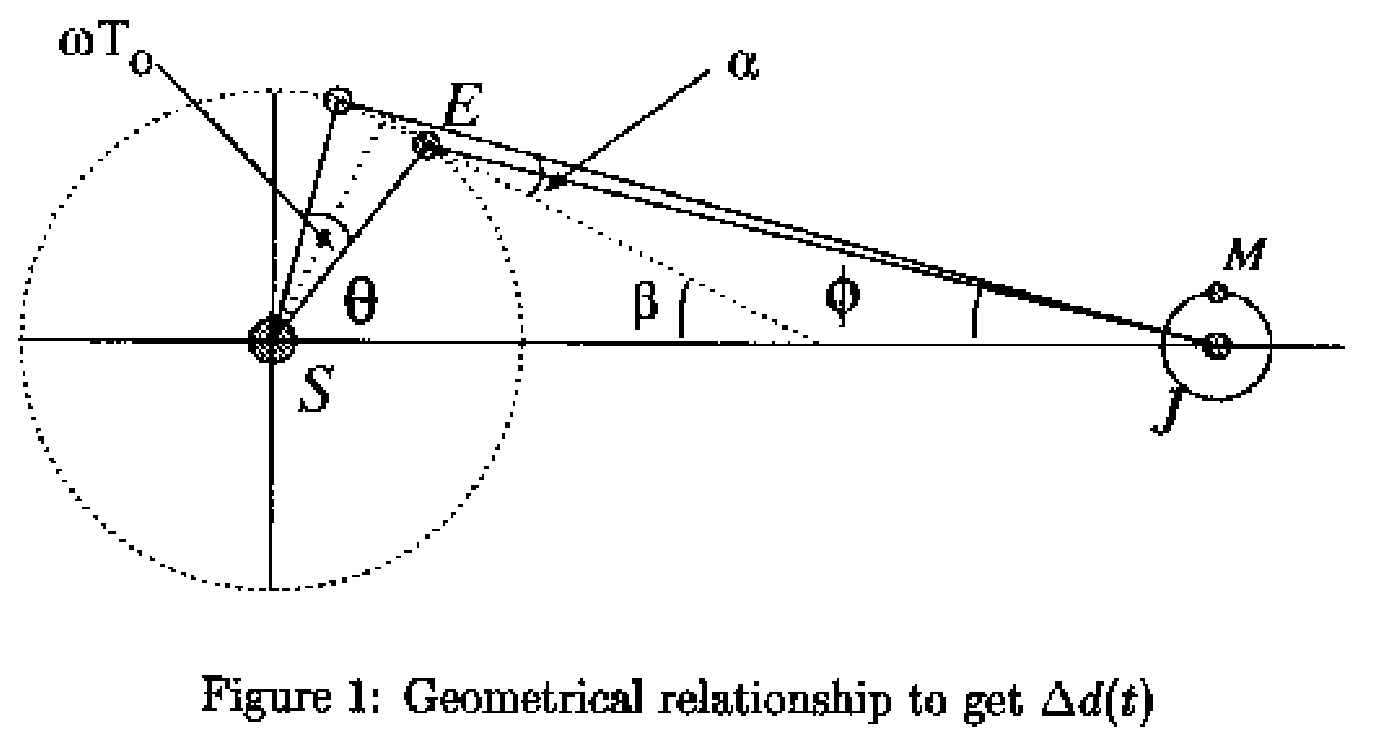
c. ( Total Point: 3 ) The distance of Jupiter to the Earth can be written as follows
(1.0 point)
The relative error of the above expression is the order of
The observer saw M begin to emerge from the shadow when his position was at d(t) and he saw the next emergence when his position was at d(t +T0)/ Light need time to travel the distance so the observer will get apparent period T instead of the true period .
(1.0 point)
because
We can also get this approximation directly from the geometrical relationship from Figure 1.
(1.0 point)
or we can use another method.
From the figure above we get
(1.0 point)
(1.0 point)
d. ( Total Point: 2)
(1.0 point)
e. Total Point : 2 from
we get
Hence
C=2.78 x km/s
(1.0 point)
Оригинал в Архива: th_problems.pdf · официални решения: th_solutions.pdf