APhO 2002, Теория — Задача 1. Theoretical Question 1 (vibrations of a linear crystal lattice)
3rd Asian Physics Olympiad, Singapore — Theoretical Competition, Wednesday, 8 May, 2002 · 8 май 2002 г. · 10 т.
Please read this first:
- The examination lasts for 5 hours. There are 3 questions.
- Use only the pen issued.
- Use only the front side of the sheets of paper provided. Do not use the side marked with a cross.
- Each question should be answered on separate sheets of paper.
- For each question, in addition to the blank writing sheets on which you may write, there is an answer sheet where you must summarize the results you have obtained. Numerical results should be written with as many digits as are appropriate to the given data. Do not forget to state the units.
- Write on the blank sheets of paper whatever you consider is required for the solution of the questions and that you wish to be marked. However you should use mainly equations, numbers, symbols and diagrams. Please use as little text as possible.
- It is absolutely essential that you enter your Country and your student number (Student No.) at the top of each sheet of paper used. In addition, on the blank sheets of paper used for each question, you should enter the number of the question (Question No.), the progressive number of each sheet (Page No.) and the total number of blank sheets that you have used and wish to be marked for each question (Total pages). It is also helpful to write the question number and the section label of the part you are answering at the beginning of each sheet of writing paper. If you use some blank sheets of paper for notes that you do not wish to be marked, put a large cross through the whole sheet and do not include it in your numbering.
- When you have finished, arrange all sheets in proper order (for each question put answer sheets first, then used sheets in order, followed by the sheets you do not wish to be marked. Put unused sheets and the printed question at the bottom). Place the papers for each question inside the envelope labeled with the appropriate question number, and leave everything on your desk. You are not allowed to take any sheet of paper out of the room.
Условие
A very large number of movable identical point particles (), each with mass , are set in a straight chain with identical massless springs, each with stiffness (spring constant) , linking them to each other and the ends attached to two additional immovable particles. See figure. This chain will serve as a model of the vibration modes of a one-dimensional crystal. When the chain is set in motion, the longitudinal vibrations of the chain can be looked upon as a superposition of simple oscillations (called modes) each with its own characteristic mode frequency.

(a) Write down the equation of motion of the particle. [0,7 т.]
(b) To attempt to solve the equation of motion of part (a) use the trial solution
where is the displacement of the particle from equilibrium, the angular frequency of the vibration mode and , and are constants; and are the wave numbers and mode frequencies respectively. For each , there will be a corresponding frequency . Find the dependence of on , the allowed values of , and the maximum value of . The chain’s vibration is thus a superposition of all these vibration modes. Useful formulas:
[2,2 т.]
According to Planck the energy of a photon with a frequency of is , where is the Planck constant divided by . Einstein made a leap from this by assuming that a given crystal vibration mode with frequency also has this energy. Note that a vibration mode is not a particle, but a simple oscillation configuration of the entire chain. This vibration mode is analogous to the photon and is called a phonon. We will follow up the consequences of this idea in the rest of the problem. Suppose a crystal is made up of a very large () number of particles in a straight chain.
(c) For a given allowed (or ) there may be no phonons; or there may be one; or two; or any number of phonons. Hence it makes sense to try to calculate the average energy of a particular mode with a frequency . Let represent the probability that there are phonons with this frequency . Then the required average is
Although the phonons are discrete, the fact that there are so many of them (and the becomes tiny for large ) allows us to extend the sum to , with negligible error. Now the probability is given by Boltzmann’s formula
where is Boltzmann’s constant and is the absolute temperature of the crystal, assumed constant. The constant of proportionality does not depend on . Calculate the average energy for phonons of frequency . Possibly useful formula: . [2 т.]
(d) We would like next to compute the total energy of the crystal. In part (c) we found the average energy for the vibration mode . To find we must multiply by the number of modes of the crystal per unit of frequency and then sum up all these for the entire range from to . Take an interval in the range of wave numbers. For very large and for much larger than the spacing between successive (allowed) values, how many modes can be found in the interval ? [1 т.]
(e) To make use of the results of (a) and (b), approximate by and replace any sum by an integral over . (It is more convenient to use the variable in place of at this point.) State the total number of modes of the crystal in this approximation. Also derive an expression but do not evaluate it. The following integral may be useful: . [2,2 т.]
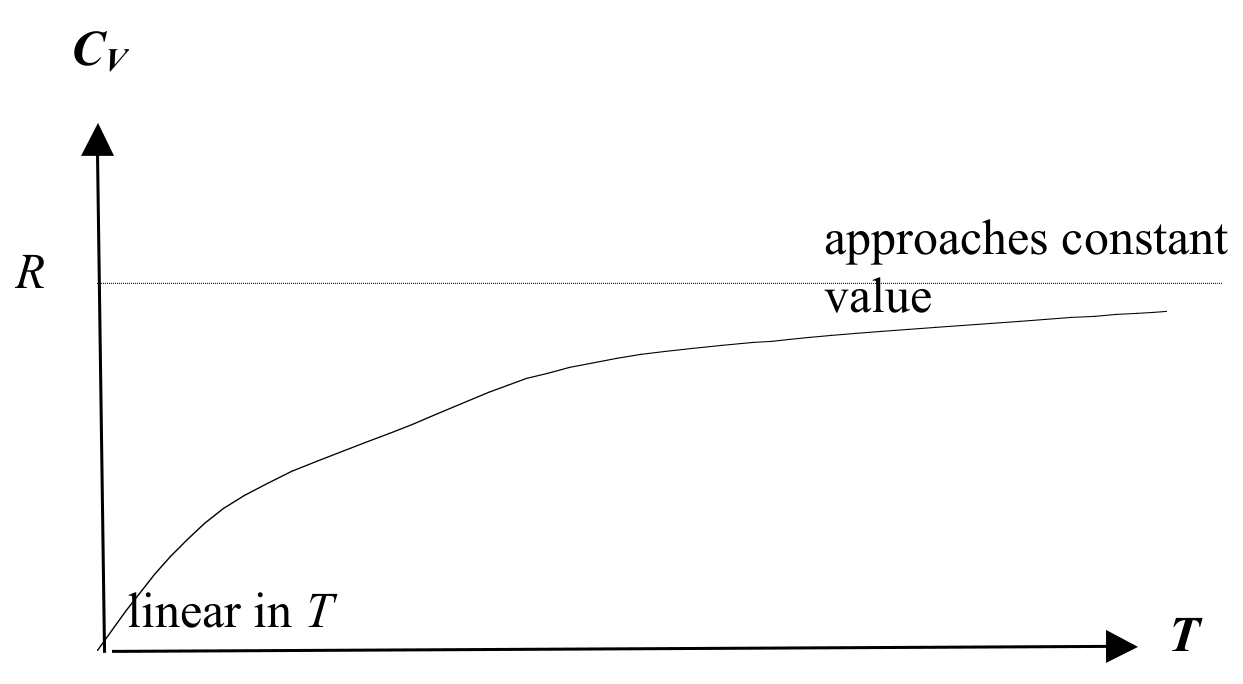
(f) The molar heat capacity of a crystal at constant volume is experimentally accessible: ( = absolute temperature). For the crystal under discussion determine the dependence of on for very large and very low temperatures (i.e., is it constant, linear or power dependent for an interval of the temperature?). Sketch a qualitative graph of versus , indicating the trends predicted for very low and very high . [1,9 т.]
Отговори
- (a)
- (c)
- (d)
- (e)
- (f) For T → 0, CV is linear in T; as T → ∞, CV → NkB = R (Dulong-Petit rule).
Решение
(a) [0.7]
(b) Let which has a harmonic time dependence.
By analogy with the spring, the acceleration is .
Substitute into (a):
[0.6]
Hence [0.2]
To determine the allowed values of , use the boundary condition . [0.7]
The allowed wave numbers are given by ( in all), [0.3]
and their corresponding frequencies can be computed from
in which is the maximum allowed frequency. [0.4]
(c)
First method:
[1.5]
The sum is a geometric series and is [0.5]
We find .
Alternatively: denominator is a geometric series [(0.5)]
Numerator is (denominator) and result follows. [(1.5)]
A non-calculus method:
Let where . This is a geometric series and equals . Let The result we want is . Observe
Hence or . [(2.0)]
(d) From part (b), the allowed values are .
Hence the spacing between allowed values is , so there are allowed modes in the wave-number interval (assuming ). [1.0]
(e) Since the allowed are , there are modes. [0.5]
Follow the problem:
from part (a) & (b)
, . This second form is more convenient for integration. [0.5]
The number of modes in the interval is
[0.5] for eith… (This part is necessary fo… below, but not for number of modes)
Total number of modes for large . [(0.5)]
Total crystal energy from (c) and of part (e) is given by
[0.7]
(f) Observe first from the last formula that increases monotonically with temperature since is increasing with . [0.2]
When , the term in the last result may be neglected in the denominator so [0.2]
[0.3]
[0.2]
which is quadratic in (denominator in integral is effectively unity) hence is linear in near absolute zero. [0.2]
Alternatively, if the summation is retained, we have
[(0.5)]
When , use in the denominator, [0.2]
[0.1]
which is linear; hence the universal gas constant. This is the Dulong-Petit rule.
Alternatively, if the summation is retained, write denominator as and [(0.2)]
which is linear in , so is constant.
Sketch of versus : [0.5]
Answer sheet: Question 1
(a) Equation of motion of the mass is:
(b) Angular frequencies of the chain’s vibration modes are given by the equation:
Maximum value of is:
The allowed values of the wave number are given by:
How many such values of are there?
(f) The average energy per frequency mode of the crystal is given by:
(g) There are how many allowed modes in a wave number interval ?
(e) The total number of modes in the lattice is:
Total energy of crystal is given by the formula:
(h) A sketch (graph) of versus absolute temperature is shown below.
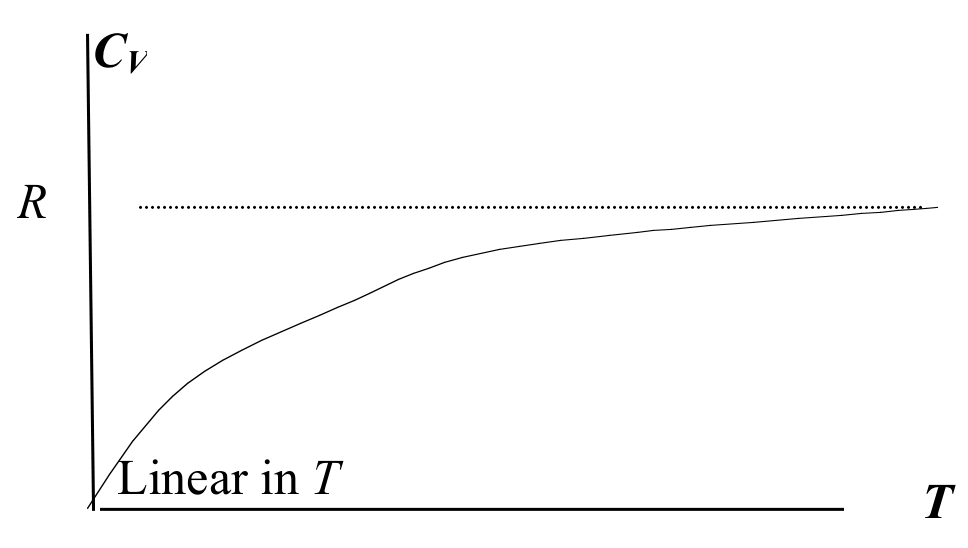
For , displays the following behaviour: is linear in .
As , displays the following behaviour: the universal gas constant.
Answer sheet: Theoretical Question 1 (vibrations of a linear crystal lattice)
Name : · Country : · Student no.: · Question no.: · Page no: · Total pages: · For Examiners use only · 3rd APHO
Write on this side of the paper only
(a) Equation of motion of the particle is:
(b) Angular frequencies of the chain’s vibration modes are given by the equation:
The allowed values of the wave number are given by:
Maximum value of is:
(c) The average energy for phonons of frequency is given by:
(d) There are how many allowed modes in a wave number interval ?
(e) The total number of modes in the crystal is:
Total energy of crystal is given by the formula:
(f) A sketch (graph) of versus absolute temperature is shown below.
For , displays the following dependence:
As , displays the following dependence:
Answer Sheet: Theoretical question 2 (The Rail Gun)
Name : · Country : · Student no.: · Question no.: · Page no: · Total pages: · For Examiners use only · 3rd APHO
Write on this side of the paper only
a) Expression for the acceleration of the young man parallel to the rail.
b) Obtain an expression for the time spent
a. on the rails .
b. in flight
c) (Examiner will refer to your tables of values and graphs in your solution.)
d) Range of angles:
Answer Sheet: Theoretical Question 3 (Wafer Fabrication)
Name : · Country : · Student no.: · Question no.: · Page no: · Total pages: · For Examiners use only · 3rd APHO
Write on this side of the paper only
(c) The time needed to deposit ONE layer is
(d) The new time needed to deposit ONE layer is:
(e) Relation between , and :
Value of :
Оригинал в Архива: th_problems.pdf · официални решения: th_solutions.pdf