APhO 2002, Теория — Задача 2. Theoretical Question 2 (the rail gun)
3rd Asian Physics Olympiad, Singapore — Theoretical Competition, Wednesday, 8 May, 2002 · 8 май 2002 г. · 10 т.
Please read this first:
- The examination lasts for 5 hours. There are 3 questions.
- Use only the pen issued.
- Use only the front side of the sheets of paper provided. Do not use the side marked with a cross.
- Each question should be answered on separate sheets of paper.
- For each question, in addition to the blank writing sheets on which you may write, there is an answer sheet where you must summarize the results you have obtained. Numerical results should be written with as many digits as are appropriate to the given data. Do not forget to state the units.
- Write on the blank sheets of paper whatever you consider is required for the solution of the questions and that you wish to be marked. However you should use mainly equations, numbers, symbols and diagrams. Please use as little text as possible.
- It is absolutely essential that you enter your Country and your student number (Student No.) at the top of each sheet of paper used. In addition, on the blank sheets of paper used for each question, you should enter the number of the question (Question No.), the progressive number of each sheet (Page No.) and the total number of blank sheets that you have used and wish to be marked for each question (Total pages). It is also helpful to write the question number and the section label of the part you are answering at the beginning of each sheet of writing paper. If you use some blank sheets of paper for notes that you do not wish to be marked, put a large cross through the whole sheet and do not include it in your numbering.
- When you have finished, arrange all sheets in proper order (for each question put answer sheets first, then used sheets in order, followed by the sheets you do not wish to be marked. Put unused sheets and the printed question at the bottom). Place the papers for each question inside the envelope labeled with the appropriate question number, and leave everything on your desk. You are not allowed to take any sheet of paper out of the room.
Условие
A young man at P and a young lady at Q were deeply in love. These two places are separated by a strait of width . After learning about the theory of rail gun in class, the young man could not wait to construct such a device to launch himself across the strait. He constructed a ramp of adjustable elevation of angle on which he laid two metal rails (the length of each rail is ) in parallel, separated by . He managed to connect a 2424 V DC power supply to the ends of the rails. A conducting bar can slide freely on the metal rails such that he could hang on to it safely as it slides.
A skilled engineer, moved by all these efforts, designed a system that can produce a magnetic field that can be directed perpendicular to the plane of the rails. The mass of the young man is 70 kg. The mass of the conducting bar is 10 kg and its resistance is .
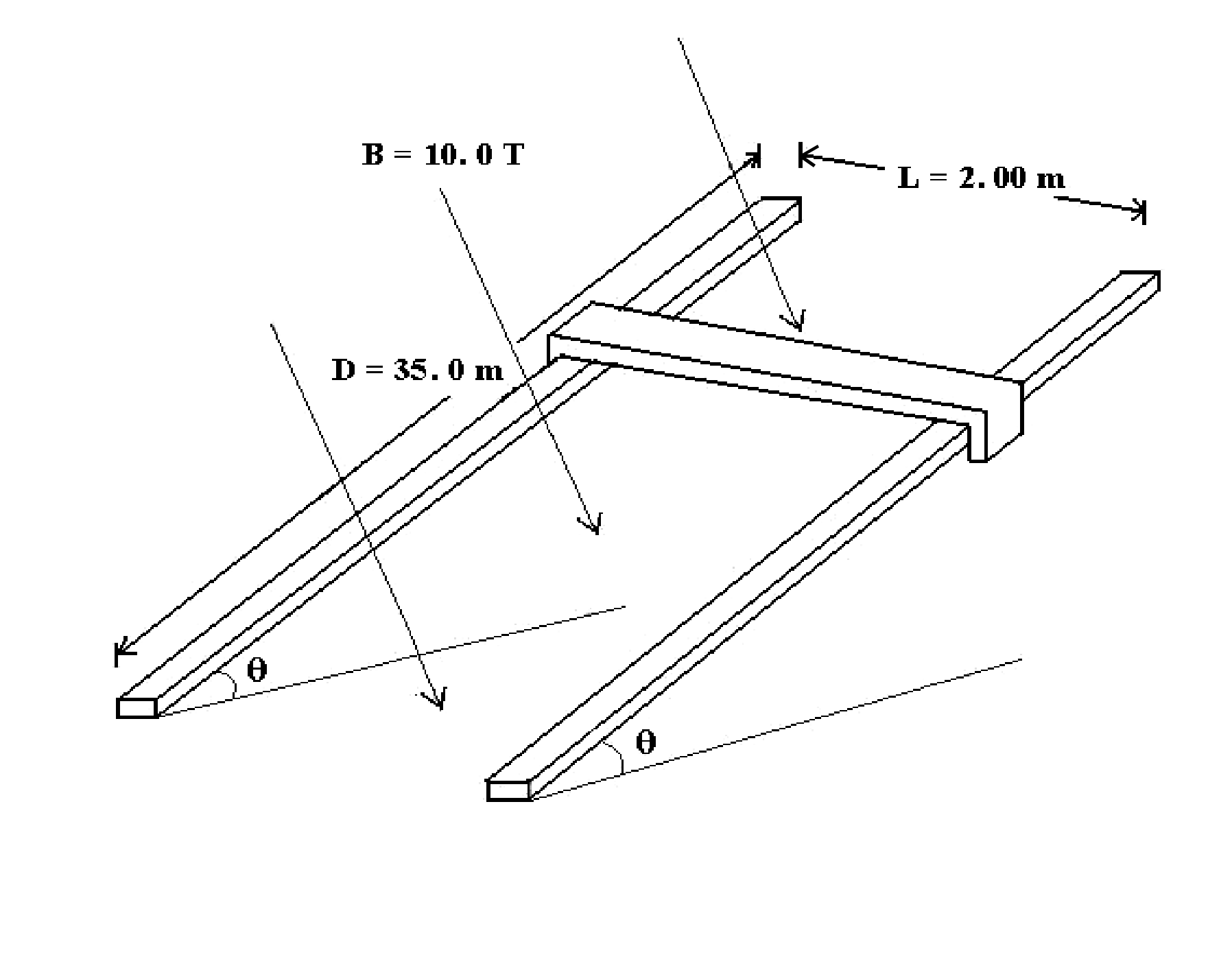
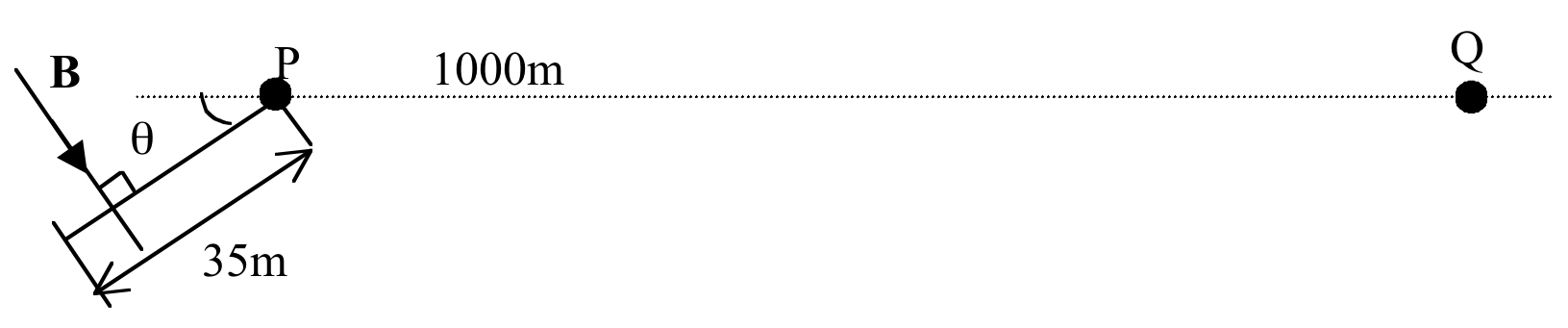
Just after he had completed the construction and checked that it worked perfectly, he received a call from the young lady, sobbing and telling him that her father was going to marry her off to a rich man unless he can arrive at Q within 11 seconds after the call, and having said that she hang up.
The young man immediately got into action and launched himself across the strait to Q.
Show, using the steps listed below, whether it is possible for him to make it in time, and if so, what is the range of he must set the ramp?
(a) Derive an expression for the acceleration of the young man parallel to the rail. [3 т.]
(b) Obtain an expression in terms of for the time spent
i. on the rails, and
ii. in flight, . [3 т.]
(c) Plot a graph of the total time against the angle of inclination . [1,5 т.]
(d) By considering the relevant parameters of this device, obtain the range of angles that he should set. Plot another graph if necessary. [2,5 т.]
Make the following assumptions:
The time between the end of the call and all preparations (such as setting to the appropriate angle) for the launch is negligible. This is to say, the launch is considered to start at time when the bar (with the young man hanging to it) is starting to move.
The young man may start his motion from any point along the metal rails.
The higher end of the ramp and Q is at the same level, and the distance between them is .
There is no question about safety such as when landing, electric shocks, etc.
The resistance of the metal rails, the internal resistance of the power supply, the friction between the conducting bar and the rails and the air resistance are all negligible.
Take acceleration due to gravity as .
Some Mathematical notes:
The solution to is given by
Отговори
(a)
(b)
(d) θ between 0.50 and 0.51 rad (28.6° to 29.2°)
Official solution: θ between 0.5 and 0.505 rad; more precisely 0.502 to 0.507 rad; to 2 significant figures 0.50 to 0.51 rad.
Решение
Proper Solution (taking induced emf into consideration):
(a)
Let I be the current supplied by the battery in the absence of back emf.
Let i be the induced current by back emf .
Since , [1]
Net current, [0.5]
Forces parallel to rail are:
Force on rod due to current is . [0.5]
Net force on rod and young man combined is . (1)
Newton’s law: . (2) [0.5]
Equating (1) and (2), & substituting for & dividing by , we obtain the acceleration
where and . [0.5] [3]
(b)(i)
Since initial velocity of rod = 0, and let velocity of rod at time be , we have
(3) [0.5]
where
Let be the total time he spent moving along the rail, and be his velocity when he leaves the rail, i.e.
(4) [0.5]
(5) [0.5] [1.5]
(b) (ii)
Let be the time in flight:
(6) [0.5]
He must travel a horizontal distance during .
(7)
(8) (from (6) & (7)) [0.5]
From (8), is fixed by the angle and the width of the strait
(9)
(Substitute (9) in (5))
And
(Substitute (9) in (8)) [0.5] [1.5]
(c)
Therefore, total time is:
The values of the parameters are: , , , , , , and .
Then
So,
By plotting as a function of , we obtain the following graph:
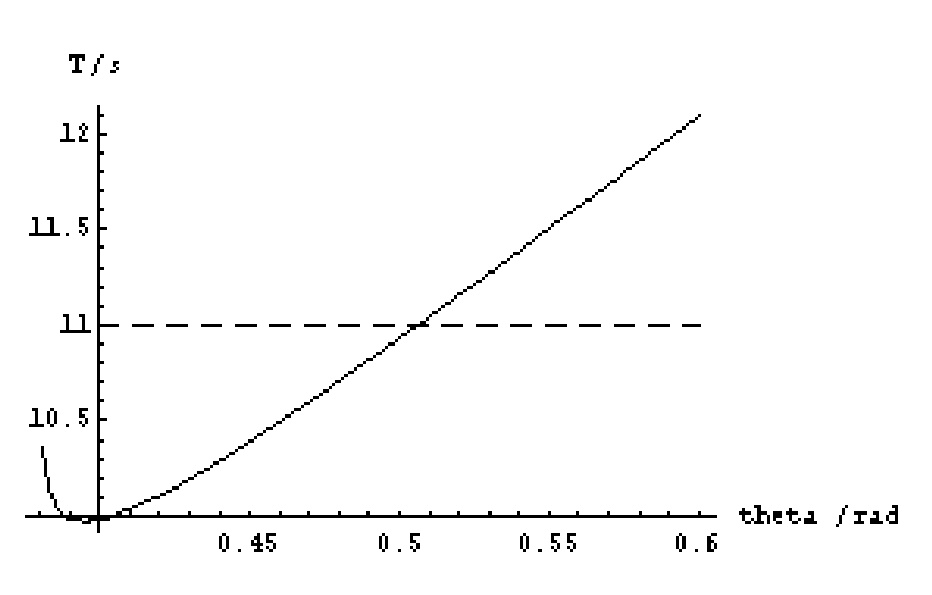
Note that the lower bound for the range of to plot may be determined by the condition (or the argument of ln is positive), and since mg/BLI is small (0.0165), (= 121 m/s), we have the condition , i.e. . So one may start plotting from .
From the graph, for within the range (~0.38, 0.505 ) radian the time is within 11 s.
Labeling: 0.1 each axis
Unit: 0.1 each axis
Proper Range in : 0.3 lower limit (more than 0.37, less than 0.5), 0.2 upper limit (more than 0.5 and less than 0.6)
Proper shape of curve: 0.2
Accurate intersection at : 0.4 [1.5]
(d)
However, there is another constraint, i.e. the length of rail . Let be the distance travelled during the time interval
i.e.
[0.5]
The graph below shows as a function of .
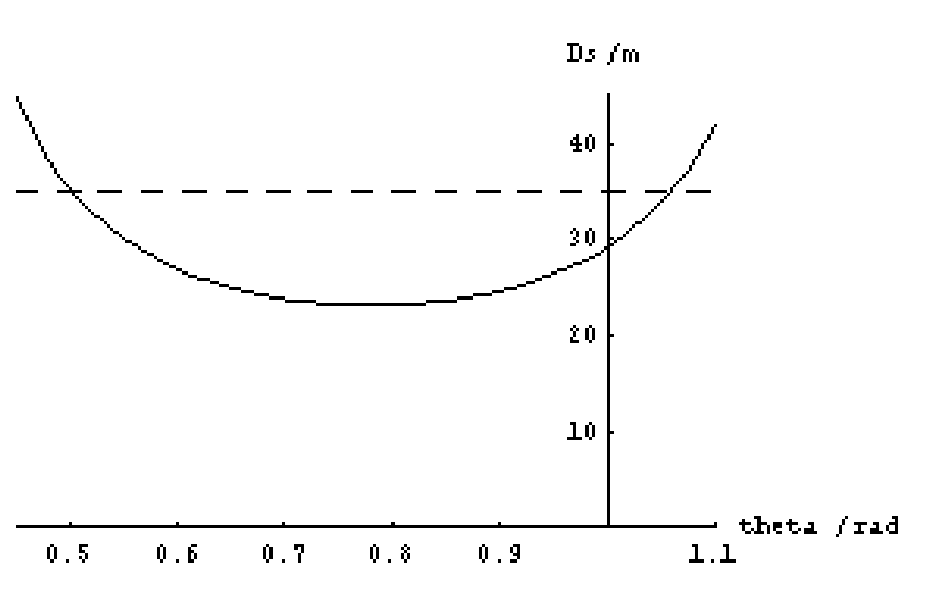
Labeling: 0.1 each axis
Unit: 0.1 each axis
Proper Range in : 0.3 lower limit (more than 0.4, less than 0.49), 0.2 upper limit (more than 0.51 and less than 1.1)
Proper shape of curve: 0.2
Accurate intersection at : 0.4
It is necessary that which means must range between .5 and1.06 radians.
In order to satisfy both conditions, must range between 0.5 & 0.505 radians.
(Remarks: Using the formula for , & D, we get
At , , , giving T = 11.01 s, & D = 34.3 m
At , , , giving T = 10.99 s, & D = 34.4 m
At , , , giving T = 10.95 s, & D =34.96 m
At , , , giving T = 10.93 s, & D =35.2 m,
So the more precise angle range is between 0.502 to 0.507, but students are not expected to give such answers.
To 2 sig fig T = 11 s. Range is 0.50 to 0.51 (in degree: to or ) [0.5] [2.5]
Alternate Solution (Not taking induced emf into consideration):
If induced emf is not taken into account, there is no induced current, so the net force acting on the combined mass of the young man and rod is
[0.2 ] [0.2 ]
And we have instead
where
[0.1]
and
[0.2]
Therefore,
giving
[0.5]
and
[0.5]
Hence,
where .
The values of the parameters are: , , , , , , and . Then,
where . [0.3] [2]
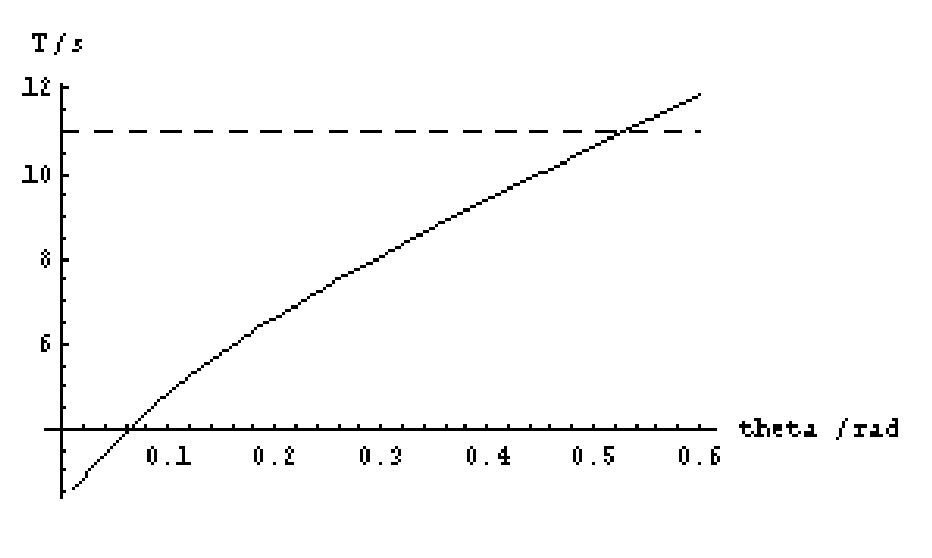
For within the range (~0, 0.52 ) radian the time is within 11 s.
Labeling: 0.1 each axis
Unit: 0.1 each axis
Proper Range in : 0.1 lower limit (more than 0, less than 0.5), 0.2 upper limit (more than 0.52 and less than 0.8)
Proper shape of curve: 0.2
Accurate intersection at : 0.4 [1.3]
However, there is another constraint, i.e. the length of rail .
Let be the distance travelled during the time interval
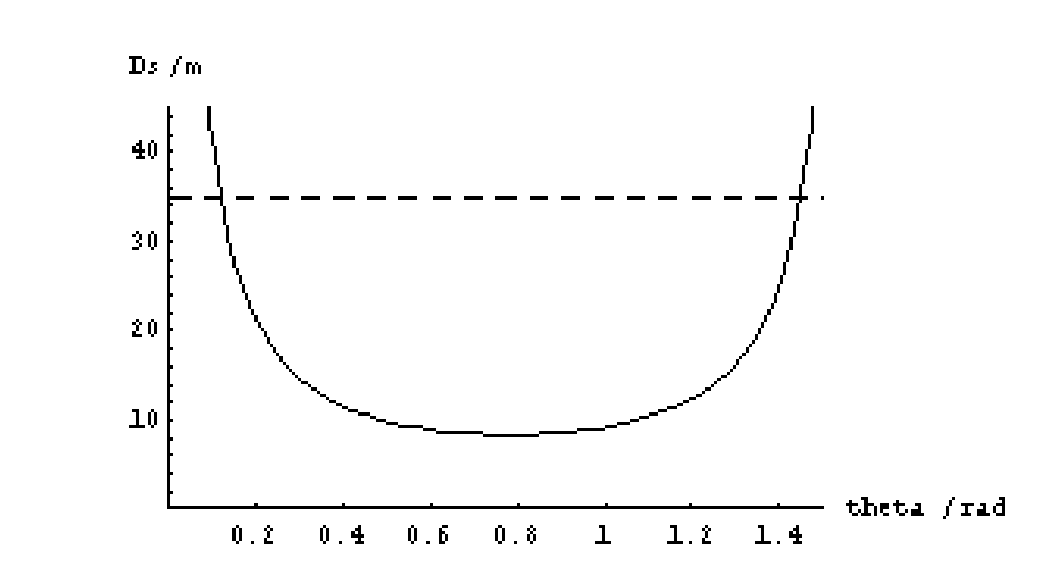
which is plotted below
Labeling: 0.1 each axis
Unit: 0.1 each axis
Proper Range in : 0.1 lower limit (more than 0.08, less than 0.11), 0.1 upper limit (more than 0.52 and less than 1.5)
Proper shape of curve: 0.2
Accurate intersection at : 0.4
It is necessary that which means must range between 0.11 and 1.43 radians. [1.2]
In order to satisfy both conditions, must range between 0.11 & 0.52 radians. [0.5]
Answer sheet: Theoretical Question 1 (vibrations of a linear crystal lattice)
Name : · Country : · Student no.: · Question no.: · Page no: · Total pages: · For Examiners use only · 3rd APHO
Write on this side of the paper only
(a) Equation of motion of the particle is:
(b) Angular frequencies of the chain’s vibration modes are given by the equation:
The allowed values of the wave number are given by:
Maximum value of is:
(c) The average energy for phonons of frequency is given by:
(d) There are how many allowed modes in a wave number interval ?
(e) The total number of modes in the crystal is:
Total energy of crystal is given by the formula:
(f) A sketch (graph) of versus absolute temperature is shown below.
For , displays the following dependence:
As , displays the following dependence:
Answer Sheet: Theoretical question 2 (The Rail Gun)
Name : · Country : · Student no.: · Question no.: · Page no: · Total pages: · For Examiners use only · 3rd APHO
Write on this side of the paper only
a) Expression for the acceleration of the young man parallel to the rail.
b) Obtain an expression for the time spent
a. on the rails .
b. in flight
c) (Examiner will refer to your tables of values and graphs in your solution.)
d) Range of angles:
Answer Sheet: Theoretical Question 3 (Wafer Fabrication)
Name : · Country : · Student no.: · Question no.: · Page no: · Total pages: · For Examiners use only · 3rd APHO
Write on this side of the paper only
(c) The time needed to deposit ONE layer is
(d) The new time needed to deposit ONE layer is:
(e) Relation between , and :
Value of :
Оригинал в Архива: th_problems.pdf · официални решения: th_solutions.pdf