APhO 2002, Теория — Задача 3. Theoretical Question 3 (wafer fabrication)
3rd Asian Physics Olympiad, Singapore — Theoretical Competition, Wednesday, 8 May, 2002 · 8 май 2002 г. · 10 т.
Please read this first:
- The examination lasts for 5 hours. There are 3 questions.
- Use only the pen issued.
- Use only the front side of the sheets of paper provided. Do not use the side marked with a cross.
- Each question should be answered on separate sheets of paper.
- For each question, in addition to the blank writing sheets on which you may write, there is an answer sheet where you must summarize the results you have obtained. Numerical results should be written with as many digits as are appropriate to the given data. Do not forget to state the units.
- Write on the blank sheets of paper whatever you consider is required for the solution of the questions and that you wish to be marked. However you should use mainly equations, numbers, symbols and diagrams. Please use as little text as possible.
- It is absolutely essential that you enter your Country and your student number (Student No.) at the top of each sheet of paper used. In addition, on the blank sheets of paper used for each question, you should enter the number of the question (Question No.), the progressive number of each sheet (Page No.) and the total number of blank sheets that you have used and wish to be marked for each question (Total pages). It is also helpful to write the question number and the section label of the part you are answering at the beginning of each sheet of writing paper. If you use some blank sheets of paper for notes that you do not wish to be marked, put a large cross through the whole sheet and do not include it in your numbering.
- When you have finished, arrange all sheets in proper order (for each question put answer sheets first, then used sheets in order, followed by the sheets you do not wish to be marked. Put unused sheets and the printed question at the bottom). Place the papers for each question inside the envelope labeled with the appropriate question number, and leave everything on your desk. You are not allowed to take any sheet of paper out of the room.
Условие
Wafer fabrication refers to the production of semiconductor chips from silicon. In modern technologies there are more than 20 processes; we are going to concentrate on thin films deposition.
In wafer fabrication process, thin films of various materials are deposited on the surface of the silicon wafer. The surface of the substrate must be extremely clean before the process of deposition. The presence of traces of oxygen or other elements will result in the formation of a contamination layer. The rate of formation of this layer is determined by the impingement rate of the gas molecules hitting the substrate surface. Assuming the number of molecules per unit volume is , the impingement rate on a unit area of the substrate from the gas is given by
where is the average or mean speed of the gas molecules.
(a) Assuming that the gas molecules obey a Maxwell-Boltzmann distribution,
where is the fraction of molecules whose speed lie between and , is the molar mass of the gas, is the gas temperature and is the gas constant, show that the average or mean speed of the gas molecules is given by
[1,5 т.]
(b) Assuming that the gases behave as an ideal gas at low pressure, , show that the rate of impingement is given by
where is the mass of the molecule and is the temperature of the gas. [1,5 т.]
(c) If the residual pressure of oxygen in a vacuum system is 133 Pa, and by modelling the oxygen molecule as a sphere of radius approximately , estimate how long it takes to deposit a molecule-thick layer of oxygen on the wafer at Celsius, assuming that all the oxygen molecules which strike the silicon wafer surface are deposited. Assume also that oxygen molecules in the layer are arranged side by side. [1,7 т.]
(d) In reality, not all molecules of oxygen react with the silicon. This can be modeled by the concept of activation energy where the reacting molecules should have total energy greater than the activation energy before it can react. Physically this activation energy describes the fact that chemical bonds between the silicon atoms have to be broken before a new bond between silicon and oxygen atoms is formed. Assuming an activation energy for the reaction to be 1 eV, estimate again how long it would take to deposit one atomic layer of oxygen at the above temperature. You may assume that the area under the Maxwell distribution in part (a) is unity. [2,8 т.]
(e) For lithography processes, the clean silicon wafer is coated evenly with a layer of transparent polymer (photo-resist) of refractive index . To measure the thickness of this photo-resist, the wafer is illuminated with collimated monochromatic beam of light of wavelength . For a certain minimum thickness of photo-resist, , there is a destructive interference of reflected light, assuming normal incidence on the coating. Derive an expression for relation between , and . Calculate using the given data. In this point you may assume that silicon behaves as a medium with a refractive index greater than 1.40 and you may ignore multiple reflections. [2,5 т.]
The following data may be helpful:
Molar mass of oxygen is 32 g mol.
Boltzmann constant, .
Avogadro number,
Useful formula:
Отговори
- (c) 0.7 µs
- (d) 20.4 s
- (e) ≈ nm
Решение
Question 3 - Marking Scheme
(a) Since
Marking Scheme:
Performing the integration correctly: 1 mark
Simplifying 0.5 marks
Subtotal for the section 1.5 marks
(b) Assuming an ideal gas, , so that the concentration of the gas molecules, , is given by
the impingement rate is given by
where we have note that and ( being Avogadro number).
Marking Scheme:
Using ideal gas formula to estimate concentration of gas molecules: 0.7 marks
Simplifying expression: 0.4 marks
Using and the formula for (0.2 mark each) 0.4 marks
Subtotal for the section 1.5 marks
(c) Assuming close packing, there are approximately 4 molecules in an area of 16 m. Thus, the number of molecules in 1 m is given by
However at (273 + 300) K and 133 Pa, the impingement rate for oxygen is
Therefore, the time needed for the deposition is
The calculated time is too short compared with the actual processing.
Marking Scheme:
Estimation of number of molecules in 1 m : 0.4 marks
Calculation the impingement rate: 0.6 marks
Taking note of temperature in Kelvin 0.3 marks
Calculating the time 0.4 marks
Subtotal for the section 1.7 marks
(d) With activation energy of 1 eV and letting the velocity of the oxygen molecule at this energy is , we have
At a temperature of 573 K, the distribution of the gas molecules is
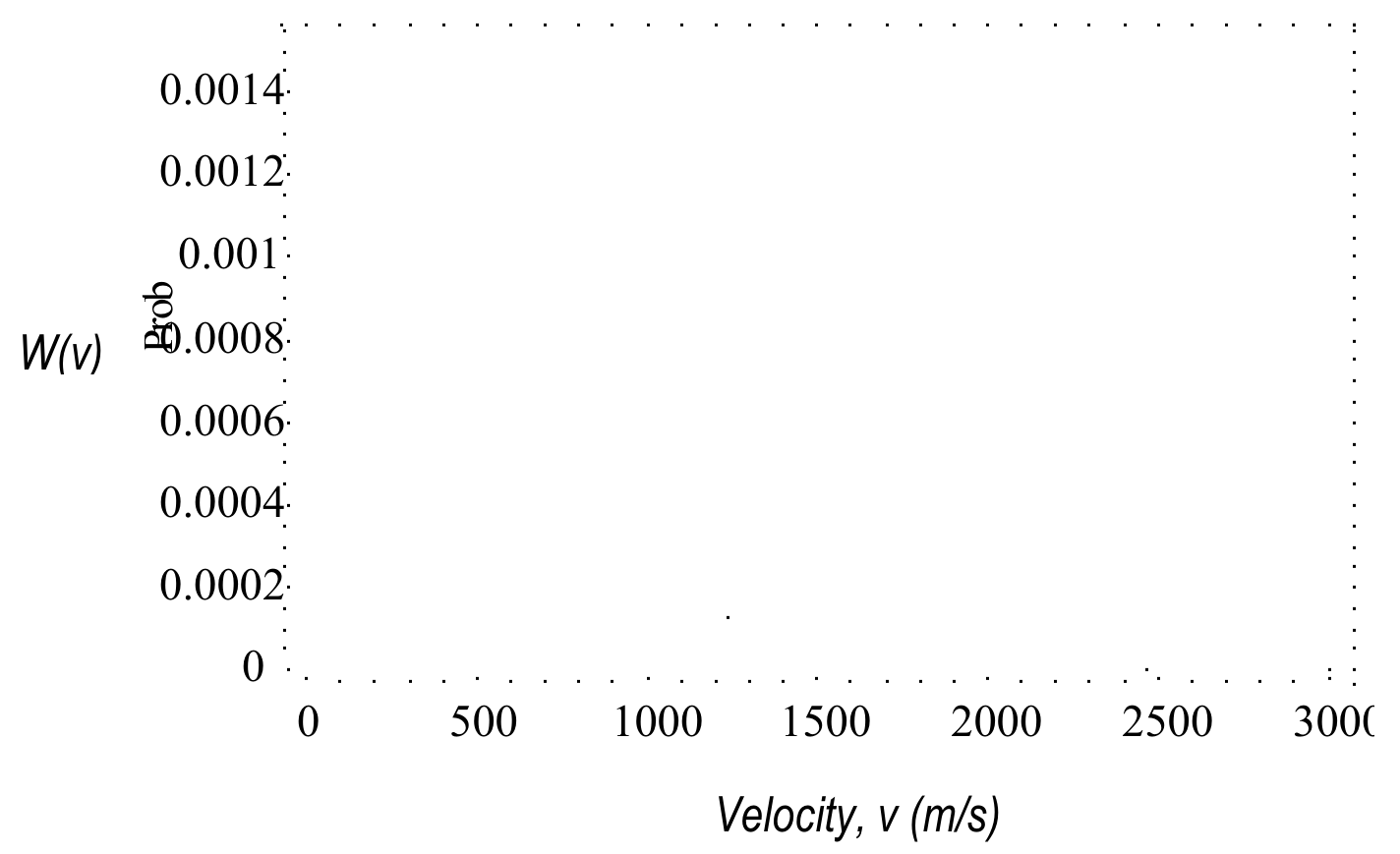
We can estimate the fraction of the molecules with speed greater than 2454 ms using the trapezium rule (or any numerical techniques) with ordinates at 2453, 2453 + 500, 2453 +1000. The values are as follows:
| Velocity, | Probability, |
|---|---|
| 2453 | 1.373 x 10 |
| 2953 | 2.256 x 10 |
| 3453 | 6.518 x 10 |
Using trapezium rule, the fraction of molecules with speed greater than 2453 ms is given by
Thus the time needed for the deposition is given by 0.7 µs/(3.43 x 10) that is 20.4 s
Marking Scheme
Computing the value of the cut-off energy or velocity: 0.6 marks
Estimating the fraction of molecules 1.2 marks
Correct method of final time 0.4 marks
Correct value of final time 0.6 marks
Subtotal for the section 2.8 marks
(e) For destructive interference, optical path difference where is the wavelength in the coating.
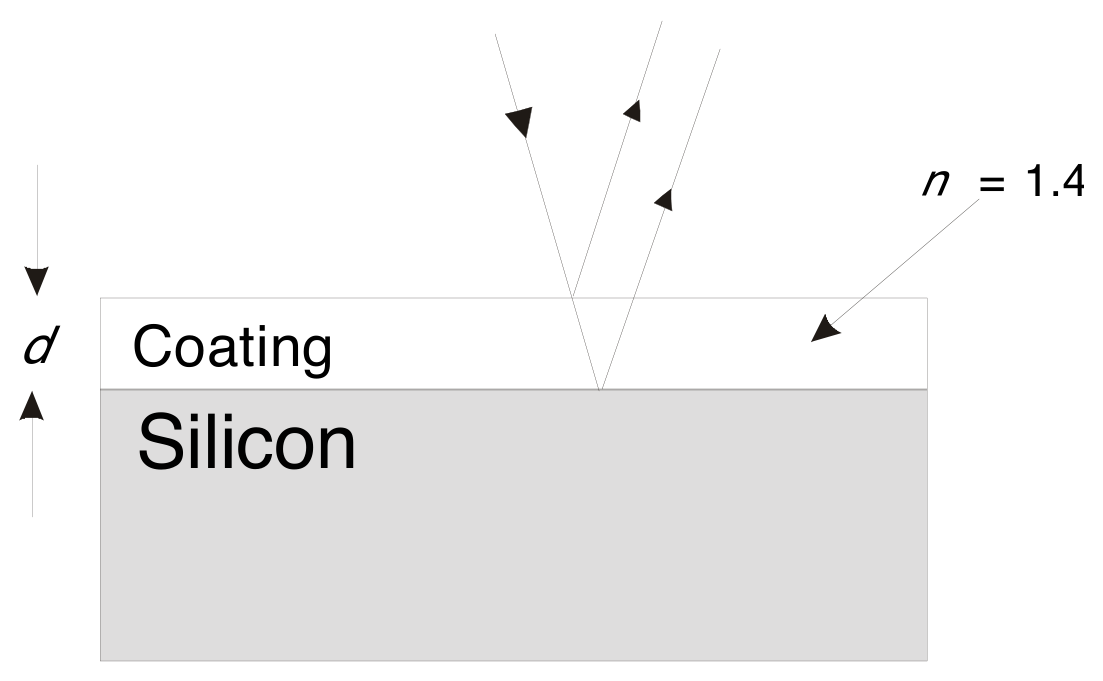
The relation is given by:
Plugging in the given values, one gets or 105.2 nm.
Derive equation:
Finding the optical path length 0.2 marks
Knowing that there is a phase change at the reflection 0.5 marks
Putting everything together to get the final expression 0.6 marks
Subtotal: 1.3 marks
Computation of : 0.6 marks
Getting the correct number of significant figures: 0.6 marks
Subtotal: 1.2 marks
Subtotal for Section 2.5 marks
TOTAL 10 marks
Answer sheet: Theoretical Question 1 (vibrations of a linear crystal lattice)
Name : · Country : · Student no.: · Question no.: · Page no: · Total pages: · For Examiners use only · 3rd APHO
Write on this side of the paper only
(a) Equation of motion of the particle is:
(b) Angular frequencies of the chain’s vibration modes are given by the equation:
The allowed values of the wave number are given by:
Maximum value of is:
(c) The average energy for phonons of frequency is given by:
(d) There are how many allowed modes in a wave number interval ?
(e) The total number of modes in the crystal is:
Total energy of crystal is given by the formula:
(f) A sketch (graph) of versus absolute temperature is shown below.
For , displays the following dependence:
As , displays the following dependence:
Answer Sheet: Theoretical question 2 (The Rail Gun)
Name : · Country : · Student no.: · Question no.: · Page no: · Total pages: · For Examiners use only · 3rd APHO
Write on this side of the paper only
a) Expression for the acceleration of the young man parallel to the rail.
b) Obtain an expression for the time spent
a. on the rails .
b. in flight
c) (Examiner will refer to your tables of values and graphs in your solution.)
d) Range of angles:
Answer Sheet: Theoretical Question 3 (Wafer Fabrication)
Name : · Country : · Student no.: · Question no.: · Page no: · Total pages: · For Examiners use only · 3rd APHO
Write on this side of the paper only
(c) The time needed to deposit ONE layer is
(d) The new time needed to deposit ONE layer is:
(e) Relation between , and :
Value of :
Оригинал в Архива: th_problems.pdf · официални решения: th_solutions.pdf