APhO 2005, Експеримент — Задача 1. DETERMINATION OF SHAPES BY REFLECTION
EXPERIMENTAL COMPETITION · 28 април 2005 г.
Please read this first
Thursday, April 28th, 2005
Before attempting to assemble your equipment, read the problem text completely!
Please read this first:
- The time available is 5 hours.
- Use only the pen and equipments provided. You may use your own calculator.
- Use only the one side of the provided sheets.
- In addition to "blank" sheets where you may write freely, there is a set of Answer sheets where you must summarize the results you have obtained. Numerical results must be written with as many digits as appropriate; don’t forget the units.
- Please write on the "blank" sheets the results of all your measurements and whatever else you deem important for the solution of the problem, that you wish to be evaluated during the marking process. However, you should use mainly equations, numbers, symbols, graphs, figures, and use as little text as possible.
- It's absolutely imperative that you write on top of each sheet: your country (“Country code”), your student code (as shown on your identification tag, “Student ID”), and additionally on the "blank" sheets: the progressive number of each sheet (from 1 to N, “Page n.”) and the total number (N) of "blank" sheets that you use and wish to be evaluated (“Page total”); leave the “Problem” field blank.
- The students should start with a new page for each section. It is also useful to write the number of the section you are answering at the beginning of each such section. If you use some sheets for notes that you do not wish to be evaluated by the marking team, just put a large cross through the whole sheet, and don’t number it.
- When you have finished, turn in all sheets in proper order (answer sheets first, then used sheets in order, the unused sheets and problem text at the bottom) and put them all inside the envelope where you found them; then leave everything on your desk. You are not allowed to take anything out of the room.
Условие
INTRODUCTION
Direct visual observation, is a method where human beings used their eyes to identify an object. However, not all things in life can be observed directly. For example, how can you tell the position of a broken bone? Is it possible to look at a baby inside a pregnant woman? How about identifying cancer cells inside a brain? All of these require a special technique involving indirect observation.
In this experiment, you are to determine the shape of an object using indirect observation. You will be given two closed cylindrical boxes and in each box, there will be an object with unknown shapes. Your challenge is to reveal the object without opening the box. The physics concepts for this experiment are simple, but creativity and some skills are needed to solve it.
EXPERIMENT
APPARATUS
For this experiment, you will be given two sets of cylindrical boxes consisting of:
- An object with unknown shape to be determined (it is a simple geometrical object with either plane or cylindrical sides)
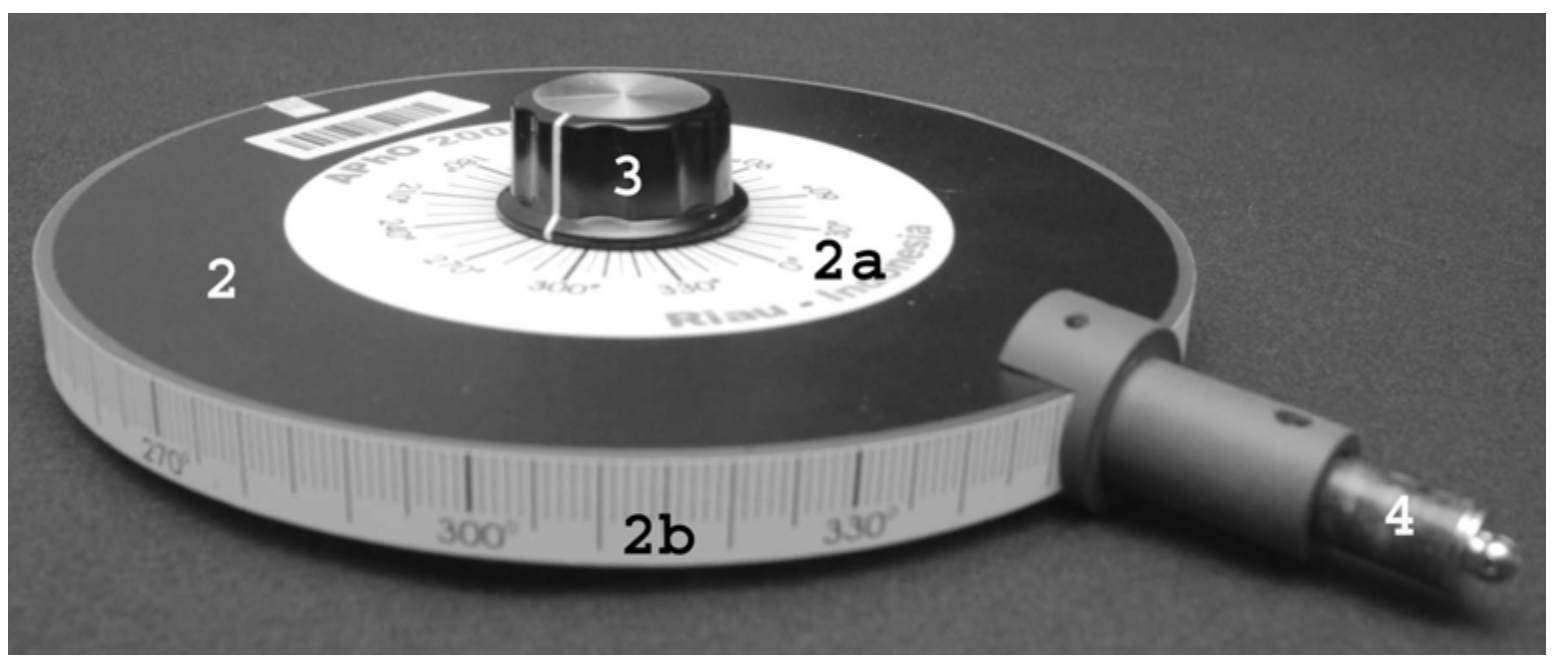
- Closed cylindrical box with an angular scale on the top side (2a) and around its circumference (2b).
- A knob which you can rotate
- A laser pointer
- Spare batteries for the laser pointer
- A ruler
EXPERIMENTAL METHOD
The students are to determine the shape of the object inside a closed cylindrical box. The diameter of the cylinder can be measured by a ruler. Students are not allowed to open the cylindrical box or break the seal to determine the shape of the object. The object is an 8-mm thick metal with its sides polished so that it can reflect light likes a mirror. You can rotate the object using the knob on the top part of the cylinder. This will rotate the object in the same axis as the cylinders axis.
The laser pointer can be switched on by rotating its position. You can adjust the position of the light beam by rotating the laser pointer in either clockwise or anti-clockwise direction. The reflection of the laser beam from the laser pointer can be observed along the circumference of the closed cylinder. Measurement using the angular scale can be used. By rotating the knob on the upper part while the laser pointer is switched on, you will notice that as you rotate the object, the position of the reflected light from the object will change. If the light from the laser pointer dim or the laser pointer fail to work, ask the committee for replacement. By observing the correlation of the angular position of the object and the reflection of the laser beam, you should be able to determine the shape of the object.
For every object (the two objects are of different shapes):
A. Draw a graph of: ‘reflection angle of the laser beam against the angular position of the object’ (2 × 1 pt) [2 т.]
B. Determine the number of edges (sides) in each object (2 × 0.25 pt) [0,5 т.]
C. Use data from the graphic to sketch the shape of the object and find the angular positions of changing sides correspond with the top angular scale (2 × 1.5 pts) [3 т.]
For the object with fewer sides only:
D. Draw rotating axis of the object and determine the distance to every sides (3 pts)
E. Determine the length of sides without error analysis; determine also the angles between neighboring sides (1.5 pts)
You must present your result on graph papers and try to deduce the mathematical equations to determine the shape of the object.
Remarks:
- One of the objects has only plane sides and the second object has one curved side.
- Sometimes you may get two reflections of the beam from the object.
- In case of a curved side the determination of the radius of curvature is not required but determination whether it is convex or concave with respect to the axis of rotation is necessary.
Отговори
- B. Object B00110: 3 sides; object B01110: 5 sides (one of them a concave curved side)
Решение
1. SHAPES DETERMINATION BY REFLECTION
SUGGESTED SOLUTION
Barcode: B00110
| Object Position (αº) | Reflected Ray (βº) | Cal. Reflected Ray (βº) |
|---|---|---|
| -10 | 211 | -149 |
| -5 | 223 | -137 |
| 0 | 230 | -130 |
| 10 | 251 | -109 |
| 20 | 270 | -90 |
| 30 | 290 | -70 |
| 40 | 310 | -50 |
| 50 | 330 | -30 |
| 60 | 349 | -11 |
| 75 | 17 | 17 |
| 80 | 28 | 28 |
| 90 | 46 | 46 |
| 100 | 65 | 65 |
| 110 | 87 | 87 |
| 120 | 117 | 117 |
| 130 | 128 | 128 |
| 140 | 273 | -87 |
| 150 | 291 | -69 |
| 160 | 310 | -50 |
| 170 | 326 | -34 |
| 180 | 343 | -17 |
| 195 | 10 | 10 |
| 200 | 12 | 12 |
| 210 | 34 | 34 |
| 220 | 249 | -111 |
| 230 | 267 | -93 |
| 240 | 285 | -75 |
| 250 | 301 | -59 |
| 260 | 319 | -41 |
| 270 | 337 | -23 |
| 275 | 345 | -15 |
| 290 | 13 | 13 |
| 300 | 29 | 29 |
| 310 | 46 | 46 |
| 320 | 64 | 64 |
| 330 | 83 | 83 |
| 340 | 102 | 102 |
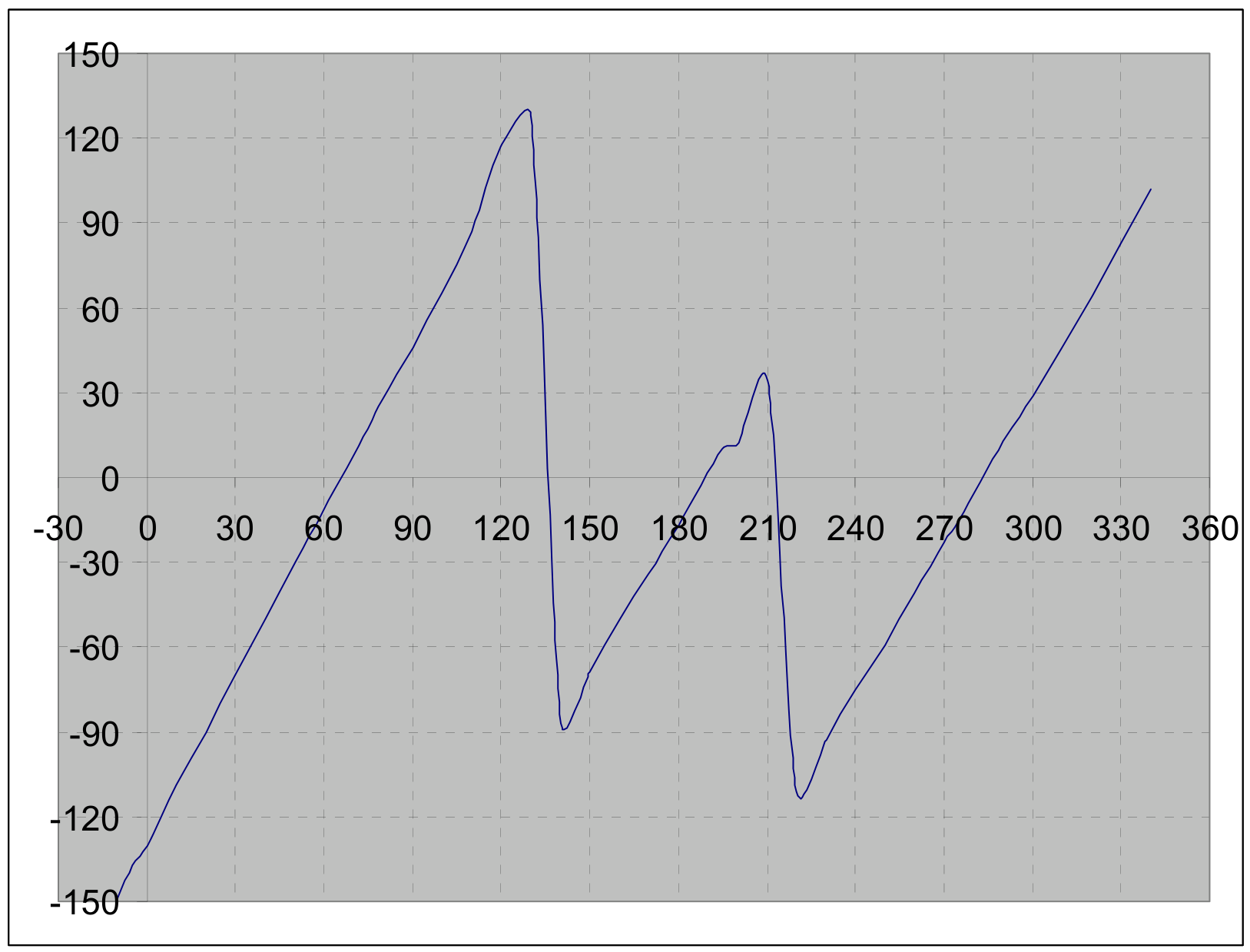
There are 3 jumps on the graph. This is observed at α = -10º, 140º and 220º. The jump in the reflection angles are caused by the change of sides, therefore the object has 3 sides and if all the sides are straight sides, we can approximate the lines on the graph using linear regression, i.e:
Where: α = position angle of the object (in º) and β = reflected ray angle (in º)
Segment 1 (-10 to 130): (A1)
Segment 2 (140 to 210): (A2)
Segment 3 (220 to 340): (A3)
To find the gradient, m, as function of side distance from the rotation axis, r, we can simulate it and get a graph and for ‘small’ r:
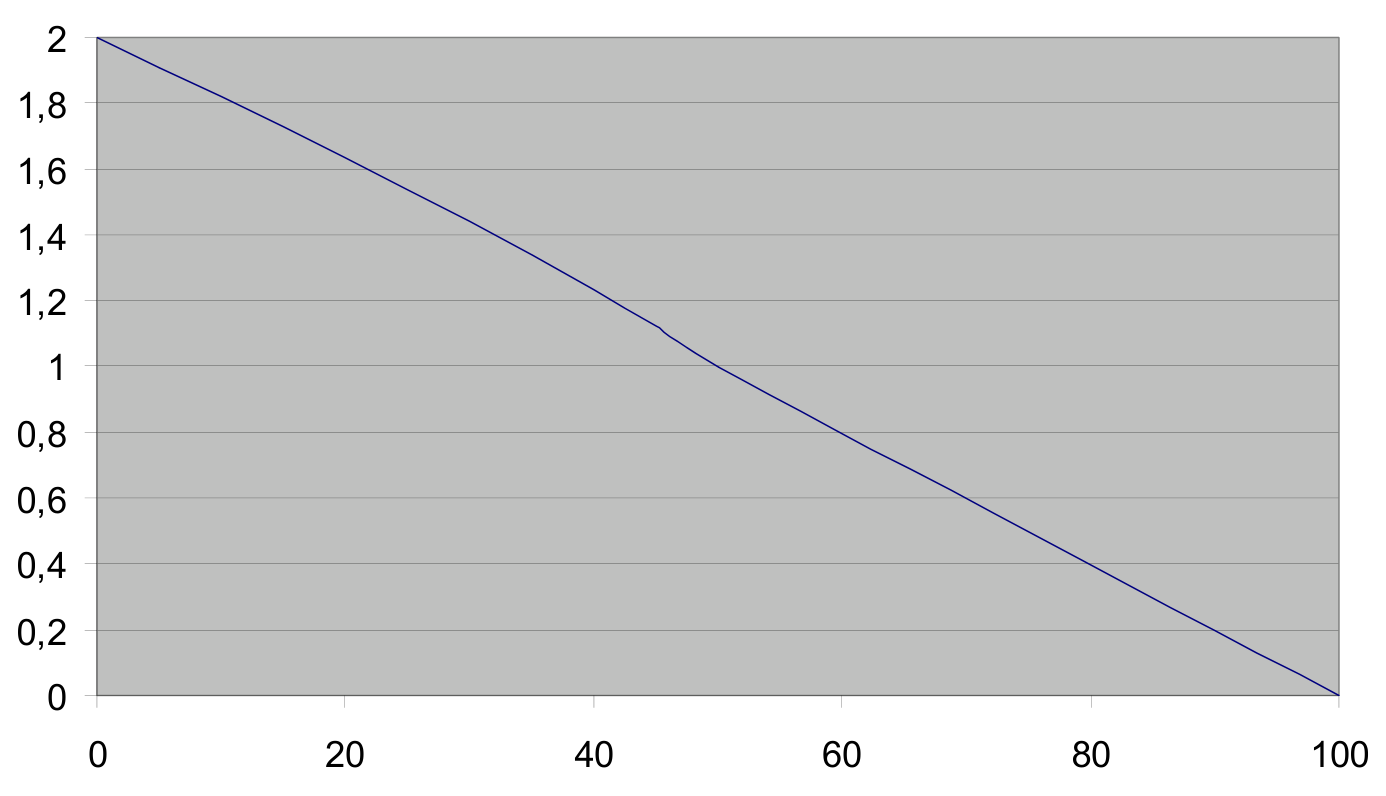
or (A4)
From (A1) to (A3) and using (A4) we can determine r from the 3 sides:
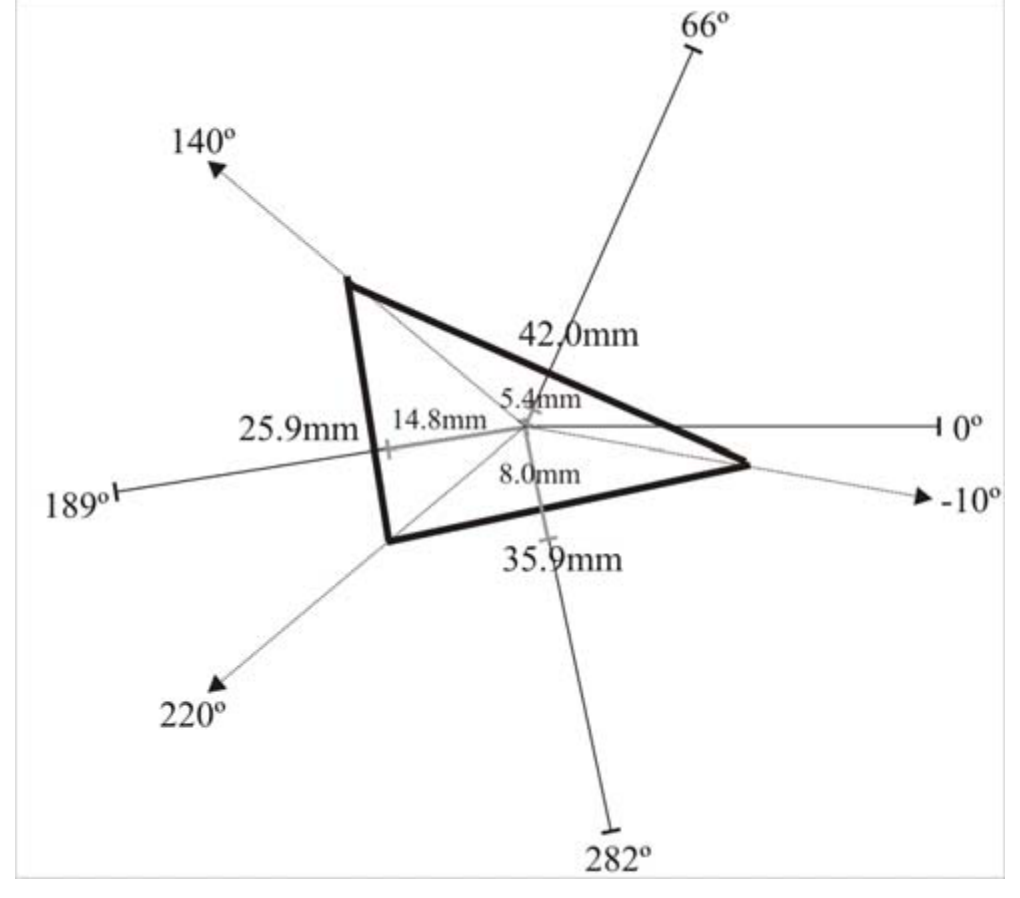
For each side, we can use the object position when the reflection angle is to draw with a higher precision. The angle for each segment is:
From data obtain the shape of the object can be determined as:
Barcode : B01110
| Object Position (αº) | Reflected Ray (βº) | Cal Reflected Ray (βº) |
|---|---|---|
| 10 | 278 | -82 |
| 20 | 296 | -64 |
| 30 | 313 | -47 |
| 40 | 330 | -30 |
| 50 | 347 | -13 |
| 65 | 12 | 12 |
| 70 | 20 | 20 |
| 80 | 36 | 36 |
| 90 | 56 | 56 |
| 100 | 73 | 73 |
| 110 | 91 | 91 |
| 120 | 300 | -60 |
| 130 | 320 | -40 |
| 140 | 342 | -18 |
| 145 | 351 | -9 |
| 155 | 13 | 13 |
| 160 | 23 | 23 |
| 170 | 43 | 43 |
| 180 | 67 | 67 |
| 190 | 277 | -83 |
| 200 | 297 | -63 |
| 210 | 313 | -47 |
| 220 | 330 | -30 |
| 230 | 347 | -13 |
| 245 | 13 | 13 |
| 250 | 22 | 22 |
| 260 | 39 | 39 |
| 270 | 55 | 55 |
| 280 | 74 | 74 |
| 290 | 91 | 91 |
| 300 | 335 | -25 |
| 305 | 335 | -25 |
| 310 | 336 | -24 |
| 315 | 337 | -23 |
| 320 | 338 | -22 |
| 345 | 21 | 21 |
| 350 | 22 | 22 |
| 355 | 22 | 22 |
| 360 | 23 | 23 |
| 365 | 23 | 23 |
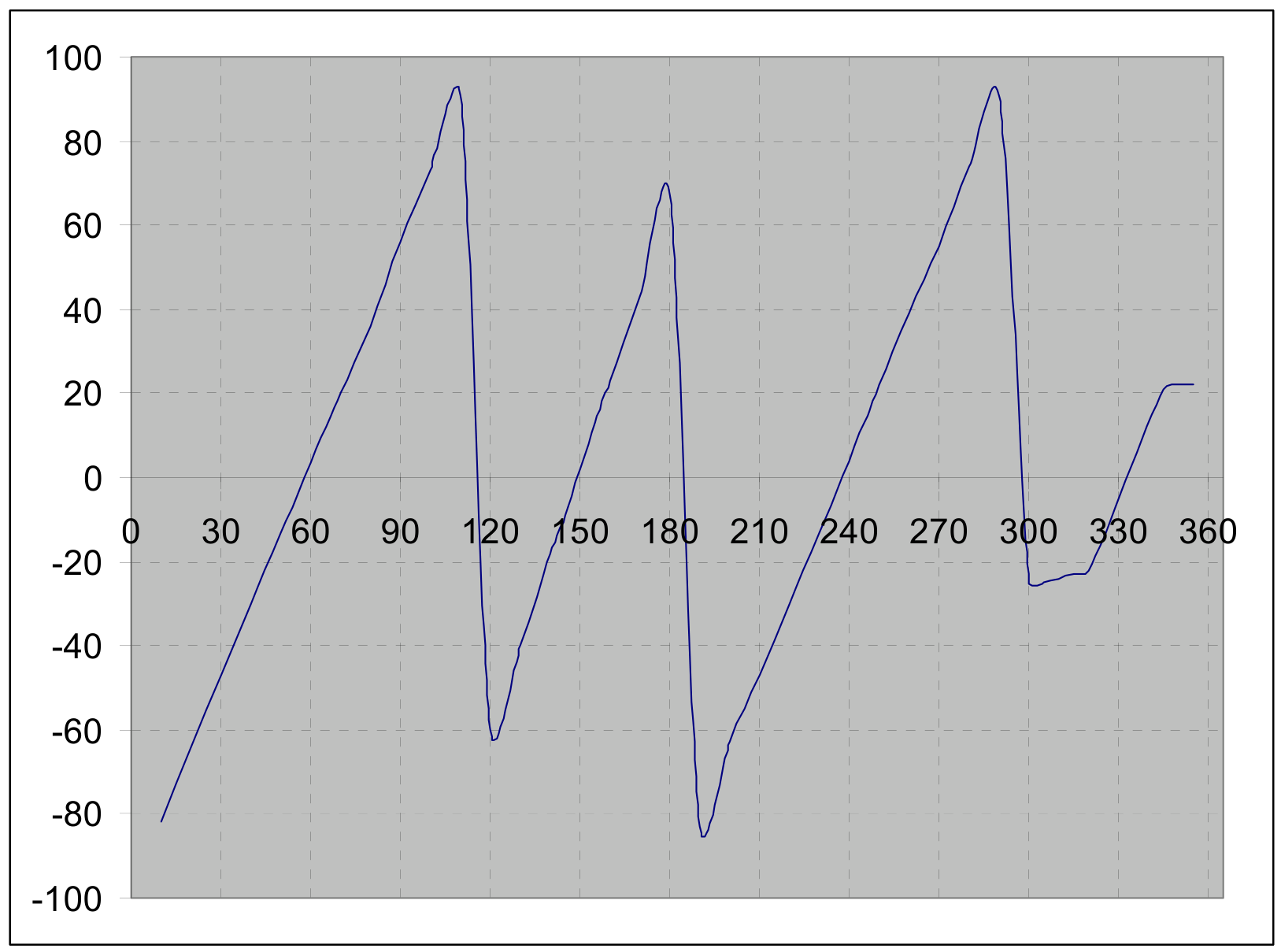
There are 5 jumps in the graphics. This can be observed at α = 10º, 120º, 190º, 300º and 345º. The jumps in reflection angle are caused by the change of sides, therefore there are 5 sides in the object and if all the sides are straight, we can approximate the lines using linear regression, i.e:
Where α = angular position of the object (in º) and β = reflected ray angle (in º)
Segment 1 (10 to 110): (B1)
Segment 2 (120 to 180): (B2)
Segment 3 (190 to 290): (B3)
Segment 4 (190 to 290): (B4)
Segment 5 (190 to 290): (B5)
From (B1) to (B3) and (A4) we can determine r from the 5 sides:
There are weird data for , and . It is impossible to have r with either negative or very large value but not so small angle of reflection. So we can guess that it is either a curve sides or double reflection. For double reflection we need to have two adjacent sides with concave angle, so only and are possible. So can only be a curve side. From segment 2 of the graph we can see that the graph looks like a reverse “S” shape, so it is only possible when the sides is concave.
Considering error in the experiment, we can guess that the shape has reflection symmetry.
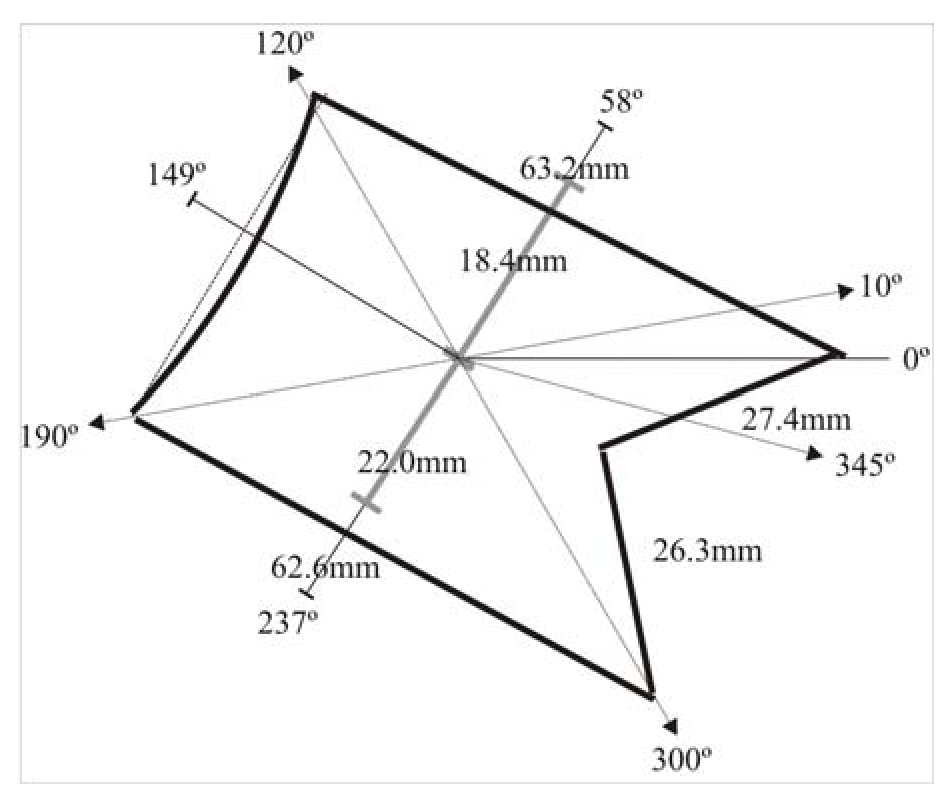
For each side, we can use the object position when the reflection angle is 0 to draw with a higher precision. The angle for segment 1 to 3 is:
From the data obtained, the shape of the object can be determined as:
[Marking Scheme] Experimental Question 1
Shapes Determination by Reflection
| (A) | 0.5 | Get data for object 1 |
| 2.0 | 0.5 | Get data for object 2 |
| 0.5 | Plot graph of object 1 | |
| 0.5 | Plot graph of object 2 | |
| (B) | 0.25 | Number of side of the object 1 |
| 0.5 | 0.25 | Number of side of the object 2 |
| (C) | 0.5 | Angles positions of object 1 |
| 3.0 | 0.5 | Angles positions of object 2 |
| 0.5 | Orientation of sides of object 1 | |
| 0.5 | Orientation of sides of object 2 | |
| 0.5 | Side shapes of object 1 | |
| 0.5 | Side shapes of object 2 | |
| (D) | 1 | Axis distance from side A of object 1 |
| 1 | Axis distance from side B of object 1 | |
| 3.0 | 1 | Axis distance from side C of object 1 |
| (E) | 0.5 | Dimension of side A of object 1 |
| 0.5 | Dimension of side B of object 1 | |
| 1.5 | 0.5 | Dimension of side C of object 1 |
Оригинал в Архива: exp_problems.pdf · официални решения: exp_solutions.pdf