APhO 2009, Теория — Задача 1. Rolling Cylinders
Theoretical competition, 26 April 2009
Внимание: Бележка към темата
The complete archive solution originals for all three questions are now included. Their printed competition headings match the question packet; organizer-host provenance was not independently established.
Obtained source packet
All question and solution originals print “Theoretical competition”, 26 April 2009, and the APhO2009 Bangkok, Thailand logo. The three separate archive keys match the three complete questions and all 21 native numbered requests. The complete archive solutions are reproduced, including three methods for 1.7 and two methods for 2.6. No separate theory answer sheet, marking-scheme file, common instruction sheet or constants companion was obtained from the complete theory folder; no explicit total points or time limit is printed. Native per-part marks are retained. Archive appearance alone is not proof of organizer-host provenance.
Условие
A thin-walled cylinder of mass and rough inner surface of radius can rotate about its fixed central horizontal axis OZ. The Z-axis is perpendicular to and out of the page. Another smaller uniform solid cylinder of mass and radius rolls without slipping (except for question 1.8) on the inner surface of about its own central axis which is parallel to OZ.
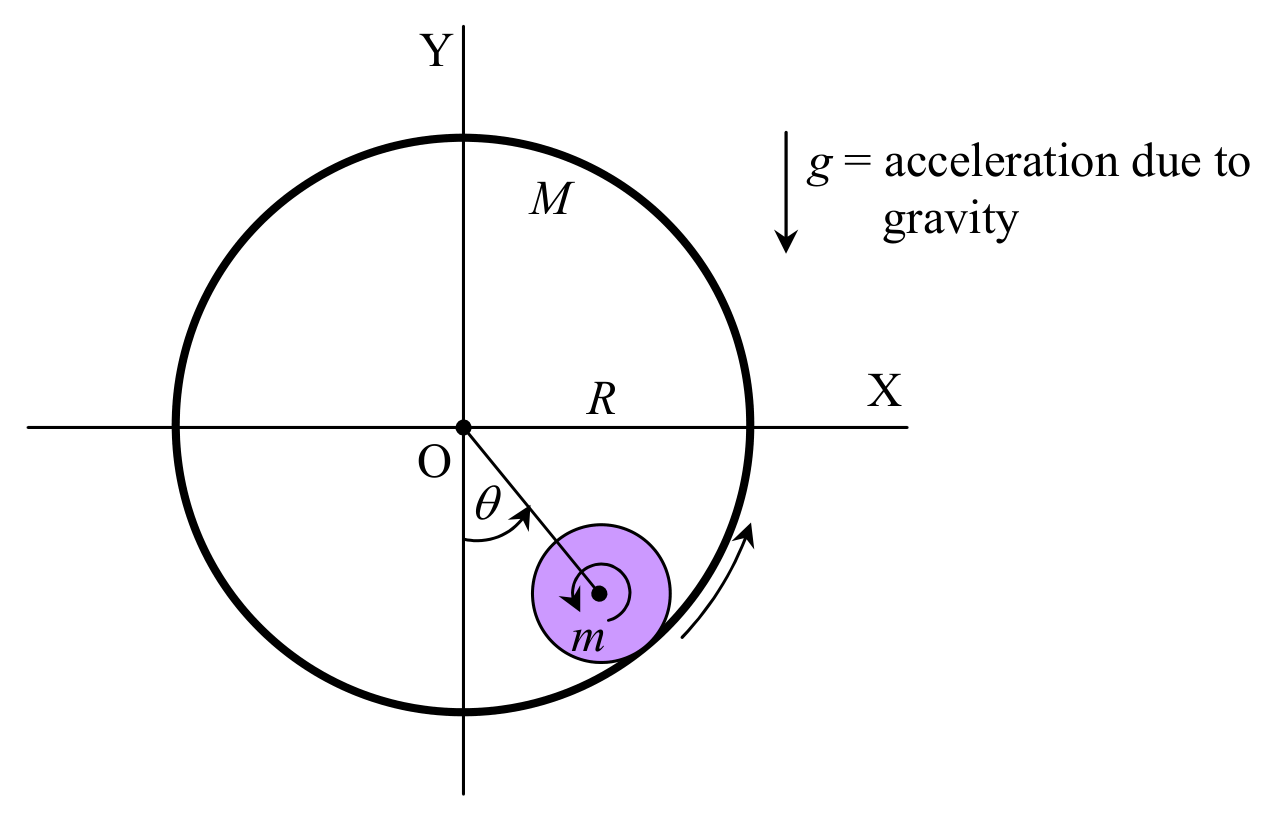
1.1) The rotation of is to be started from rest at the instant when is resting at the lowest point. At a later time the angular position of the centre of mass of is and by then has turned through an angle radians. How many radians (designated ) would have mass turned through about its central axis relative to a fixed line (for example, the negative Y-axis)? Give your answer in terms of and . [0,8 т.]
1.2) What is the angular acceleration of , , about its own axis through its centre of mass? Give your answer in terms of and derivatives of and . [0,2 т.]
1.3) Derive an equation for the angular acceleration of the centre of mass of , , in terms of , and the moment of inertia of about its central axis. [1,8 т.]
1.4) What is the period of small amplitude oscillation of when is constrained to rotate at a constant angular velocity? Give your answer only in terms of and . [1,3 т.]
1.5) What is the value of for the equilibrium position of in question 1.4? [0,2 т.]
1.6) What is the equilibrium position of when is rotating with a constant angular acceleration ? Give your answer in terms of and . [0,7 т.]
1.7) Now is allowed to rotate (oscillate) freely, without constraint, about its central axis OZ while is executing a small-amplitude oscillation by pure rolling on the inner surface of . Find the period of this oscillation. [2,5 т.]
1.8) Consider the situation in which is rotating steadily at an angular velocity and is rotating (rolling) about its stationary centre of mass, at the equilibrium position found in question 1.5. is then brought abruptly to a halt. What must be the lowest value of such that will roll up and reach the highest point of the cylindrical surface of ? The coefficient of friction between and is assumed to be sufficiently high that begins to roll without slipping soon after a short skidding right after is stopped. [2,5 т.]
Решение
SOLUTION: Rolling Cylinders — archive original
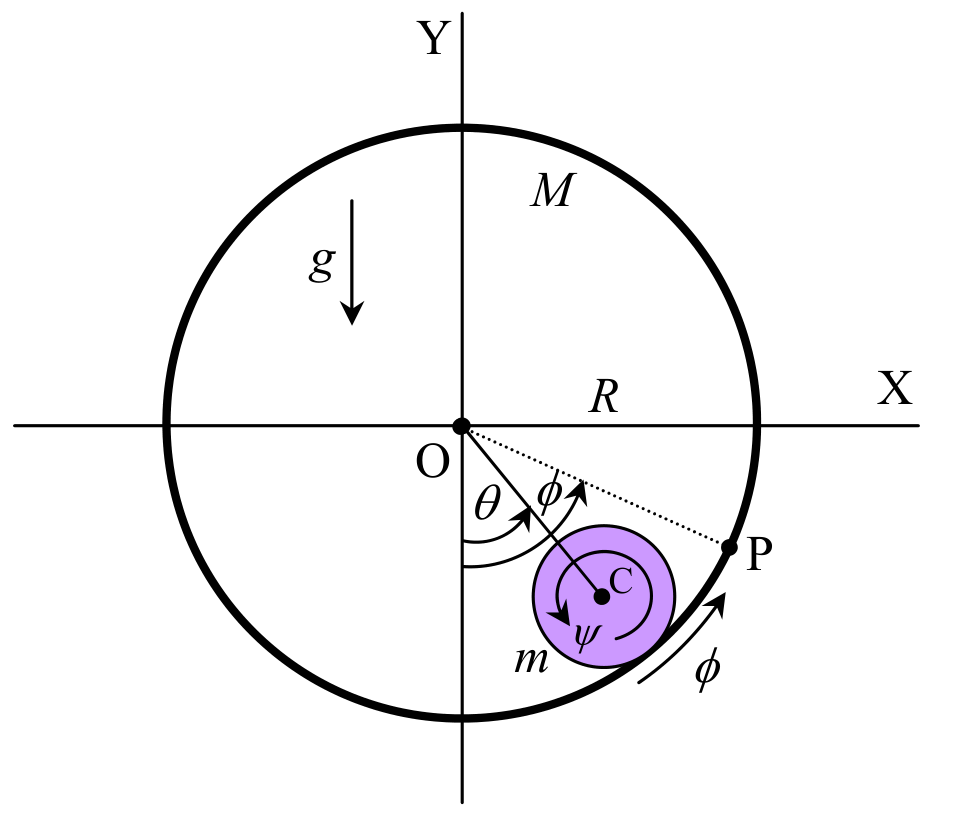
1.1) The point P which is fixed on the surface of was at the position directly below O at time . Hence must have rolled through an angle radians relative to surface of in time during which the line OC has also turned anti-clockwise through an angle . Therefore the total angular displacement of about its centre of mass relative to any fixed reference line in time is
1.2) By differentiating the equation (i) twice with respect to time, we get
1.3)
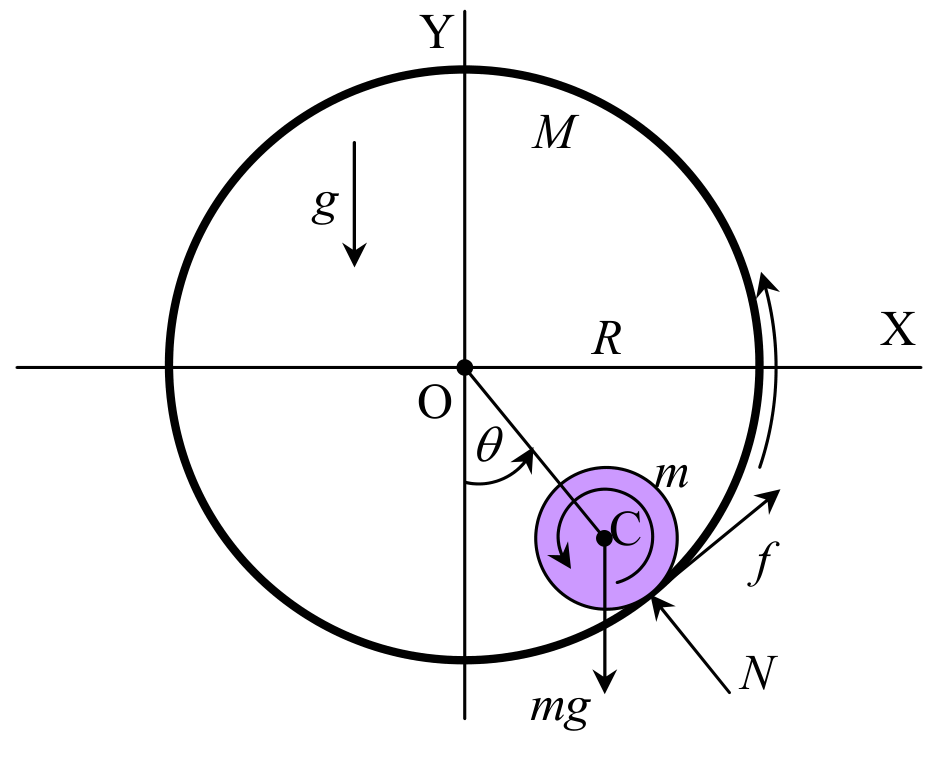
The equations of motion of centre of mass of are:
The equation for the rotation of about its centre of mass is:
where . Equations (iii) and (v) yield:
1.4) Here, , and also , the equation (vi) is reduced to:
This gives a period
1.5) The equilibrium position of in question 1.4) is .
1.6) But the equilibrium position for the case where is rotating with a constant angular acceleration is by considering the equation (vi), namely,
Let be the equilibrium position; this implies that remains stationary at this position if it does not oscillate. Hence , and
1.7)
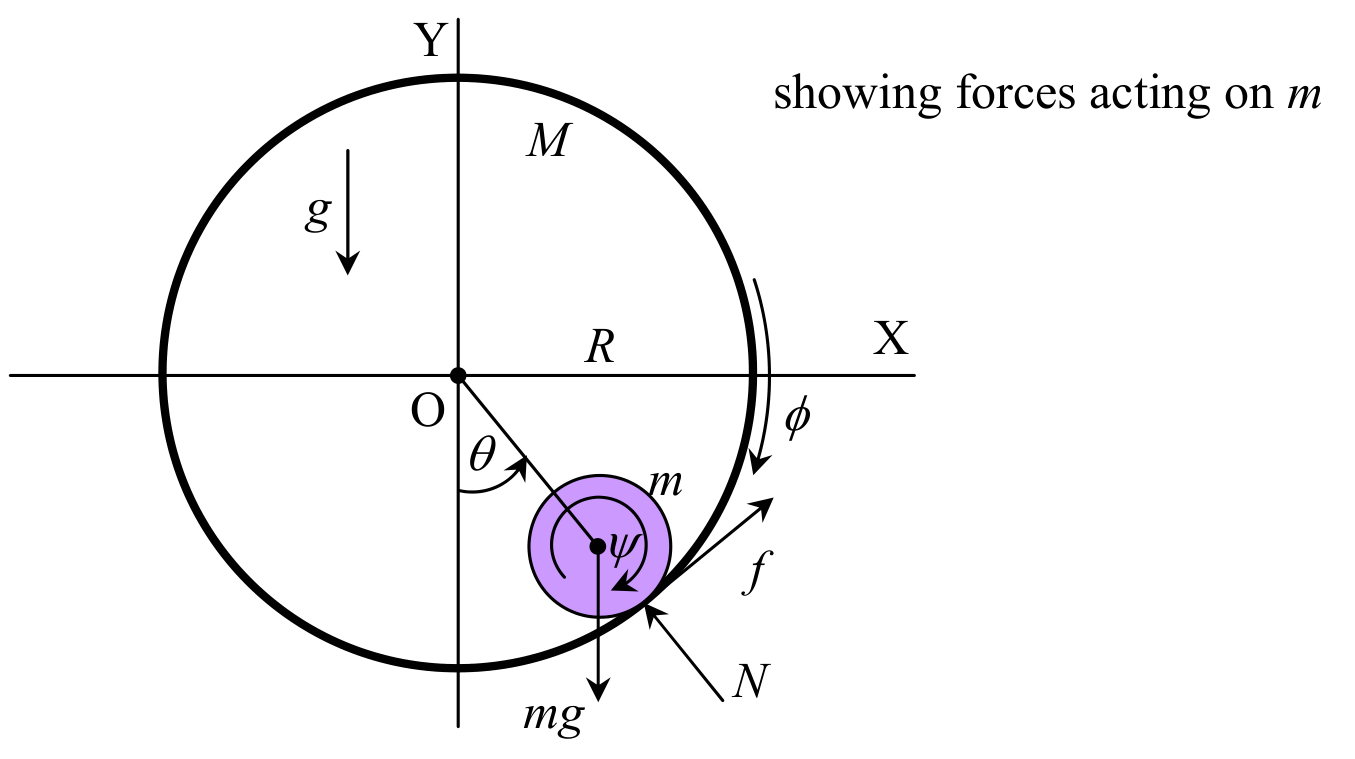
From the equation (i) we get, after changing the directions of and ,
The equations of motion of and are:
Method 1: (Angular Momentum)
The effect of gravity on the system as a whole is to change its angular momentum:
Hence
and
Combining the last two equations:
For a small-amplitude oscillation we put and equation (xvii) is reduced to:
The period of this oscillation is, therefore,
Method 2: (Newton’s law)
From Newton’s law: ,
From equation (xiii): . By substituting this into equation (xiv.2) we have
From equations (xi) (xii) and (xiii), we then have
Then (xv.2) becomes
For a small-amplitude oscillation we put and equation (xvii) is reduced to:
The period of this oscillation is, therefore,
Method 3: (Conservation of Energy)
The total mechanical energy of the system is given by
We now use conservation of mechanical energy,
By applying the equations (xi), (xii), and (xiii), we have
Without loss of generality, we can integrate both equations and obtain
by imposing the condition that all bodies have zero linear and angular velocities at the same particular instant. And by substituting these relations into the equation above from conservation of energy, we have
This equation must hold at all time, so we can divide on both sides. After some simplifications, we have
For a small-amplitude oscillation we put , and the above expression is reduced to:
The period of this oscillation is, therefore,
Note that, although it seems like we have more than one degree of freedom, there exists only one mode of oscillations because the coupling to the potential energy is only through the angle .
However, we have a freedom to impose any constant angular velocity and (and the condition for rolling without slipping), and this will not alter the period of the oscillations. This corresponds to a freedom in choosing different initial conditions of the motion of the system.
1.8) When is made to rotate steadily at an angular velocity the equation (vi) becomes
which implies that remains at if does not oscillate. Hence the equation (i) is reduced to and
This means that is rotating at a constant angular velocity prior to the instant when is stopped.
After that instant will accelerate itself by way of frictional impulse. This acceleration process lasts for only a short time due to the high value of frictional coefficient . To simplify the calculation we will take to lower surface of to be flat.
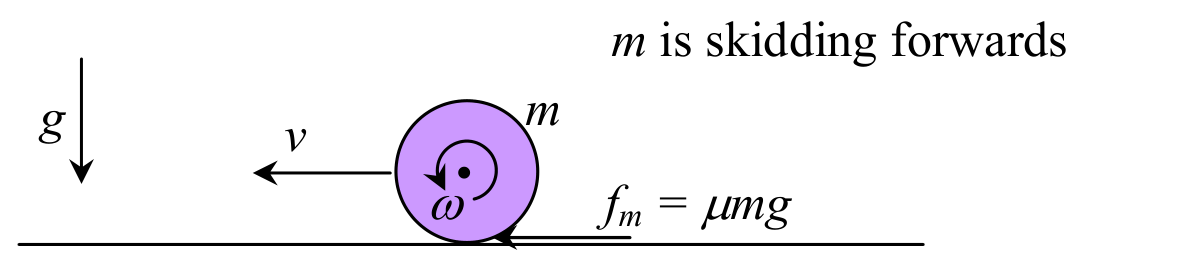
By solving these last two equations for and with initial conditions and , and imposing the condition for the onset of pure rolling we get
From now on, the cylinder will roll up the side of the cylindrical wall. And since frictional force does not do work in pure rolling we can use the principle of conservation of energy.
We have also
will reach the top if . Hence
Printed source notation
The dynamo key says that must be positive for current growth but prints and labels the equality value . The original inequality and value are preserved; at equality the printed exponential has zero exponent. In the Leidenfrost key the first heat-balance equation prints bare , whereas subsequent equations use ; both native forms are retained. The rolling-cylinder key changes the directions of and for 1.7 as explicitly stated, then returns to equation (i) in 1.8.
Оригинал в Архива: th_problems.pdf · решение от архива: 1_sol.pdf · допълнителни данни: 2_sol.pdf · допълнителни данни: 3_sol.pdf