APhO 2009, Теория — Задача 2. A Self-excited Magnetic Dynamo
Theoretical competition, 26 April 2009
Внимание: Бележка към темата
The complete archive solution originals for all three questions are now included. Their printed competition headings match the question packet; organizer-host provenance was not independently established.
Obtained source packet
All question and solution originals print “Theoretical competition”, 26 April 2009, and the APhO2009 Bangkok, Thailand logo. The three separate archive keys match the three complete questions and all 21 native numbered requests. The complete archive solutions are reproduced, including three methods for 1.7 and two methods for 2.6. No separate theory answer sheet, marking-scheme file, common instruction sheet or constants companion was obtained from the complete theory folder; no explicit total points or time limit is printed. Native per-part marks are retained. Archive appearance alone is not proof of organizer-host provenance.
Условие
A metallic disc of radius mounted on a slender axle is rotating with a constant angular velocity inside a long solenoid of inductance whose two ends are connected to the rotating disc by two brush contacts as shown. The total resistance of the whole circuit is . A small magnetic disturbance can initiate the growth of an induced electromotive force across the terminals P, Q.
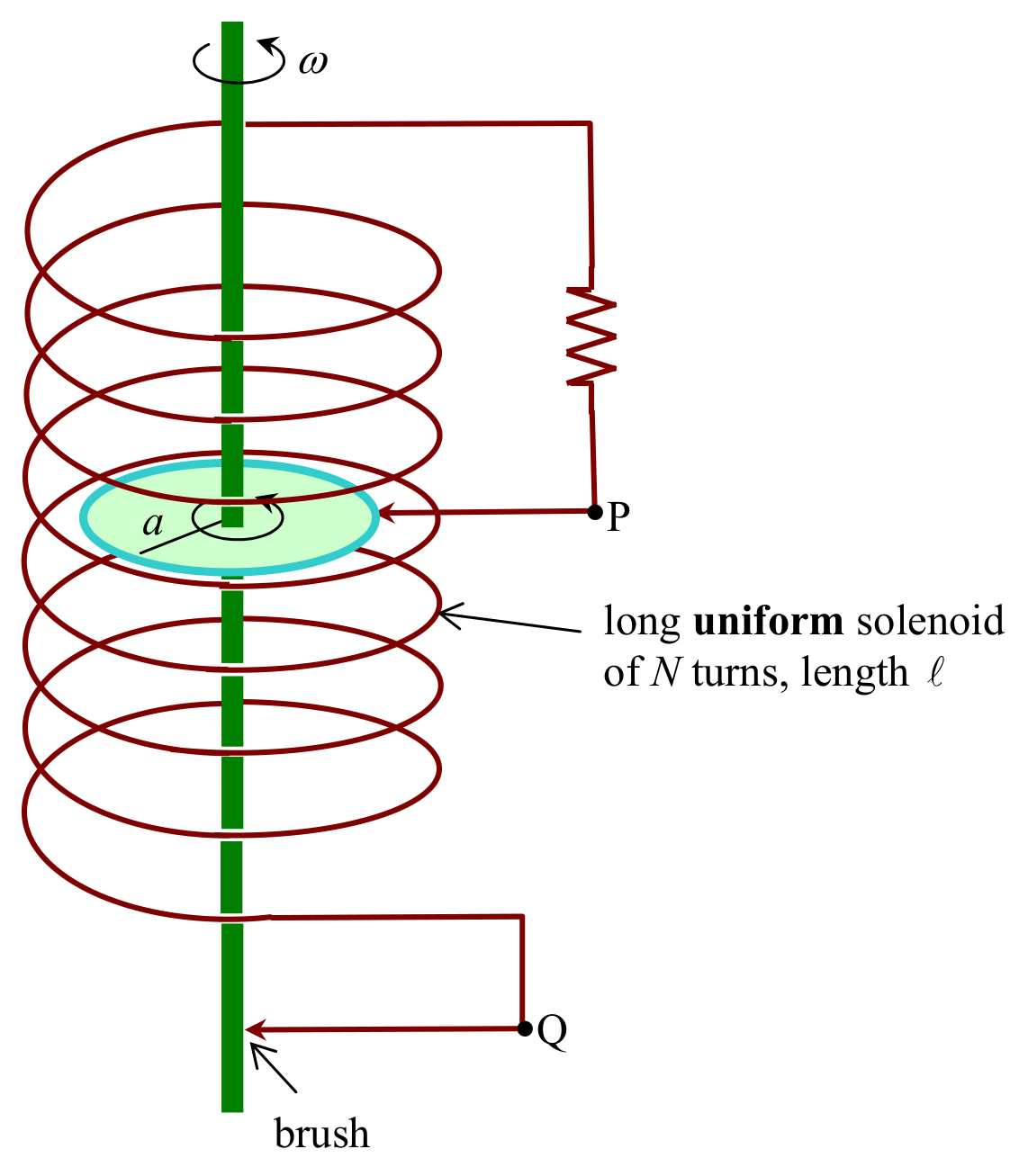
2.1) Write down the differential equation for , the current through the circuit. Express your answer in terms of and the induced e.m.f. across the terminals P and Q. [1 т.]
2.2) What is the value of the magnetic flux density in terms of and the permeability of free space ? Ignore the magnetic field generated by the disc and the axle. [1,5 т.]
2.3) What is the expression for the induced e.m.f. in terms of and the angular velocity ? [2 т.]
2.4) Solve the equation in question 2.1 for current at any time in terms of the initial current , and other parameters. [1,5 т.]
2.5) What is the minimum value of the angular velocity that will permit the current to grow? Give your answers in terms of and . [2 т.]
2.6) In order to maintain a certain steady angular velocity , what must be the value of torque applied to the axle at the instant ? [2 т.]
Решение
A Self-excited Magnetic Dynamo — archive solution original
2.1)
2.2) If the length of solenoid is much greater than its diameter, then the magnetic flux density in the inside mid-section of the solenoid is given by
2.3)
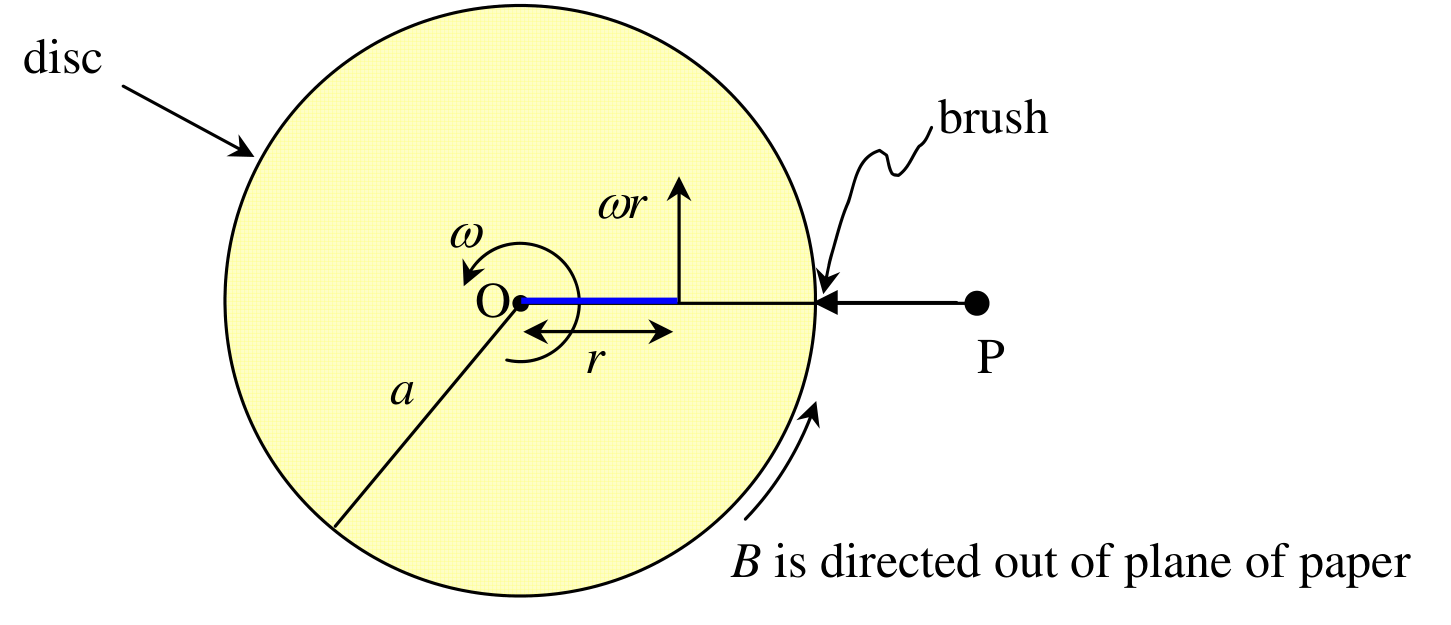
The electric field intensity at distance from the centre of the axle is pointing towards the rim of the disc. The induced e.m.f. between terminals P and Q is given by
2.4) By combining the results in 2.1) and 2.3) we get
Therefore
where
2.5) In order that the current will grow, the value of must be positive otherwise the current will gradually decay.
2.6)
Method 1
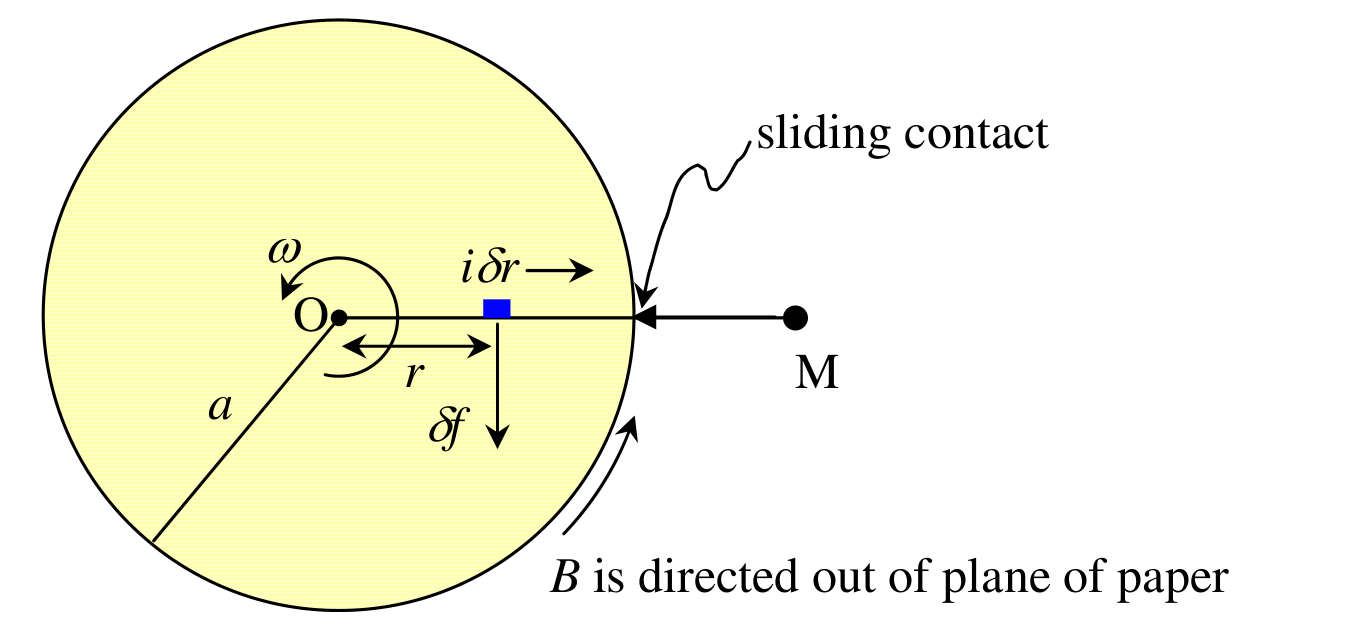
At the instant the current is given in 4) as .
The magnetic force on the current element is . (1.0 point)
The torque opposes the rotation of the disc. The total torque
In order to maintain the angular velocity of the disc at a steady value we must apply a turning torque of equal magnitude and of opposite direction to that of (vi).
Method 2
Printed source notation
The dynamo key says that must be positive for current growth but prints and labels the equality value . The original inequality and value are preserved; at equality the printed exponential has zero exponent. In the Leidenfrost key the first heat-balance equation prints bare , whereas subsequent equations use ; both native forms are retained. The rolling-cylinder key changes the directions of and for 1.7 as explicitly stated, then returns to equation (i) in 1.8.
Оригинал в Архива: th_problems.pdf · решение от архива: 2_sol.pdf · допълнителни данни: 2_sol.pdf · допълнителни данни: 3_sol.pdf