The complete archive solution originals for all three questions are now included. Their printed competition headings match the question packet; organizer-host provenance was not independently established.
Obtained source packet
All question and solution originals print “Theoretical competition”, 26 April 2009, and the APhO2009 Bangkok, Thailand logo. The three separate archive keys match the three complete questions and all 21 native numbered requests. The complete archive solutions are reproduced, including three methods for 1.7 and two methods for 2.6. No separate theory answer sheet, marking-scheme file, common instruction sheet or constants companion was obtained from the complete theory folder; no explicit total points or time limit is printed. Native per-part marks are retained. Archive appearance alone is not proof of organizer-host provenance.
Условие
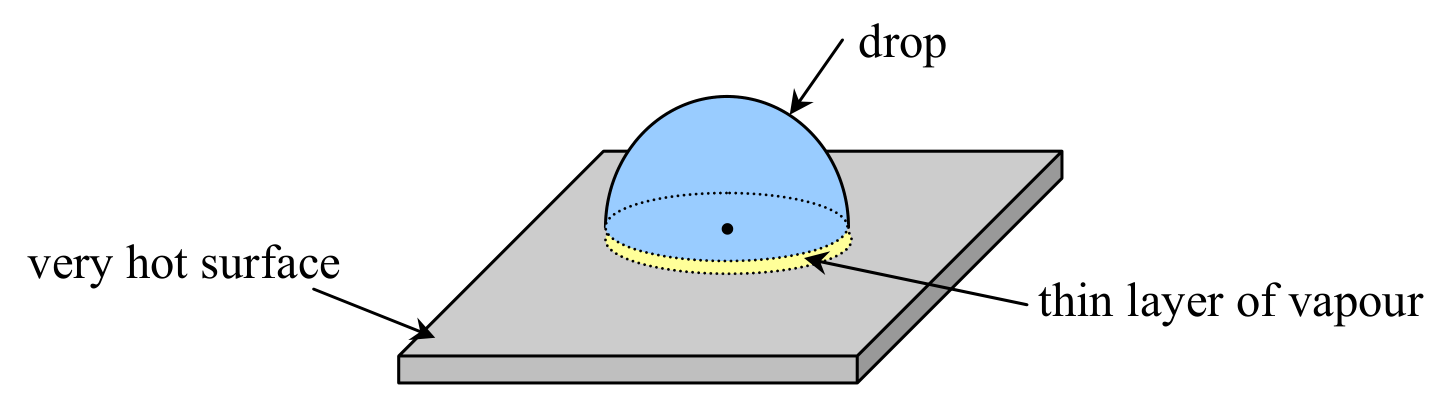
The purpose is to estimate the lifetime of a (hemispherical) drop of a liquid sitting on top of a very thin layer of vapour which is thermally insulating the drop from the very hot plate below.
Figure 1
It will be assumed here that the flow of vapour underneath the drop is streamline and behaves as a Newtonian fluid of viscosity coefficient η and of thermal conductivity K. The specific latent heat of vaporization of the liquid is ℓ. And for a Newtonian fluid we have the shear stress AF=η× the rate of shear dzdv where v is the flow velocity and z is the perpendicular distance to the direction of flow, and the direction of F is tangential to the surface area A.
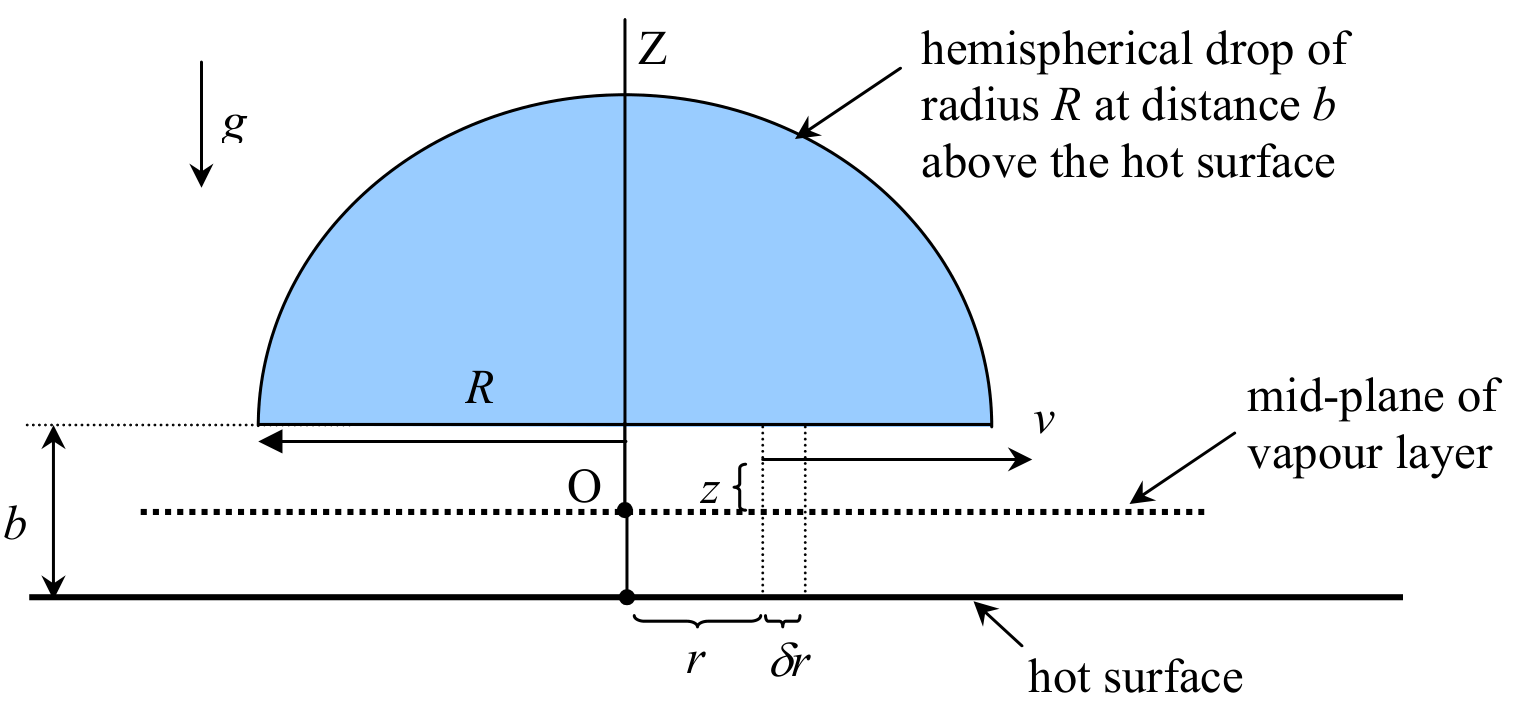
Figure 2
v is the velocity of vapour in the radial direction at the height z above the mid-plane. The pressure P inside the vapour must be higher towards the centre O. This will result in the out-flowing of vapour and in force that holds the drop against the pull of gravity. The thickness of vapour layer under thermal and mechanical equilibria is b.
For a Newtonian flow of vapour we can approximate that
dzdv=ηzdrdP
3.1) Show that
v(z)=2ηz2drdP+C
where C is an arbitrary constant of integration. [0,5 т.]
3.2) Refer to figure 2, find the value of C in terms of η,drdP, and b using the boundary condition v=0 for z=±2b. [0,5 т.]
3.3) Calculate the volume rate of flow of vapour through the cylindrical surface defined by r. (Hint: the cylinder is of radius r and of height b underneath the drop). [1 т.]
3.4) By assuming that the rate of production of vapour of density ρV is due to heat flow from the hot surface to the drop, find the expression for the pressure P(r). Use Pa to represent the atmospheric pressure, and use ΔT for the temperature difference between those of the hot surface and of the drop. Assume that the system has reached the steady state. [2 т.]
3.5) Calculate the value of b by equating the weight of the drop to the net force due to pressure difference between the bottom and the top of the drop. The density of the drop is ρ0. [2 т.]
3.6) Now, what is the total rate of vaporization? [2 т.]
3.7) Assume that the drop maintains a hemispherical shape, what is the life-time of the drop? [2 т.]
Решение
The Leidenfrost Phenomenon — archive solution original
3.1) As given in the problem
dzdv=(η1drdP)⋅z.(i)
Integrating (i) with respect to z, we get
v(z)=(2η1drdP)⋅z2+C.(ii)(0.5 point)
3.2)
v(2b)=0=(2η1drdP)⋅(2b)2+C.(iii)
Therefore
C=−8ηb2drdP.(0.5 point)
Note that C is not a real constant; its value depends on drdP which is a function of r.
3.3) Let Q be the volume rate of flow of the vapour through the cylindrical surface of 2πrb.
The dynamo key says that γ must be positive for current growth but prints μ0Na2ω/(2ℓ)−R≥0 and labels the equality value ωmin. The original inequality and value are preserved; at equality the printed exponential has zero exponent. In the Leidenfrost key the first heat-balance equation prints bare ρ, whereas subsequent equations use ρV; both native forms are retained. The rolling-cylinder key changes the directions of ψ and ϕ for 1.7 as explicitly stated, then returns to equation (i) in 1.8.