APhO 2024, Теория — Задача 1. Geometry of Water Fountain
24th Asian Physics Olympiad, Malaysia 2024 — APHO 2024 Theory, English (Official) · 10 т.
General Instructions for Theoretical Examination
Before the Exam
- The allocated time for theoretical examination is 5 hours for answering 3 questions that carry 10 points each.
- Please ensure that your student code matches the one on your desk. Place your ID / tag on the top right corner of the desk.
- Kindly ensure that you have the following items on the desk: (i) A sealed envelope containing the Question Papers and Answer Scripts.
(ii) A labelled envelope.
(iii) Pens/relevant stationery (You need to bring in your own calculator).
If you find that the items are incomplete, kindly raise your hands. - You must not open the sealed envelopes before the start of the examination.
During the Exam
- You must use the dedicated answer scripts provided for writing your answers. Write your answers only in boxed answer scripts. If you need more boxed answer scripts, please raise your hand and ask an invigilator. Clearly write your student code and write which question you are attempting on each of your extra requested answer scripts.
- There are additional blank draft papers. These will not be marked.
- Try to be as concise as possible in your answers: use equations, logical operators, and sketches to illustrate your thoughts whenever possible. Avoid the use of long sentences.
- Use an appropriate number of significant figures when stating numbers.
- You are not allowed to leave your working place without permission. If you need any assistance (malfunctioning calculator, need to visit a restroom, insufficient Draft Papers, etc), please draw the attention of the invigilator by raising your hand.
At the end of the Exam
- At the end of the examination, you must stop writing immediately.
- Put all the Answer Scripts into the labelled envelope and seal it, including any blank Answer Scripts. It is your responsibility to ensure all Answer Scripts are inside the envelope and submitted to the invigilator.
- Put question papers and draft papers into another envelope. You are not allowed to take any sheets of paper out of the examination hall.
- Wait at your table in silence till your envelopes are collected. Once all envelopes are collected, your guide will escort you out of the examination area.
Answer Scripts
You must use the dedicated Answer Scripts provided for writing your answers. Write your answers only in boxed answer scripts. If you need more boxed answer scripts, please raise your hand and ask an invigilator. Clearly write your student code and write which question number you are attempting on each of your extra requested answer scripts.
There are additional blank draft papers. These will not be marked.
Physical Constants
| Acceleration due to gravity | |
|---|---|
| Boltzmann constant | |
| Current Mass of the Sun | |
| Current Radius of the Sun | |
| Average Mass of a Galaxy | |
| Magnitude of the electron charge | |
| Mass of the electron | |
| Mass of the proton | |
| Mass of the neutron | |
| Permeability of free space | |
| Permittivity of free space | |
| Intrinsic impedance of free space | |
| Planck’s constant | |
| Speed of light in vacuum | |
| Stefan-Boltzmann constant | |
| Universal Gravitational constant |
Условие
Introduction
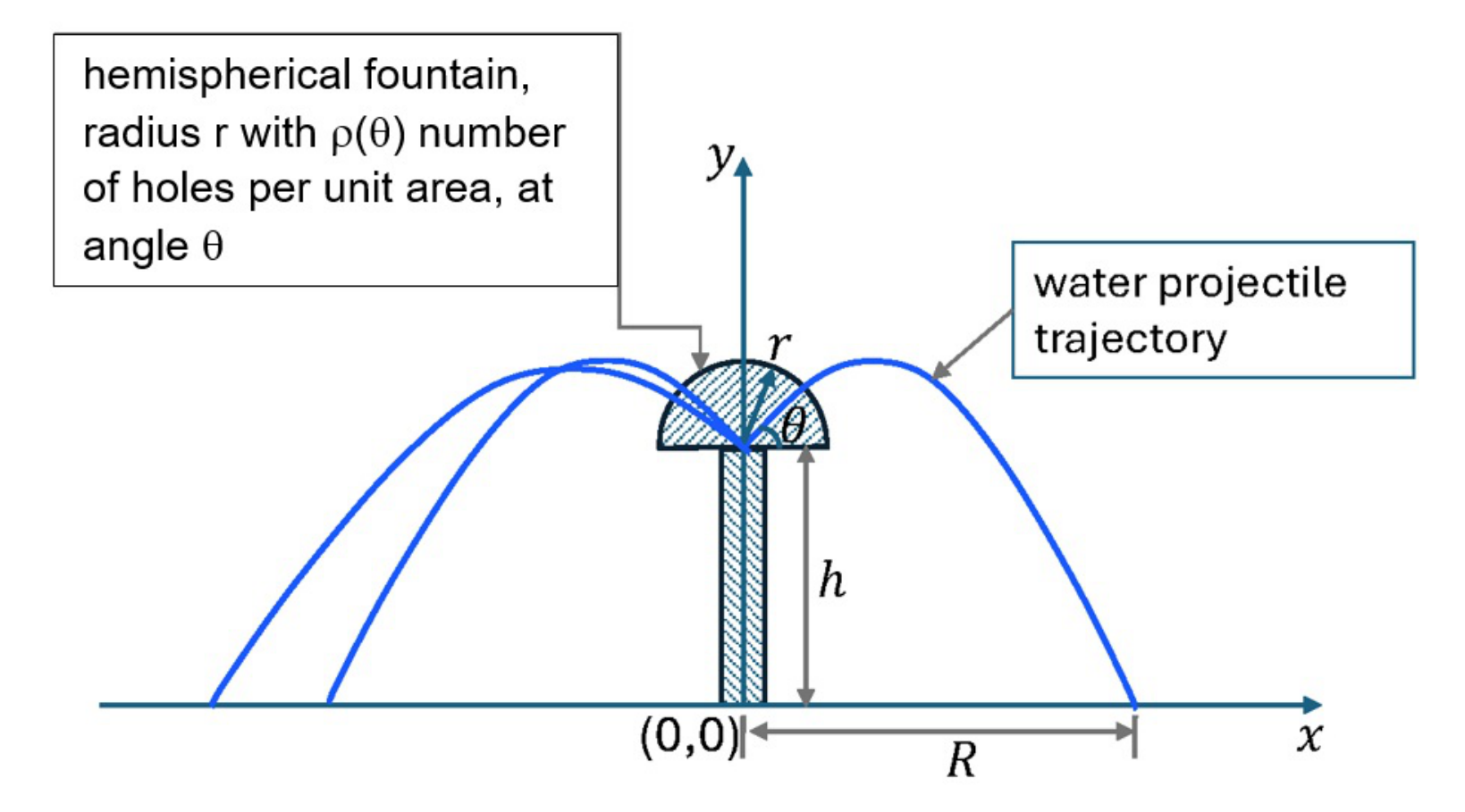
Water sprayers are found at various places such as agriculture farms, green parks or urban areas for functional purposes or for aesthetic art installation. Consider a hemispherical shaped fountain sprayer of radius at the height from the ground as shown in a cross-sectional diagram in Fig. 1. Let the radius of the hemisphere to be small compared to the range , hence can be treated as a point source. However there are number of holes per unit area at angle . The water spurts in all directions at the same initial velocity .
Part A: Uniformly Distributed Holes on the Surface of the Hemisphere (6 т.)
First consider the holes distribution on the surface of the hemisphere to be uniform (i.e. is a constant).
A.1 Express the instantaneous position and of a water element (can be treated as a stream of particles) launched at velocity at angle . [0,5 т.]
A.2 Derive the water trajectory relation and express in a same type of trigonometric function (e.g. in terms of sine, cosine or tangent ONLY). Note that . [1 т.]
A.3 The envelope is the minimal boundary which encloses all water trajectories (i.e. no water will be found beyond this boundary). Derive the equation for the envelope for this system. Express your answer as y(x). Sketch the envelope over the trajectories. [3 т.]
A.4 Calculate the range as a function of angle . [1 т.]
A.5 Letting in the range obtained in A.4, show that . [0,5 т.]
Part B: Non-Uniformly Distributed Holes on the Surface of the Hemisphere (4 т.)
Now, consider the area of holes per unit area to be non-uniformly distributed and depended on the angle .
B.1 Using the results from part A.4 above, calculate the elemental area of an annulus (ring) of radius and width of the water hitting the ground. Express your answer in R, R' and d. [hint: consider R'= ] [1 т.]
B.2 Determine the relation for that gives a uniform spray coverage pattern on the ground by considering elemental area on the hemisphere in proportional to the elemental area of the water spray on the ground. Express your answer in terms of R and its derivative. [hint: consider condition where ]. [1 т.]
B.3 Letting , calculate explicitly the relation for that gives a uniform spray coverage pattern for . [2 т.]
Отговори
- Part A: Uniformly Distributed Holes on the Surface of the Hemisphere, A.1
- Part A: Uniformly Distributed Holes on the Surface of the Hemisphere, A.2
- Part A: Uniformly Distributed Holes on the Surface of the Hemisphere, A.3
- Part A: Uniformly Distributed Holes on the Surface of the Hemisphere, A.4
- Part A: Uniformly Distributed Holes on the Surface of the Hemisphere, A.5 Доказателство (Eq. (1.22)–(1.24) в официалното решение).
- Part B: Non-Uniformly Distributed Holes on the Surface of the Hemisphere, B.1
- Part B: Non-Uniformly Distributed Holes on the Surface of the Hemisphere, B.2
- Part B: Non-Uniformly Distributed Holes on the Surface of the Hemisphere, B.3
Решение
Part A: Uniformly Distributed Holes on the Surface of the Hemisphere
A.1 Given the radius of the hemisphere is small compared to the range, that we can treat all the different water sprouts emanate from a point source at the center of the hemisphere at the same initial velocity but at different angles . Note that the distribution of the holes on the surface of the hemisphere is uniform.
Consider the motion in x- and y-directions with coordinate (x,y) as indicated in the Fig. 1.
Horizontal motion – no acceleration
[0.2pt]
Vertical motion – ‘particle’ in free fall under gravity,
[0.3pt] [0,5 т.]
A.2 Equation of water trajectory (or path of the projectile) is obtained by eliminating time from equations (1.1) and (1.2). [0.1pt]
Using Eq. (1.1), we get and substituting in Eq.(1.2) we obtain [0.1pt]
[0.2pt]
[0.2pt]
Using trigonometry identity: , thus we write: [0.1pt]
[0.3pt]
or
The equation of water trajectory is given by Eq. (1.5) (with reference to the ground) or Eq. (1.6) with reference to the base of the hemisphere. [1 т.]
A.3 We rewrite the trajectory equation in the form of quadratic function in [0.2pt]
[0.5pt]
where .
Let , thus we express Eq. (1.7) as a quadratic function in :
[0.3pt]
where
The quadratic equation Eq.(1.8) must have a real solution for , i.e
[0.2pt]
Or the discriminant is non-negative, i.e. , which gives. [0.2pt]
[0.4pt]
Re-arranging Eq.(1.11) for y’ to get
or
[0.2pt]
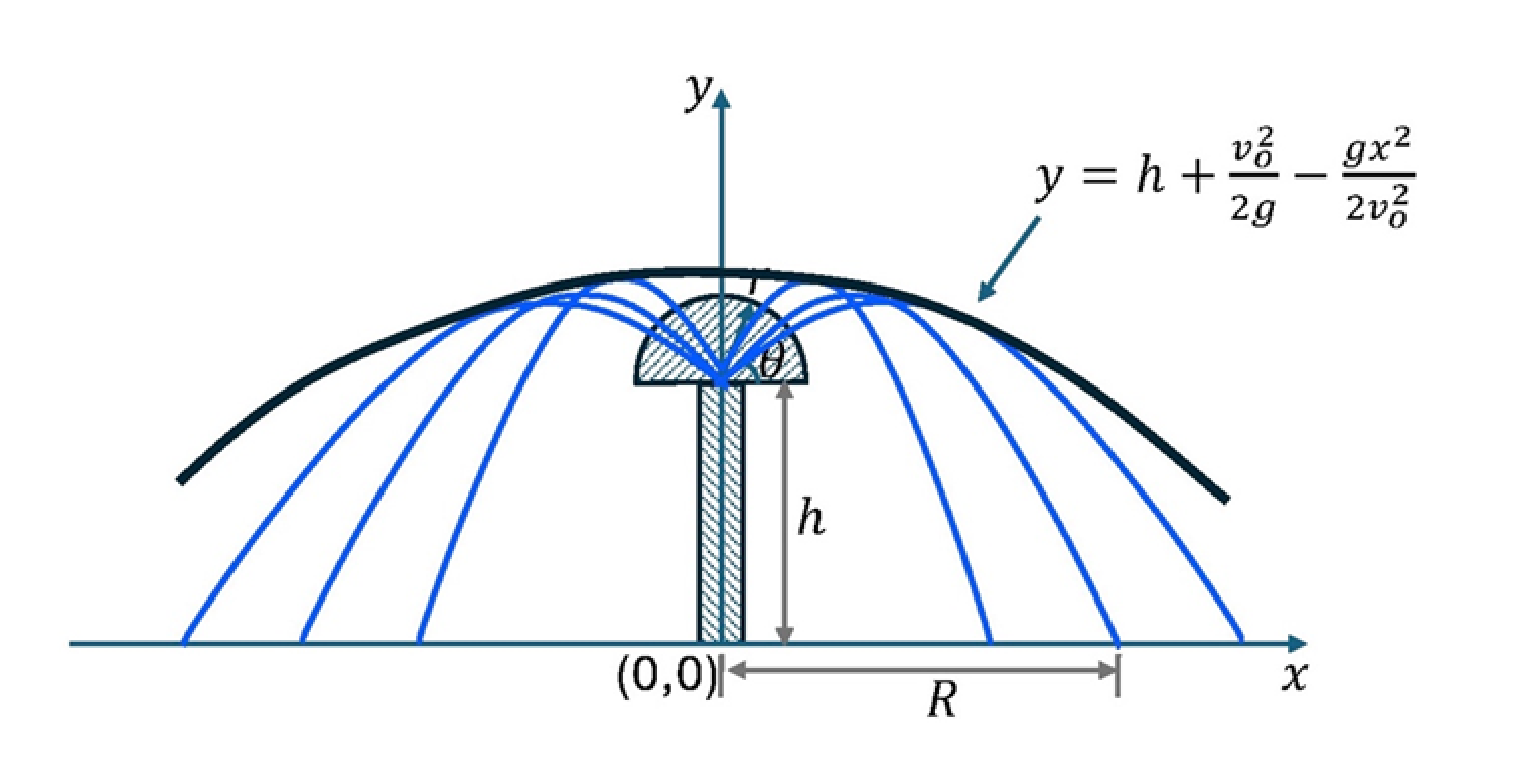
The water trajectory follows the inequality in (1.13) and the envelop of different water trajectories with different launch angles follow the parabolic equation:
[0.2pt]
Or
[0.3pt]
The sketch of the envelop of water trajectory is shown below:
[0.5pt] [3 т.]
A.4 Recall the trajectory Eq. (1.5) and set to obtain the horizontal range :
[0.2pt]
[0.2pt]
which is a quadratic equation
[0.2pt]
with
The solution of Eq. (1.18) is the range of the water trajectory on the ground.
[0.1pt]
[0.3pt] [1 т.]
A.5 Letting in Eq.(1.21) gives
[0.2pt]
[0.3pt] [0,5 т.]
Part B: Non-Uniformly Distributed Holes on the Surface of the Hemisphere
B.1 Recall the range from (A.4) above (Eq. (1.21))
[0.2pt]
Let
[0.2pt]
and thus
[0.2pt]
There is no need to determine the R' explicitely. Answers can be left in R'. Consider an annulus (or ring) water on the ground with radius R and thickness dR where the element area of annulus is given by
[0.2pt]
[0.2pt] [1 т.]
B.2 Number of holes in on the elemental area of annulus , on the hemisphere, of radius at angle with angular width is
[0.2pt]
In order the water sprouts to spray uniformly on the ground such that
[0.4pt]
And to ensure the expression is independent of , we express
[0.3pt]
where and are given by Eq. (1.21) and Eq.(1.25), respectively.
If the distribution of the holes on the hemisphere follows Eq. (1.31), then the water spray on the ground will be uniform (independent of angle). The condition set for angle does not affect the general expression in (1.31). [0.1pt] [1 т.]
B.3 When , the range become simple to estimate, namely from Eq. (1.24) we have
[0.2pt]
and
[0.2pt]
[0.1pt]
Consider an annulus (or ring) water on the ground with radius and thickness where the element area of annulus is given by
[0.2pt]
[0.2pt]
[0.1pt]
Thus, elemental area of water annulus follows
[0.1pt]
Recall from B.2 the number of holes in on the elemental area of annulus , on the hemisphere, of radius at angle with angular width is [0.1pt]
[0.1pt]
In order the water sprouts to spray uniformly on the ground such that [0.1pt]
[0.3pt]
And to ensure the expression is independent of , we express
[0.2pt]
If the distribution of the holes per unit area on the hemisphere follows Eq. (1.39), then the water sprayed on the ground will be uniform (independent of angle). The condition set on the angle only to avoid duplication of water hitting the same area for . [0.1pt] [2 т.]
Оригинал в Архива: th.pdf · официални решения: th_sol.pdf