APhO 2024, Теория — Задача 2. Snell's Law
24th Asian Physics Olympiad, Malaysia 2024 — APHO 2024 Theory, English (Official) · 10 т.
General Instructions for Theoretical Examination
Before the Exam
- The allocated time for theoretical examination is 5 hours for answering 3 questions that carry 10 points each.
- Please ensure that your student code matches the one on your desk. Place your ID / tag on the top right corner of the desk.
- Kindly ensure that you have the following items on the desk: (i) A sealed envelope containing the Question Papers and Answer Scripts.
(ii) A labelled envelope.
(iii) Pens/relevant stationery (You need to bring in your own calculator).
If you find that the items are incomplete, kindly raise your hands. - You must not open the sealed envelopes before the start of the examination.
During the Exam
- You must use the dedicated answer scripts provided for writing your answers. Write your answers only in boxed answer scripts. If you need more boxed answer scripts, please raise your hand and ask an invigilator. Clearly write your student code and write which question you are attempting on each of your extra requested answer scripts.
- There are additional blank draft papers. These will not be marked.
- Try to be as concise as possible in your answers: use equations, logical operators, and sketches to illustrate your thoughts whenever possible. Avoid the use of long sentences.
- Use an appropriate number of significant figures when stating numbers.
- You are not allowed to leave your working place without permission. If you need any assistance (malfunctioning calculator, need to visit a restroom, insufficient Draft Papers, etc), please draw the attention of the invigilator by raising your hand.
At the end of the Exam
- At the end of the examination, you must stop writing immediately.
- Put all the Answer Scripts into the labelled envelope and seal it, including any blank Answer Scripts. It is your responsibility to ensure all Answer Scripts are inside the envelope and submitted to the invigilator.
- Put question papers and draft papers into another envelope. You are not allowed to take any sheets of paper out of the examination hall.
- Wait at your table in silence till your envelopes are collected. Once all envelopes are collected, your guide will escort you out of the examination area.
Answer Scripts
You must use the dedicated Answer Scripts provided for writing your answers. Write your answers only in boxed answer scripts. If you need more boxed answer scripts, please raise your hand and ask an invigilator. Clearly write your student code and write which question number you are attempting on each of your extra requested answer scripts.
There are additional blank draft papers. These will not be marked.
Physical Constants
| Acceleration due to gravity | |
|---|---|
| Boltzmann constant | |
| Current Mass of the Sun | |
| Current Radius of the Sun | |
| Average Mass of a Galaxy | |
| Magnitude of the electron charge | |
| Mass of the electron | |
| Mass of the proton | |
| Mass of the neutron | |
| Permeability of free space | |
| Permittivity of free space | |
| Intrinsic impedance of free space | |
| Planck’s constant | |
| Speed of light in vacuum | |
| Stefan-Boltzmann constant | |
| Universal Gravitational constant |
Условие
Introduction
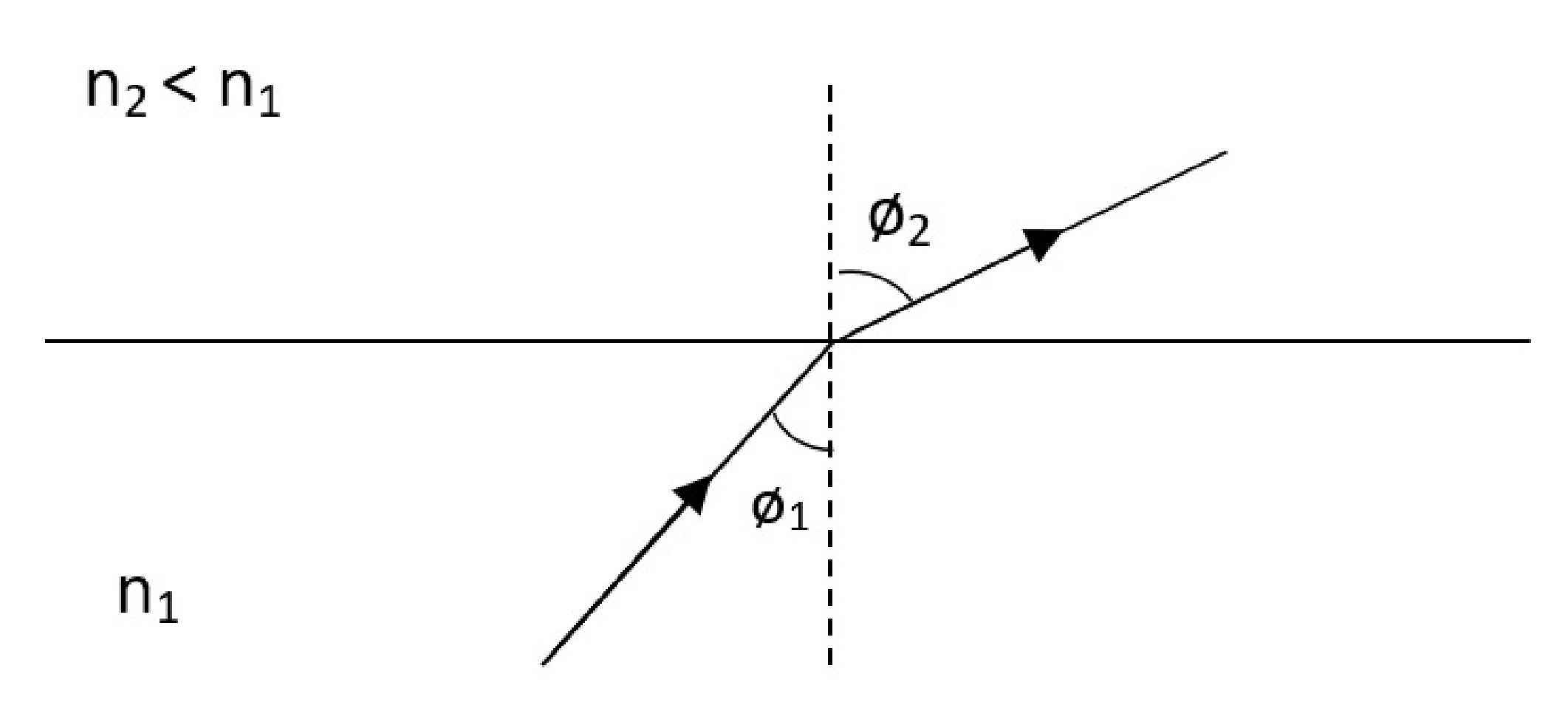
When light is incident upon a dielectric interface, it will be reflected and refracted, depending on the incident angle of the light and the refractive indices of the dielectric media as shown in Fig. 1. The refraction of light is governed by the Snell’s law,
where and are the refractive indices of the lower and upper parts of the boundary, and are the angles that the light ray makes with the normal of the boundary.
Part A: Light Propagation Through a Semi-Sphere (1,5 т.)
Fig. 2 illustrates how light that consists of two rays with different colour, and , is incident along the radius of a semi-sphere with refractive index , in air, before being refracted at the bottom at an angle of and , respectively.
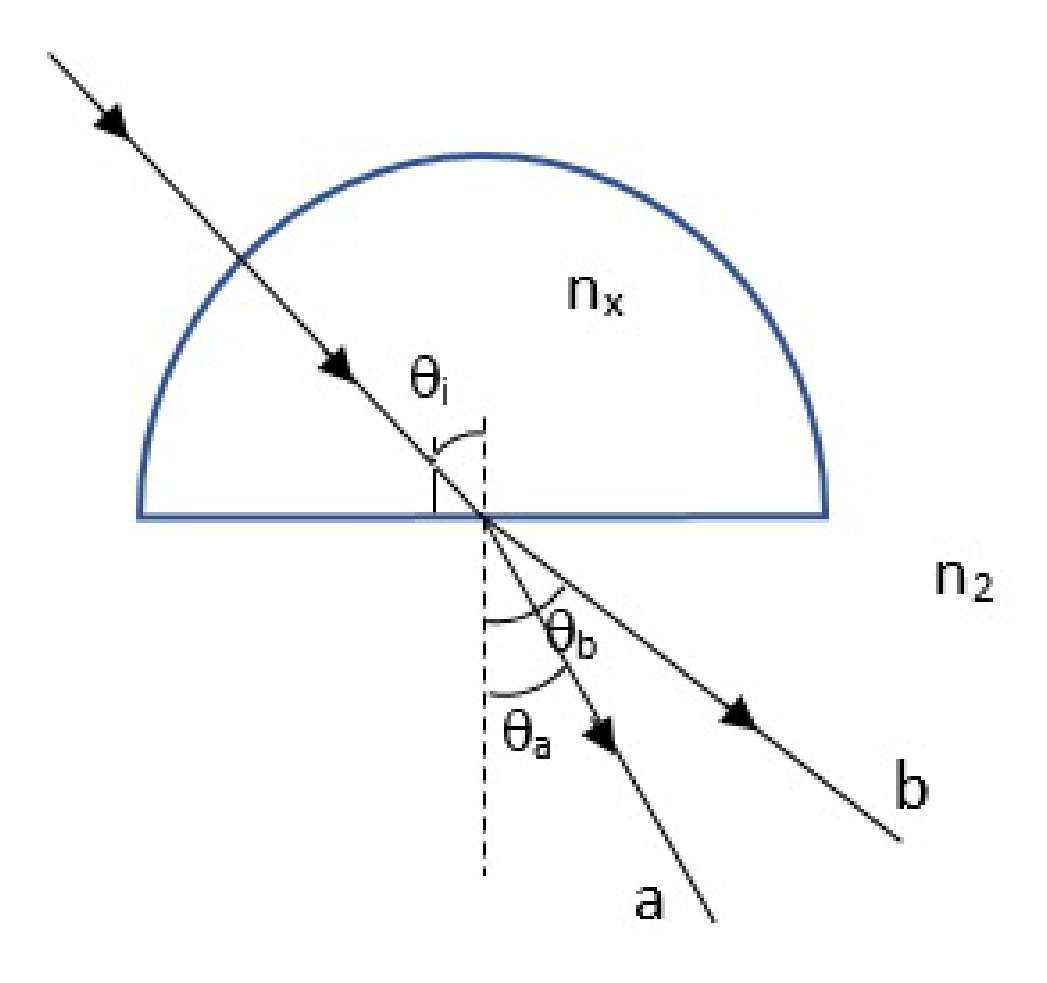
A.1 Which ray ( or ) propagates faster in the semi-sphere? Please provide justification. [0,5 т.]
A.2 When the incident angle, , is slowly increased to , ray no longer exits the bottom of the semi-sphere. When is further increased to , the same happens to ray . What is the difference between the refractive index of ray and in the semi-sphere? [1 т.]
Part B: Light Propagation Through a Cylindrical Rod (3,5 т.)
A cylindrical rod has a refractive index of = 1.50. The rod is placed in air, with one end coated with a polymer with refractive index = 1.40, as shown in Fig. 3 below. Light is incident from the polymer into the rod at an angle, . When is changed, there is an instance when light is totally reflected back to the polymer.
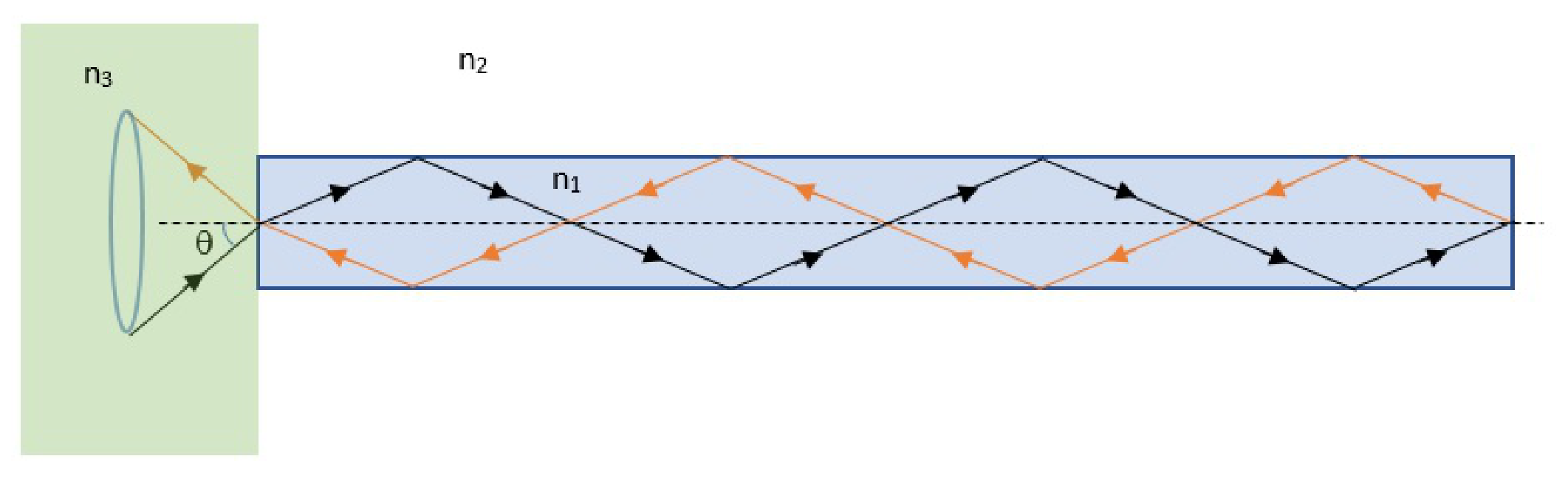
B.1 Determine the range of incident angle, , for this condition to happen. [2 т.]
B.2 How does the condition in B.1 change,
(i) if the other, open end of the rod is now coated with a thick layer of oil with refractive index of 1.60? 0.6pt
(ii) if the setup is placed in water with refractive index of 1.33? 0.9pt [1,5 т.]
Part C: Light Propagation Through an Optical Fibre (5 т.)
Optical fibre is formed by surrounding the medium with refractive index, with a lower refractive index medium, , as shown in Fig. 4 below. The medium with refractive index, is known as the fibre core, and the medium with refractive index, is known as the fibre cladding. The refractive index, , is typically the refractive index of air ( = 1).
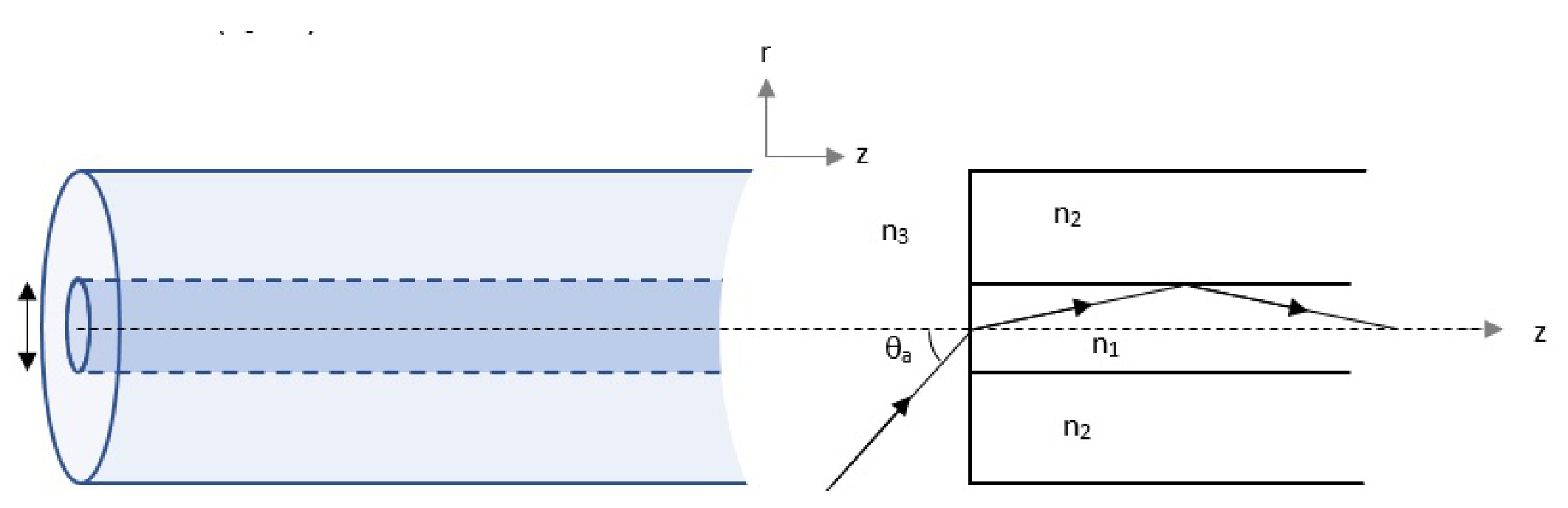
C.1 In order for light to propagate inside the optical fiber, it first needs to be coupled into the optical fiber. The maximum angle of the light incident at the end of the fiber, so that the light can be guided inside the fiber without being refracted out is related to the refractive indices of the fiber core and cladding. Consider a ray that propagates along the meridional plane (plane that cuts across the fibre axis), formulate the relationship between the angle, and the refractive indices. [2 т.]
C.2 Optical fibers are not always aligned in a straight line but need to be bent to go through different spaces. Given the fiber core diameter of 50 , if the minimum bending radius on the optical fiber is 1.0 , how much will change? [2,6 т.]
C.3 Given the refractive index of the fiber core and cladding is 1.45 and 1.44, respectively, what are the maximum angle of light incident for case C.1 and C.2 above, when the fiber is placed in air? [0,4 т.]
Отговори
Part A: Light Propagation Through a Semi-Sphere, A.1 Ray a (colour a) propagates faster in the semi-sphere.
Part A: Light Propagation Through a Semi-Sphere, A.2 0.109
, .
Part B: Light Propagation Through a Cylindrical Rod, B.1 45.58° < θ < 53°
В официалното решение ъгълът е отпечатан като „q“ (изгубен символ θ).
Part B: Light Propagation Through a Cylindrical Rod, B.2 (i) Light cannot be totally reflected back to the polymer (condition #2 fails); (ii) conditions #1 and #2 do not overlap, so again light cannot be totally reflected back to the polymer.
Part C: Light Propagation Through an Optical Fibre, C.1
Part C: Light Propagation Through an Optical Fibre, C.2
Part C: Light Propagation Through an Optical Fibre, C.3 C.1: θa = 9.79°; C.2: θ′a = 5.15°
Решение
Part A: Light Propagation Through a Semi-Sphere
A.1 Using Snell’s law, larger angle of refraction corresponds to larger refractive index that the light sees in the semi-sphere (). [0.2pt]
This means that the colour with a smaller angle of refraction propagates faster in the semi-sphere, which is colour a. [0.3pt] [0,5 т.]
A.2 The light rays no longer exit the bottom of semi-sphere when the ray is refracted by with respect to the normal. [0.2pt]
Using Snell’s law,
[0.2pt]
Replace “x” with “a” and “b” for the condition of ray a and ray b, respectively.
For ray a,
[0.2pt]
For ray b,
[0.2pt]
Difference in refractive index, Δn = 0.109 [0.2pt] [1 т.]
Part B: Light Propagation Through a Cylindrical Rod
B.1 Given = 1.5, = 1.0, = 1.4,
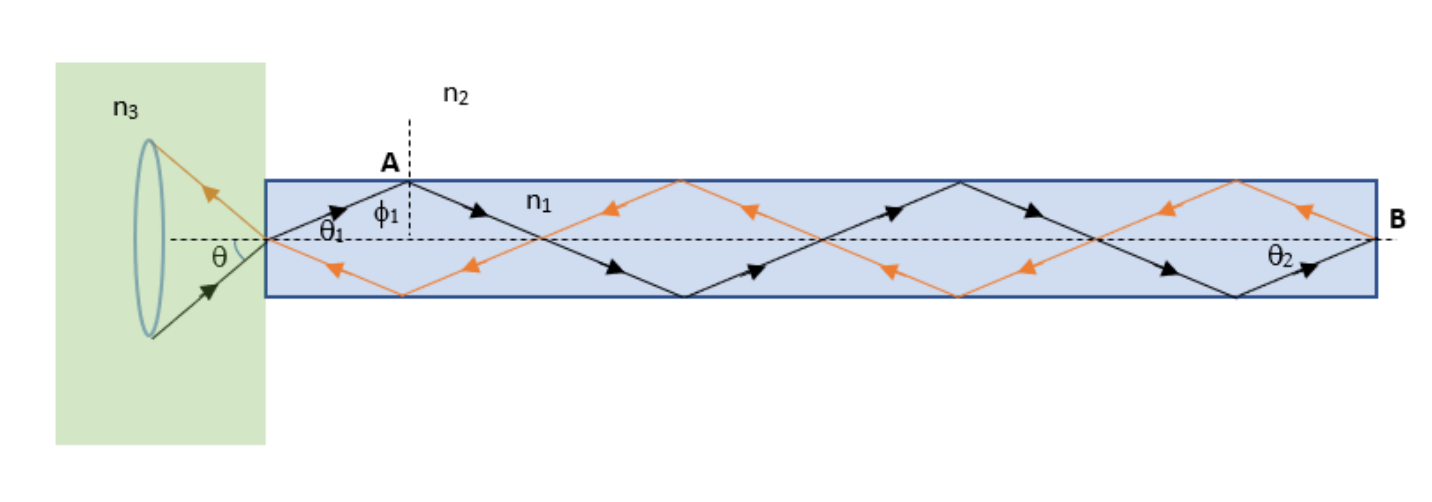
Identify 2 conditions that need to be obeyed: [0.2pt]
#1: Light incident at point A should be totally reflected.
[0.3pt]
The condition for angle [0.2pt]
Using Snell’s law,
[0.2pt]
#2: Light incident at point B should be totally reflected.
[0.3pt]
The condition for angle [0.2pt]
Using Snell's Law
[0.2pt]
Therefore, the incident angle, , where light is totally reflected back to the polymer is . [0.4pt] [2 т.]
B.2 (i) When right end of rod is coated with oil with = 1.6, condition #2 changes. [0.2pt]
Light incident on point B will always be refracted. [0.2pt]
Light CANNOT be totally reflected back to the polymer. [0.2pt] [0,6 т.]
B.2 (ii) When the setup is placed in water, = 1.33. Both condition #1 and #2 change. [0.2pt]
#1:
[0.2pt]
Using Snell’s law,
#2:
Using Snell’s law,
[0.2pt]
As conditions #1 and #2 does not overlap. [0.1pt]
Again, light CANNOT be totally reflected back to the polymer. [0.2pt] [0,9 т.]
Part C: Light Propagation Through an Optical Fibre
C.1
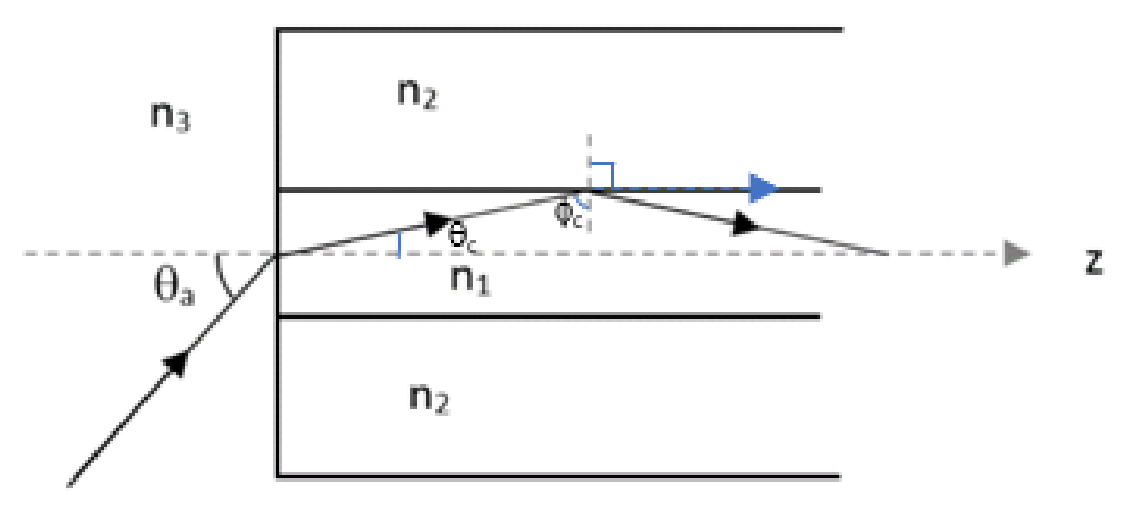
In order for light to not refractive out from the fiber, the angle of refraction that the light makes with the normal of the fiber core/cladding boundary needs to be . Using Snell’s law,
[0.4pt]
Taking the square of eq. (1), we have,
Using the trigonometry identity, we have, [0.2pt]
Rearranging, we got,
Or, [0.2pt]
Taking the square root of eq. (2), we have,
[0.4pt]
With this, we can use Snell’s law to calculate the maximum angle of light incident,
[0.4pt]
[0.4pt]
or [2 т.]
C.2
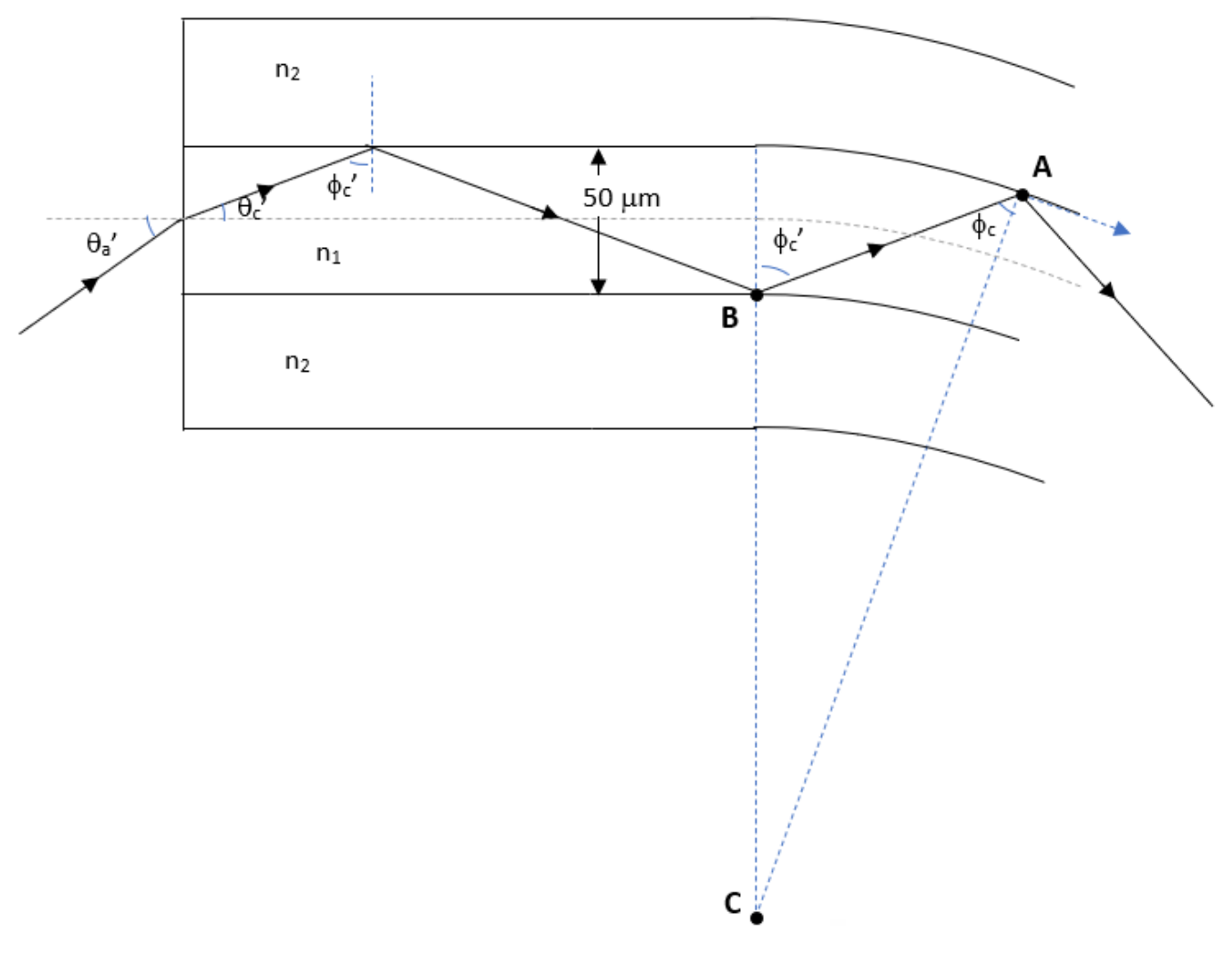
Identifying the correct relationship between and [0.4pt]
Find the relationship between and ’:
Using the Law of Sine,
[0.4pt]
- For light guiding at point A,
[0.4pt]
CB = 10000-25 = 9975 m
CA = 10000+25 = 10025 m [0.4pt]
Therefore,
[0.4pt]
Rearrange into eq.(1) and derive following part (a):
[0.4pt]
To calculate the new angle of acceptance,
[0.2pt] [2,6 т.]
C.3 For case C.1: State that = 1;
[0.1pt]
[0.1pt]
For case C.2: Substitute,
[0.1pt]
[0.1pt] [0,4 т.]
Оригинал в Архива: th.pdf · официални решения: th_sol.pdf